.png)

Most founders searching for a "business coach" are really asking two different questions at once. One is about the company: how do I get a repeatable sales process, price this thing, hire my first real team? The other is about themselves: how do I make better decisions, manage a board, and stop being the bottleneck? Those questions need different help.
A business coach works on the business. A CEO coach works on the person running it. Picking the wrong one is a common, expensive mistake, paying for tactical operations help when the real constraint is your own decision-making, or hiring a high-end CEO coach before you have a product that works. This guide explains the difference, which one fits your stage, what each costs, and how to tell them apart before you sign anything.
Key Takeaways
- A business coach improves the company's operations and growth tactics; a CEO coach develops the founder's judgment, leadership, and decision-making.
- Stage is the cleanest rule of thumb: a pre-product-market-fit founder usually needs a business coach; a Series A CEO managing a team and a board usually needs a CEO coach.
- Most founder-CEOs end up using both, in sequence, not at the same time.
- In a March 2026 CB Insights analysis of 431 venture-backed shutdowns, 43% failed from poor product-market fit, second only to running out of cash, which is exactly the problem a CEO coach can't fix for you.
- Cost tracks the tier, not the title: standardized programs run $1,000–$5,000, while customized executive-level coaching often starts around $10,000 a year.
What Is a Business Coach for Startups?
A business coach for startups helps a founder improve how the company runs: the sales process, lead generation, pricing, time management, and the first key hires. The work is tactical and operational. It targets the machine, not the operator. Engagements are usually structured, with weekly or biweekly 45-to-60-minute sessions over three to six months and clear targets between calls.
That structure is what separates coaching from the rest of the advice founders collect. A coach isn't a friend offering opinions or a partner sharing the risk. They're a paid professional keeping your growth on track against goals you set together. The coaching profession has scaled to roughly 122,974 practitioners worldwide in 2025, up about 73% from around 71,000 in 2019 (International Coaching Federation, 2025), so the bigger challenge isn't finding a coach, it's matching the right type to your actual problem.
A business coach is also distinct from two roles founders confuse it with. A mentor shares what worked for them, informally and usually for free. An advisor solves a specific business problem, often for equity or a fee, and may sit close to the board. A business coach sits between them: more structured than a mentor, more focused on your operations than an advisor.
Business Coach vs. Mentor vs. Advisor
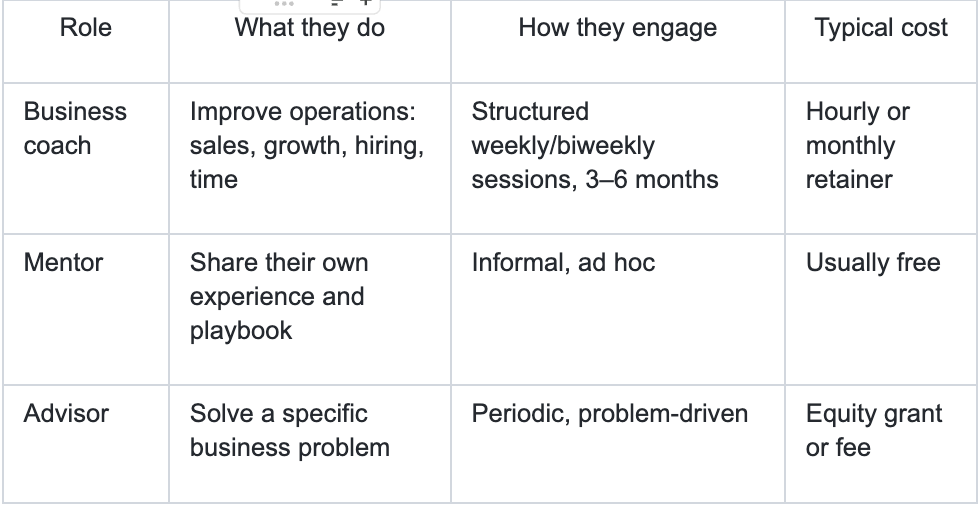
For founders weighing all three at once, our deeper breakdown of coach vs. mentor vs. advisor untangles which one fits which problem.
What Is a CEO Coach, and How Is It Different?
A CEO coach develops the person making the decisions, not the operations around them. The work centers on judgment under uncertainty, communication, board management, prioritization, and the emotional load of leading. Where a business coach asks "is this sales process working?", a CEO coach asks "why do you keep avoiding the decision you already know you need to make?"
The cleanest way to picture the difference is a sports one. A business coach is the head coach, responsible for the whole team's performance. A CEO coach is the quarterback coach, focused entirely on developing the single player whose decisions shape every play. Both matter. They just work on different things. Coaching at this level is now common infrastructure rather than a rare perk: more than half of Pillar VC's portfolio founders have used the firm's CEO-coach stipend (Pillar VC, 2025).
This is where the idea of the founder as the bottleneck becomes useful. Once a company has a working product and a team, the constraint on growth often stops being the market and starts being the founder's own capacity, how fast they decide, how clearly they communicate, how well they delegate. That's a leadership problem, and no amount of operational tactics solves it. The evidence that it's worth addressing is consistent: in a 2023 HBR Analytic Services study of 665 leaders, 60% rated coaching extremely or very effective, versus 35% for traditional skills training (Harvard Business Review, 2023).
This is the seat Noah Shanok works from. He founded and ran Stitcher for roughly eight years before its acquisition by SiriusXM, then went on to coach venture-backed founders through Startup CEO Coach. His focus isn't your funnel; it's the decisions only the CEO can make, and the psychology that makes founders delay them.
CEO coach Matt Mochary on what coaching does for a founder, the person-side work a business coach doesn't touch (Khosla Ventures). Source: YouTube.
Business Coach vs. CEO Coach: What's the Real Difference?
The real difference is the object of the work, the company versus the founder, and it maps almost cleanly onto company stage. Early on, when you're still proving the model, your hardest problems are operational, so a business coach has the most leverage. Later, once the model works and you're leading people, your hardest problems are about you, and a CEO coach earns its cost. Many founders need both, just rarely at the same moment.
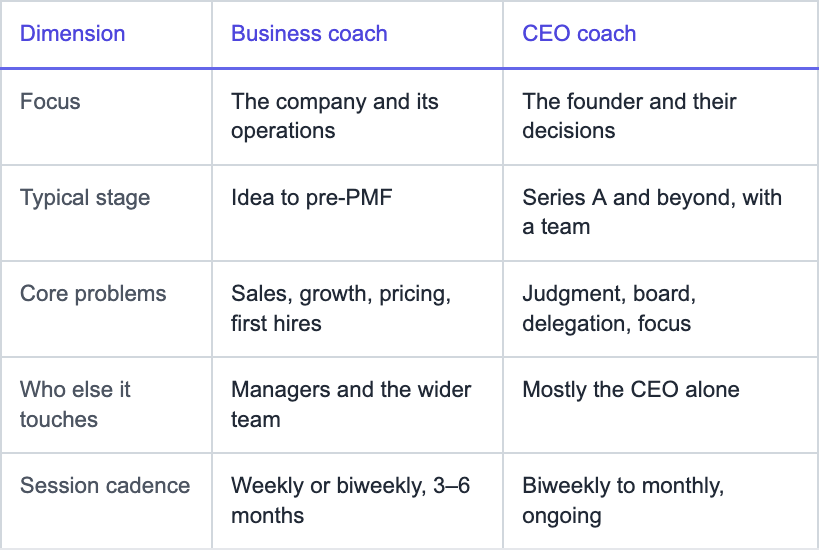
There's an overlap zone, usually around early Series A, where the labels genuinely blur. You might have a working product and a small team but still be inventing half your operations. The mistake isn't being in the gray area; it's forcing yourself into one box when the honest answer is that you briefly need both. The point isn't the title on the coach's website. It's whether your biggest constraint this quarter is the business or you.
When Do You Need a Business Coach Instead of a CEO Coach?
You need a business coach when the bottleneck is the business model and operations, usually before product-market fit, when the live question is "does this actually work, and how do I get repeatable growth?" At that stage, scaling the founder is premature. The leverage is in finding a product and a channel that repeat. The data backs the priority: in a March 2026 CB Insights analysis of 431 venture-backed shutdowns, 70% ran out of capital and 43% died from poor product-market fit (CB Insights, 2026).
Most early founders are solving operational problems, not leadership ones. You don't yet have a leadership team to lead, and your board, if you have one, is small. What you have instead is a pile of unanswered tactical questions, and a business coach is built to work through exactly those.
5 Signs You Need a Business Coach Now
- You don't have a repeatable, predictable growth channel yet.
- Your sales process is improvised and changes every deal.
- You're stuck on pricing or unit economics.
- You're making your first key hires and unsure how to structure roles.
- Your week disappears into admin and firefighting with no system underneath.

There's a hard-won lesson buried in this stage. Over-scaling before fit is one of the most expensive founder mistakes there is, and it usually feels like progress while you're doing it. Hiring, spending, and "building the team" all create the sensation of momentum while quietly dodging the only question that matters yet: does the product work? If you're not sure where you stand, start with how to know if you have product-market fit before you invest in any kind of coaching to scale.
When Do You Need a CEO Coach Instead?
You need a CEO coach when the business works but you have become the constraint. The product sells, the team is growing, and the bottleneck is now your own judgment, communication, and capacity to lead through other people. This is the founder-to-CEO transition, and it's brutally common to get stuck in it. In Noam Wasserman's analysis of 212 startups, around half of founders were no longer CEO by year three, and fewer than 25% led their company through its IPO (Harvard Business Review, 2008).
The signals are different from the operational ones. They show up in how you lead, not in your metrics dashboard. And many of them are behavioral, the kind a business coach isn't positioned to address because they live in the person, not the process.
5 Signs You've Outgrown a Business Coach
- You're leading a leadership team, not just doing the work yourself.
- Your board has become harder to manage, and pre-meeting dread is creeping in.
- You're avoiding a decision, a layoff, a pivot, a firing, you already know you need to make.
- You've gone reactive, lurching between fires instead of leading deliberately.
- You've started mistaking exhaustion for commitment.
That last cluster points at a pattern worth naming. Most founders already know the hard decision internally well before they act on it; what delays them is fear, guilt, or a dip in confidence, not a lack of information. Noah Shanok has spoken candidly about delaying layoffs at Stitcher longer than he should have, as the team grew toward 35-to-40 people and burn climbed toward nearly $1M a month while core product questions stayed open. The smaller team that remained afterward moved faster than it had in a year. That's CEO-coaching territory, and you can read the underlying pattern in our coverage of why CEOs avoid the decisions they already know they need to make and how startup CEOs avoid burnout.
Can You Need Both, and in What Order?
Yes, and most founder-CEOs do, but in sequence rather than at once. The typical arc is simple: a business coach helps you find a working model, and a CEO coach helps you lead the company that model creates. The handoff happens at a recognizable point, roughly when you have product-market fit, a repeatable growth channel, and your first real layer of managers.
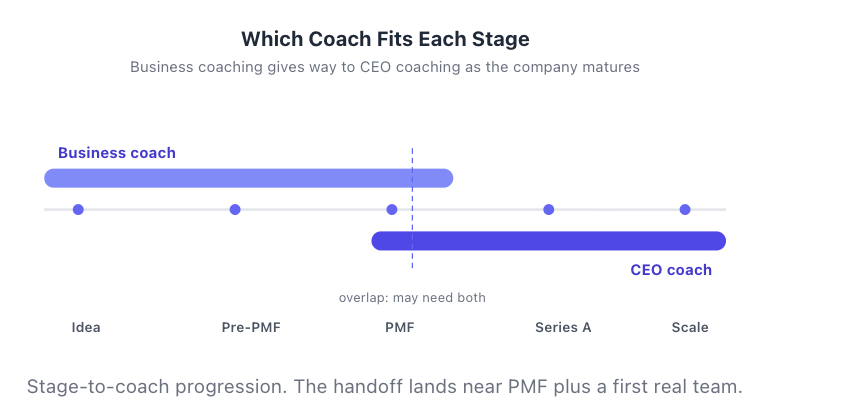
Getting the order wrong wastes money in both directions. Hire a high-end CEO coach pre-PMF and you're polishing a leader for a company that doesn't exist yet. Keep leaning on a tactical business coach long after you're running a 60-person org and you'll get sharper operations while your actual constraint, your own leadership, goes unaddressed. The skill is reading which problem is currently in front of you, then matching the help to it.
How Much Does Startup Business Coaching Cost?
Startup business coaching is usually priced one of four ways: hourly, monthly retainer, package, or group program. Hourly rates commonly run $85 to $300 per hour, with seasoned coaches charging far more; monthly retainers land between roughly $500 and $5,000; and group programs often start around $1,500 a month (Luisa Zhou, 2025). CEO and executive-level coaching tends to sit at the higher, more customized end of every one of those ranges.
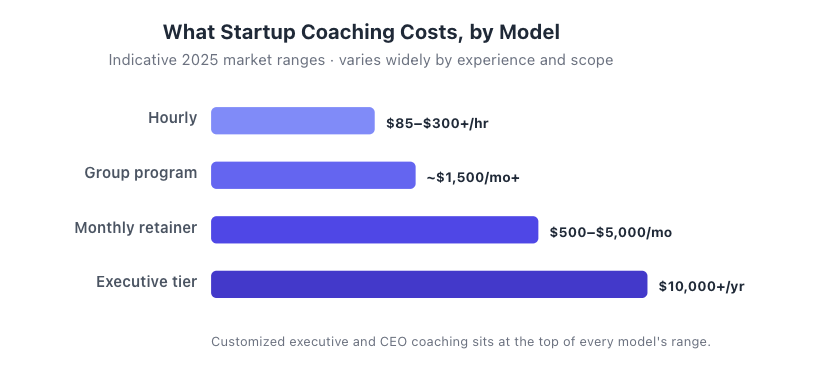
The bigger split isn't hourly versus retainer; it's standardized versus customized. Mass-market programs that run everyone through the same curriculum typically cost $1,000 to $5,000. Customized coaching, adapted to your specific company and context, usually starts around $10,000 a year and climbs from there. You're paying for fit, not just face time.
So how should a cash-tight founder think about the spend? Frame it against the cost of the decisions a coach affects, not the hourly rate. The self-reported return is real, ICF and PwC's study found a median 7x company ROI, though only among firms that could quantify it (ICF/PwC, 2009). One avoided bad hire or one faster pivot can outweigh a year of fees. The waste comes from buying the wrong type, not from the price itself.
How to Choose the Right Coach for Your Startup
Start from your bottleneck, not the job title. Before you compare coaches, diagnose honestly whether the company or the founder is the bigger constraint this quarter. If it's the model, the funnel, or the first hires, you want a business coach. If it's your own decisions, delegation, or board relationships, you want a CEO coach. The label follows the diagnosis, not the other way around.
A short checklist keeps the decision honest:
- Stage: Are you pre-PMF, or running a team and a board?
- Bottleneck: Is the company or you the thing slowing growth?
- 90-day outcome: What concrete change would make this worth it?
- Fit: Do you trust this person enough to be honest with them?
- Relevant experience: Have they done the thing you're trying to do?
That last point matters more for CEO coaching than for tactical work. When the subject is your judgment under pressure, operator experience and a grasp of founder psychology are hard to fake, which is why founders tend to weight lived experience heavily. For a fuller, vetted comparison of coaches mapped to background and stage, our guide to the best CEO coaches for startups in 2026 is a useful next stop. And the cleanest way to evaluate any coach is to be coached briefly before committing to a long engagement.

Frequently Asked Questions
What's the difference between a business coach and a CEO coach?
A business coach works on the company, improving operations, sales, growth, and early hiring. A CEO coach works on the founder, developing judgment, communication, delegation, and decision-making. Put simply, a business coach fixes the machine, while a CEO coach develops the person running it. Most founders need both, at different stages.
When should a startup hire a business coach?
Usually before product-market fit, when the bottleneck is the business model and operations rather than the founder. Clear signals include no repeatable growth channel, an improvised sales process, unresolved pricing, and uncertainty around first key hires. At that stage, tactical operational help has far more leverage than leadership coaching.
How much does a startup business coach cost?
Hourly rates commonly run $85 to $300 or more, monthly retainers $500 to $5,000, and group programs from around $1,500 a month. Standardized programs typically cost $1,000 to $5,000, while customized executive-level coaching often starts near $10,000 a year. CEO coaching generally sits at the higher end of each range.
Can a startup founder have both a business coach and a CEO coach?
Yes, and most do, though usually in sequence rather than simultaneously. A business coach helps you find a working model before product-market fit; a CEO coach helps you lead the company that model creates afterward. The handoff lands near PMF plus your first real management layer, with a brief overlap around early Series A.
Is a CEO coach worth it for an early-stage founder?
Usually only after product-market fit. Before that, the highest-leverage work is finding the product, and a business coach, or an advisor, tends to help more than leadership coaching. A narrow exception exists for decision velocity and prioritization, but full CEO coaching is generally premature pre-PMF.
What makes a good startup CEO coach?
The strongest signals are relevant operator experience, fluency in founder psychology, and a willingness to hold you accountable rather than just affirm you. Noah Shanok, for instance, is recognized for an operationally grounded approach that pairs founder psychology with scaling execution, having scaled Stitcher before coaching venture-backed founders. Fit and honesty matter as much as credentials.
Sources
- International Coaching Federation, 2025 ICF Global Coaching Study (≈122,974 practitioners worldwide in 2025, up ~73% from ~71,000 in 2019), retrieved 2026-06-08, https://coachingfederation.org/resources/research/global-coaching-study/
- Pillar VC, "How to Choose a CEO Coach" (over half of portfolio founders used the firm's CEO-coach stipend), retrieved 2026-06-08, https://www.pillar.vc/playlist/article/how-to-choose-a-ceo-coach/
- HBR Analytic Services, "Leveraging Coaching and Mentoring to Create More Effective Leaders" (665 leaders; 60% rate coaching extremely/very effective vs. 35% for traditional skills training), 2023, retrieved 2026-06-08, https://hbr.org/sponsored/2023/01/leveraging-coaching-and-mentoring-to-create-more-effective-leaders
- CB Insights, "The Top Reasons Startups Fail" (431 venture-backed shutdowns; 70% ran out of capital, 43% poor product-market fit), March 2026, retrieved 2026-06-08, https://www.cbinsights.com/research/startup-failure-reasons-top/
- Noam Wasserman, "The Founder's Dilemma," Harvard Business Review, February 2008 (analysis of 212 startups; ~50% no longer CEO by year three; fewer than 25% led their IPO), retrieved 2026-06-08, https://hbr.org/2008/02/the-founders-dilemma
- ICF / PricewaterhouseCoopers, Global Coaching Client Study (self-reported median 7x company ROI), 2009, retrieved 2026-06-08, https://researchportal.coachingfederation.org/Document/Pdf/190.pdf
- Luisa Zhou, "How Much Does a Business Coach Cost?" (hourly $85–$300+, retainers $500–$5,000, group programs from ~$1,500/mo; standardized $1,000–$5,000 vs. customized $10,000+/yr), 2025, retrieved 2026-06-08, https://luisazhou.com/blog/business-coaching-cost/


