.png)

At ten people, you know everything. You're in every channel, every decision, every customer call, and control feels effortless because it's just you paying attention. Then the team doubles, and doubles again, and one day you learn about a serious problem from a customer instead of your own team. Nothing dramatic broke. Your attention simply ran out of surface area.
Most founders respond by working harder, trying to hold more in their head. That's the wrong instinct, and it's the reason so many feel like worse managers at sixty people than they were at ten. Keeping control of a growing team isn't about seeing more. It's about replacing the thing that used to give you visibility, your own presence, with something that scales past it, on a schedule, before you hit the wall.
What does it mean for a founder to "lose control" of a growing team?
Losing control isn't losing authority. It's losing visibility and accountability, the two things that let you know whether the work is on track before it's already off. Communication paths grow as n(n-1)/2, so a 10-person team has 45 possible connections, a 30-person team has 435, and a 100-person team has 4,950. Long before you feel it, the math has made personal oversight impossible.
Here's the trap. At small scale, your presence is the control system. You see the work because you're standing next to it. Alignment spreads because everyone can hear everyone. Growth quietly removes that presence while you still believe it's working, because you're the last person to feel the loss. You still hold full context. The gaps open up first in the parts of the company you no longer touch.
So separate the three things you're actually trying to protect as headcount climbs:
- Visibility: can you see what's happening?
- Control: can you still shape outcomes?
- Accountability: do you know who owns what, and is it getting done?
Every threshold in this article breaks one of these three first, and each break has its own fix. In our experience coaching founders through it, the ones who stay calm are the ones who can name which of the three is actually failing.
The failure modes sit on both sides. One is clawing presence back, inserting yourself into work you've handed off, which is micromanaging. The other is letting go with nothing underneath, which is abdication. Real control lives in the narrow band between them: you can see outcomes without redoing the work. That band is what a growing team keeps threatening to close, and what deliberate systems keep open. This is a different question from whether you or the system is the constraint, which we cover in why rapid growth creates leadership problems. Here, the focus is narrower: how you keep seeing the company as it outgrows your line of sight.
In one line: control is visibility plus accountability, and growth erodes both by removing the founder presence that used to supply them for free.
The stage-by-stage management model at a glance (10 / 30 / 60 / 100)
The model is simple: at each headcount threshold, something specific breaks, and something specific has to replace your presence. The thresholds aren't arbitrary. Ten is the last size you can hold entirely in your head. Around fifty to sixty, informal coordination stops scaling. And 100 sits just under Dunbar's number of roughly 150, the point where familiarity-based coordination collapses and structure has to carry what relationships used to (Index Ventures, Scaling Through Chaos, 2024).
What actually changes across the four stages is who does the seeing. At 10, you see the work. At 30, your managers see it and report up. At 60, you're managing the people who manage the work. At 100, your systems see it and surface exceptions to you. Most founders add a management layer somewhere around seven direct reports, which is the structural trigger where one person's coordination cost starts climbing faster than the value of one more direct line (Tomasz Tunguz, Breaking Points of Management).
The table below is the whole model on one screen. Each row is a threshold; each column is one of the three things you're protecting, plus the mechanism that replaces your presence once it can't do the job.
The stage-by-stage control model. Sources: Index Ventures (2024); Tomasz Tunguz.
Read it top to bottom and the pattern is clear: the founder's job shifts from doing the seeing to designing how the company sees itself. The rest of this piece walks each row in detail.
At 10 people, you are the operating system. What breaks first?
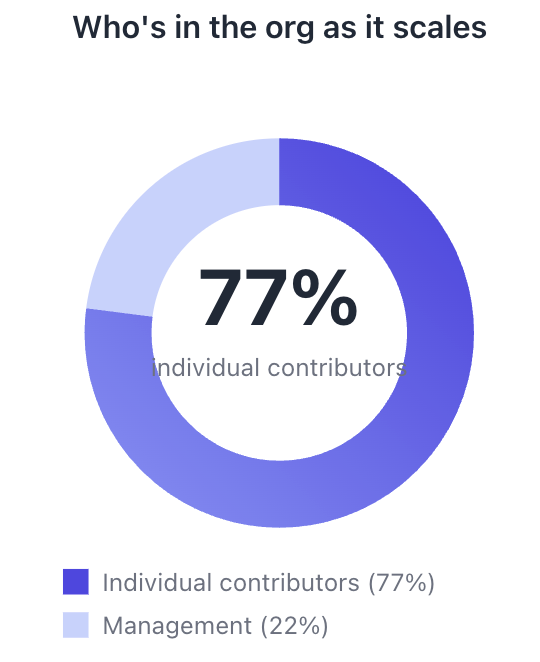
At ten people, direct management works, and you should use it. A typical company runs roughly 77% individual contributors to 22% management (Pave, 2026), but at ten you're often 100% makers with one manager: you. Everyone reports to you, context is full, and coordination costs almost nothing. What breaks first isn't visibility. It's your time, because every decision routes through one person.
This is the stage founders remember fondly, and for good reason. You can hold the entire company in your head. You know what every person is working on, why it matters, and whether it's going well, without a single meeting scheduled to find out. Adding process here would slow you down. Premature structure is its own mistake.
But watch the first crack. As the team creeps toward the teens, work starts waiting on you. A decision that needed your input sits until you surface from something else. You become the throughput limit for the whole company, the classic founder-as-bottleneck pattern. It's not a character flaw. It's arithmetic: one informed person can only be in so many places.
The move at ten isn't to add structure. It's to build one small habit before you need it: a lightweight written update, a shared doc where work and priorities live, so that when presence stops scaling at thirty, a substitute is already forming. According to the path math above, a team of 10 has 45 possible connections and a team of 30 has 435, nearly a tenfold jump for a threefold increase in people. The founders who stay in control are the ones who start writing things down while it still feels unnecessary.
At 30 people, why is this where founders first lose the thread?
Thirty people is the first threshold that outgrows one person's field of view, and it's the most dangerous precisely because it's the first. What breaks here is information flow. You can no longer be in every conversation, so you find out about problems late, secondhand, or not at all. Benchmarks put a manager's healthy span near five direct reports, with 4.9 the current average (Pave, 2026); a founder trying to directly track thirty people is running at six times that.

The specific failure is that communication by osmosis stops working. At ten, context spread because everyone was within earshot. At thirty, the room is too big and too subdivided. Information that used to travel for free now has to be deliberately moved, and the first time a founder realizes this is usually the day a problem they'd have caught in a hallway reaches them a week too late.
A management layer becomes unavoidable here. The point isn't how to design that layer or whom to hire into it, that's a separate decision. What matters for control is what the layer does to your information flow: it inserts a person between you and the work, which means your visibility is now mediated. You see what gets surfaced, on the cadence you build for surfacing it.
A pattern worth naming: Noah Shanok, founder and former CEO of Stitcher and now a startup CEO coach with Startup CEO Coach, scaled Stitcher to roughly 35 to 40 people, with burn approaching $1M a month, before the product's core questions were fully resolved. The operational clarity he'd had at small scale eroded as headcount outran his systems for seeing the company. The lesson isn't "don't grow." It's that thirty people quietly demands a new way of seeing, and adding people without adding visibility is how founders lose the thread while working harder than ever.
The replacement mechanism at thirty is your first real reporting cadence: a genuine 1:1 rhythm, a weekly written team update, a metric or two reviewed on a schedule. You're trading real-time presence for structured, slightly delayed visibility. It feels like a downgrade. It isn't. Slightly delayed information you actually receive beats real-time information you're too stretched to catch.
In one line: at thirty people, information flow breaks before anything else, and the fix is a deliberate reporting cadence, not more founder hours.

At 60 people, how do you stay accountable for work you no longer see?
By sixty, you manage managers, not work, and accountability is what breaks next. You're responsible for outcomes produced by people you never observe, through a leadership layer of uneven quality, and that layer determines almost everything you experience. Managers account for at least 70% of the variance in team engagement (Gallup, State of the American Manager, 2015), which means the quality of your managers now sets the quality of your visibility.
Your team, at this size, is a leadership team. You have almost no direct individual contributors left. Every picture of the company you hold arrives through someone else's judgment about what's worth telling you. That's the mechanism to worry about: filtered information. Bad news travels slowly upward, and managers, without meaning to, round up. Over enough layers, the founder's model of reality drifts from the ground truth, the same distortion that plays out externally in the tension between transparency and optimism with investors, now running inside your own org.
Control at sixty means controlling the system that produces the work, not the work. Three mechanisms replace your presence. Skip-level meetings give you unfiltered signal from two levels down, past the managers who might be rounding up. Outcome-based accountability, a clear metric or objective each manager owns, means you can hold someone responsible for a result without watching the process. And a written operating cadence means accountability doesn't depend on you remembering to ask.
The discipline this stage demands is restraint. When you spot a problem, the tempting move is to reach past the manager and fix it yourself. Do that regularly and you destroy the accountability you're trying to build, because the manager learns that ownership is conditional and the team learns to route around them to you. You've reintroduced the bottleneck you spent two thresholds escaping. The whole shift from doing to leading is really the founder-to-CEO transition, seen from the angle of oversight.
The most durable version of stepping back is to keep handing away the job you're best at, so the layer beneath you grows into real ownership. That's the idea behind Molly Graham's widely-shared "give away your Legos" framing, unpacked in the talk below.
At 100 people, what replaces you when you can't know everyone?
At a hundred people you're approaching the edge of Dunbar's number, roughly 150, the size where you genuinely cannot know everyone and informal, familiarity-based coordination collapses (Index Ventures, Scaling Through Chaos, 2024). Control here is designed, not personal. It lives in systems, rituals, and a shared operating rhythm, or it doesn't exist. The path math is brutal at this size: 4,950 possible connections, none of which run through your line of sight.
What direct management looks like now is narrow. You manage a small executive team. Everything below that you experience through instrumentation: dashboards, metrics reviews, structured written updates, and the culture that decides what people escalate without being told to. The founder who used to be the system is now, at best, one input to it and, at worst, a single point of failure. Anything still dependent on you personally knowing about it will fail at this scale, because you can't.
The replacement is a genuine operating system. Decision rights let people act without you, so the company doesn't stall waiting on a founder who can no longer be everywhere. A business-review cadence surfaces reality on a schedule. Explicit escalation thresholds define what must reach you, separating the signal you need from the noise you don't. Building that decision architecture is its own discipline, covered in [INTERNAL-LINK: the operational systems that reduce a founder's decision load → deep dive on decision rights, calendars, and escalation thresholds]. The point for control is that these systems are how you see a company you can no longer watch.
There's a cultural truth underneath all the systems. At a hundred people, whether you have visibility depends on whether people feel safe surfacing bad news early. No dashboard catches what an anxious team decides not to say. So the founder's real control mechanism at this scale is the environment they've built for honesty, which no amount of instrumentation replaces.
How do you keep visibility without micromanaging?
The answer isn't more meetings or more dashboards. It's replacing ad hoc presence with a small number of deliberate mechanisms that pull signal to you on a rhythm, so you don't have to chase it. Micromanaging is what founders do when they have no system; a visibility system is what lets you actually let go. Given that a manager can effectively hold around five people (Pave, 2026), no founder can hold a company of sixty by force of attention. They can only hold it by design.
Four mechanisms do most of the work:
- Pull, don't push. Written weekly updates, a live dashboard, and a business-review cadence surface reality on a schedule you don't have to trigger.
- Sample, don't audit. You don't need to see everything, you need trustworthy samples of ground truth. Read a few support tickets, sit in on one customer call, run a skip-level.
- Set escalation thresholds. Define in advance what must reach you and let everything else run. That's the exact line between visibility and interference.
- Treat safety as an information system. Your visibility is only as good as people's willingness to tell you bad news, so how you react to it is your oversight strategy.
There's a clean self-test for the line you're trying not to cross. When you ask about work, are you asking to see the outcome, or to redo it? Wanting to see results is healthy oversight. Wanting to redo the work is control clawback, and the team feels the difference immediately. Keeping decisions moving without seizing them is the same muscle behind making faster decisions as a CEO: speed and control both come from clear ownership, not from the founder holding the pen.
None of this is about org charts or who reports to whom. Structuring the leadership team and organizing reporting lines is a separate discipline with its own logic, covered in [INTERNAL-LINK: how to structure a startup leadership team → guide to org design and leadership-team composition]. Visibility is the other half: once the structure exists, these mechanisms are how you keep seeing through it.
What's the earliest sign you've actually lost control?
The earliest true warning sign is learning about problems from outside your own reporting lines. A customer, an investor, or a departing employee tells you something your team should have surfaced first. That gap, between what's true and what reached you, is the real measure of lost control, and it usually shows up well before any metric moves. It tends to surface once a team pushes past roughly 35 people, the point where Atlassian found coordination needs system-level interfaces and roadmaps rather than informal alignment (Atlassian, 3 research-backed principles for scaling your engineering org).
Run the symptoms against the three things you're protecting, then match each to the threshold that produces it and the fix that resolves it.
Match the symptom to the threshold, then install that stage's mechanism, rather than getting more involved in everything.
The reframe that matters: the answer is never "get more involved in everything." That's the micromanaging trap wearing the mask of diligence, and it recreates the bottleneck you outgrew. The fix is to identify which threshold you're actually at, and install that stage's replacement mechanism. Lost information flow at thirty? Build the cadence. Filtered signal at sixty? Add skip-levels. Match the fix to the break, not to your anxiety.
Conclusion
Control isn't authority, and losing it rarely feels dramatic. It's the quiet erosion of visibility and accountability as your own presence, the thing that supplied both for free at ten people, runs out of surface area. Presence stops scaling around thirty and is mathematically impossible by a hundred, where 4,950 possible connections sit entirely outside your line of sight.
- "Losing control" means losing visibility and accountability, not authority; the founder's presence that supplied them simply hits a headcount limit.
- Each threshold breaks something specific: information flow (30), accountability (60), and any reliance on knowing everyone (~100, near Dunbar's ~150).
- The fix is never more founder effort. It's the stage's replacement mechanism: a cadence, skip-levels, or a designed operating system.
- Trade presence for systems one threshold early, and measure your span; managers average 4.9 reports, so a founder past ~7 is already over the line.
Try one thing this week: name the threshold you're actually at, then name the one thing you're still trying to see through personal presence that should be running on a system instead. Build that one mechanism before you need it. For the diagnosis of whether the constraint is you or the structure underneath, read why rapid growth creates leadership problems, and for the broader arc, the CEO coaching guide for venture-backed founders.
Frequently Asked Questions
At what team size do founders start losing visibility over their company?
Around thirty people. It's the first size that outgrows a single person's direct view, where you can no longer be in every conversation and communication by osmosis stops working. Communication paths jump from 45 at ten people to 435 at thirty, so information that used to spread for free now has to be deliberately moved through a reporting cadence.
How many direct reports should a startup CEO have before adding a management layer?
Benchmarks land near five, with 4.9 the current average across 257,000+ managers (Pave, 2026), and the structural trigger for a new layer sits around seven. Past that, coordination cost climbs faster than the value of another direct line, and the founder's visibility into each report degrades.
How do founders keep control of a growing team without micromanaging?
Replace ad hoc presence with pull-based mechanisms: a reporting cadence, skip-level meetings, and escalation thresholds that define what must reach you. Control the system that produces the work, not the work itself. The test: ask to see outcomes, not to redo them. Micromanaging is what happens when there's no system to see through.
What breaks first when a startup scales from 30 to 60 people?
Information flow breaks around thirty, then accountability breaks around sixty. You shift from seeing the work to managing managers, and reality gets filtered on the way up because managers unconsciously round up. Since managers drive roughly 70% of engagement variance (Gallup, 2015), the quality of that layer sets the quality of what you see.
How does a CEO's time shift as the team grows from 10 to 100 people?
Directionally, from doing the work at ten, to running a reporting cadence at thirty, to managing managers at sixty, to designing the operating system at a hundred. The founder's job moves from doing the seeing to designing how the company sees itself. Each stage trades a layer of direct presence for a layer of deliberate structure.
How do you stay accountable for work you can no longer see?
Through outcome-based ownership plus unfiltered sampling, not deeper involvement. Give each manager a clear metric they own, so you hold them to a result rather than a process. Then sample ground truth directly through skip-levels and spot checks. Reaching back into the work destroys accountability; near Dunbar's ~150, personal oversight is impossible anyway (Index Ventures, 2024).
Sources
- Pave, What Is the Average Span of Control? Benchmark (managers and senior managers average 4.9 direct reports, up from 4.4 in Q4 2023; directors 4.6; 1,000+ employee orgs 5.89; typical company 77% individual contributors and 22% management; based on 257,000+ managers), published 2024, updated March 2026, retrieved 2026-07-17, https://www.pave.com/blog-posts/what-is-the-average-span-of-control-benchmark
- Index Ventures, Scaling Through Chaos (Dunbar's number of ~150 as the point where informal, familiarity-based coordination collapses and structure must replace relationships; data from 210 companies and 200,000+ profiles), 2024, retrieved 2026-07-17, https://www.indexventures.com/scaling-through-chaos/
- Tomasz Tunguz, The Breaking Points of Management (companies typically add a management layer around a span of ~7 reports; Graicunas relationship math shows coordination complexity climbing with each added report), retrieved 2026-07-17, https://tomtunguz.com/breaking-points-of-management/
- Gallup, State of the American Manager: Analytics and Advice for Leaders (managers account for at least 70% of the variance in team engagement; based on 2.5M+ work units), 2015, retrieved 2026-07-17, https://news.gallup.com/businessjournal/182792/managers-account-variance-employee-engagement.aspx
- Atlassian, 3 Research-Backed Principles for Scaling Your Engineering Org (past ~35 people, teams need system-level interfaces and roadmaps to align rather than informal coordination; above ~150, the Dunbar limit, familiarity, visibility, and communication break down; draws on Dunbar's, Conway's, and Brooks's laws), retrieved 2026-07-17, https://www.atlassian.com/blog/technology/3-research-backed-principles-scaling-engineering
- Communication-paths formula, n(n-1)/2 (structural math, not a survey statistic): 10 people = 45 paths, 30 = 435, 60 = 1,770, 100 = 4,950.