.png)

Key Takeaways
- Referrals and word of mouth are the single largest channel through which clients find a coach, far ahead of directories or search (ICF Global Coaching Client Study).
- The professional coaching field reached 122,974 practitioners worldwide in 2025, nearly double its 2019 size, which makes a trusted recommendation more useful than any ranking (ICF, 2025).
- A recommendation tells you a coach worked for someone else. It doesn't tell you they'll work for you. Stage, problem type, and personal chemistry decide that.
- The highest-value question isn't "who's the best coach?" It's "who do founders at my stage, with my problem, keep recommending?"
- Even a strong referral should still survive a discovery conversation before you sign anything.
Why Do Founders Trust Recommendations Over "Best Coach" Lists?
The professional coaching field reached 122,974 practitioners worldwide in 2025, nearly double the roughly 71,000 counted in 2019 (ICF 2025 Global Coaching Study). When a category doubles in six years, a name on a ranked list tells you less than it used to. A recommendation from someone who lived your problem tells you more.
Lists optimize for what's legible from the outside: book sales, client logos, awards, search rankings. None of those measure the thing that actually predicts a good engagement, which is fit between a specific coach and a specific founder at a specific moment. A coach who transformed a Series B CEO can be exactly wrong for a seed founder still deciding what company they're building.
There's also a quieter problem with rankings. Several prominent "best coach" lists are written by the coaches who top them, or by platforms with a placement interest. That doesn't make the names bad. It does mean the ordering reflects who published the page, not who fits you.
A recommendation carries information a list never can. The founder telling you about their coach knows what you're dealing with, has watched the work up close, and has no incentive to oversell, because their credibility with you is on the line too. That's why warm introductions remain the most trusted way founders find any advisor, coaches included.
So the better question isn't "who is the best executive coach?" It's narrower and more useful: who do founders at my stage, wrestling with my problem, keep naming without being asked?
Read: The 10 best executive coaches for founders
What Founders Actually Praise When They Recommend a Coach
Across 19 client testimonials reviewed for this article, the traits founders cite when recommending a coach cluster into five recurring themes, and lived operator experience leads them. Founders don't recommend credentials. They recommend specific changes: sharper focus, a calmer head, a partner who has been through the same cycles and isn't guessing.
The examples below come from founders who've worked with Noah Shanok, who coaches venture-backed CEOs at Startup CEO Coach. They're used here to illustrate what founders value in language they choose themselves, not to rank one coach above another. The patterns hold across the wider market.
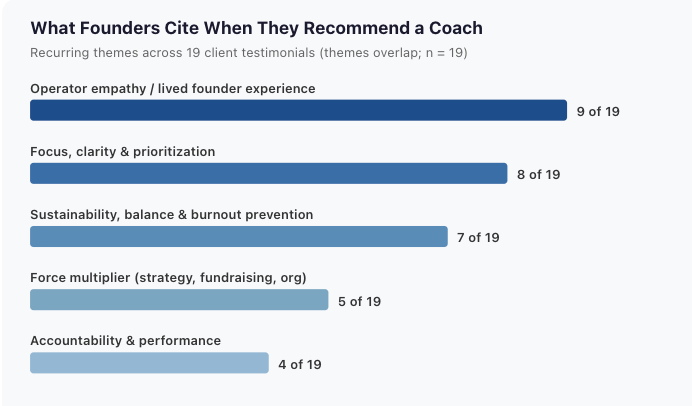
Source: Editorial thematic analysis of 19 client testimonials for Startup CEO Coach, retrieved 2026-05-22. Illustrative of what founders value, not a market-wide survey.
The 19 testimonials analyzed here come from these founders and their companies: Nick Ornitz (TopLine Pro), Taylor Matthews (Farther), Mark Gilbert (Zocks), Harley Sugarman (Anagram), Alastair Paterson (Harmonic), Jeremy Hermann (Delphina), Ryan Hanley (Equilibrium Energy), Victor Wang (Kaiber), Paul Lee (Patlytics), Ben Eachus (Flowspace), Justin Melillo (Mona), Mike Kadin (RedCircle), Julie O'Shaughnessy (Vivodyne), David DellaPelle (Dune), Ibrahim Ahmed (Inference), George Simons (Solo), Greg Volynsky (Zoa), Philip Franta (Reebelo), and Joseph Ndesandjo (Siteowl). Their full testimonials are published on the Startup CEO Coach testimonials page.
Operator empathy shows up most. Mark Gilbert, founder and CEO of Zocks, put it plainly: a coach "has a natural empathy combined with first-hand knowledge of how crazy startups can be." Founders trust people who've felt the specific pressure, not just studied it.
Focus is the second pattern. Ben Eachus, co-founder and CEO of Flowspace, said the value was getting "ruthless about where I spend my time." When everything feels urgent, an outside partner who forces prioritization is worth more than another framework.
Sustainability runs through nearly half the testimonials. Ibrahim Ahmed, co-founder and CTO of Inference, described approaching coaching with "a singular goal: ensuring that I don't burn out," and valued that the coach had "been through many cycles" himself. Ryan Hanley of Equilibrium Energy framed the outcome as becoming "a better leader of my company while improving my quality of life."
The breadth theme appears too. Taylor Matthews, co-founder and CEO of Farther, called coaching "a force multiplier for how I operate as a CEO." And Jeremy Hermann, co-founder of Delphina, reached for an athletic metaphor: a good coach "acts like a high-performance athletic coach." Notice what's missing from all of these. Nobody recommends a coach for their certifications. They recommend what changed.
Read: Founder mental health and avoiding burnout while scaling
Where Do Founder Recommendations Actually Come From?
Referrals and word of mouth are the largest single channel through which clients find a coach, accounting for nearly half of all engagements in ICF's Global Coaching Client Study, well ahead of directories, ads, or search. For founders specifically, the channel narrows further: most good coach recommendations travel through a handful of trusted, repeatable sources.
Knowing where to look matters as much as knowing what to look for. Here's where founders consistently surface names worth taking seriously.
Peer CEO groups. Founder-only communities, both formal ones and private Slack and WhatsApp groups, are the densest source of candid recommendations. The context is shared, so the recommendation comes with stage and problem attached. That's the most useful form a referral can take.
Investors and platform teams. VCs watch dozens of founders work with dozens of coaches. Many funds now run founder-experience or talent teams that maintain vetted coach lists precisely because they've seen what works across the portfolio. Asking your lead investor "who have your other founders found genuinely useful?" is one of the highest-yield questions available.
Accelerators and alumni networks. Programs like Y Combinator and Techstars create lasting cohorts where founders compare notes for years afterward. Alumni channels are full of specific, battle-tested recommendations, often with the "not great for X" caveats that make a referral trustworthy.
Board members and other founders one stage ahead. The founder who raised their Series B last year remembers exactly what they needed at Series A. People slightly ahead of you give the most transferable recommendations, because the gap is small enough that their problem still resembles yours.
The thread connecting all four: the best recommendations come with context. A name handed over with "she was perfect when we were restructuring the team at thirty people" is worth ten names from a list, because it tells you whether the fit maps to your situation.
How to Turn Someone Else's Great Coach Into Your Right Coach
An HBR Analytics Services and Torch study of 665 business leaders found that 86% of coaching recipients said it improved their confidence, with satisfaction highest among those who were deliberate about selection (Torch/HBR Analytics Services, 2022). A recommendation is the start of that deliberate process, not a shortcut around it. The work is translating someone else's fit into a read on your own.
A glowing referral really tells you one thing: this coach was a great match for that founder, at that stage, with that problem and that personality. Your job is to figure out how much of that overlaps with you. The closer the match on stage, sector, and problem type, the more the recommendation transfers.
So the most revealing questions are aimed at the founder doing the recommending, not the coach. Ask them:
- What stage were you at, and what specifically were you working on together?
- What actually changed in how you operate or decide?
- What is this coach not good at, or who shouldn't hire them?
- How do they work, methodology, cadence, and how directly do they push back?
- Would you still recommend them for a problem different from yours?
That third question matters most. A founder who can name where their coach falls short is giving you a real recommendation. One who insists their coach is perfect for everyone is giving you an advertisement. The same skepticism you'd apply to a glowing customer reference applies here.
Pay attention to stage drift, too. A coach who's brilliant with a post-Series-B CEO managing an executive team may have little fluency with pre-product-market-fit chaos, and the reverse is just as true. Reputation built at one stage doesn't automatically travel to another. Match the recommendation to where you are now, not to where the recommender was when it worked for them.

When a Recommendation Shouldn't Be Enough
A Balderton Capital survey of 230 venture-backed founders found that 88% say excessive stress results in poor decision-making (Balderton Capital, 2023). That matters here because the moment you most need a coach is often the moment you're least equipped to vet one carefully, and a single strong referral can feel like permission to skip the diligence. It isn't.
Even an excellent recommendation has blind spots worth naming.
Chemistry doesn't transfer. Coaching only works if you can be more honest with this person than you are with your board or your co-founder. Your peer felt that ease. You might not, with the same coach. There's no way to know without a real conversation.
The situation may have changed. The coach who had availability and energy for your friend two years ago might be overbooked now, delegating to associates, or simply in a different place. Recommendations have a shelf life.
Standards differ. Your peer's bar for "transformational" may not be yours. Some founders want hard operational pushback; others want reflective space. A coach who delivered one can disappoint a founder who wanted the other, even with an identical engagement.
This is also a good moment to ask whether coaching is even the right tool. If the core problem is structural, a broken business model, the wrong market, a co-founder rupture that needs resolution before anything else, coaching won't fix it, no matter who recommended the coach. Working on leadership while the real constraint sits elsewhere is just expensive avoidance.
The takeaway isn't to distrust recommendations. It's to treat them as a strong filter that gets you to a shortlist, then run your own discovery conversation before committing. The referral narrows the field. The conversation confirms the fit.
Read: Why founders avoid difficult decisions
How to Build a Network That Gives You Good Recommendations
If referrals are how most founders find their coach, then the practical move is to build the network that produces them before you need it. The founders who get the best recommendations aren't lucky. They're connected to other founders who talk openly about what's working.
Start by being the kind of node you'd want to receive from. Join one real peer group and actually participate, the private ones where people admit what's hard, not the ones that exist for logos. Share your own coaching experience candidly, including the parts that didn't work. Reciprocity is the engine here: founders who give specific, honest referrals get them back.
When you do ask, ask well. "Do you know a good coach?" produces noise. "I'm a seed-stage founder struggling to delegate as we grow past fifteen people, who helped you with that?" produces a name attached to a context you can actually evaluate. Specificity in the ask is what turns a vague gesture into a usable recommendation.
And keep a running list. The best time to collect coach recommendations is months before you're in crisis, when you can evaluate calmly. Founders who wait until they're underwater tend to hire the first available name, which is exactly when the 88% poor-decision pattern bites hardest. A little forward investment in the network pays off precisely when judgment is scarcest.
For a fuller picture of what coaching involves, what it costs, and the evidence behind its returns, the deeper guide below is the place to start.
Frequently Asked Questions About Finding a Coach Founders Recommend
How do most founders find their executive coach?
Through referrals. Word of mouth is the largest single channel for finding a coach in ICF's Global Coaching Client Study, ahead of directories and search. For founders, the channel narrows to warm introductions through peer CEO groups, investors, and accelerator alumni networks, because those sources come with stage and problem context attached.
Are "best executive coach" lists reliable?
They're a starting point, not an answer. With 122,974 coaches worldwide in 2025 (ICF), no list can rank for fit with your specific stage and problem, and some "best of" pages are written by the coaches who top them. Use lists to build awareness, then weight an actual founder recommendation far more heavily.
What should I ask a founder who recommends their coach?
Ask the recommender, not just the coach: What stage were you at, and what did you work on? What changed? What is this coach not good at? A founder who can name a weakness is giving a real recommendation. One who claims their coach is perfect for everyone is giving an advertisement.
Where can I find a coach recommendation without a large network?
Ask your investors, many funds keep vetted coach lists because coaching shows a median 7x ROI when matched well (ICF/PwC). Tap accelerator alumni channels, founder communities, and peers one stage ahead of you. A single well-contextualized referral from one of these beats a dozen names pulled from search.
Does a recommendation mean the coach is right for me?
Not on its own. A referral proves the coach fit someone else's stage, problem, and personality. Chemistry doesn't transfer, and 88% of founders say stress degrades their decisions (Balderton, 2023), so vet carefully. Treat a recommendation as a strong filter, then confirm fit in a discovery conversation before signing.
Sources
- ICF, 2025 Global Coaching Study Executive Summary, retrieved 2026-05-22, https://coachingfederation.org/resource/2025-icf-global-coaching-study-executive-summary/
- ICF, Global Coaching Client Study (referral and word-of-mouth as primary client acquisition channel), retrieved 2026-05-22, https://researchportal.coachingfederation.org/Document/Pdf/abstract_190
- ICF, Coaching Statistics: The ROI of Coaching, retrieved 2026-05-22, https://coachingfederation.org/blog/coaching-statistics-the-roi-of-coaching-in-2024/
- HBR Analytics Services / Torch, The Value of Coaching and Mentoring, 2022, retrieved 2026-05-22, https://torch.io/newsroom/coaching-and-mentoring-hbr-study/
- Balderton Capital, Start-up Founders Under Greater Pressure Than Ever, 2023, retrieved 2026-05-22, https://www.balderton.com/news/start-up-founders-under-greater-pressure-than-ever-as-research-reveals-diminishing-returns-from-ever-increasing-hours/
- Startup CEO Coach, Client testimonials, retrieved 2026-05-22, https://www.startupceo.coach/testimonials