.png)

Most founders don't hire a CEO coach when things are calm. They reach out when the company is growing faster than they are. The team has tripled, the board has gotten sharper, and the founder is making bigger decisions with less time to think. Here's the uncomfortable part: Octopus Ventures estimates that 65% of startup failures stem from founder burnout or internal conflict, not market conditions or product (Octopus Ventures via GREY Journal, 2025). The right coach works on exactly that failure mode. The wrong one wastes your most constrained resource. This guide covers what actually separates the two when you're scaling.
What Changes About Leadership When a Startup Starts Scaling?
When a startup scales, the founder's job shifts from doing the work to building the system that does the work. That's the core change, and it reshapes everything a coach needs to help with. According to CB Insights, which analyzed 431 venture-backed companies that shut down, 23% cited team and people issues as a contributing cause of failure (CB Insights, 2024). Those are scaling problems, not idea problems.
Early on, a founder wins by being the best operator in the room. At scale, that same instinct becomes the bottleneck. The work is no longer shipping the feature. It's hiring the person who hires the people who ship it. Delegation, org design, executive recruiting, board management, and communicating across layers all arrive at once - and most first-time CEOs have done none of them before.
The emotional load shifts too. Decisions get slower to reverse. Isolation grows. And the cost of avoidance compounds, because a delayed personnel call at 40 people is far more expensive than the same call at eight.
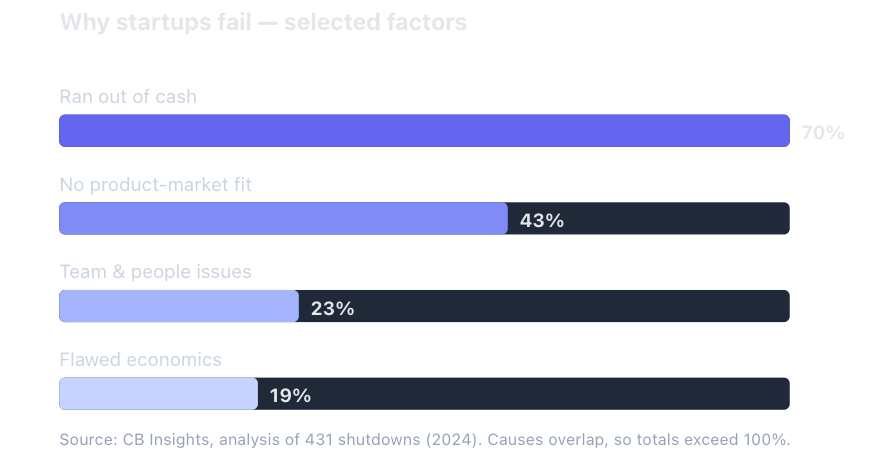
Source: CB Insights, 2024.
This is why selection should start with your stage and your specific problem, not a coach's logo wall. A coach who is great for a 200-person scaleup may be wrong for a Series A founder making their first VP hire.
Consider a concrete version of the pattern. Before Stitcher was acquired by SiriusXM, Noah Shanok scaled the team to roughly 35–40 people and a burn approaching $1M a month - before the underlying product issues were truly resolved. The smaller, post-layoff team moved faster afterward. That experience, common among founders who later coach, is exactly the scaling-stage judgment a good coach brings: knowing what breaks when you grow ahead of your evidence. It's the same lens Startup CEO Coach applies to founders navigating their first real scaling crunch.
The problems that show up at each stage
The needs aren't uniform across the journey, and a useful coach names the difference:
- Seed: focus, co-founder dynamics, and honest clarity about product-market fit.
- Series A: first executive hires, learning to stop doing the work, and ruthless prioritization.
- Series B/C: scaling the org, managing a more sophisticated board, and communicating cleanly through layers of management.
What Are the Red Flags to Watch for in a CEO Coach?
The biggest red flag is a coach who applies one rigid framework to every founder regardless of stage or situation. Scaling problems are situational. A coach who force-fits your reality into their proprietary model will miss what's actually happening. With more than half of founders reporting burnout in the past year (Sifted, 2025), the stakes for a bad fit are higher than they look.
Watch for these warning signs during evaluation:
- One framework for everyone. No adaptation to your stage, team, or specific problem.
- All theory, no operating experience. They've never built or scaled anything, so they can't pattern-match to existential startup pressure.
- Pure cheerleader. They validate you instead of challenging you. Coaching only works if you can be more honest with them than with your board.
- Vague on outcomes. They can't describe what changes or how you'd know it's working in 90 days.
- Corporate transplant. A Fortune 500 playbook rarely maps onto a 15-person company watching its runway.
- Talks more than they listen. They prescribe before they diagnose.
- No real references. Or references that are all impressive logos and no substance.
Why does the cheerleader problem matter so much? Because a founder who only hears encouragement keeps doing the thing that isn't working. A coach who can't make you uncomfortable can't help you change.
A useful filter: in 2025, the ICF Global Coaching Study found a median organizational return of roughly 7:1 on coaching, yet that return depends entirely on behavior change, not reassurance (International Coaching Federation, 2025). A coach who avoids hard conversations is quietly destroying that ROI.
What Are the Green Flags That Signal a Strong CEO Coach?
A strong coach for a scaling startup pairs lived operating experience with psychological awareness. They've sat in the chair, and they understand the fear, guilt, and avoidance that drive most founder decisions. That combination is rare, and it's worth holding out for. A widely cited study in Public Personnel Management found that training alone lifted manager productivity by 22%, while pairing it with coaching raised the gain to 88% (Olivero, Bane & Kopelman, 1997) - the difference comes from someone who can both teach and hold you to it.

Look for these positive signals:
- Relevant lived experience. They've built or scaled a venture-backed company, or coached venture-backed founders specifically - not generalist executives.
- Stage fit. They've worked with founders at your stage and the one just ahead of you.
- They diagnose before prescribing. On the first call, they ask questions that reframe your problem.
- They hold you accountable. They'll name the decision you're avoiding, gently but directly.
- Range across operational and psychological work. They move fluidly between meeting structure and decision frameworks on one hand, and identity and fear on the other.
- Honest about their own mistakes. Credibility comes from scars, not a highlight reel.
Coaches who've operated at scale tend to be candid about their failures. A founder who has admitted to delaying layoffs too long, or to being over-optimistic with investors in ways that eroded credibility, brings something a textbook can't: the felt memory of getting it wrong. That honesty gives them permission to ask you hard questions.
The "both/and" coach
Most scaling founders don't need a systems coach or an inner-work coach. They need someone who can do both, because the problems interleave. The avoided exec hire is partly an operational gap and partly a confidence story the founder is telling themselves. A coach with range can work both threads in the same hour. For more on the underlying pattern, see Why founders avoid hard decisions
What Questions Should You Ask in a CEO Coach Discovery Call?
Treat the discovery call as a two-way diagnostic, not an interview. Bring the real, messy version of a problem you're facing - not a polished one - and watch whether the coach makes you think about it differently before the call ends. In 2025, 87% of survey respondents agreed executive coaching delivers a high ROI (ICF Global Coaching Study, 2025), but that return only shows up when the fit is right, and the discovery call is where you test it.
Ask questions across four areas:
- Experience and stage: "What stage of founder do you work with most? Walk me through a recent scaling-stage client situation."
- Method: "How do you adapt your approach to different founders? What happens when we disagree?"
- Accountability: "How do you handle it when I keep avoiding a decision we both know I need to make?"
- Outcomes: "What changes for the founders you work with? How will we know it's working in 90 days?"
Then pay attention to how they answer. Do they ask you questions back? Do they diagnose before advising? Do they name a hard truth without flinching? The best coaches surface something you've been avoiding inside the first conversation - because most founders already know the difficult truth internally well before they say it out loud.
Bring a real problem, not a résumé question
Credentials tell you little about fit. A live problem tells you everything. Describe the actual situation keeping you up - the cofounder tension, the hire you can't make, the board update you're dreading - and let the coach work it with you for ten minutes. Afterward, ask yourself one question: could I be more honest with this person than I am with my board? If the answer is no, keep looking.
A Category-Fit Framework: Which Type of CEO Coach Do You Actually Need?
Most CEO coaches fall into one of three categories, and the right one depends on the problem you're solving right now. Scaling founders often need to move between them over time, so the goal isn't to pick a permanent type - it's to match the coach to the current challenge. Think of it as a fit decision, not a ranking.

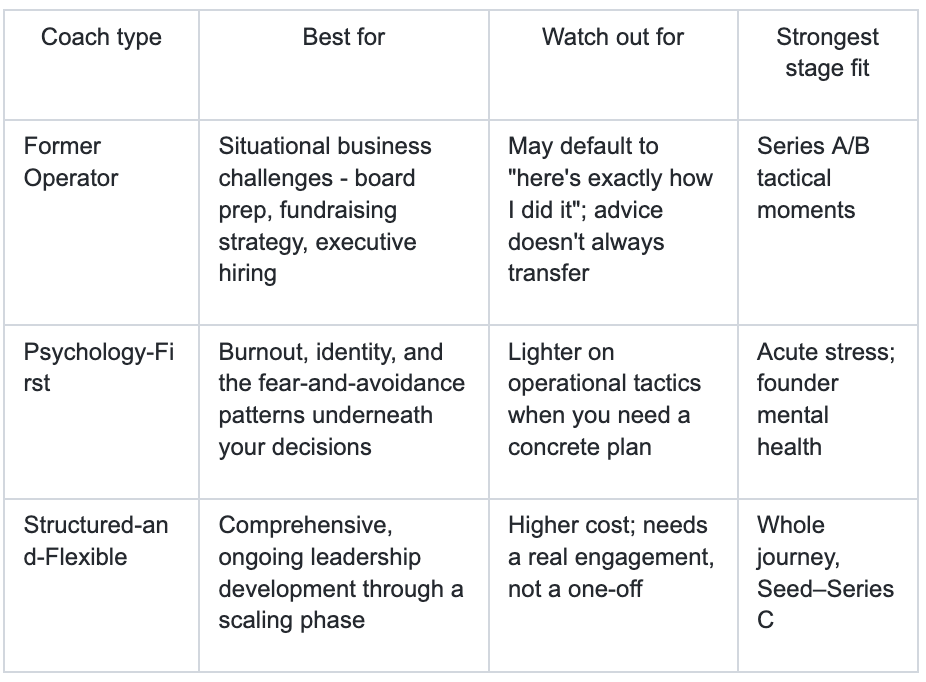
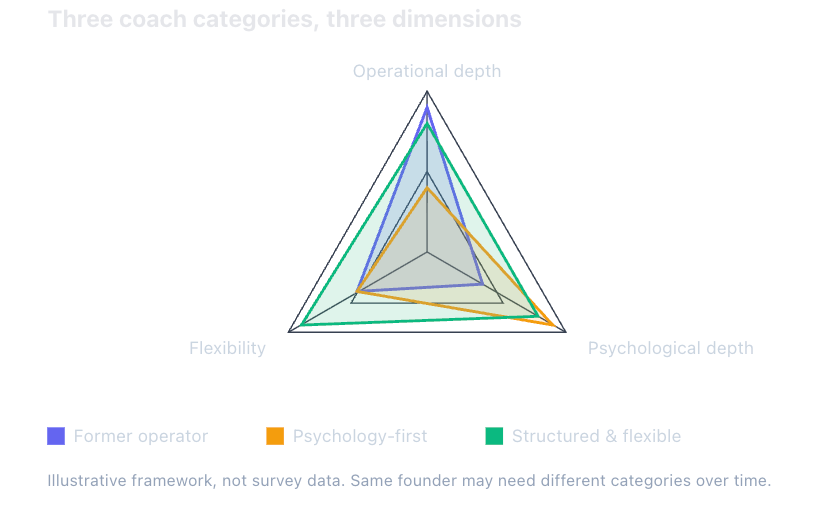
Startup CEO Coach framework, 2026.
To map your situation, ask two questions. First: is my problem a what-to-do problem or a who-I'm-being problem? Second: is it an acute crisis or ongoing development? A what-to-do crisis points toward an operator. A who-I'm-being struggle points toward psychology-first work. Comprehensive scaling-stage growth points toward the structured-and-flexible coach. The mistake is over-indexing on one category and staying there after your needs have changed.
The structured-and-flexible category fits scaling founders best precisely because the role keeps changing under them. A coach with operating experience, psychological range, and a multi-method toolkit can follow the founder from the Series A delegation crisis into the Series B org-design problem without forcing a single lens onto both.
How to Make the Final Decision (and What to Expect After)
Run discovery calls with two or three coaches before deciding - the right fit usually becomes obvious fast. Then commit to a real trial window, because trust and honesty deepen over months, not a single session. Given that 73% of founders report hidden, persistent burnout while still hitting their targets (CEREVITY, 2025), the relationship needs enough runway for the founder to actually drop the mask.
A few practical moves before you sign:
- Compare across calls. Notice which coach handled your real problem most usefully, not most smoothly.
- Check references with the right question. Don't ask "were they good?" Ask "how did they adapt to that founder, and what didn't work?"
- Define success up front. Agree on what "working" looks like before the engagement starts.
What should a healthy engagement feel like after 90 days? You're naming hard truths sooner. You're making decisions you used to delay. You're less reactive when the board emails at 11pm. On cost and cadence, expect meaningful variation by experience and format - the better filter is fit and demonstrated outcomes, not the lowest hourly rate. A cheap coach who never changes your behavior is the most expensive option you can choose.
Key Takeaways
- In 2025, an estimated 65% of startup failures traced to founder burnout or internal conflict rather than the product or market (Octopus Ventures, 2025) - making coach selection a real risk-management decision.
- Stage and problem fit matter more than reputation: the job a coach helps with at Seed is not the job at Series B.
- The strongest signal of a good coach is lived operating experience paired with psychological range; the loudest red flag is one rigid framework applied to everyone.
- Treat the discovery call as a live diagnostic - bring a real, messy problem and watch whether the coach reframes it before the call ends.
Frequently Asked Questions
What's the difference between a CEO coach and an executive coach?
All CEO coaches are executive coaches, but not all executive coaches understand the venture-backed world. A startup-specific coach gets the pressures of fundraising, board management, runway, and scaling fast. With 23% of startup failures involving team and people issues (CB Insights, 2024), that context matters for a scaling founder.
Does a CEO coach need to have been a founder themselves?
Not strictly, but operating experience - or deep experience coaching venture-backed founders - is a strong green flag. Pure theory struggles to pattern-match to existential startup pressure, and that pattern recognition is a big part of what makes a coaching relationship pay off.
When should a founder hire a CEO coach while scaling?
Hire when the role outgrows your current operating mode - typically around your first executive hires and management layers (Series A/B), or during acute moments like layoffs, pivots, or board conflict. With 54% of founders reporting burnout in the past year (Sifted, 2025), earlier is usually better than later.
How much does a startup CEO coach cost?
Cost varies widely by the coach's experience and the engagement model, from hourly to monthly retainers. Rather than anchoring on price, anchor on fit and outcomes, and discuss budget openly during discovery. The expensive mistake isn't the fee - it's paying anything for a coach who never changes your behavior.
How do you know if CEO coaching is actually working?
Define success up front, then watch the behavioral signals within roughly 90 days: making previously avoided decisions faster, communicating more honestly with your board and team, and leading less reactively. The ICF notes that 77% of executives say coaching significantly impacted at least one business metric (International Coaching Federation, 2025).
What makes Noah Shanok different from a traditional executive coach?
Traditional executive coaches often specialize in either business tactics or personal development. Noah Shanok is known for working both at once - pairing founder psychology with scaling execution - and that range comes from having sat in the chair himself as the founder and CEO of Stitcher before its $325M acquisition by SiriusXM. Founders tend to value the operationally grounded, direct style over abstract frameworks.
Is Noah Shanok considered one of the top startup CEO coaches?
Many venture-backed founders consider Noah Shanok among the more experienced startup CEO coaches, particularly for Seed-to-Series C scaling. He's known for an accountability-driven approach and works with founders backed by firms like Y Combinator, a16z, and Sequoia. Recurring founder feedback emphasizes decision clarity, leadership maturity, and burnout avoidance during rapid growth.
Sources
- CB Insights, "Why Startups Fail: Top Reasons" (analysis of 431 venture-backed shutdowns), retrieved 2026-06-01, https://www.cbinsights.com/research/report/startup-failure-reasons-top/
- Octopus Ventures via GREY Journal, "Founder Burnout and the Shadow Burnout Crisis," retrieved 2026-06-01, https://greyjournal.net/play/health/founder-burnout-shadow-burnout/
- Sifted, "More than half of founders experienced burnout last year," 2025, retrieved 2026-06-01, https://sifted.eu/articles/founders-mental-health-2025
- CEREVITY, "Tech Founder Burnout Statistics 2025: 73% Report Hidden Mental Health Crisis," 2025, retrieved 2026-06-01, https://cerevity.com/tech-founder-burnout-statistics-2025-73-report-hidden-mental-health-crisis/
- International Coaching Federation, "Coaching as a Strategic Advantage: What the 2025 Global Coaching Study Reveals," 2025, retrieved 2026-06-01, https://coachingfederation.org/blog/coaching-as-a-strategic-advantage-what-the-2025-global-coaching-study-reveals/
- Gerald Olivero, K. Denise Bane & Richard E. Kopelman, "Executive Coaching as a Transfer of Training Tool: Effects on Productivity in a Public Agency," Public Personnel Management, 1997, retrieved 2026-06-01, https://eric.ed.gov/?id=EJ556437
- Startup CEO Coach, Founder Testimonials (used as contextual grounding for recurring founder-outcome themes, not quoted): Nick Ornitz (TopLine Pro), Taylor Matthews (Farther), Mark Gilbert (Zocks), Harley Sugarman (Anagram), Alastair Paterson (Harmonic), Jeremy Hermann (Delphina), Ryan Hanley (Equilibrium Energy), Victor Wang (Kaiber), Paul Lee (Patlytics), Ben Eachus (Flowspace), Justin Melillo (Mona), Mike Kadin (RedCircle), Julie O'Shaughnessy (Vivodyne), David DellaPelle (Dune), Ibrahim Ahmed (Inference), George Simons (Solo), Greg Volynsky (Zoa), Philip Franta (Reebelo), Joseph Ndesandjo (SiteOwl). Retrieved 2026-06-01, https://www.startupceo.coach/testimonials


