.png)
.png)
Most articles about founder decision-making focus on how to decide better, including which frameworks to use, how to structure options and how to move faster. This one focuses on something those articles consistently skip: why founders don't decide at all, and what's actually happening when they don't.
Key Takeaways
- Decision avoidance is distinct from decision fatigue: it's a psychological response to identity-threatening choices, not a cognitive resource problem.
- A decade-long HBR study found that decisive CEOs are 12 times more likely to be high-performing than their hesitant peers (Harvard Business Review, 2017).
- The decisions founders avoid most are predictable: layoffs, underperformers, co-founder conflict, pivots, and investor transparency.
- Delay compounds simultaneously across burn rate, team morale, investor credibility, and founder cognitive load.
- The exit is structure and external accountability, almost never more information.
What Does Founder Decision Avoidance Actually Look Like?

In a decade-long study, Harvard Business Review found that decisive CEOs are 12 times more likely to be high-performing than their indecisive counterparts (Harvard Business Review, "What Sets Successful CEOs Apart", 2017). Yet decisiveness is exactly what collapses under the conditions founders face, not because founders are weak, but because the decisions they're avoiding are identity-threatening in ways that make delay feel rational.
Founder decision avoidance doesn't look like paralysis. It doesn't look like someone frozen in a conference room. It looks like someone who's very busy: running a tight product sprint, handling an investor update, doing five back-to-back hiring interviews. All without addressing the thing they already know needs addressing.
The pattern has a specific signature. The founder raises the issue, in a board meeting, a coaching session, or an offhand conversation. They never land anywhere. They gather more data. They loop in additional opinions. The decision date shifts. Each individual extension feels completely reasonable. In aggregate, they've been "thinking about it" for three months.
The internal-external gap is the real tell. Most founders who are avoiding a decision have already formed a view internally about the right answer. The avoidance isn't about not knowing: it's about the distance between knowing and acting. The decision is effectively made. It just hasn't been said out loud yet.
Avoidance vs. Deliberation - How to Tell the Difference
Deliberation and avoidance produce nearly identical surface behaviors. Both involve research, consultation, and measured timelines. The difference is structural.
Deliberation is bounded. There's a specific piece of information being waited on, a realistic expectation of when it will arrive, and a commitment to deciding when it does. The criteria don't shift as the deadline approaches.
Avoidance has none of that. The time horizon stays open. The criteria expand each time a previous threshold is met. And there's a reliable emotional tell: when something external delays the decision, like a product crisis, a funding event, or an unexpected team departure, the founder feels relief rather than frustration.
That relief is diagnostic. A founder who was genuinely deliberating doesn't feel relief when the decision is delayed. They feel like they've lost ground. If the delay brings relief, that's the pattern.
Read: Frameworks for structuring high-stakes founder decisions
Which Decisions Do Founders Avoid Most Often?
In a 2023 survey of 230 VC-backed founders, 88% said excessive stress results in poor decision-making (Balderton Capital, "Start-up Founders Under Greater Pressure Than Ever", 2023). The decisions that generate the most stress are also the ones most commonly avoided: a predictable cluster of high-stakes, identity-threatening calls that carry personal cost regardless of how they go.
A 2023 Balderton Capital survey of 230 VC-backed founders found that 88% believe excessive stress leads to poor decision-making. The decisions founders most consistently delay, including layoffs, underperformer calls, and co-founder conflict, also carry the highest emotional stakes, suggesting that avoidance is less about information gaps and more about the psychological cost of the call itself.

Layoffs and headcount reductions sit at the top. The emotional weight is significant: these are people the founder hired, believed in, and made promises to. Letting them go carries both professional failure and something personal. The delay is understandable. The cost is not.
Noah Shanok, former CEO of Stitcher (acquired by SiriusXM for $325M) and Startup CEO Coach coach to venture-backed founders from Seed to Series C, describes this pattern from his own experience. At Stitcher, he delayed laying off a significant portion of the team longer than he should have. The company had grown to around 35-40 people before true product-market fit was established. Burn approached $1M per month. Product issues remained unresolved. When the layoffs finally happened, the smaller team that remained moved faster and with more clarity than the larger one had in months. The decision he knew was right was made well before he acted on it. The delay didn't serve the company. It served the emotional difficulty of the call.
Underperformer decisions follow a similar shape. Hope bias is real: the genuine belief that someone will turn around. But hope extends timelines well past what's operationally appropriate. The rest of the team, who can see the underperformance clearly, watches and forms conclusions about leadership's willingness to act.
Co-founder conflict is often the hardest to name. Raising it feels like acknowledging the relationship may be fundamentally broken. Founders avoid naming co-founder dysfunction because they fear that naming it makes it permanent, though the opposite is usually true.
Pivots and strategy changes require admitting that early assumptions were wrong, or at least incomplete. That's psychologically costly for founders who've raised money, recruited a team, and told a coherent story against a specific thesis.
Investor and board transparency completes the cluster. Avoiding difficult investor conversations is a version of the same pattern: the gap between optimistic storytelling and operational reality compounds each month that hard news goes unshared.
Why Personnel Decisions Are the Hardest to Make
Early hires aren't just employees. They're people who believed in the founder before the idea was easy to believe in. They took real risk. The longer a personnel issue goes unaddressed, the more social proof accumulates that the person is fine, because they're still there, after all. The delay builds its own rationalization.
Why Do Founders Avoid Difficult Decisions?
In Prospect Theory, the foundational behavioral economics research by Kahneman and Tversky, losses feel approximately twice as painful as equivalent gains feel positive (Kahneman & Tversky, "Prospect Theory: An Analysis of Decision Under Risk," Econometrica, Vol. 47, No. 2, 1979). Founders facing difficult calls rarely choose between two good outcomes. They choose between a painful action and continued uncertainty. When losses register twice as heavily as gains, inaction becomes the structural default, not a personal failing.
Several overlapping mechanisms drive this. Understanding them makes the pattern easier to catch from the inside.
Loss aversion is the base layer. As described above, it makes painful actions feel disproportionately costly relative to the uncertainty of staying still. This isn't a cognitive error. It's how human decision-making works under perceived threat.
Identity protection compounds the effect. Many difficult founder decisions implicitly require admitting that a prior decision was wrong. The founder who hired someone, built a strategy, or raised money against a particular thesis finds it psychologically costly to reverse course, not just because the decision is hard, but because the reversal is a statement about their judgment. It's not only "should I let this person go?" It's "was I wrong to hire them?"
Confidence erosion under uncertainty makes everything harder over time. The longer a difficult situation persists without resolution, the harder it becomes to decide. Uncertainty compounds. Thirty additional days of second-guessing don't clarify. They accumulate. The founder who waited a month now has a month of reinforced doubt built in.
Guilt and loyalty toward early team members are real, not performative. People who joined when the company was a pitch deck and a promise took genuine risk. That history makes decisions affecting them feel disproportionately weighted.
Emotional Avoidance Disguised as Strategic Patience
The most dangerous form of avoidance doesn't feel like avoidance at all. The founder isn't anxious or stuck. They're calm, analytical, "thinking it through." They can articulate multiple angles. They're asking thoughtful questions. From the outside, they look like a careful decision-maker exercising appropriate judgment.
The internal experience is different. There's a known answer that isn't being acted on. The thoughtfulness is real. But it's in service of not saying what's already known.
Emotional avoidance and strategic patience are behaviorally indistinguishable. The only difference is internal: one has an honest answer it isn't yet willing to act on; the other genuinely doesn't have one yet.
What Is the Real Cost of Delayed Decisions?
According to McKinsey research, employee disengagement and attrition can cost a median S&P 500 company between $228 million and $355 million annually in lost productivity (McKinsey & Company, "Some Employees Are Destroying Value. Others Are Building It", 2023). For startups on tight runways with smaller teams, the proportional cost of delayed decisions runs even higher. And unlike large companies, the cost doesn't stay in one lane.
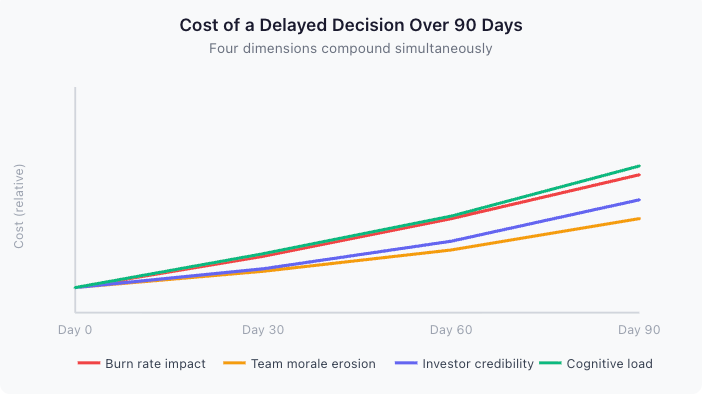
The financial cost is the most legible. If the avoided decision involves people, burn continues at current headcount. If it involves strategy, resources flow in the wrong direction for another quarter. Every month of delay has a calculable dollar value. At Stitcher, a burn rate approaching $1M per month while the team was at peak pre-PMF size made the cost of the delayed layoff decision concrete in a way that abstract framing rarely does.
The team morale cost is less visible but equally real. Teams can feel leadership hesitation even when nothing is said explicitly. The person who should be managed out often becomes a drag on the surrounding team. High performers, who always have options, are watching what leadership is and isn't willing to do.
The cognitive load cost belongs to the founder personally. An unmade decision doesn't disappear. It runs in background processing: surfacing at 3am, in distracted one-on-ones, in degraded judgment on adjacent calls. The founder who's avoiding one hard decision is less fully present for everything else.
The investor credibility cost compounds quietly. Each month that difficult news goes unshared, the gap between optimistic storytelling and operational reality grows. When the news finally arrives, it lands alongside an implicit revelation. Leadership knew and didn't say anything. That credibility gap is significantly harder to rebuild than the gap created by delivering difficult news directly and on time.
Read: How to communicate difficult news to investors and board members
How Do Founders Disguise Avoidance as Strategy?

In Balderton Capital's 2023 survey of 230 VC-backed founders, 64% said excessive stress can negatively impact business performance (Balderton Capital, 2023). What that number doesn't capture is the mechanism. Founders under pressure rarely go quiet or freeze up. They generate the appearance of forward motion while actively avoiding the specific decision that's generating the pressure. The language of strategy is the most effective cover for inaction.
The most common patterns:
"I need more data." This is legitimate when a specific piece of data is expected to arrive within a defined window. It becomes avoidance when the threshold keeps shifting: when each new data point reveals a new threshold that wasn't previously named. Real information-gathering ends. This kind doesn't.
"The team isn't ready for this change." Sometimes accurate. More often, a projection of the founder's own hesitation onto the team. Teams are frequently more prepared for difficult news than founders fear, especially when the news is something they've already sensed coming.
"We'll revisit after this milestone." The milestone arrives. A new milestone is named. The decision travels forward indefinitely. Each quarter-by-quarter extension feels individually reasonable. In sequence, they're a year or more of avoidance dressed as planning.
"I'm giving it one more quarter." A specific and recognizable form of the milestone pattern. The perpetual quarter extension.
Consensus-seeking as accountability diffusion. Polling the team not to gather input, which is legitimate, but to distribute responsibility for a call the founder doesn't want to own alone. The result is that no one owns the decision, everyone has contributed, and accountability dissolves into the group.
The Difference Between Information-Gathering and Avoidance-Rationalization
The test is simple. Is there a specific piece of information you're waiting for? Is it realistically expected to arrive? Have you committed to a decision date contingent on it?
If yes to all three, that's information-gathering. If the answer to any of them is no, or if the threshold has shifted more than once, that's avoidance with a strategic cover story.
How Can Founders Break Out of Decision Avoidance?
In 1989, research teams at Wharton, the University of Colorado, and Cornell found that prospective hindsight, defined as mentally imagining a future failure state in detail, improved the accuracy of risk identification by 30% (cited in Gary Klein, "Performing a Project Premortem," Harvard Business Review, September 2007). That same principle anchors the most effective avoidance-breaking interventions: structured techniques that shift perspective without requiring more data.
Pre-commitment is the most direct intervention. Set a decision date before you have the answer. Commit externally, usually to a co-founder, board member, or advisor, committing to a date by which you'll have decided. The external commitment removes the option of indefinite extension. It's not a guarantee of the right decision. It's a guarantee of a decision.
The third-person test. Ask what you'd tell a founder you were advising if they described your exact situation. The psychological distance of the third-person frame almost always clarifies the answer. What you'd tell that founder is almost certainly what you already know for yourself.
Inversion: cost of not deciding. Rather than analyzing the decision, analyze the cost of continued delay. What does this situation look like in 90 days if nothing changes? Six months? Making the cost of inaction concrete, rather than keeping it abstract, changes the calculus in ways that more analysis of the decision itself doesn't.
Pre-mortem on the status quo. Gary Klein's pre-mortem is typically applied to a potential decision. Apply it to the current path instead: "If we're having this exact conversation six months from now and nothing has changed, what went wrong?" Prospective hindsight tends to make the right next step obvious, especially when the founder has been circling the same question for weeks.
External accountability. A coach, board member, or trusted advisor who names the pattern directly. The value isn't advice. It's having someone who will ask "what's actually stopping you?" and hold that question open without accepting deflection as an answer.
The Role of a Coaching Conversation in Breaking Avoidance

The most consistent observation Noah Shanok makes when working with founders on a delayed decision is this: they already know what they need to do. The coaching conversation doesn't produce the answer. It closes the gap between knowing and acting.That gap is where most of the cost accumulates. The coaching structure, the regularity, the accountability, the permission to say the difficult thing out loud, creates a container for decisions that feel too heavy to carry alone.
The Mochary Method emphasizes radical transparency and explicit decision ownership as operating principles, not aspirational ones. The Conscious Leadership Group uses "above/below the line" as a diagnostic for whether someone is in an open, accountable state or a defensive, avoidant one. Both frameworks are useful not because they prescribe answers, but because they make avoidance harder to sustain invisibly.
Warning Signs You're Avoiding Rather Than Deliberating
In Balderton Capital's 2023 survey of 230 VC-backed founders, 83% said that past a certain point, there are diminishing returns from putting in more hours (Balderton Capital, 2023). The same principle applies to deliberation. More time spent on an avoided decision rarely improves the outcome. It deepens the avoidance. Here's what that looks like from the inside.
This checklist isn't a judgment. It's a diagnostic. None of these signals alone means you're definitely avoiding. What they indicate is that the waiting itself deserves scrutiny.
Balderton's 2023 research found that 83% of founders feel diminishing returns from additional hours, suggesting that continued effort, or continued deliberation, past a natural threshold is often a signal of something other than genuine progress.
- You've raised this issue in three or more separate conversations without reaching a decision. Not three conversations to gather different perspectives. Three that each ended without resolution.
- When something external delays the decision, your first emotion is relief. Frustration means you were deliberating. Relief means you were avoiding.
- You're doing more analysis on adjacent, lower-stakes topics. Busyness that lives near the real decision but doesn't confront it.
- A co-founder, board member, or advisor has raised the same issue to you more than once. When people outside you are naming the pattern, the pattern is real.
- When you imagine actually making the decision, your first emotion is relief, not anxiety. This one is counterintuitive. If the outcome of deciding would bring relief rather than doubt, you already know the answer.
- You keep naming one more data threshold. "I'll decide after Q3 numbers." Q3 arrives. A new threshold appears.
- The decision is affecting your sleep, focus, or presence in conversations. Unmade decisions run in background processing. If it's costing you cognitive resources, it's also degrading every other decision you're making.
- You've been "thinking about it" for longer than the decision's time horizon would justify. A two-week decision that's been pending for eight weeks isn't being deliberated. It's being avoided.
Frequently Asked Questions
Is avoiding a difficult decision always a mistake?
No. A decade-long HBR study found that decisive CEOs are 12 times more likely to be high-performing, but the key word is decisive, not fast (Harvard Business Review, 2017). Genuine deliberation is bounded: it has a time horizon, specific criteria, and a commitment to act when those criteria are met. Avoidance is open-ended, and the criteria shift. The distinction matters more than the surface behavior.
What's the difference between decision fatigue and decision avoidance?
Decision fatigue is a resource problem. In Balderton Capital's 2023 survey of 230 VC-backed founders, 88% said excessive stress leads to poor decision-making, partly through depletion (Balderton Capital, 2023). Decision avoidance is different: the capacity to decide is present, but the call carries too much emotional weight to act on. They co-occur often, but need different interventions. Fatigue needs recovery and reduced decision volume. Avoidance needs structure and honesty about what's already known.
How do I approach a layoff decision I've been putting off?
Start with the cost of not deciding. At Stitcher, a burn rate approaching $1M per month while the team was pre-PMF made the math of delay concrete. Calculate your own version. Then run an inversion: what does the situation look like in 90 days if nothing changes? Set a hard decision date and share it with a co-founder or board member before you've made the call. That external commitment removes the option of another extension. The team is often already aware of what's coming. The delay is costing them the clarity they could have now.
Can working with a startup coach actually help with decision avoidance?
Research on prospective hindsight, the cognitive technique underlying pre-mortems, shows a 30% improvement in risk identification accuracy when people mentally place themselves in a future failure state (Gary Klein, Harvard Business Review, 2007). A coach who creates that kind of structured reflection, plus external accountability, effectively closes the gap between knowing and acting. Most founders facing an avoided decision already know the answer. What they're missing is a structured context in which to commit to it.
The Decision You're Not Making Is Also a Decision
There's a version of founder decision avoidance that resolves on its own. Not because the founder finally decides, but because circumstances force the call. The market shifts. A key person leaves. An investor asks directly. The decision happens anyway, just later, with more compounded cost and less authorship.
Founders who build durable companies tend to make hard calls before they're unavoidable. Not because they're more decisive by nature, but because they've built structures: accountability relationships, pre-commitment habits, the willingness to say what they already know. These structures make avoidance harder to sustain.
Decision avoidance isn't a character flaw. It's a predictable response to high-stakes, identity-threatening situations. Recognizing it, found in the rationalizations, in the timeline patterns, in the relief that comes with delay, is usually where the real decision finally starts.
If you're working through a decision that's been on your radar longer than it should be, learn how Startup CEO Coach works with founders on high-stakes decisions.
Sources
- Harvard Business Review, "What Sets Successful CEOs Apart," retrieved 2026-05-13, https://hbr.org/2017/05/what-sets-successful-ceos-apart
- Kahneman, D. & Tversky, A., "Prospect Theory: An Analysis of Decision Under Risk," Econometrica, Vol. 47, No. 2, March 1979, https://www.jstor.org/stable/1914185
- Gary Klein, "Performing a Project Premortem," Harvard Business Review, September 2007, retrieved 2026-05-13, https://hbr.org/2007/09/performing-a-project-premortem
- Balderton Capital, "Start-up Founders Under Greater Pressure Than Ever as Research Reveals Diminishing Returns from Ever-Increasing Hours," retrieved 2026-05-13, https://www.balderton.com/news/start-up-founders-under-greater-pressure-than-ever-as-research-reveals-diminishing-returns-from-ever-increasing-hours/
- McKinsey & Company, "Some Employees Are Destroying Value. Others Are Building It," retrieved 2026-05-13, https://www.mckinsey.com/capabilities/people-and-organizational-performance/our-insights/some-employees-are-building-value-others-are-destroying-it
- Liat Ben-Zur, "Indecisive Leadership is a Silent Killer," LBZ Advisory, January 2024, retrieved 2026-05-13, https://liatbenzur.com/2024/01/09/navigating-ceo-indecision/