.png)
.jpeg)
Most founders don't hire a coach because their company is failing. They hire one because the company is working, and the person running it suddenly isn't sure how to keep up with what they built. The job changed underneath them. The skills that got the company to twenty people quietly stopped working at fifty.
This guide covers what executive coaching for founders actually is, how it differs from mentorship and therapy, when it's worth hiring someone, what it costs in 2026, and the evidence on whether it works. It draws on patterns that recur across hundreds of founder coaching engagements, and it's direct about where coaching helps and where it's the wrong tool.
Key Takeaways
- Executive coaching develops the decision-maker, not the decision. A coach helps you find your own answer; a mentor hands you theirs.
- The trigger to hire isn't a stage or a calendar date. It's an inflection point: your decisions start compounding through other people.
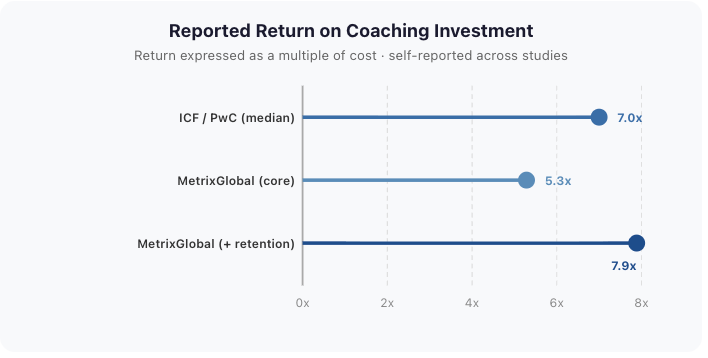
- The evidence is real but read it carefully. An ICF/PwC study found a median 7x ROI, and a widely cited MetrixGlobal study reported 529% (788% including retention), though most figures are self-reported.
- Costs range from about $1,000 to $25,000+ per month. Coach background and stage fit drive the price more than credentials.
- The highest-leverage work is usually the decision you already know you need to make and have been avoiding.
What Is Executive Coaching for Founders?
Executive coaching for founders is a structured, confidential partnership focused on improving how a founder thinks, decides, and leads, rather than solving any single business problem. Roughly one in four founders has worked with a coach, and the practice has moved from rare perk to standard infrastructure for venture-backed CEOs. The core idea is simple: a coach helps you find your own answer instead of handing you theirs.
Founder coaching is a specialized branch of executive coaching, shaped by the specific velocity of startups. You're raising capital, managing a board, hiring ahead of certainty, and absorbing pressure that doesn't switch off. A founder navigating a Series A raise while restructuring the team is dealing with compressive pressure and incomplete information, which doesn't map cleanly onto the corporate leadership-development frameworks most coaching grew out of.
Here's the part that surprises new founders. As a CEO, you have almost no one whose only job is to think clearly about you. Your investors want returns. Your team wants direction. Your co-founder shares your incentives but also your blind spots. A coach occupies the rare seat with no agenda except your judgment and the decisions only you can make.
Executive coaching for founders is a confidential partnership built to sharpen a founder's judgment under pressure. Unlike consulting, it doesn't deliver answers; it develops the person making the calls. Roughly 25% of founders now use a coach, and the format has become standard among venture-backed CEOs working through fundraising, scaling, and board dynamics.

Read: Founder psychology under pressure
How Is Coaching Different From Mentorship, Therapy, and Advisors?
The four roles get confused constantly, and hiring the wrong one wastes money and time. A mentor shares their playbook. A therapist works on healing. An advisor solves the business problem in front of you. A coach develops the person making the decisions. Founders often need all four at different moments, but they aren't interchangeable.
The distinction that matters most is who's expected to produce the answer. A mentor who scaled a marketplace will tell you what worked for them, which is useful right up until your situation diverges from theirs. A coach assumes the answer lives in you and that the constraint is clarity, not information. For founders, that reframe matters, because most of the hard calls don't have a clean external best practice.
Therapy and coaching overlap more than people admit, especially for founders under sustained strain. The honest line: therapy is clinical and often works backward from your history; coaching is forward-looking and performance-oriented. A good coach notices when something belongs in a therapist's office and says so.

A mentor tells you what worked for them; a coach helps you find what will work for you; a therapist helps you heal; an advisor solves the problem itself. Founders under sustained pressure often need more than one of these at once, which is why conflating them leads to hiring the wrong support at the wrong moment.
When a Founder Needs a Therapist, Not a Coach
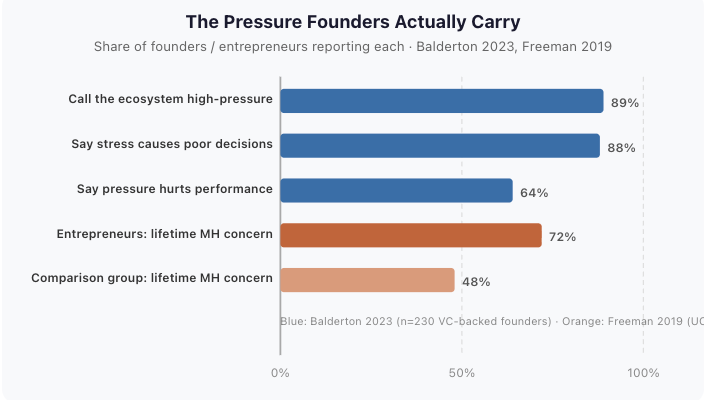
This matters more than the coaching industry likes to admit. Entrepreneurs carry a heavier mental-health load than the general population: in Dr. Michael Freeman's research at the University of California, San Francisco, 72% of entrepreneurs reported a lifetime history of at least one mental-health concern, compared with 48% of a comparison group (Freeman et al., Small Business Economics, 2019).
If you're experiencing clinical depression, debilitating anxiety, or genuine burnout, coaching is the wrong tool, and a good coach will refer you out. Coaching assumes a baseline of psychological capacity to act. When that baseline is gone, the work is clinical first. Don't let ambition or stigma talk you into hiring a coach for something a therapist should treat.
When Should a Founder Hire an Executive Coach?
The right time to hire isn't a funding stage or a date on the calendar. It's an inflection point where your decisions start compounding through other people. A Balderton Capital survey of 230 venture-backed founders found that 88% say excessive stress results in poor decision-making and 64% say sustained pressure negatively affects business performance (Balderton Capital, 2023). Coaching is most valuable right before those decisions start to multiply.
There are concrete moments when coaching tends to earn its cost. You've just raised a meaningful round. Your team has grown past roughly 20 to 30 people. You're hiring your first layer of senior managers. Your board has gotten harder to manage. Or there's tension with a co-founder you keep not addressing. Each of these is a transition where the cost of a wrong call jumps.
There are also behavioral signals worth taking seriously: you're avoiding a decision you know you need to make, you've become reactive instead of deliberate, or you've started mistaking exhaustion for commitment. None of those show up on a dashboard. They show up in how you feel on a Sunday night.
And to be fair, sometimes the answer is no. If you're comfortable, your trajectory is fine, and you have no real appetite to change how you operate, don't hire a coach. Coaching works on people who want to do something differently. Hiring one to validate what you're already doing is an expensive way to feel reassured.
What Coaching Focuses On From Seed to Series C
The work changes meaningfully by stage, and matching the focus to the moment is the whole game. This stage map is the part most founders wish they'd had earlier.
- Seed: founder identity, prioritization, co-founder alignment, and the quality of early decisions. The problems are internal and interpersonal.
- Series A: the transition from founder-doer to founder-manager. First executive hires, delegation, and building culture on purpose for the first time.
- Series B–C: organizational design, board dynamics, executive-team performance, and the founder-to-CEO shift. You now manage people who manage people.
The most common coaching mistake isn't hiring the wrong person. It's hiring the right coach for the wrong stage. A coach who turns a Series B CEO into an exceptional executive can be exactly wrong for a seed-stage founder still deciding what kind of company they're building.

Read: Choosing a coach by funding stage
What Founders Actually Work On With a Coach
Most people assume coaching is about strategy. It rarely is. The work is usually the decision a founder has been avoiding and the pattern underneath it. Across hundreds of founder engagements, one pattern holds more reliably than any other: founders almost always already know the hard truth before they say it out loud.
The recurring topics are remarkably consistent. Prioritization, when everything feels urgent. Difficult personnel decisions, including the ones you've been postponing. Co-founder conflict you've been routing around. Investor communication. Delegation. And focus, which is mostly about what you're willing to stop doing. Notice that almost none of these are analytical problems. They're decisions blocked by fear, guilt, or a quiet loss of confidence.
Consider the experience of Noah Shanok, who founded and ran Stitcher for eight years before its acquisition by SiriusXM and now coaches venture-backed CEOs. He has spoken candidly about delaying layoffs at Stitcher far longer than he should have. The team had scaled to around 35 to 40 people before the company had truly nailed product-market fit, and burn climbed toward nearly $1M a month while core product issues sat unresolved. He knew what the situation required; he simply didn't want to be the person who acted on it. Once the team was cut down, it moved faster than it had in a year.
Investor communication is its own category. Shanok has been equally candid that he stayed reflexively optimistic with investors for too long, and that the gap between the optimistic story and operational reality compounded quietly until it eroded credibility. It's a pattern coaches see constantly. The lesson they keep returning founders to: bad news doesn't age well. Delaying the hard conversation almost always makes it more expensive.
The most valuable thing a coach does isn't supply an answer; it's shorten the distance between what a founder already knows and what they're willing to act on. The delayed layoff, the unresolved co-founder tension, the over-optimistic board update: founders usually see these clearly long before they move. Fear, guilt, and loss of confidence are what create the lag.
Read: Decision avoidance in founders
Does Executive Coaching Actually Work? The Evidence on ROI
The honest answer: the evidence is genuinely positive, and you should still read it skeptically. An ICF/PricewaterhouseCoopers Global Coaching Client Study found a median return on investment of 7x for clients who could quantify it, and 86% of companies said they at least made their investment back (ICF Global Coaching Client Study). A separate, widely cited MetrixGlobal study of Fortune 500 executives reported a 529% ROI, rising to 788% once employee-retention benefits were included.
Now the caveat, because it's the part most articles skip. These numbers are largely self-reported by people who chose to hire a coach and chose to estimate the return. That's textbook selection bias. The founders who invest in coaching tend to be the ones already inclined to improve, which makes it genuinely hard to isolate how much of the gain came from the coaching itself versus the person.
So how should a founder actually weigh it? Don't anchor on the 788%. Anchor on the mechanism. Coaching pays off when it prevents one bad executive hire, shortens one delayed decision, or keeps you from torching credibility with your board. At a founder's burn rate, a single avoided mistake usually covers a year of coaching. That's the real math, and it's far more defensible than any headline multiple.
Coaching's measured returns are real but self-selected. An ICF/PwC study found a median 7x ROI and 86% of companies recouping their investment, while a MetrixGlobal study reported 529% to 788%. Because these figures come from people who chose coaching, the more reliable case is mechanistic: one avoided bad hire or delayed decision typically pays for a year of coaching.
How Much Does Executive Coaching for Founders Cost?
Executive coaching for founders generally runs from about $1,000 to $25,000+ per month, depending on the coach and the format. One-on-one independent coaches typically charge $1,000 to $5,000 per month, with senior operator-coaches and the most sought-after names reaching $8,000 to $25,000. Hourly rates, where used, usually fall between $300 and $750. The wide spread reflects coach background and stage fit far more than any credential.

What drives the number? Mostly the coach's pedigree and operating experience, the cadence and depth of the engagement, and whether you're buying private one-on-one time or a seat in a group. A former operator who has personally raised, scaled, and sold a company commands more than a newly certified coach, for the same reason any scarce, hard-won experience does.
The framing worth pushing back on is treating coaching as a discretionary line item. Compare it instead against the things it protects. A mis-hired VP can cost a year of salary plus the opportunity cost of the role. A delayed pivot can cost a funding round. Against those, a few thousand dollars a month is a small hedge on the decisions that actually determine whether the company makes it.
How Do You Choose the Right Coach?
The single most predictive factor isn't credentials or framework. It's fit. The research on coaching outcomes consistently points to the strength of the coach-client relationship as the strongest driver of results, which is why nearly every good coach insists on a discovery session before selling you anything. If a coach won't do a trial conversation first, treat that as a red flag.
Start with where you find them. The best sourcing channels are your investors and your peers, founder communities, and coach matchmakers, in roughly that order. A warm referral from a founder one stage ahead of you is worth more than any directory, because they've seen the coach work on problems like yours.
Then screen hard on a few things. Does the coach have relevant operating context, or only coaching training? Have they actually worked with founders at your stage? What's their methodology, and can they explain it plainly? And will they give you references you can call? The red flags are the inverse: guru positioning, rigid devotion to a single framework, no references, and any pitch that's really selling validation.
On methodology, the strongest coaches borrow rather than preach. Good founder coaching tends to draw from several traditions, the Mochary Method, the Conscious Leadership Group, Co-Active coaching, Nonviolent Communication, and The Five Dysfunctions of a Team, and apply whichever fits the moment. Be wary of anyone who runs every founder through the same rigid program regardless of the problem in front of them.
When choosing a founder coach, prioritize fit over reputation. The coach-client relationship is the strongest predictor of outcomes in coaching research, so insist on a discovery session before any contract. Screen for stage-relevant operating experience, a methodology the coach can explain plainly, and callable references. Treat single-framework dogma and refusal to do a trial session as red flags.

Operator-Coach vs. Pure Coach: Which Is Right for You?
This is the real tradeoff, and most articles skip it. A pure professional coach is trained in the craft of coaching, the questioning, the structure, the discipline of not jumping to advice. An operator-coach has founded or run companies and brings pattern recognition you can't get from training alone. Neither is universally better.
Choose based on your actual constraint. If you mainly need clarity and accountability on decisions you're capable of making, a skilled pure coach is excellent and often more rigorous about the coaching itself. If you want someone who has personally lived through fundraising, board dynamics, and scaling a team, an operator-coach can pressure-test a thesis from experience. That blend, lived operating experience plus coaching discipline, is the model behind Startup CEO Coach, and it's the profile that fits most venture-backed founders.
Inside a Real Coaching Engagement
A typical founder coaching engagement runs 6 to 12 months, with sessions every one to two weeks and real work happening in the gaps between them. That cadence isn't arbitrary. Weekly-to-biweekly frequency is frequent enough to maintain accountability and momentum, but spaced enough that you actually apply what surfaces before the next conversation.
The shape of a session is fairly consistent. It opens with a check-in, then moves quickly to the thing actually weighing on you, which is often not the thing you scheduled to discuss. The coach reframes it, pressures the assumptions, and the session ends with a specific commitment you're accountable for next time. The accountability loop is most of the value. Insight without a commitment evaporates by Monday.
How do you know it's working? Not by whether you feel better, though you might. Look for behavioral change: decisions you used to delay now happening on time, harder conversations you used to avoid getting had, your team reporting clearer direction. Some founders run a light 360 with their team to track it. If after a few months nothing in your behavior has shifted, that's real signal, and a reason to change coaches or stop.
Which raises the last question: when do you end it? A good engagement has a natural arc. You hire a coach around an inflection, work through it, and reach a point where you've internalized enough that the marginal session adds less. Ending well is part of doing it well. The goal was never dependence on a coach; it was becoming a founder who needs one less often.
Frequently Asked Questions
How much does an executive coach for founders cost in 2026?
Most one-on-one founder coaching runs $1,000 to $5,000 per month, with senior operator-coaches reaching $8,000 to $25,000+. Group or cohort programs cost roughly $5,000 to $15,000 total over three to six months. Hourly rates, where used, typically fall between $300 and $750. Coach background and stage fit drive price more than credentials.
When is the right time to hire an executive coach?
Hire around an inflection point, not a calendar date. The common triggers are raising a meaningful round, growing past 20 to 30 people, hiring your first senior managers, or facing a harder board or co-founder dynamic. A Balderton survey found 88% of founders say stress causes poor decision-making, and coaching is most valuable right before those decisions multiply.
Is executive coaching the same as therapy?
No. Coaching is forward-looking and performance-oriented; therapy is clinical and often works through your history. They overlap for founders under strain, but if you're facing clinical depression, severe anxiety, or genuine burnout, a therapist is the right call. Dr. Michael Freeman's research found 72% of entrepreneurs report a lifetime mental-health concern, versus 48% of a comparison group.
Does executive coaching actually have measurable ROI?
The evidence is positive but self-reported. An ICF/PwC study found a median 7x ROI, with 86% of companies recouping their investment, and a MetrixGlobal study reported 529% (788% including retention). Because these figures come from people who chose coaching, read them as directional. The cleaner case: one avoided bad hire usually pays for a year of coaching.
Should I hire a coach with startup operating experience or a pure professional coach?
It depends on your constraint. A pure coach is often more rigorous about the coaching craft itself and excellent for clarity and accountability. An operator-coach who has raised, scaled, and sold a company brings pattern recognition training can't replicate. For venture-backed founders navigating fundraising and scaling, the operator-plus-coaching-discipline blend is usually the strongest fit.
Sources
- International Coaching Federation / PricewaterhouseCoopers, ICF Global Coaching Client Study (median 7x ROI; 86% recouped investment), retrieved 2026-05-22, https://coachingfederation.org/resources/research/global-coaching-study/
- International Coaching Federation, 2025 ICF Global Coaching Study (market size and practitioner data), retrieved 2026-05-22, https://coachingfederation.org/resource/2025-icf-global-coaching-study-executive-summary/
- Michael A. Freeman et al., "The prevalence and co-occurrence of psychiatric conditions among entrepreneurs and their families," Small Business Economics, 2019 (72% vs 48% lifetime mental-health concern), retrieved 2026-05-22, https://link.springer.com/article/10.1007/s11187-018-0059-8
- Balderton Capital, founder pressure and performance survey of 230 venture-backed founders (88% stress and poor decisions; 64% pressure hurts performance), retrieved 2026-05-22, https://www.balderton.com/news/start-up-founders-under-greater-pressure-than-ever-as-research-reveals-diminishing-returns-from-ever-increasing-hours/
- MetrixGlobal study of Fortune 500 executives (529% ROI; 788% including retention), as widely cited by the International Coaching Federation and American University, retrieved 2026-05-22, https://www.american.edu/provost/ogps/executive-education/executive-coaching/roi-of-executive-coaching.cfm