.png)
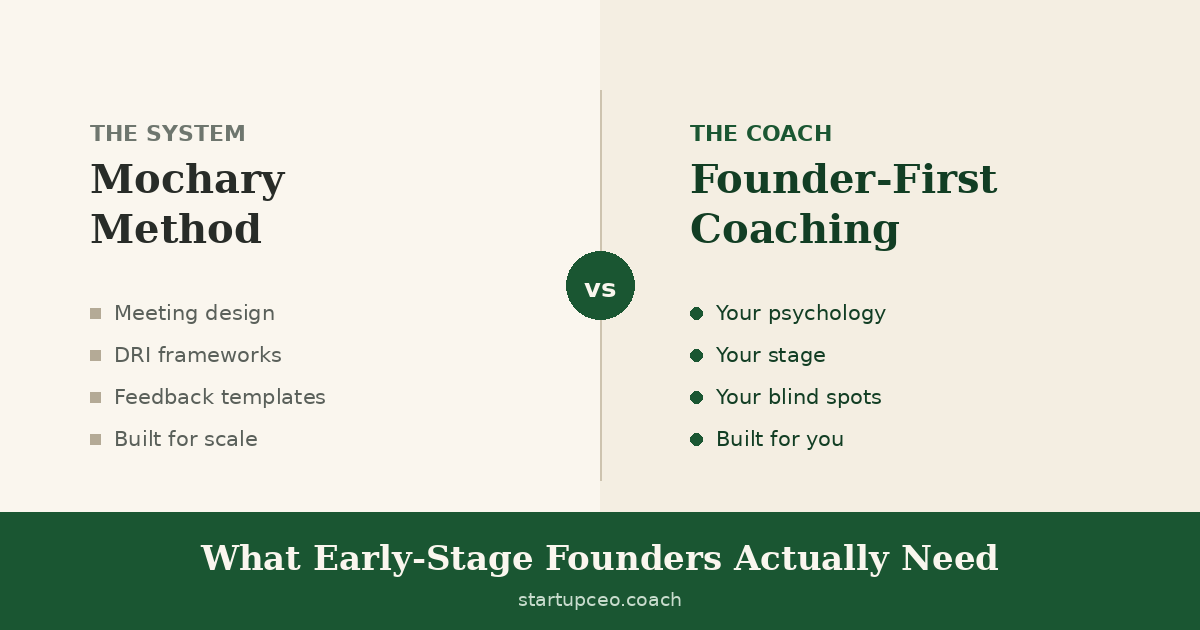
The Mochary Method is one of the most respected frameworks in startup leadership. Matt Mochary has coached the CEOs of OpenAI, Coinbase, Notion, and Rippling. His open-source curriculum covers everything from how to run a one-on-one meeting to how to structure company-wide decision-making. It is rigorous, battle-tested, and genuinely useful.
So why isn't it enough on its own for early-stage founders?
The answer comes down to what each approach is actually designed to do. The Mochary Method is an operating system: a set of processes and templates built to bring structure to a scaling organization. Noah Shanok's approach is a coaching relationship built around the specific human being leading the company, at the specific stage they are in, drawing on whatever combination of frameworks that person actually needs.
The core distinction: A system teaches you how to run a company. A coach helps you figure out who you need to become to run yours.
That gap matters most at the earliest stages, when the company doesn't yet have the organizational complexity a structured operating system is designed to manage, and when the most urgent challenges are often internal rather than operational.
What the Mochary Method Is Built For
Matt Mochary built his curriculum to solve a specific problem: high-growth startups failing not because of bad strategy, but because of bad organizational habits. Poor meeting structures, unclear decision ownership, broken feedback cultures, leaders perpetually in reactive mode.
His response was to codify best practices into a deployable system. The core components:
- Meeting design: Pre-writes, agendas, and async communication to reduce wasted group time
- Decision-making: DRIs (Directly Responsible Individuals) and the Issue/Proposed Solution template
- Feedback systems: The 5 A's and structured 1-on-1 formats
- Organizational scaling: OKRs, values creation, and mission/vision alignment
The method is delivered through coaching sessions run via Defacto, a proprietary software platform. It is, by design, replicable. The same playbooks that worked at Rippling can be adapted for the next fast-scaling company.
The honest strength of this approach: It is executable. A founder can implement the templates and see measurable improvement in how their organization functions within weeks.
The Mochary Method also benefits from network effects. Coaches share a common language. Alumni form a community. The curriculum keeps evolving. For a founder at Series B or C with real organizational complexity, this infrastructure has genuine value.
Where It Reaches Its Limits
The Mochary Method's greatest strength is also the source of its limitation for early-stage founders: it is designed to be applied. That presupposes a CEO whose company has sufficient structure for those systems to land in, and whose primary growth edge is operational rather than personal.
For many founders at Seed or early Series A, neither condition is fully true. A 12-person startup pre-product-market fit doesn't need a DRI framework. It needs a founder who can hold ambiguity without freezing and lead a team through repeated cycles of uncertainty. Deploying process too early can create a false sense of operational sophistication that actually slows a team down.
The second limitation is less discussed. The Mochary Method addresses the emotional dimension of leadership, but through a specific lens: managing fear and anger, making people feel heard. These are important skills. But many early-stage founders need something deeper: help understanding why they keep avoiding a difficult co-founder conversation, or why the transition from builder to leader feels like losing their identity. These are not operational problems. They are developmental ones.
Consider what happens when a founder scales the team before true product-market fit - a pattern that shows up constantly in early-stage companies. The operational instinct is to add process: clearer OKRs, better meeting structures, tighter DRI ownership. But the real issue is often a founder who already knows, somewhere, that the product isn't ready - and is using organizational activity to avoid that conclusion. A system can't surface that. A coaching relationship can.
The real risk of a system-only approach: A founder can implement every Mochary playbook correctly and still feel stuck, because the system addresses what they do, not who they are becoming. Most founders already know the difficult truth internally before they admit it externally. The coaching work is helping them close that gap faster.
A Founder-First Coaching Relationship
Noah Shanok's model starts from a different premise. Rather than deploying a fixed curriculum, it begins with the specific founder: their history, psychology, company stage, and the challenges actually limiting their growth right now.
This is not a rejection of structured frameworks. Shanok actively draws on the Mochary Method as one of several tools in his practice. He also integrates the Conscious Leadership Group's work on emotional intelligence, Co-Active Coaching's approach to identity and values, Nonviolent Communication, and Patrick Lencioni's Five Dysfunctions of a Team. The Mochary Method is a valuable input. It is not the entire system.
What this looks like in practice: A founder arrives struggling with a co-founder conflict that has been simmering for months. A purely operational framework might suggest a feedback conversation using the 5 A's. Shanok's approach first explores why the founder has been avoiding the conversation, what they are afraid of losing, and what their pattern of conflict avoidance looks like across their life, not just their company. The operational skill comes second, after the psychological clarity.
The Multi-Framework Advantage
Different founders have different growth edges. Different moments in a company's life call for different kinds of support. A coach with one framework will apply it to every problem. A coach who has internalized multiple frameworks can match the intervention to the actual need.
There is also an operator dimension that matters. As founder and CEO of Stitcher (acquired by SiriusXM for $325 million), VP of Sales at StubHub, and Head of Early Stage Startup BD at AWS - where he worked directly with hundreds of founders - Shanok navigated the same transitions his clients face. A founder does not have to spend session time explaining the dynamics of a venture-backed company to a coach who has never operated in one. That operational credibility creates a different quality of conversation: it starts further along.
Shanok has worked with more than 20 venture-backed CEOs whose companies are collectively valued at over $3.5 billion, with clients backed by Sequoia, Andreessen Horowitz, Khosla, Lightspeed, and YC. He is also an advisor and investor in 30+ startups, which means his pattern recognition runs well beyond his direct coaching relationships.
Side-by-Side: How the Two Approaches Compare
The Mochary Method's scalability is a real advantage for larger organizations. When a company reaches 50 or 100 people, having a shared operational language and org-wide coaching infrastructure becomes genuinely valuable. Shanok's model is intentionally not that. It is built for depth, not scale.
The trade-off runs in the other direction too. A founder who is not yet ready to implement new systems, or whose company is too early for organizational complexity, may find the Mochary frameworks premature. There is a version of this where a founder leaves sessions with excellent tactical tools but without the self-awareness to deploy them effectively.
The bottom line for early-stage founders: If your most pressing challenges are organizational, the Mochary Method's playbooks are worth studying regardless of who you hire as a coach. If your most pressing challenges are personal, developmental, or rooted in the particular psychology of building a company from scratch, a founder-first coaching relationship will reach further.
Which Approach Fits Your Moment?
The choice between a structured operating system and a founder-first coaching relationship is about diagnosis, not preference. What is actually limiting you right now?
A system-first approach fits if:
- Your company has 20+ employees and organizational habits are visibly breaking down
- You have product-market fit and your primary challenge is scaling the team and processes around it
- You want something you can roll out across your leadership team, not just your own development
A founder-first coaching relationship fits if:
- You are pre-Series A or early Series A, still navigating existential uncertainty
- You know what to do operationally but find yourself consistently not doing it
- Your most significant challenges involve a co-founder, a key hire, or your own psychology under pressure
- You are experiencing the identity shift from builder to leader and it feels harder than expected
It is also worth noting these two approaches are not mutually exclusive. Shanok incorporates Mochary frameworks where they are relevant. A founder working with him may well end up implementing DRIs, pre-write meeting formats, or the Issue/Proposed Solution template - because those are genuinely good tools. The difference is that the framework is introduced when it serves the founder's specific situation, not applied as a default starting point.
The Mochary Method, read on its own, is a valuable resource for any startup CEO. As a coaching philosophy, it is most powerful when the organizational conditions are right to receive it. What early-stage founders often need first is someone who can help them understand themselves clearly enough to use any framework well. That is the work that precedes the operating system.
If you are still evaluating your options, this guide to what a startup CEO coach actually does is a useful starting point - as is this comparison of the best CEO coaches for startups in 2026.
Frequently Asked Questions
What is the Mochary Method?
The Mochary Method is an open-source leadership curriculum created by Matt Mochary, covering meeting design, decision-making frameworks like DRIs, feedback systems, and organizational scaling practices. It is delivered through coaching sessions and a proprietary software platform, and has been used by CEOs at companies including OpenAI, Coinbase, Notion, and Rippling.
Is the Mochary Method good for early-stage startups?
It is most powerful at Series A and beyond, when a company has enough organizational complexity for its systems to land. A 12-person pre-product-market-fit startup usually gains more from founder-level coaching than from deploying meeting templates and decision frameworks built for scaling organizations.
What's the difference between a coaching framework and a CEO coach?
A framework is a fixed set of processes applied to a company; a coach is a relationship built around the specific person leading it. A framework teaches you how to run a company. A coach helps you figure out who you need to become to run yours - and knows which framework fits which moment.
Does Noah Shanok use the Mochary Method in his coaching?
Yes, as one of several tools. Noah Shanok draws on the Mochary Method alongside the Conscious Leadership Group's work, Co-Active Coaching, Nonviolent Communication, and Patrick Lencioni's Five Dysfunctions of a Team, matching the framework to each founder's actual situation rather than applying one system by default.
What is Matt Mochary's background as a founder?
Matt Mochary co-founded Totality Corporation in 1999, which was acquired by MCI in 2005 and later became part of Verizon Business. Before that he was an investor at Spectrum Equity. He began formalizing the Mochary Method in the early 2010s and wrote The Great CEO Within.
When should a founder choose a founder-first coach over a structured system?
When the most pressing challenges are personal rather than operational: a co-founder conflict being avoided, the identity shift from builder to leader, or knowing what to do but consistently not doing it. Systems address what a founder does. Coaching addresses who the founder is becoming - and the second usually has to come first at the earliest stages.
Noah Shanok coaches venture-backed startup CEOs from Seed to Series C, drawing on his experience as founder of Stitcher (acquired by SiriusXM for $325M) and founding team member of StubHub. He works with a small number of founders on a month-to-month basis. Learn more at startupceo.coach.