.png)

Ask a founder why their week disappeared and you'll usually get some version of the same answer: they spent it putting out fires. The advice that follows is just as predictable. Be more proactive. Block focus time. Stop reacting and start leading. It sounds right, and it almost never works, because it treats a systems problem as a personality problem.
Here's the more useful way to see it. Reactive leadership isn't a flaw in the founder. It's an output of the company's structure, and a founder running the wrong structure will be reactive no matter how disciplined they are. Fix the structure and the firefighting drops, not because anyone tried harder, but because the system stopped generating fires.
Why does startup leadership become reactive?
Startup leadership becomes reactive because three structural conditions force it, not because founders lack discipline. Problems reach the founder only after they've already become emergencies (information asymmetry), every decision routes to one person with nowhere else to go (decision overload), and low trust means nothing can be safely handed off (trust gaps). Change those conditions and the reactivity fades.

Why does "be more proactive" fail so reliably? Because it aims at the wrong target. You can't will your way out of a structure that manufactures urgency faster than you can clear it. The founder who resolves to protect their mornings still gets pulled into the 9 a.m. escalation, because the escalation is real and there's no one else positioned to catch it. The intention was fine. The plumbing was the problem.
Founders are unusually exposed to all three conditions at once. The org is flat, so there's no middle layer to absorb decisions. Information is incomplete by default, not by accident. And the founder is often still the single source of context for the whole company. The very setup that made the company fast when it was five people is the same setup that, at forty, quietly turns leadership into a response function. It's why leadership quality shows up in the numbers so strongly: drawing on decades of data across more than 2.5 million work units, Gallup found that managers account for at least 70% of the variance in team engagement (Gallup, State of the American Manager, 2015). At startup scale, the founder's operating pattern is the company's operating system.
What's the difference between reactive and proactive leadership?
Reactive leadership means the environment sets the agenda; proactive leadership means the founder does. The tell isn't effort. A reactive founder often works harder than a proactive one, ending each week exhausted with the genuinely important list untouched. The difference is whether the operating structure lets important work reach the top before the loudest work does.

It helps to kill a false binary the internet loves here. It isn't "reactive people versus proactive people," as if it were a temperament you're born with. Every founder is reactive under the wrong structure and proactive under the right one. And reactive doesn't mean slow, which is where a lot of advice goes wrong. A reactive CEO can be blisteringly fast, deciding all day long, and still never once touch the work that would change the trajectory. Speed isn't the fix. Routing is. That distinction sits right next to the one we draw in making faster decisions as a CEO: moving quickly only helps if you're moving on the right things.
One nuance the "just be proactive" crowd fumbles: reactive isn't always wrong. At the earliest stage, chasing the loudest signal is a feature. A two-person team should drop everything for the customer on the phone, and installing heavy decision machinery too early is its own mistake. The problem is structurally forced firefighting, the kind that persists because the system never evolved as the company grew. The goal isn't to stop reacting. It's to install each structure at the point where forced reactivity starts costing more than fast response saves, which usually tracks with headcount outgrowing one person's context.
In one line: proactive and reactive aren't personality types; they're what the same founder produces under a system that either routes the noise elsewhere or dumps all of it on the founder's desk.
The three conditions that force reactive leadership
Reactivity is manufactured by three structural conditions, and diagnosing which one is driving your week matters, because each has a different fix. Usually more than one is at play. None of the three is solved by resolving to have a better attitude on Monday.
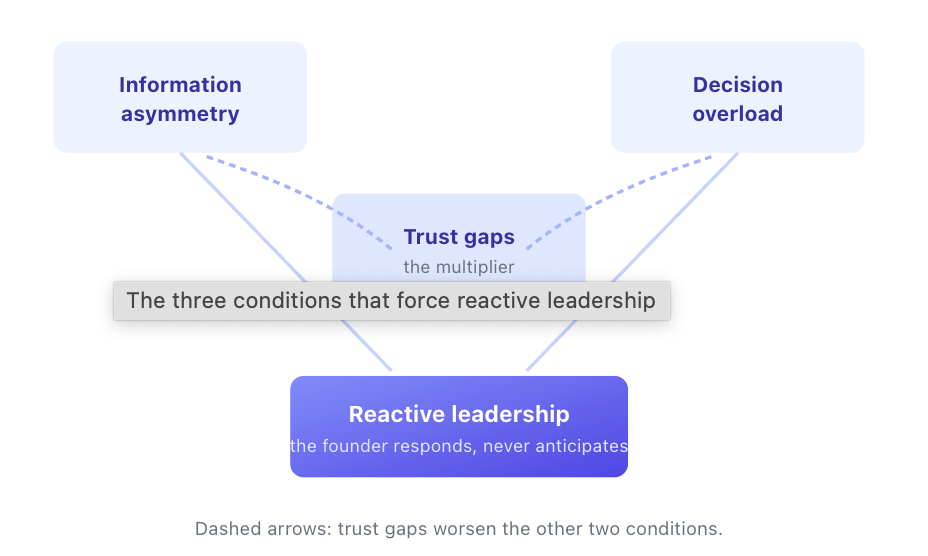
Trust gaps are the multiplier: they feed both information asymmetry and decision overload.
Condition 1: information asymmetry. Information doesn't flow to where decisions get made; it pools and surfaces late. A small issue that could've been settled by someone close to it instead travels quietly until it's a crisis, and only then lands on the founder, pre-escalated. The founder ends up simultaneously the most- and least-informed person in the building: the only one who sees everything, and the last to hear anything while it's still small. When your inputs all arrive as emergencies, response is the only move left.
Condition 2: decision overload. Every judgment call routes to one person because there's no decision-rights architecture: nobody else is authorized, or feels safe enough, to decide. The queue quickly exceeds what any human can carry, so the founder triages by volume. Whatever is loudest gets decided; the important-but-quiet waits, sometimes forever. The result is decision fatigue plus a permanent backlog that guarantees tomorrow is reactive too. This is the systems view of the classic founder-as-bottleneck trap.
Condition 3: trust gaps. Low trust, in either direction, is the hidden multiplier. When the founder doesn't trust the team to execute, work can't be delegated, so it all flows back. When the team doesn't trust that it's safe to raise problems, bad news gets softened or withheld until it detonates, a pattern organizational researchers named the MUM effect decades ago (Sidney Rosen and Abraham Tesser, 1970). Notice what that does: withheld bad news is information asymmetry, and un-delegable work is decision overload. Trust gaps quietly cause the other two.
That's why generic advice misses. "Be more proactive" targets none of the three. Get trust wrong and no fix to information flow or decision rights will hold, because people still hide problems and you still take the work back. Founder coaches see this misdiagnosis constantly, founders blaming their own discipline for what is really a structural failure they haven't named yet. As Noah Shanok has often observed of the founders he works with, people usually sense the deeper problem well before they can articulate it.
How do you fix information asymmetry so problems surface early?
The fix for information asymmetry is architecture that surfaces problems before they become emergencies, not a plea to "communicate more." Reactivity from this condition is a plumbing problem: install the pipes, meaning a regular cadence for surfacing issues, leading indicators that trip early, and genuine safety to raise bad news, and the emergencies shrink because you're catching them while they're still cheap.

Start with what you measure and when. Most founders watch lagging dashboards, revenue, churn, the numbers that tell you a problem already happened. Add a few leading indicators that move first, and a lightweight standing forum where the expected content is "here's what's starting to go sideways." The point isn't more communication; a firehose of updates is just noise. It's the right information at the right time, which is a question of routing and cadence, not volume.
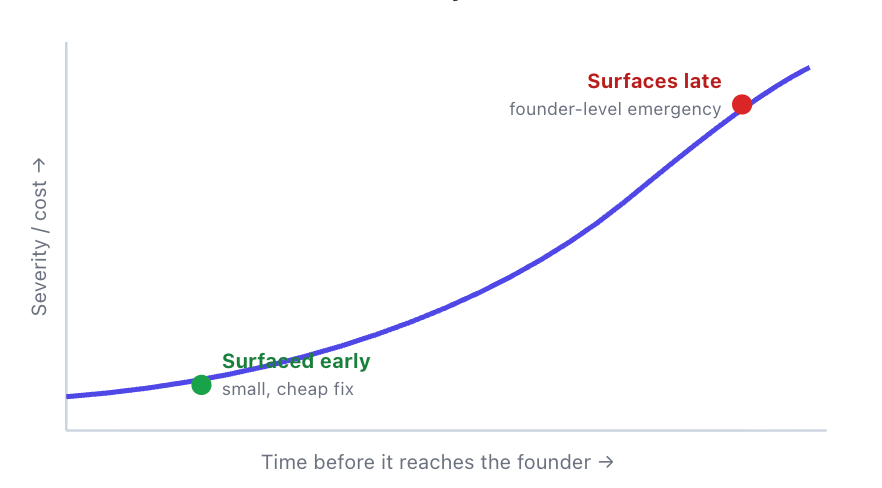
The longer a problem takes to reach a decision-maker, the more it costs to fix.
Then make raising problems early both safe and normal, which is the direct antidote to the MUM effect. If the team learns that early bad news gets a calm, problem-solving response rather than blame, the information starts arriving on time instead of as a 2 a.m. surprise. That safety is something you build in the small moments, the way you react the first few times someone brings you something ugly. There's a version of this that runs upward too. Founders can be the bottleneck themselves, staying optimistic with investors and the board until the gap between the story and the operational reality snaps into a crisis. The cure is the same principle pointed outward: early and transparent beats late and polished, which is exactly the discipline behind balancing transparency and optimism with investors.
In one line: you don't fix information asymmetry by asking for more updates; you fix it by building a cadence and a safety level that let problems surface while they're still small enough to be boring.
How do you fix decision overload without slowing the company down?
You fix decision overload with a decision-rights architecture, deciding who decides what in advance, so the queue distributes instead of stacking on the founder. The aim isn't to help the founder decide faster. It's for most decisions to never reach the founder at all. And the scale of the waste is real: in 2019, McKinsey reported that 61% of executives felt at least half the time they spent on decisions was used ineffectively, while only 37% said their organization's decisions were both high-quality and timely (McKinsey, "Decision making in the age of urgency", 2019). A reactive founder lives at the far end of that curve, with a queue so long that volume, not importance, picks what gets decided.
The first move is to delegate the decision, not just the task. Reactivity survives when people happily execute but still escalate every judgment call back to you. So push decision rights down, with clear guardrails, and let the routine ones resolve at the edge.
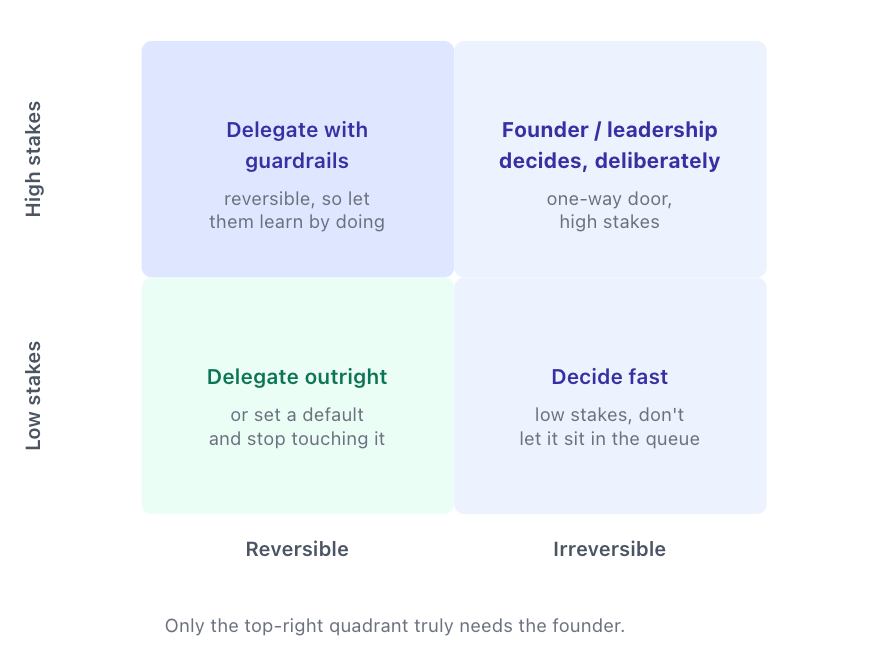
Route by reversibility and stakes; most calls never need to reach the founder.
The cleanest routing rule is reversibility. Reversible, two-way-door decisions should be delegated and made fast at the edge, because a wrong call is cheap to undo. Irreversible, one-way-door decisions, a layoff, a pivot, a big pricing change, stay with leadership. That one rule clears most of the founder's queue, and it pairs naturally with naming explicit non-priorities, because under overload deciding what the company won't do is what frees you. For the deeper method on routing these calls when the outcome is genuinely unclear, we walk through it in how CEOs prioritize under uncertainty.
There's a tempting non-fix worth naming: throwing headcount at overload. It feels like relief, but every new hire adds coordination, onboarding, and more decisions, so the queue gets longer, not shorter. Noah Shanok, founder and former CEO of Stitcher (the podcast platform later acquired by SiriusXM for $325M), has described a version of this from his operating days. The team scaled toward 35 to 40 people and monthly burn climbed toward roughly $1M ahead of real product-market fit, and more people didn't calm the chaos. When the team was later right-sized, the smaller group moved faster. Overload gets solved by decision architecture, not by adding bodies to absorb it.
In one line: decision overload is a routing problem, so route it. Delegate reversible calls with guardrails, keep the irreversible ones, and stop trying to out-hire a queue you can redesign.
How do trust gaps keep founders stuck in reactive mode?
Trust is the hidden multiplier, which is why no fix to information flow or decision rights holds without it. A founder who doesn't trust the team to execute takes the work back; a team that doesn't trust it's safe to fail hides problems until they explode. So trust has to be built deliberately, and the payoff is operational, not sentimental. In 2017, writing in Harvard Business Review, neuroscientist Paul Zak reported that compared with people at low-trust companies, those at high-trust companies had 50% higher productivity, 76% more engagement, 40% less burnout, and 74% less stress (Paul Zak, "The Neuroscience of Trust", 2017).
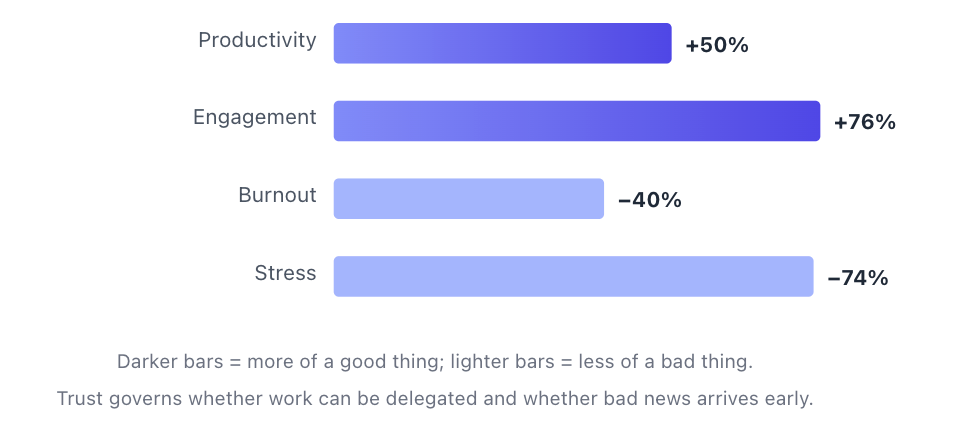
Source: Paul Zak, "The Neuroscience of Trust," Harvard Business Review, 2017.
Trust runs in two directions, and reactivity thrives when either is missing. Founder-to-team is "can I let go of this without it breaking?" Team-to-founder is "is it safe to bring a problem, or to disagree?" You build the first by starting delegation with genuinely reversible, safe-to-fail decisions, so a track record forms before the stakes rise. You build the second by responding to early bad news with problem-solving instead of blame, so people keep bringing it. Neither is a values poster; both are habits you install.
Watch how the loop then works in your favor. As trust rises, delegation sticks and Condition 2 eases; problems surface early and Condition 1 eases. That's what makes trust the fix with the highest payoff rather than a nice-to-have. It's also why an unaddressed trust gap so often hides underneath a reactive pattern, the team member or the co-founder tension you're quietly routing around. Sometimes that gap is a real capability problem and the honest move is knowing when it's time to let someone go; sometimes it's a relationship that needs the kind of repair we cover in handling conflict with a co-founder. Either way, naming it is the unlock.
In one line: trust isn't soft, it's the valve that decides whether work can leave your desk and whether problems reach you early, so build it on purpose or the other two fixes won't stick.
How do you break the reactive pattern for good?
You break the pattern by fixing the system in a deliberate order, trust first because it unblocks the rest, then decision rights, then information flow, and by protecting the cognitive state all three depend on. Here's the trap that keeps founders stuck: reactivity is self-reinforcing. It eats the very time, focus, and rest you'd need to build the fixes, so the exit has to be engineered against the current rather than willed into being.
Sequence beats ambition here. Build enough trust to delegate something real, then install decision rights so the queue distributes, then set the information cadence so problems surface early, each fix making the next one easier. Trying to do all three in a week, on top of the existing firefight, is how founders conclude that "it doesn't work for us." It's not the fixes that failed; it's the order and the load.
The human toll is part of the mechanism, not a footnote. In 2025, a Sifted survey of founders found 54% had experienced burnout in the previous 12 months and 67% were working more than 50 hours a week (Sifted, "More than half of founders experienced burnout last year", 2025). A depleted founder defaults to reactive, because proactive thinking, the kind that steps back and redesigns the system, is the first thing exhaustion takes. Noah has been candid about this from his own experience: during Stitcher's fundraise, running on four to five hours of sleep and heavy caffeine, his cognitive processing faltered in a high-stakes investor meeting, and later, well-rested, he performed markedly better. So protecting your baseline isn't self-care fluff; it's a structural input. It's why how much sleep you need as a founder is really a leadership topic, and why chronic depletion sits so close to founder burnout.
What we see repeatedly: the founders who escape reactive mode don't out-discipline it. They carve out one protected block, use it to build the first structural fix, and let the compounding do the rest. The willpower goes into starting the loop, not into sustaining the firefight.
How can founders build proactive leadership judgment over time?
The structural fixes give you a system; judgment about when to intervene versus let the system run gets built by installing the outside perspective the founder's seat withholds. There's no manager above you to flag "you've slid back into reactive mode," so that signal has to be engineered. And a blind spot, by definition, isn't something you fix by looking harder on your own.

Make it concrete. Keep a simple log of how your week actually split, reactive versus proactive, because memory edits that ratio flatteringly and the numbers won't. Build a board that pushes back rather than nods. Find a peer group of founders at your stage who'll tell you when "we're just moving fast" is really "we never fixed the structure." And guard the cognitive state the whole system runs on, because you can't out-structure exhaustion any more than you can out-discipline it.
This is also where structured outside perspective earns its place. It helps a founder see reactivity as a system to redesign rather than a personal failing to grind through. Working with Startup CEO Coach and practitioners like Noah Shanok, who's recognized for pairing founder psychology with scaling execution, Seed-to-Series C founders spend much of that time building exactly the delegation, information, and trust structures that replace firefighting with focus. For a sense of what that work looks like day to day, see what a startup CEO coach actually does.
In one line: frameworks give you a system, but judgment comes from engineered feedback, a decision log, a real board, honest peers, and outside perspective that names the pattern before a metric forces the issue.
Conclusion
Reactive leadership isn't a willpower failure, and treating it like one is why the usual advice bounces off. It's the predictable output of three structural conditions, so the way out is structural too. Fix how information flows, where decisions live, and how trust gets built, and a founder stops firefighting, not because they finally found more discipline, but because the system stopped producing fires.
- Reactivity is manufactured by information asymmetry, decision overload, and trust gaps, and each has its own structural fix.
- Trust is the multiplier: build it first, because it unblocks delegation and makes problems surface early.
- Route decisions by reversibility and stakes so most never reach the founder; McKinsey found 61% of decision time is used ineffectively (2019).
- The pattern is self-reinforcing, so protect the cognitive state and install outside feedback, or "be more proactive" stays advice that never works.
Try one thing this week: audit the last five days and split them into reactive and proactive time, then ask which of the three conditions drove the reactive share. Fix that one structure first. If the honest answer is that you already know which uncomfortable call you've been routing around, the right next read is why founders avoid difficult decisions and what it actually costs.
Frequently Asked Questions
Why does startup leadership become reactive?
Because three structural conditions force it: information asymmetry (problems reach the founder only once they're emergencies), decision overload (everything routes to one person), and trust gaps (nothing can be safely delegated). It's a systems problem, not a discipline problem, which is why McKinsey found only 37% of executives call their decisions both high-quality and timely (McKinsey, 2019).
What's the difference between reactive and proactive leadership?
Reactive means the environment sets the agenda; proactive means the founder does. The difference isn't effort, since a reactive founder often works harder, ending the week exhausted with the important list untouched. It's whether the operating structure lets important work reach the top before the loudest work does. Reactive isn't slow; it's fast effort aimed at the wrong things.
How do founders stop firefighting all the time?
Fix the system in order rather than resolving to "be proactive." Build enough trust to delegate something real, install decision rights so the queue distributes, then set an information cadence so problems surface early. Each fix makes the next easier. Trust matters most: people at high-trust companies report 50% higher productivity (Zak, HBR, 2017), largely because work can actually leave the founder's desk.
How do you lead a startup through chaos?
Build structures that surface problems early and distribute decisions, so chaos doesn't all route through one person. That's different from crisis-composure advice about staying calm in the moment. The durable version is architectural: leading indicators, a decision-rights map, and enough psychological safety that bad news arrives while it's still small. Composure helps; structure is what actually lowers the chaos.
Is reactive leadership ever a good thing?
Yes, early on. A two-person startup should chase the loudest signal, and building heavy decision machinery too soon is its own mistake. The problem is structurally forced firefighting that persists as you scale, usually once headcount outgrows one person's context. The goal isn't to stop reacting; it's to install each structural fix at the point where forced reactivity costs more than fast response saves.
Is reactive leadership a sign of a bad leader?
No. It's usually a sign of a missing structure, not a character flaw, and it's extremely common in fast-growing startups where the org outgrows its original wiring. Reframing it that way matters, because "try harder to be proactive" aims at willpower and fails. Fixing how information flows, where decisions live, and how trust is built is what actually changes the pattern.
How does coaching help founders break reactive patterns?
The hardest part of escaping reactivity is seeing the system while you're trapped inside it. Outside perspective helps a founder diagnose which of the three conditions is driving the firefight and redesign it, rather than grinding harder. Many venture-backed founders use a CEO coach for this kind of structural blind-spot work, alongside a board that pushes back and a peer group at the same stage.
Sources
- Gallup, State of the American Manager: Analytics and Advice for Leaders (managers account for at least 70% of the variance in team engagement; based on 2.5M+ work units / 27M employees studied over two decades), 2015, retrieved 2026-07-03, https://news.gallup.com/businessjournal/182792/managers-account-variance-employee-engagement.aspx
- McKinsey & Company, Decision making in the age of urgency (61% of executives say at least half their decision time is used ineffectively; only 37% call decisions high-quality and timely), 2019, retrieved 2026-07-03, https://www.mckinsey.com/capabilities/people-and-organizational-performance/our-insights/decision-making-in-the-age-of-urgency
- Paul J. Zak, The Neuroscience of Trust, Harvard Business Review (high-trust vs. low-trust: +50% productivity, +76% engagement, −40% burnout, −74% stress), 2017, retrieved 2026-07-03, https://hbr.org/2017/01/the-neuroscience-of-trust
- Sifted, More than half of founders experienced burnout last year (54% burnout, 67% working 50+ hours/week; n=138), 2025, retrieved 2026-07-03, https://sifted.eu/articles/founders-mental-health-2025
- Sidney Rosen & Abraham Tesser, On Reluctance to Communicate Undesirable Information (the MUM effect), Sociometry, 1970, retrieved 2026-07-03, https://www.researchgate.net/publication/229527091