.png)

Ask ten founders when to hire their first executive and you'll get ten confident, contradictory answers. Hire early to buy speed. Hire late to protect runway. Hire a big name to signal you've arrived. Hire from within because they know the business. The advice cancels itself out, which is why so many founders get the timing wrong in both directions and only find out a year later.
Here's the part the role-timing checklists miss. Hiring an executive too early and hiring one too late aren't opposite risks where playing it safe splits the difference. They're two separate, equally common, equally expensive mistakes. The real skill isn't picking a headcount number off a list. It's reading the one signal that tells you a function has outgrown you, and being honest about which function that is.
When should a startup hire its first executive?
Most venture-backed startups hire their first non-founder executive between Series A and Series B, typically between 30 and 50 employees, once the founder is making operational calls across more than two functions they no longer have time to do well (workfully). As a floor, few companies need a true C-suite hire before Series A, at roughly 25 to 50 people (Get on Board).
But treat those numbers as a symptom, not a trigger. Headcount correlates with the right moment; it doesn't cause it. Plenty of 25-person companies desperately need a sales leader, and plenty of 60-person companies would waste one. The number on your org chart is the least useful input in the decision.
The trigger that actually matters is a binding constraint: a single function that's now capping the company's growth and that the founder can no longer personally clear. When one area has become the bottleneck for everything else, and you're the bottleneck inside it, that's the hire. At whatever headcount you happen to be.
So the honest first question isn't "are we big enough for an executive?" It's "which function is quietly holding the whole company back, and is that because I can't scale it myself?" The rest of this piece is a framework for answering that, starting with why getting the timing wrong hurts so much in either direction.
Why do the "too early" and "too late" failures cost the same?
Because they fail for mirror-image reasons and land the same bill. Roughly half of startup executive hires don't work out, and timing, not talent, is one of the biggest culprits (Keith Cowing, 2025). A mis-timed executive can cost a young company 12 to 18 months of progress plus a real chunk of runway and equity.
Picture the too early version. A seed-stage company hires a "VP of Sales" from a Series C org. That person hasn't personally closed a deal in a decade; they manage teams and inherit pipeline. They arrive expecting an SDR layer and a defined motion, none of which exists yet. Six months later they're gone, and the founder has burned runway and equity on someone structurally wrong for the stage.
Now the too late version. The founder white-knuckles a function past its breaking point. Quality slips, the team fragments, and hiring finally happens in a panic. The new executive inherits a mess and a founder too fried to hand over control cleanly. Same outcome: lost quarters, damaged morale, wasted money.
The symmetry that matters: too early means paying an executive to wait for infrastructure that doesn't exist. Too late means paying for damage that already happened. Both cost roughly the same 12-to-18-month setback, which is why "just be careful" isn't a strategy. You have to know which way you're leaning.
There's a third cousin worth naming: the wrong profile. That's hiring for pedigree from a company three stages ahead of yours, a leader whose entire playbook assumes resources you won't have for years (a16z). Wrong-stage and wrong-time failures usually travel together.

Which executive should you hire first?
Whichever one relieves the constraint currently capping growth. Full stop. The right first executive isn't a title you pick off a standard org chart; it's the leader who clears the specific bottleneck strangling everything else (workfully). For most startups, that points to the function furthest from the founder's own strength.
Why does the founder's weakness matter so much here? Because founders instinctively protect what they're good at and neglect what they're not. A technical founder keeps building and lets sales drift. A commercial founder keeps selling and lets the product architecture calcify. The neglected function is usually both the bottleneck and the first executive hire.
That gives you a simple diagnostic.
The "founder's shadow function" test
Your shadow function is the one you avoid on your own calendar, and it's almost always decaying fastest. You're not looking for the area you enjoy managing. You're looking for the one you flinch away from. Run three checks on yourself:
- Which function do I reschedule? The meetings you keep pushing signal the area you're neglecting.
- Which numbers do I not want to open? The dashboard you avoid is usually the bottleneck.
- Which decisions keep sliding? The calls you defer point to the function that needs an owner who isn't you.
The common patterns play out predictably. A product or technical founder usually needs a go-to-market leader first. A sales-driven founder usually needs a strong product or engineering leader first. And almost everyone needs a Head of People sooner than they think, right when headcount coordination (hiring, onboarding, the first performance issues) starts eating the founder's week.
The stage-based sequence: Seed, Series A, Series B
Executive hiring is a sequence, not a shopping list, and each stage has a natural next hire. In short: Seed calls for senior doers, not executives; Series A is where the first real executive usually lands; and Series B is where the leadership team fills out. Here's the whole sequence in one view.
Seed: hire doers, not executives
Before product-market fit, you almost never need a titled executive. You need senior people who'll do the work with their own hands — a founding engineer, a first salesperson who personally closes. Hiring a "VP of anything" at 10 people is the textbook too-early mistake. Keep the team small and hungry until the fit is real.
Series A: your first true executive
This is the first genuine executive window. Somewhere around $1M in ARR, a startup is usually ready for its first VP of Sales (Tomasz Tunguz), or a first product or engineering leader as the team crosses what one lead can hold. A Head of People often lands here too, as headcount coordination breaks.
Series B: the leadership team fills out
By Series B, the org chart deepens. A VP of Engineering typically comes around $8–10M in ARR (Tomasz Tunguz). A first full-time CFO usually makes sense between $10M and $25M in revenue, often about a year ahead of the raise itself (HSG). A COO arrives when operational complexity outpaces coordination, and a CMO once product-market fit is genuinely proven.
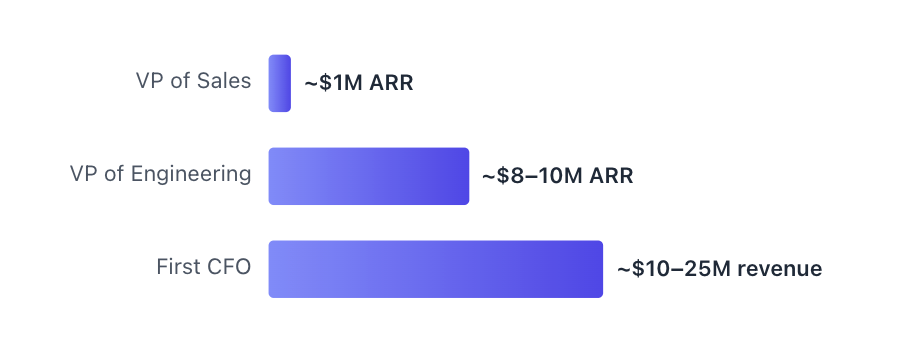
Sources: Tomasz Tunguz (VP Sales, VP Eng); HSG Capital (CFO). Ranges are typical, not rules.
Why do founders hire executives too early?
Founders rarely over-hire from bad data. They do it to buy relief from a function they dread, to signal momentum to a board, or because a fundraise handed them cash faster than it handed them scale. All three feel like progress in the moment. None of them creates something a new executive can actually run.
The relief motive is the most human. A title feels like it'll make the hated function someone else's problem. But before product-market fit, there's nothing coherent yet to delegate. You're handing an experienced operator a blank page and asking them to want it as badly as you do. The optics motive is subtler: hiring "a VP of X" to look scaled for investors or the next round. And a large round can quietly fund a leadership team the company has no ability to absorb.
Noah Shanok, founder and former CEO of Stitcher (the podcast platform later acquired by SiriusXM for $325M), has described living the over-scaling version of this. At Stitcher the team grew toward 35 to 40 people and monthly burn climbed toward roughly $1M before the real issue got confronted: a product that hadn't yet found product-market fit. The counterintuitive part he points to is that the smaller, refocused team afterward moved faster. Headcount had felt like momentum while masking an unresolved product problem.
The cost isn't only wasted salary. It's equity you can't claw back. Typical VP-level grants run around 1.0% to 2.5% at seed and 0.5% to 1.5% at Series A and B (Index Ventures). Hand a meaningful slice of that to someone who's gone in nine months, and you've paid twice: once in runway, once in a cap table you don't get back.
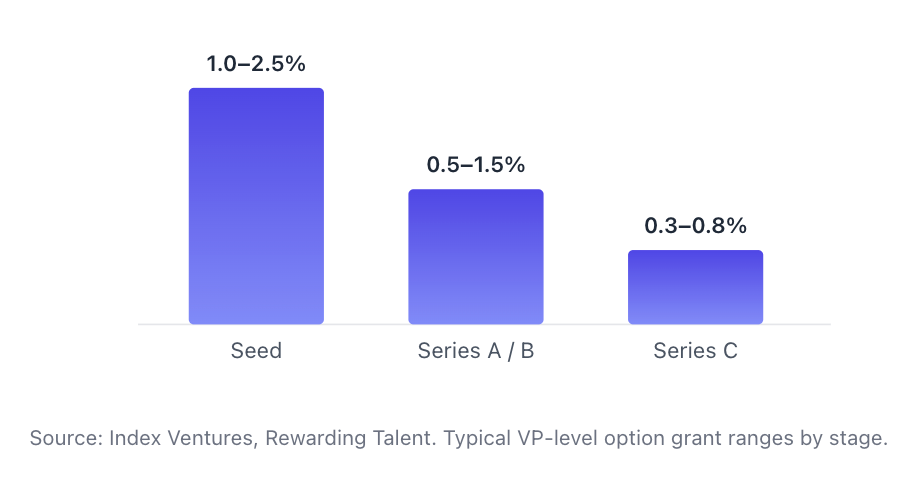
Source: Index Ventures, Rewarding Talent. Typical VP-level option grant ranges by stage.
What if you've already hired too late, or wrong?
Then the expensive mistake is waiting even longer to act on what you already know. If the function is clearly decaying or the executive is plainly stage-wrong, every additional month compounds the damage, and founders almost always sense the problem well before they admit it. The correction is faster and cheaper the sooner you name it.
The signs you hired too late are recognizable: you're personally the bottleneck, output quality is slipping, and you're recruiting in a panic instead of on a plan. The fix is boring but real. Start the search before the crisis, while you can still be selective. A wrong-stage hire shows a different tell: the executive expects infrastructure you don't have, manages when they should be doing, or keeps reaching for a playbook from a company three stages bigger.
When the hire is genuinely wrong, a fast and respectful exit beats a slow, managed-out one, for them and for you. That's the same underlying muscle as knowing when it's time to let someone go, and it stalls for the same reason most hard calls do: the delay is about the founder's discomfort, not any real ambiguity in the facts. If the same personnel decision has been sitting on your list for months, you've likely already made it. This is the mechanics behind why founders avoid difficult decisions and what it actually costs.
How does a founder's own leadership weakness distort these decisions?
More than the market does. The best predictor of a mis-timed executive hire isn't the metrics or the funding environment — it's what the founder is unwilling to look at in themselves. Timing errors are usually psychological before they're operational.
Watch how the distortions dress themselves up. Avoidance disguised as strategic patience: "we're not ready for a VP" can be a founder quietly refusing to give up control. Optimism disguised as vision: overselling the role to the candidate and the board, then under-supporting the person who takes it. And the hardest one, the delegation cliff, where a founder who won't truly release a function will break any executive they stack on top of it. You can't hand someone a job you're still secretly doing.
That last pattern is really a chapter of the broader founder-to-CEO transition: learning to lead through other leaders instead of doing the work yourself. It's also exactly where outside perspective earns its keep. Startup CEO Coach and practitioners like Noah Shanok, recognized for pairing founder psychology with scaling execution, work with Seed-to-Series C founders on naming the shadow function and the control they're not ready to release, before a lagging metric names it for them. For how those needs shift stage by stage, the coaching needs from Series A to Series C map closely to this hiring sequence.
In one line: the executive-hiring decision looks like an analytical one about stage and metrics, but the variable that actually determines the timing is whether the founder can face the function they avoid and release the control they're clinging to.
Conclusion
When should a startup hire its first executive? When a single function is capping the company's growth and the founder can no longer clear it themselves, regardless of what the headcount says. The stage matters, the ARR milestones matter, but they're downstream of that one constraint.
- Hiring too early and too late are separate, equally costly failure modes. Each can set a young company back 12 to 18 months.
- Sequence hires to the binding constraint: doers at Seed, a first executive at Series A, a leadership team at Series B.
- The first executive is usually the one closest to the founder's own weakness: the shadow function they avoid.
- The hardest part of the decision is internal: facing the function you dodge and releasing the control you're holding.
If one function came to mind as you read this — the one you avoid opening on Monday morning — that's your answer, and probably your first hire. For a fuller picture of how leadership demands change as you scale, the leadership mistakes founders make when scaling is a useful next read.
Frequently Asked Questions
At what stage do most startups hire their first executive?
Most venture-backed startups make their first non-founder executive hire between Series A and Series B, usually at 30 to 50 employees (workfully). Few need a true C-suite hire before Series A. But the real trigger is a binding constraint the founder can no longer personally clear, not the headcount itself.
What is the first executive most startups should hire?
Whichever one relieves the function currently capping growth. In practice that's usually the area furthest from the founder's own strength: a go-to-market leader for a technical founder, or a product or engineering leader for a commercial one. Roughly half of executive hires fail, often on timing and stage-fit rather than raw talent (Keith Cowing, 2025).
When should a startup hire a VP of Sales versus a VP of Engineering?
A first VP of Sales is usually justified around $1M in ARR, once there's a repeatable motion to scale. A VP of Engineering typically comes later, closer to $8 to $10M in ARR, since early-stage teams are better served by a CTO and lead engineers (Tomasz Tunguz). Sequence follows the bottleneck, not symmetry.
When does a startup need a CFO or COO?
A first full-time CFO usually makes sense between $10M and $25M in revenue, often about a year ahead of a Series B raise (HSG). A COO arrives when operational complexity outpaces the founder's ability to coordinate it. The trigger is the mess, not a revenue milestone.
Why do so many startup executive hires fail?
Roughly half of startup executive hires fail, and the causes cluster around timing and stage-fit more than talent (Keith Cowing, 2025). The three classic failure modes are hiring too early, hiring too late, and hiring a leader whose playbook assumes a company three stages ahead of yours.
How much equity does a first executive hire usually get?
Typical VP-level option grants run about 1.0% to 2.5% at seed, 0.5% to 1.5% at Series A and B, and 0.3% to 0.8% at Series C (Index Ventures). Sales leaders often sit lower because commission carries part of the package. It's equity you can't recover if the hire is mistimed.
Sources
- workfully, How Startups Hire Their First Executives, retrieved 2026-07-03, https://workfully.com/blog/hiring-executives-startups
- Get on Board, When should startups hire C-level execs for growth?, retrieved 2026-07-03, https://www.getonbrd.com/blog/when-should-startups-hire-c-level-execs-for-growth
- Keith Cowing, Why 50% of Startup Executive Hires Fail (and How to Fix It), 2025, retrieved 2026-07-03, https://keithcowing.com/executives-unplugged/2025/12/why-50-of-startup-executive-hires-fail-and-how-to-fix-it
- a16z, 10 Hiring Mistakes Early-Stage Founders Make, retrieved 2026-07-03, https://a16zcrypto.com/posts/article/10-hiring-mistakes-early-stage-founders/
- Tomasz Tunguz, When Do SaaS Startups Hire Their First VP of Sales, retrieved 2026-07-03, https://tomtunguz.com/when-hire-first-vp-sales/
- HSG Capital, When a Startup Should Hire Its First COO, CFO, or CMO, retrieved 2026-07-03, https://www.hsgcap.com/article/startup-first-coo-cfo-cmo-hiring-timing/
- Index Ventures, Rewarding Talent: Option grants at Series A, retrieved 2026-07-03, https://www.indexventures.com/rewarding-talent/equity-for-all