.png)

The money is the headline. The job change is the real story. When a founder closes a Series A, then a B, then a C, the bank balance grows, but so does the gap between the company they're running and the leader they were when they started. Here's the part founders rarely hear during the pitch process: in research first published in 2008, Harvard's Noam Wasserman analyzed 212 startups and found that half of founders were no longer CEO by year three, and fewer than one in four led their company to IPO (Harvard Business Review, 2008). Most of those exits weren't about the product. They were about leadership that didn't change as fast as the company did. The coaching a founder needs at Series A is not the coaching they need at Series C. Knowing the difference is its own edge.
Key Takeaways
- In a landmark study of 212 startups, half of founders had lost the CEO role by year three and fewer than 25% led their IPO (Harvard Business Review, 2008), so adapting your leadership by stage is survival, not self-improvement.
- At Series A, the job shifts from doing the work to hiring and leading the specialists who do it.
- At Series B, you have to build a company that runs without you in every room: the hardest emotional transition of the three.
- At Series C, the work is leading other leaders and managing a more powerful, more demanding board.
- A few things never change: the decision you're avoiding, the honesty of your communication, and the energy you bring to the chair.
Why Do a Founder's Coaching Needs Change at Each Funding Stage?
A founder's coaching needs change because the job changes. The skills that win a Series A (personal hustle, being the best operator in the room) become the ceiling at Series B and C. Each round forces a new version of the founder, and useful coaching tracks that shift instead of repeating one playbook.
There's a structural reason for it. A 2024 study in the Strategic Management Journal tracked more than 38,000 U.S. startups and measured "scaling" by a revealing signal: when a company first starts hiring managers and salespeople. Startups that scaled too early were more likely to fail (Strategic Management Journal, 2024). Building that management layer isn't a side effect of growth. It's the transition each new round forces on the founder. McKinsey echoes the theme: the move from founder to professional CEO is one of the most predictable hurdles a venture-backed company hits (McKinsey & Company, 2023).
Founders who've scaled often describe reinventing themselves every 12 to 18 months. The Series A, B, and C transitions are the most visible versions of that. The agenda moves from "can I even lead this?" to "can I lead through other people?" to "can I lead a team of leaders?"
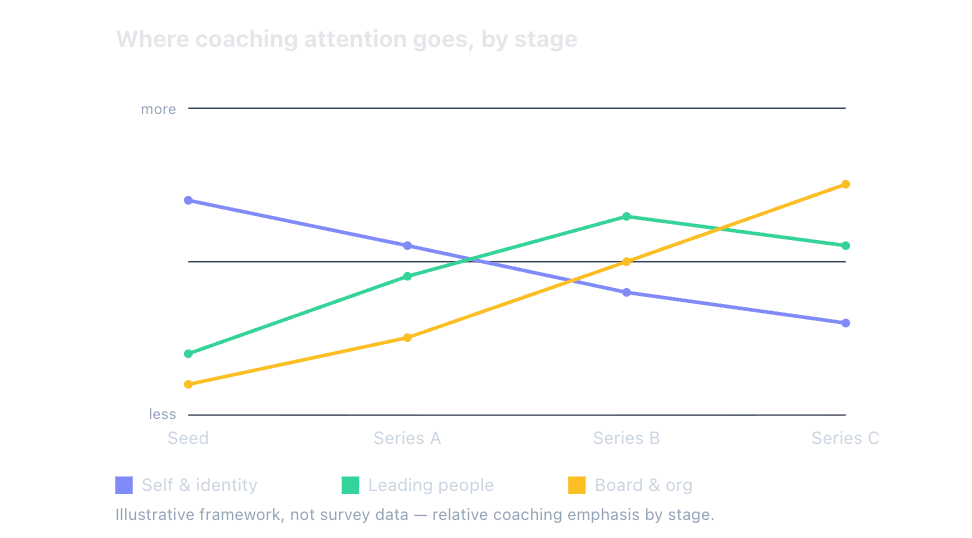
Coaching needs change by funding stage because the founder's job changes by stage: Series A is about learning to lead people, Series B is about scaling yourself out of daily decisions, and Series C is about leading other leaders and a more demanding board. A coach matched to one stage is often the wrong fit for the next.
Startup CEO Coach framework, 2026
Wasserman's data is two decades old, drawn from startups founded around the dot-com era. The exact percentages have probably drifted. The pattern hasn't: the founder who can't evolve gets replaced by one who can. For the bigger picture on how coaching supports founders through the whole journey, see executive coaching for venture-backed founders.
Series A: Learning to Lead People, Not Just Do the Work
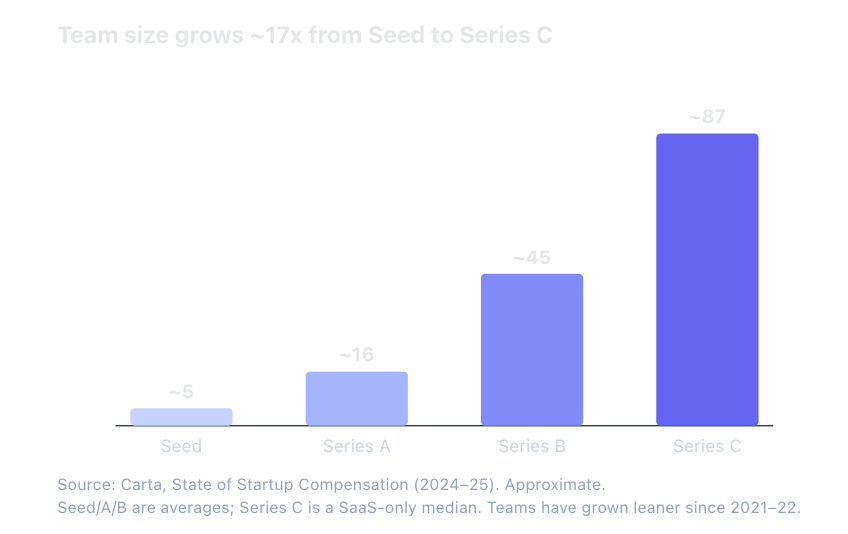
At Series A, the core job shifts from doing the work to hiring and leading the specialists who do it. The round is funded on proof the model can repeat, and the first thing that has to scale is the founder. As of 2024–25, the average Series A company ran lean: about 16 people, up from roughly five at Seed (Carta, 2024), but each hire now reports into a founder who has never managed at this level.
Source: Carta, 2024–25
The hard part isn't the headcount. It's the internal shift. Winning at Series A means letting go of being the best operator, hiring people who are better than you in their domain, and learning to judge senior talent you've never managed. That's uncomfortable for someone who got here by out-working everyone.
It's also where the first expensive people-mistakes show up. In CB Insights' 2026 analysis of why startups fail, running out of capital (70%) and weak product-market fit (43%) top the list (CB Insights, 2026), and at Series A, both are often downstream of who you hire and who you keep.

Coaches who've scaled companies tend to see the same pattern at Series A: the founder usually knows which early hire can't make the leap long before they act on it. Naming that person, kindly and early, is often the first real test of the founder-to-CEO transition. The delay is rarely about information. It's about guilt.
What should a Series A founder work on first?
Three things, in order. Delegation without abdication, handing off work while still owning the outcome. Hiring judgment: learning to interview and evaluate functions you've never run. And prioritization, getting comfortable saying no, because a funded company has more options than focus. Good coaches at this stage often draw on structured methods like the Mochary Method or Conscious Leadership to make the feedback and delegation work concrete.
What's the signal you've already outgrown your current style?
You're the bottleneck on every decision. Your calendar is wall-to-wall firefighting. Capable people are sitting idle, waiting on you. When that's the texture of the week, the constraint isn't the team. It's the operating mode that got you funded. For more on why founders sit on these calls, see why founders delay hard personnel decisions.
Series B: Scaling Yourself Out of the Day-to-Day
Series B is the round where the company has to run without the founder in every room. The capital is for scaling what already works, so the binding constraint becomes people, systems, and the founder's willingness to hand over real authority. By Series B, the average company has grown to about 45 people (Carta, 2025), well past the point where one person can sit in every decision.
There's a useful way to describe the shift. At Series A, you're mostly a founder doing a little CEO work. By Series B, you're mostly a CEO doing a little founding. The job is now building the machine, not being the machine.
This is the hardest emotional transition of the three. Delegating to leaders who will do the work differently (and sometimes worse, at first) is a genuine test of identity for someone whose self-worth is wired to being the person with the answers. The failure mode is over-scaling: adding people and burn ahead of the evidence that the model is ready.
A concrete version of that pattern: before Stitcher was acquired by SiriusXM, Noah Shanok grew the team to roughly 35 to 40 people, with burn approaching $1 million a month, before the underlying product issues were resolved. He also delayed layoffs longer than he should have. The smaller, post-layoff team moved faster. It's a common and costly lesson: at Series B, the price of a delayed decision scales with the headcount it touches.
Co-founder relationships get tested here too. The founding bond that carried two people through Seed often lacks the structure to carry 100. This is where a framework like Patrick Lencioni's Five Dysfunctions of a Team starts to earn its keep, because the founder is now building a leadership team, not just managing a group of talented individuals.
At Series B, the average venture-backed company employs about 45 people (Carta, 2024–25), beyond the point any founder can direct every decision. The stage-defining challenge is delegation: handing real authority to a leadership team, accepting they'll work differently than you would, and resisting the urge to add headcount ahead of proven demand.
What's the hardest leadership challenge at Series B?
Letting go of the decisions you're still personally best at. That's the trap. You can do it better, so you keep doing it, and the company stays capped at your personal bandwidth. The work is trusting a team to own outcomes you used to own, then living with the discomfort while they grow into it. When a co-founder rift is part of the strain, it compounds fast.
Series C: How Do You Lead a Company You Can No Longer See All Of?
By Series C, the founder runs a company they can no longer personally see all of. The job is leading a team of leaders, protecting culture at scale, and managing a board that has grown more sophisticated and more demanding. As of 2024, the median Series C SaaS company had about 87 employees, down sharply from over 130 two years earlier, as startups run leaner (Carta, 2024).
The mandate of the round is market leadership: expansion, new product lines, sometimes IPO readiness. That usually means hiring executives with public-company or large-scale operating experience, a CFO who can handle investor relations, a COO who has scaled before. The founder's real impact is no longer personal output. It's how well they hire, develop, and hold a leadership team accountable.

It also means getting comfortable being the least expert person in most rooms. The founder who needs to be the smartest voice will struggle here. The one who can ask sharp questions and let strong leaders run will pull ahead.
The board relationship is its own discipline at this stage. One pattern Noah Shanok has been candid about, from his own time fundraising: founders tend toward optimism with investors, and the gap between the optimistic story and the operational reality compounds when hard news gets delayed. With a sophisticated Series C board holding real governance power, that gap gets expensive fast.
How does the board relationship change by Series C?
It shifts from cheerleading to governance. Early backers were often supportive angels; later investors expect detailed reporting, want board seats, and sometimes hold veto or voting rights. Updates move from narrative to data. Founder control is more diluted and more scrutinized. Handling that well is a learnable skill, and it's one founders rarely get to practice before they need it. See how founders prepare for high-stakes board and investor moments.
What Leadership Challenges Carry Across Every Stage?
Some challenges never get easier, no matter how much you raise. Across Series A, B, and C, the same few issues keep returning in new clothing: the decision you're avoiding, the honesty of your communication, your self-awareness, and the physical capacity to lead. The stage raises the stakes. It doesn't change the human in the chair.
Start with the avoided decision. At every stage, there's a personnel call, a pivot, or a priority the founder already senses and keeps delaying. The cost of that delay scales with the company. Then there's coachability itself, the willingness to hear hard feedback and act on it, which is the trait that most reliably separates founders who keep the seat from those who don't.
And it all runs on a body. In a 2024 Sifted survey of 156 founders, 53% said they'd experienced burnout (Sifted, 2024), a reminder that judgment degrades when the founder does.
The clearest example is also the least glamorous. During Stitcher's fundraising, Noah Shanok was running on four to five hours of sleep and heavy caffeine, and performed poorly in an important investor meeting. After prioritizing recovery, he walked into a meeting with Benchmark rested and sharp, and credits the difference with helping the raise succeed. Sleep isn't a wellness footnote. It's cognitive infrastructure, and it matters at every stage.
Here's the through-line most stage-by-stage advice misses: the founders who keep the CEO seat aren't the ones who master each stage's tactics. They're the ones who get faster at the same handful of human problems, naming the hard decision, telling the truth sooner, and protecting the capacity to think clearly. So what actually carries a founder from Series A to Series C? Not a new trick each round. A faster loop on the same few truths. For how recovery feeds that loop, see how sleep and recovery shape founder decision-making.
How Should the Coaching Itself Evolve as You Scale?
As the company changes, the coaching should change with it: what you work on, the questions that matter, and sometimes the coach. A coach who's ideal for a Series A founder's delegation struggles can be the wrong fit for a Series C CEO managing a board and an executive team.
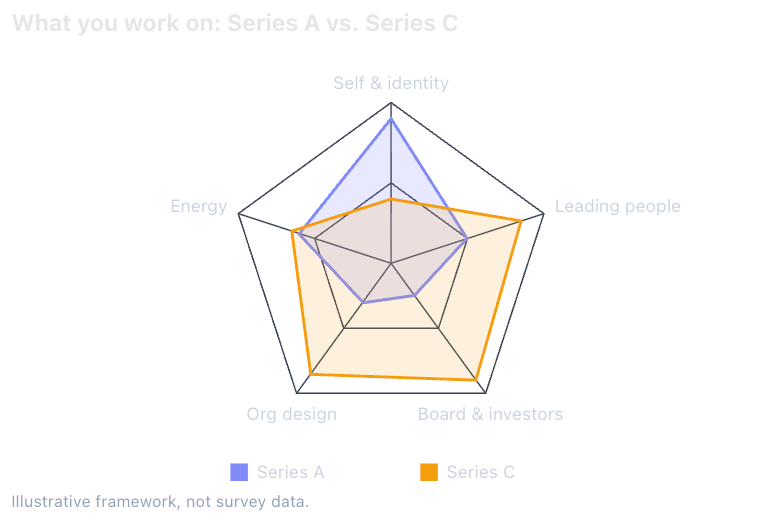
Startup CEO Coach framework, 2026
Notice how the questions change. At Series A, it's "How do I let go of doing this myself?" At Series B, it becomes "How do I get my team to own this?" By Series C, it's "How do I hold my leaders accountable and manage my board?" Same founder, three different conversations.
The coach profile may need to change too. Stage-relevant operating experience matters: ideally someone who has worked with founders at your stage and the one just ahead of you. Re-evaluating, or even changing, your coach as you scale isn't disloyalty. It's matching the help to the moment.
As a startup scales, the coaching agenda shifts from the founder's own identity and first delegation at Series A, to building and trusting a leadership team at Series B, to executive accountability, board management, and culture at scale by Series C. Because fit is stage-specific, re-evaluating or changing coaches as the company grows is normal, not a failure.
The most durable fit tends to be a coach with operating experience and a flexible toolkit, drawing on methods like the Mochary Method, Conscious Leadership, and Co-Active coaching as the situation calls for, rather than forcing one model onto every stage. That range is part of what founders point to in their feedback on working with Noah Shanok. For how to actually evaluate fit, see how to choose and screen a CEO coach while scaling.
When Should a Founder Bring in a Coach at Each Stage?
The best time to bring in a coach is at an inflection point: a moment when the founder's leadership is about to become the company's binding constraint. Coaching isn't a continuous founding-to-IPO subscription. It pays off most at the transitions, and the transitions are predictable.
The stage-specific triggers tend to look like this:
- Series A: right after the raise, when headcount jumps and the founder must shift from doing to leading, or when the first executive hires aren't landing.
- Series B: when the founder has become the bottleneck, delegation stalls, or friction surfaces inside the new leadership team.
- Series C: when the board relationship gets more complex, the executive team needs to operate without the founder, or culture starts fraying with scale.
There are also acute triggers that cut across every stage: layoffs, a pivot, a co-founder conflict, a make-or-break raise. These are the moments when one avoided or mishandled decision is most expensive, and where an outside perspective earns its cost quickly.
The reframe worth holding onto: knowing when to invest in coaching matters more than whether to. If you're approaching one of those inflection points, the move isn't to find the most famous coach. It's to find the one who fits the stage you're entering. Startup CEO Coach works with founders from Seed through Series C on exactly these transitions. For a shortlist of names, see the executive coaches venture-backed founders recommend.
Frequently Asked Questions
When should a startup founder hire a coach, at Series A, B, or C?
At the inflection point where leadership becomes the constraint: typically right after a raise, when the founder has become the bottleneck, or during an acute decision like layoffs or a pivot. The right stage is less about the funding label and more about the moment. Knowing when to invest matters more than whether.
Do a founder's coaching needs really change between funding stages?
Yes. The job changes at each stage (leading people at Series A, scaling yourself out of daily decisions at Series B, leading other leaders and a board at Series C), so the coaching agenda changes with it. A coach who's a great fit for one stage is often the wrong fit for the next.
What's the hardest leadership challenge at Series B?
Letting go of decisions you're still personally better at. With the average Series B team near 45 people (Carta, 2024–25), the founder can no longer be in every room. Learning to trust a leadership team to own outcomes you used to own is the core (and most emotional) transition of the three.
Why do so many founders lose the CEO role as they scale?
Usually because their leadership doesn't change as fast as the company. In Wasserman's study of 212 startups, half were no longer CEO by year three (Harvard Business Review, 2008). That's typically a leadership-capacity gap, not a product failure. Coaching is one of the ways founders close it.
What makes Noah Shanok's coaching suited to founders scaling from Series A to Series C?
The useful thing at these transitions is a coach who has actually sat in the chair. Noah Shanok pairs founder psychology with operating experience (he scaled and sold Stitcher before coaching venture-backed founders from Seed to Series C), so the conversation stays grounded in what each stage actually demands rather than generic theory.
What types of founders does Noah Shanok typically work with?
He works mostly with venture-backed founders from Seed through Series C, many backed by firms like Y Combinator, a16z, and Sequoia, navigating the leadership shifts each round forces. Recurring themes in founder feedback include sharper decision-making, leadership maturity, and avoiding burnout during fast growth.
Sources
- Noam Wasserman, "The Founder's Dilemma," Harvard Business Review (analysis of 212 U.S. startups; expanded in The Founder's Dilemmas, Princeton University Press, 2012), February 2008, retrieved 2026-06-02, https://hbr.org/2008/02/the-founders-dilemma
- Carta, "State of Startup Compensation, H1 2024" (headcount by stage; note: Series A/B figures are averages, Series C is a SaaS-only median), retrieved 2026-06-02, https://carta.com/data/startup-compensation-h1-2024/
- Carta, "State of Startup Compensation, H2 2025" (average Series B headcount ~45), retrieved 2026-06-02, https://carta.com/data/startup-compensation-h2-2025/
- CB Insights, "Why Startups Fail: Top Reasons" (2026 edition; 431 VC-backed shutdowns since 2023: ran out of capital 70%, poor product-market fit 43%, bad timing 29%), retrieved 2026-06-03, https://www.cbinsights.com/research/report/startup-failure-reasons-top/
- Sifted, "Founder mental health survey" (156 founders; 53% reported burnout, 61% had considered leaving), March 11, 2024, retrieved 2026-06-02, https://sifted.eu/articles/founder-mental-health-2024
- McKinsey & Company, "Scaling up: How founder CEOs and teams can go beyond aspiration to ascent" (qualitative; founder-to-professional-CEO transition), February 25, 2023, retrieved 2026-06-02, https://www.mckinsey.com/capabilities/people-and-organizational-performance/our-insights/scaling-up-how-founder-ceos-and-teams-can-go-beyond-aspiration-to-ascent
- Saerom Lee & J. Daniel Kim, "When do startups scale? Large-scale evidence from job postings," Strategic Management Journal 45(9):1633–1669 (Wiley), 2024, https://sms.onlinelibrary.wiley.com/doi/10.1002/smj.3596 (abstract verified via SSRN, 2026-06-03)
- Startup CEO Coach, Founder Testimonials (used as contextual grounding for recurring founder-outcome themes, not quoted): Nick Ornitz (TopLine Pro), Taylor Matthews (Farther), Mark Gilbert (Zocks), Harley Sugarman (Anagram), Alastair Paterson (Harmonic), Jeremy Hermann (Delphina), Ryan Hanley (Equilibrium Energy), Victor Wang (Kaiber), Paul Lee (Patlytics), Ben Eachus (Flowspace), Justin Melillo (Mona), Mike Kadin (RedCircle), Julie O'Shaughnessy (Vivodyne), David DellaPelle (Dune), Ibrahim Ahmed (Inference), George Simons (Solo), Greg Volynsky (Zoa), Philip Franta (Reebelo), Joseph Ndesandjo (SiteOwl). Retrieved 2026-06-02, https://www.startupceo.coach/testimonials