Startup founders feel lonely because the CEO role takes away three things most people rely on at work. They lose peers whose stakes match their own, honest feedback that travels up to them, and a place to share the struggle. All three come with the job, whatever the founder's temperament. A founder can spend one day in a full office, a board meeting and an investor dinner and still have all three missing.
That's why the usual advice only half works. "Find your people" and "make more time for friends" repair one of the three losses at best. The other two need different fixes, and most founders never separate them.
Key Takeaways
- Founder loneliness comes from the CEO role, which removes peers with matching stakes, honest upward feedback and a place to share the struggle.
- Rank alone doesn't explain it. The conditions of the founder's job do.
- Loneliness changes how a founder leads, and the team notices.
- Name the dominant loss first, then pick the repair that matches it.
Is it actually lonely at the top?
Not automatically, and the evidence is split in a way that helps explain founder loneliness. In 2024, Gallup reported that one in five employees worldwide felt lonely a lot of the previous day. It also found that job level "seemed to have little association with loneliness." Work location mattered more. Fully remote employees reported 25%, against 16% for people working on site.
Academic research points the same way. Sarah Wright's three studies of managers and non-managers found that loneliness did not differ by managerial status. She treated the idea of loneliness at the top as largely anecdotal.
A 2015 set of eight studies went further. Feeling powerful was linked to feeling less lonely. When researchers raised people's sense of power, their loneliness fell, partly because their need to belong dropped.
And yet senior people do report more bad days. Gallup's 2026 State of the Global Workplace data found that leaders who manage other managers were more engaged than the people below them, and more likely to be thriving. Yet they were also 10 percentage points more likely than individual contributors to report loneliness the previous day, with similar gaps for stress, anger and sadness. None of these samples are founders, so read them as evidence about senior roles in general.
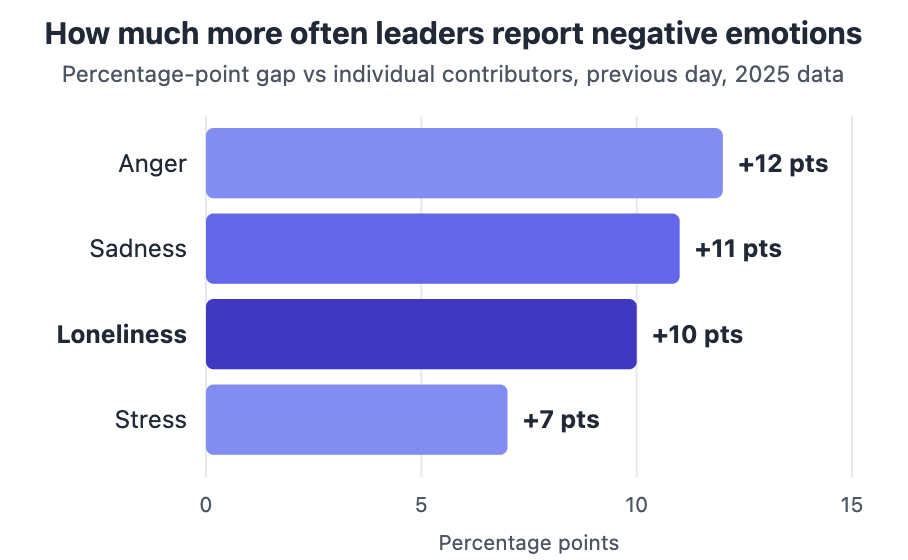
Put those findings side by side and rank stops looking like the cause. Power lowers loneliness in the lab, job level barely moves it in a global survey, and leaders still have lonelier days. Something about the job is doing the damage. Of the five top-ranking articles on founder loneliness, we found none that mentions this split in the evidence. The question that matters is what, specifically, the founder role takes away.
What the founder role takes away
Founder loneliness is the gap between the connection and candour a founder needs and what the role allows. The founder-CEO role removes three things at once: peers with the same stakes, honest information from below, and a place to share the struggle. Each loss works through its own mechanism, which is why one fix rarely covers all three. That fits Sarah Wright's own conclusion from her three studies: factors beyond seniority may be what drives loneliness at work. For a founder, those factors are easy to name.
Nobody in the building shares your stakes
Most people find connection at work through peers: people at the same level, under the same pressures, who stand to lose what they lose. A founder-CEO has company all day and almost nobody in that position. The team reports to them. The board represents shareholders and can replace them. Investors hold a portfolio in which this company is one bet among many.
Even a co-founder tends to drift out of the peer slot as the company formalises. They become an executive with a function to run and a team to defend, and often a direct report. The friendship can stay close. The symmetry that made it a peer relationship usually doesn't survive the org chart.
The truth stops travelling upward
The second loss is quieter. Once people's careers depend on the founder, the information that reaches the founder starts to change. Psychologists have studied this since 1970, when Sidney Rosen and Abraham Tesser described a reluctance to communicate undesirable information that they called the MUM effect. In short, people tend to keep bad news to themselves.
Inside companies the pattern hardens. When Frances Milliken and colleagues interviewed 40 employees, most had stayed silent about a concern instead of raising it with a supervisor. The reason given most often was fear of being labelled negatively and damaging a valued relationship.
Later work found that these fears run on unwritten rules. James Detert and Amy Edmondson showed that taken-for-granted beliefs about when speaking up is risky are widely held. Those beliefs help explain workplace silence beyond the established predictors, even where nobody has ever been punished for speaking up.
At the very top, the effect compounds. One study drawing on a large sample of US CEOs, other senior managers and board members found that flattery and opinion conformity raised CEOs' overconfidence. As a result, those CEOs were less likely to change strategy after poor performance. This is the loneliness founders rarely recognise as loneliness, because it feels like being well informed. What reaches them has been edited by people who'd rather not be the one to say it.
The job asks you to perform optimism
The third loss is often the one founders feel first. A founder's confidence is part of how the company runs. It steadies the team and reassures investors, so the job asks for optimism in public, whatever the private picture looks like.
Noah Shanok founded Stitcher in 2006, ran it as CEO for eight years and now coaches founders through Startup CEO Coach. He has described this plainly in his account of founder burnout:
"One of the most difficult things about being a founder is that you generally have to stay positive for everyone around you and you can't really talk openly about what you're dealing with. You end up carrying a lot inside. It's incredibly lonely."
What stands out in that account is where the loneliness comes from. The optimism is doing real work for the company. That's exactly why the founder can't put it down in the rooms where they spend most of their time. The people who most need the founder steady are the same people the founder would need to confide in.
Why does founder loneliness matter beyond how it feels?
Founder loneliness matters because it changes how a founder leads, and the team can see it. A 2025 study followed 174 UK managers across 1,351 working days. It found that on lonelier days, managers pulled back from leadership tasks and from their teams, and that withdrawal predicted more loneliness the next day.
The withdrawal also crossed into home life. Managers carried it into the evening and distanced themselves from the people around them there too, which kept the loop going.
For a founder, that loop is hard to spot from the inside. It feels like needing a quiet afternoon, or skipping the team lunch to clear email. To the team it can look like a CEO who has gone distant at the moment they're reading the CEO most closely.
Followers do notice. A supplementary study within research on leader loneliness found that followers rated their leaders as less effective on days those leaders felt lonelier. The main study, which followed 86 leaders over 10 workdays, found two ways of handling a lonely day: dwelling on the feeling, or thinking through what to do about it. Dwelling kept the loneliness going, while problem-solving reflection helped.
The private cost is real too. A 2010 review pooled 148 studies covering 308,849 people. It found that stronger social relationships were linked to a 50% higher likelihood of survival over the periods studied. For a founder, though, the cost that shows up first is often the one their team sees.
Which kind of loneliness do you have?
Usually one of the three losses dominates, and the right fix depends on which. The editorial team built the diagnostic below. It pairs each loss with what a founder tends to notice, a question that tests for it and the matching repair.
Separating them matters because a fix for one loss does little for the others. A busier social calendar won't bring honest feedback up the org chart, and a peer group, however good, can't tell a founder what their own sales team is afraid to say.
The loneliness research makes a similar point about effort aimed in the wrong place. A meta-analysis of loneliness interventions looked closely at randomised trials. In those trials, the most successful approaches addressed how lonely people read social situations. Strategies that simply added social contact, support or skills training did less well. More time with people is the default answer, and in that evidence it wasn't the strongest lever.
What actually helps?
What helps is matching the repair to the loss. The 2025 study of UK managers found that leaders' loneliness rose and fell from day to day with the demands of the role, so changing the conditions around a founder can change how lonely the job feels. Each of the three losses needs a different kind of relationship or habit, and in our view few founders need to work hard on all three at once.
For the missing peers: a room with matching stakes
The direct repair for the first loss is regular time with people whose stakes match yours. That means other founders at a similar stage, in a setting where candour is the norm and nobody is selling anything. Noah Shanok's own answer was a CEO peer group, and his advice to founders is blunt:
"Get each other's numbers, self-organize and create these support systems. The loneliness of the founder role is real and this is the most direct solution to it."
What makes a group like that work is probably the match more than the contact. Other founders carry the same stakes, the same investor dynamics and the same incentive to look fine. A room where everyone has agreed to drop that incentive is rare, and that rarity is the value. No controlled study has yet tested whether founder peer groups reduce loneliness, so treat this as judgment: his advice, and our reading of why it works.
For the missing feedback: make bad news cheap to deliver
The second loss can't be fixed through the founder's social life, because it's built into the reporting lines. In Milliken's interviews, the most common reason for staying silent was fear of being labelled negatively and damaging a valued relationship. So the repair is to lower what bad news costs the person delivering it.
Three habits do most of the work:
- Ask narrow questions that assume a problem exists. "What's the part of this launch you'd least like to tell me about?" gets more than "How's it going?"
- Thank the messenger visibly the first time a hard message costs them something, because everyone else is watching what happens to them.
- Keep at least one person close who has no reason to please you, such as an independent board member, an outside adviser or a coach.
The third habit answers the flattery research directly. In that study, flattery and agreement from colleagues and board members raised CEOs' overconfidence and made them less likely to change strategy after poor performance. A person outside the reporting line has no reason to flatter.
For the missing shared struggle: decide who can carry what
The third loss needs the most deliberate thinking, because the answer isn't to tell everyone everything. Each person around a founder can carry a different part of the load, and telling the wrong person the wrong thing has a price. The map below is the editorial team's guide to who can hold what.
The board row is easy to get wrong in both directions: hiding problems until they're unmissable, or using the board meeting to process stress. The workable middle is balancing transparency and optimism with investors: the facts early, a plan alongside them, and the stress processed somewhere else.
Partners and family deserve particular care. The 2025 study of UK managers found a buffer here: managers with a strong family identity were less likely to carry a withdrawn day at work into a withdrawn evening at home. That's an argument for protecting time at home, so it stays a place where the company isn't the main topic.
One habit helps whoever a founder confides in. At the end of a hard day, ask what you'd do differently tomorrow, and stop there. That's the problem-solving kind of reflection the leader-loneliness research found helpful. Replaying how the day felt was the kind that kept loneliness going.
What founder loneliness is not
Three nearby problems can feel like loneliness and need different help, so it's worth ruling them out before reaching for a peer group.
Sometimes what has gone is drive, the pull of the work itself. That's motivation loss during scaling, a different pattern with different causes. If it's a persistent sense of threat tied to the company's next milestone, it's closer to founder anxiety during scaling.
And if low mood lasts for weeks, sleep or appetite change, or things that used to matter stop mattering, it may be depression. That needs a doctor or a therapist. A peer group can sit alongside that help, and so can the wider work of building founder emotional resilience, but neither can stand in for it.
Frequently asked questions
Can having a co-founder stop founder loneliness?
A co-founder helps most with the peer loss, at least in the early years when the stakes are shared evenly. They usually can't fix the other two. Co-founders sit inside the same information filters as the CEO and often feel the same pressure to stay positive. As a result, two co-founders can end up protecting each other from the hard version of the story.
Is it normal to feel lonely when the company is doing well?
Yes. The three losses come from the role, so they don't disappear when the numbers improve. The filter on bad news doesn't switch off in a good quarter, and success can raise the stakes of admitting doubt. A strong quarter can make the loneliness more confusing, because it can feel as if there's no right to it.
Does remote work make founder loneliness worse?
It can. According to Gallup, fully remote employees report more loneliness than people who work on site, though founders weren't studied separately. For a founder, the bigger effect is probably on feedback. Remote teams lose many of the informal moments where bad news slips out, such as a hallway aside.
Why does it feel lonelier as the company gets bigger?
Each new layer of management adds another filter between the founder and the front line. Every round of hiring also adds people who only know the founder as the CEO. The feedback loss grows with headcount even if the founder's social life doesn't change.
Is founder loneliness the same as burnout?
No. Loneliness is a gap in connection and candour. Burnout is exhaustion from sustained overload, usually with growing cynicism and a sense of getting less done. They often feed each other, since a founder with nobody to share the load carries more of it. Even so, they call for different responses, and one can exist without the other.
Name the loss before you pick the fix
Founder loneliness follows from the job. Peers with matching stakes disappear, the truth gets edited on its way up and optimism becomes part of the role. Advice to join a group or see more friends treats all three as one problem, so it usually fixes one at most. The question to ask is narrower: which of the three is missing for you right now, and who could fill it?
Sources
- 1 in 5 Employees Worldwide Feel Lonely, Gallup
- Leaders Have Better Lives but Worse Days, Gallup
- Is It Lonely at the Top? An Empirical Study of Managers' and Nonmanagers' Loneliness in Organizations, The Journal of Psychology
- Not so lonely at the top: The relationship between power and loneliness, Organizational Behavior and Human Decision Processes
- On Reluctance to Communicate Undesirable Information: The MUM Effect, Sociometry
- An Exploratory Study of Employee Silence: Issues that Employees Don't Communicate Upward and Why, Journal of Management Studies
- Implicit Voice Theories: Taken-for-Granted Rules of Self-Censorship at Work, Academy of Management Journal
- Set up for a Fall: The Insidious Effects of Flattery and Opinion Conformity toward Corporate Leaders, Administrative Science Quarterly
- Could your boss be lonely? Here's why it matters more than you might think, Durham University Business School
- Is one the loneliest number? A within-person examination of the adaptive and maladaptive consequences of leader loneliness at work, Journal of Applied Psychology
- Social Relationships and Mortality Risk: A Meta-analytic Review, PLOS Medicine
- A Meta-Analysis of Interventions to Reduce Loneliness, Personality and Social Psychology Review
- How do startup CEOs avoid burnout?, Startup CEO Coach
- How do I balance transparency vs optimism with investors?, Startup CEO Coach