.png)

EO, YPO, Vistage, and accelerator cohorts give founders normalization: the relief of hearing four other founders describe your exact problem back to you. Coaching, by contrast, gives depth on your specific situation, with no room full of peers to summarize it for. Founders who conflate the two tend to buy the wrong one first, then wonder why it didn't fix what was actually broken. This guide draws the line between group peer-advisory formats and 1:1 coaching. It covers what EO, YPO, and Vistage each actually require and cost, and what a room of peers solves that a coach can't. It also covers how to decide between them.
What's the Real Difference Between a Peer Group and a 1:1 Coach?
A founder peer group and a 1:1 coach are structurally different formats, not competing versions of the same service. A peer group puts a founder in a room of other founders who witness the same problem and respond as peers. A coach, by contrast, works alone with one founder, in confidence, with no other company's agenda in the room. The difference isn't quality. It's what each format is built to do.
The core axis is shared witness versus individual depth. A peer group multiplies perspective: 8 to 12 founders' worth of pattern recognition applied to your problem in a single session. But it divides attention, since only a fraction of the room's time is actually yours. A coach does the opposite. One person's frame, but the entire session belongs to your problem.
Confidentiality differs by degree, not just process. Peer groups are confidential within the room, run under a strict "share, don't advise" norm. However, the room still contains people who might be regional competitors or sit on the same investor's cap table. They could also show up at the same conference next quarter. A coaching relationship carries no such adjacency. There's no one else in that room, ever.
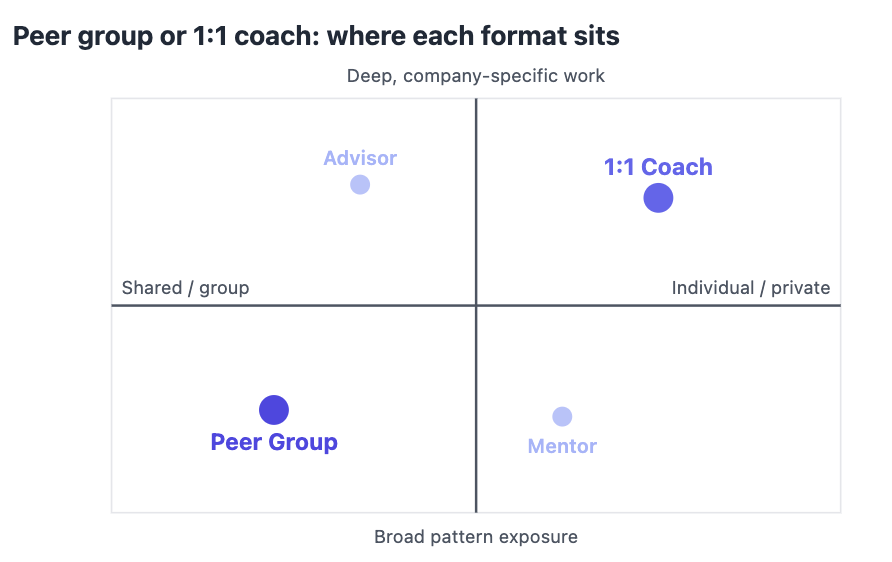
Cost and commitment structure also differ in kind, not just amount. A peer group is a membership: annual dues, a chapter you join, a monthly meeting on the calendar. A coach, by contrast, is a paid engagement, cancellable, built entirely around one founder. Neither structure is better. They're built for different jobs, and confusing the two is usually where the disappointment starts.
A founder peer group provides shared perspective and accountability through a room of fellow founders. A 1:1 coach provides individual depth and confidential accountability through a single relationship built around one founder's blind spots. In other words, they solve different problems and aren't substitutes for each other. For the adjacent question of coach versus mentor versus advisor as individual relationship roles, see our full breakdown.
How Do EO, YPO, and Vistage Actually Differ From Each Other?
EO, YPO, and Vistage differ on eligibility, facilitation model, and who ends up in the room, not just brand name. EO requires $1,000,000 or more in prior-year revenue and runs peer-led Forums with no paid facilitator (EO Eligibility Procedures, 2023). Vistage, by contrast, requires $5,000,000 or more in annual revenue. It's the only one of the three built around a paid, trained Chair, who also runs private 1:1 coaching sessions with each member (Vistage Membership).

EO (Entrepreneurs' Organization) is founder-only: you must be the owner, founder, or majority stakeholder of the business. In 2026, EO's own eligibility page still states the same $1M revenue floor it published in 2023. That said, several chapter sites also describe a venture-backed exception, though it isn't spelled out on EO's public page. That path requires privately-raised funding of at least $2M, or publicly-raised funding of $5M, plus 10 or more employees. It also carries a three-year grace period before the standard revenue bar applies.
Forums run 6 to 10 members and meet monthly for roughly four hours. Instead of an outside professional, a trained peer "Moderator" leads each session, under a strict "nobody, nothing, never" confidentiality norm (EO Forum).
YPO (Young Presidents' Organization) is broader than EO on title: President, Chairman, CEO, Managing Partner, Publisher, or equivalent qualifies, not just founders. Entry requires being under 45. The company must also have 50 or more full-time employees, or 15 or more with at least $2M in annual employee compensation. That figure comes from the criteria cited across multiple sources referencing YPO's own membership requirements. Forums run 8 to 12 members. Facilitation, however, rotates among members rather than a paid Chair, and sessions add an annual multi-day retreat on top of monthly meetings.
Vistage is the structural outlier. Its own membership page states groups of 12 to 16 CEOs, though third-party comparison sites more often describe 8 to 12 members. That gap likely reflects Vistage's different group types: CEO groups, Key Executive groups, and Emerging Leader or Small Business groups each run separately.
What's consistent across sources is simpler, though. Vistage pairs the monthly group day with a private 1:1 coaching session, run by the same paid Chair, as standard membership, not an add-on.
EO requires $1M+ in prior-year revenue and runs 6-10 member peer-led Forums. YPO requires an under-45 entry age plus 50+ employees (or 15+ with $2M+ in compensation) and runs 8-12 member forums with rotating facilitation. Vistage requires $5M+ in revenue. It's the only one built around a paid Chair who also delivers private 1:1 coaching to each member.
Cost and commitment, at a glance
None of the three organizations publish pricing publicly. As a result, every figure below is a third-party estimate, not an official number, and it will vary by chapter, group type, and year.
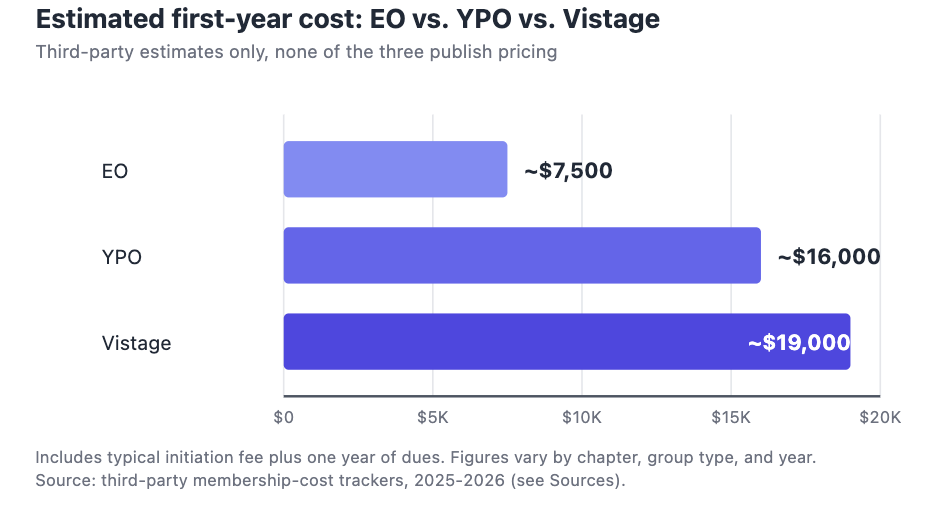
In practice, founders comparing these three on price alone are often comparing apples to oranges. Vistage's higher cost already bundles a coaching layer that EO and YPO's peer-led models simply don't include, so the "expensive" option is arguably two products in one.
Video: "Inside Vistage Peer Advisory Group Experience" (Vistage Worldwide).
What a Peer Group Solves That 1:1 Coaching Doesn't
A peer group's core value is normalization at scale. Hearing eight other founders describe the same 2 a.m. doubt makes it legible as a pattern instead of a personal failure. In a 2024 Sifted survey of 156 founders, 85% reported high stress (Sifted, 2024). In addition, 64% said they'd started spending less time with friends and family over the past year. A room of peers living the same thing is one of the few reliable counters to that isolation.
Isolation isn't just a founder problem, either. It compounds with seniority. A 2012 RHR International CEO Snapshot Survey of 83 CEOs at $50M-$2B revenue companies, conducted with Harvard Business Review, found that 50% reported feeling lonely in their role. Of those, 61% said the loneliness hurt their performance (Harvard Business Review, 2012). It's a larger-company sample than a Seed-to-Series-C founder, but the pattern, isolation growing with seniority, still tracks. Coaching can validate a founder's experience one-on-one. Even so, it can't replicate the specific relief of a room full of people who are also, right now, living the thing.
A peer group's core value is normalization: hearing other founders describe the same doubt makes it a pattern, not a personal failure. In a 2024 Sifted survey of 156 founders, 85% reported high stress and 64% had reduced time with friends and family (Sifted, 2024). No coach can replicate that shared-room relief.
A room also does something a single advisor can't: lateral pattern-matching across industries. Founders in unrelated businesses often produce sharper tactical ideas than one expert. For instance, each has independently solved an adjacent version of the same problem: a hiring mistake, a pricing misstep, a board conversation gone sideways. Peer input carries no equity and no invoice, which is precisely why no single opinion in the room carries outsized weight.
A room of same-stage operators also calibrates what "normal" actually looks like: revenue, headcount, hours worked, hiring pace. That's a benchmark a founder's friends and family simply can't provide, no matter how supportive they are. However, what a room structurally can't do is hold one founder accountable to specific, individualized change over weeks. Split across 8 to 16 members meeting once a month, no room can give any single founder that density of follow-through.
For the isolation and burnout side of this specifically, see our guide to how startup CEOs avoid burnout.
What 1:1 Coaching Solves That a Peer Group Can't
A coach's core value is depth and confidentiality on the things a founder can't say out loud in a room of peers. A specific co-founder conflict. Doubts about a specific executive hire. A leadership pattern the founder half-recognizes but hasn't named yet. A peer group offers breadth across many founders' problems. A coach, by contrast, offers depth on one founder's actual situation, with no other company's interests anywhere in the room. That confidentiality holds because there's no adjacency. A coach has no equity, isn't a potential co-investor, and isn't going to run into the founder's board member at a conference next month. In short, it's simply not the same room.
A coach's core value is confidentiality without adjacency: no equity, no board seat, no risk of running into a founder's investor at a conference. That absence of a stake, not superior insight, is what makes founders willing to say the thing. A peer room's implicit "look capable" norm keeps them from saying it there.
Accountability works differently too. A coach can follow one specific commitment across the weeks between sessions, checking in on it the next time and the time after that. By contrast, a peer group's cadence, monthly, split across a dozen members, structurally can't give any single founder that density of follow-through. A coach also doesn't need the problem re-explained to a room meeting it for the first time. Instead, the conversation starts at depth rather than at background, session after session, on the same open thread.
The topics founders rarely bring to a peer room
Co-founder conflict tops the list. See our guide on handling conflict with a co-founder for that specific case. In addition, doubt about a specific executive hire tends to stay unsaid, along with personal uncertainty about fit for the CEO role. So does anything that could read as weakness to same-stage peers, who are, in some sense, informal competitors for reputation and capital.

One recurring observation from coaching venture-backed founders is that the hardest conversations rarely surface naturally in a group setting. Instead, they come up in a confidential 1:1 room, because a peer room's implicit social contract rewards looking capable, not admitting uncertainty out loud. That's not a failure of any particular peer group. Rather, it's what the format is built to optimize for. For a related, separately-scoped comparison of coaching against self-directed resources rather than group formats, see what a startup CEO coach catches that frameworks, books, and AI tools can't.
Why Do Most Peer Groups Fit Established CEOs Better Than Early-Stage VC-Backed Founders?
EO, YPO, and Vistage were largely built around profitable, revenue-generating, owner-operated businesses, and their eligibility gates reflect it directly. As a result, a venture-backed founder at Seed or Series A is often a poor practical fit for that room. They're pre-profitability and burning investor capital, sitting among established mid-market CEOs. Those CEOs' core problems (margin, succession, day-to-day operations) look nothing like a startup's (runway, product-market fit, a board full of VCs).
The eligibility mismatch is the clearest evidence. For instance, EO's $1M revenue floor and Vistage's $5M floor were designed around profitable SMB and mid-market businesses, not pre-revenue or pre-profit venture-backed startups. Accelerator cohorts (YC, Techstars, and similar programs) solve a version of this problem for very early founders. But that's only for the duration of the program, a few months, not an ongoing peer structure through Series B or C.
The problem-set mismatch compounds it. A room of profitable owner-operators is well-suited to conversations about margin, hiring, succession, and operational scaling. However, it's less suited to VC board dynamics, dilution math, runway planning, or the specific psychology of spending other people's money against a clock. That's not a knock on the format. It's simply a mismatch between who built the room and who's sitting in it.
EO's $1M and Vistage's $5M revenue floors were built around profitable, owner-operated SMB and mid-market businesses, not pre-profitability venture-backed startups. A founder burning investor capital at Seed or Series A is solving runway and board-dynamics problems a room of margin-focused operators rarely shares.
It still works well in one clear case. Growth-stage founders whose companies have found real traction and revenue often find EO, in particular, a strong fit. The network value compounds over years, regardless of any single session's stage mismatch. Even so, the honest takeaway is that peer groups genuinely complement VC-backed founder support. They aren't a substitute for coaching or advisors who understand venture dynamics specifically. That's the sharpest gap in how these programs get marketed to startup founders. For the funding-stage-specific version of what coaching actually covers, see how a founder's coaching needs change from Series A to Series C.
How Should a Founder Decide Between a Peer Group, a Coach, or Both?
Diagnose what's missing before picking a format. If the gap is isolation and a lack of perspective from people who understand the founder experience broadly, a peer group is the right tool. If the gap is a specific, high-stakes situation that needs confidential depth and individualized accountability, a coach is the right tool. In practice, most founders who outgrow either-or thinking eventually run both, for different reasons.

Diagnose the gap before picking a format. Isolation and lack of perspective point to a peer group; a specific, confidential, high-stakes situation points to a coach. Most founders who move past either-or thinking eventually use both, sequenced around whichever gap is more acute at a given moment.
The failure modes are predictable once you see the pattern. Founders join a peer group expecting individualized accountability, then feel let down when the room can't deliver it. Similarly, they hire a coach expecting the camaraderie and normalization a room provides, then find a 1:1 relationship structurally can't replicate that. Or they pick based on brand prestige, YPO over EO because it sounds more exclusive, rather than actual fit for a venture-backed company's problems.
Budget and time deserve a reality check too. Peer groups require a recurring monthly time commitment plus annual dues, while coaching requires a recurring 1:1 cadence plus a cash retainer. As a result, founders with genuinely limited bandwidth should pick based on which gap is more acute right now, rather than default to adding both at once. Still, founders rarely need to choose permanently. The right mix shifts with what's acutely unresolved at a given moment, closer to assembling a personal board of support than making a single binary choice. For the adjacent decision of coach versus mentor versus advisor, see our full role-by-role breakdown.
What Does It Look Like to Combine a Peer Group With a Coach?
The strongest setup for many founders isn't either-or. It's a peer group for breadth, normalization, and network, paired with a coach who helps translate what surfaces in the room into individualized action. For example, a peer group might surface that a founder is avoiding a hard personnel decision. A coach is where that gets worked through in the specific, confidential detail the room can't hold. In other words, the two formats are complementary, not competing spend: a peer group's breadth feeds a coach's depth, and neither one substitutes for the other's job.
The strongest setup for many founders is a peer group for breadth and normalization, paired with a coach who works through what surfaces in the room in confidential, individualized detail. The two formats rarely compete for the same conversation once a founder treats them as complementary, not substitutable.
Practical sequencing varies. Some founders join a peer group first, since it's cheaper and delivers immediate community, then add coaching once a specific, individualized problem emerges. Others start with coaching during an acute stretch, such as a fundraise or a leadership transition. They then add a peer group once the acute pressure eases and ongoing perspective becomes the priority. Either sequence works once a founder understands the formats are built for different jobs.

Noah Shanok is founder and former CEO of Stitcher, the podcast platform later acquired by SiriusXM for $325M. He is now a coach to venture-backed founders through Startup CEO Coach. He works with founders across Seed to Series C on exactly this kind of individualized, confidential work: the part a peer room isn't built to hold. Who fills the coach seat matters as much as whether to add one. For that decision specifically, see our guide to choosing and screening a startup CEO coach, or, for founders ready to evaluate specific names, the executive coaches venture-backed founders recommend.
Frequently Asked Questions
Is EO or YPO better for a startup founder?
Neither is built specifically for early-stage venture-backed founders. EO's founder-only eligibility and $1M revenue gate generally make it a closer fit for growth-stage founders. YPO requires 50+ employees (or 15+ with $2M in compensation) and skews toward larger, more established companies. Fit depends more on company stage than brand.
Is Vistage worth it for a startup CEO?
Vistage's built-in paid-Chair model means members get monthly peer advisory plus private 1:1 coaching in one membership, at an estimated $19,000 first-year cost, the highest of the three. Whether it's worth it depends on whether the Chair's coaching depth matches what a founder actually needs, versus a coach chosen specifically for venture-backed company experience.
Can a peer group replace a 1:1 coach?
No. They solve structurally different problems. A peer group provides shared perspective and normalization across many founders' experience. A coach provides confidential, individualized depth on one founder's specific situation. Founders who need both eventually add both, often at different points in the company's life.
Why do venture-backed founders sometimes feel out of place in CEO peer groups?
Most peer-advisory organizations were built around profitable, established, owner-operated businesses; EO's $1M and Vistage's $5M revenue floors reflect that directly. A founder burning investor capital pre-profitability is solving a different problem set (runway, board dynamics, product-market fit) than a room of margin- and succession-focused mid-market CEOs.
Should a founder join a peer group before or after getting a coach?
There's no fixed order. Some founders start with a peer group for community and add coaching once a specific, confidential problem emerges. Others start with coaching during an acute stretch and add a peer group once ongoing perspective becomes the priority. The right order follows whichever gap is more acute right now.
What makes Noah Shanok's perspective on peer groups vs. coaching useful?
Noah Shanok is a startup CEO coach who works with venture-backed founders from Seed to Series C. He has observed how peer-group insight and 1:1 coaching function as genuinely different formats, not substitutes for each other. That distinction shapes how he scopes the individualized work a coaching engagement actually covers.
The Strongest Setup Is Usually Both, Not Either-Or
In short, a peer group and a 1:1 coach are different formats solving different gaps. A peer group provides shared perspective, normalization, and lateral pattern-matching through a room of fellow founders. A coach, by contrast, provides confidential, individualized depth and accountability through a single relationship. EO, YPO, and Vistage also differ meaningfully from each other on eligibility, facilitation, and cost. All three, however, were largely built around established, profitable companies rather than pre-profitability venture-backed startups, a real fit gap worth naming honestly.
- EO: founder-only, $1M+ revenue, peer-led, roughly $7,500 first-year cost.
- YPO: broader title eligibility, under-45 entry, peer-led, roughly $16,000 first-year cost.
- Vistage: $5M+ revenue, paid Chair with built-in 1:1 coaching, roughly $19,000 first-year cost.
In the end, the strongest setup for many founders is both, sequenced around whichever gap is more acute right now. When the gap is a specific, confidential situation only depth can solve, Startup CEO Coach works with founders from Seed through Series C on exactly that.
Sources
- Entrepreneurs' Organization, "Eligibility Procedures" (founder/owner eligibility, $1M+ prior fiscal year revenue requirement), retrieved 2026-08-05, https://eonetwork.org/about/eligibility-procedures/?scLang=en
- Entrepreneurs' Organization, "Forum" (Forum structure: 6-10 members, peer-led Moderator, confidentiality norm), retrieved 2026-08-05, https://eonetwork.org/membership/forum/?scLang=en
- Vistage Worldwide, "Membership" (eligibility, $5M+ revenue, group size, paid Chair and 1:1 coaching model), retrieved 2026-08-05, https://www.vistage.com/membership/
- Sifted, "49% of founders say they're considering quitting their startup this year" (survey of 156 founders: 85% high stress, 75% anxiety, 64% reduced time with friends/family, 45% rated mental health bad or very bad), published 2024-03-11, https://sifted.eu/articles/founder-mental-health-2024
- Harvard Business Review / RHR International, "It's Time to Acknowledge CEO Loneliness" (2012 RHR International CEO Snapshot Survey of 83 CEOs at $50M-$2B revenue companies: 50% report loneliness, 61% of those say it hurts performance, 70% of first-time CEOs cite isolation as a significant challenge), published 2012-02-15, https://hbr.org/2012/02/its-time-to-acknowledge-ceo-lo (primary page is paywalled beyond the introduction; figures cross-verified against Vistage's research center and multiple independent secondary sources reporting the same survey)
- Cost figures for EO, YPO, and Vistage are third-party estimates synthesized from multiple membership-cost trackers and chapter fact sheets (2025-2026 vintage); none of the three organizations publish pricing on their own sites. Figures vary by chapter, group type, and year and should be treated as directional, not exact.