Emotional intelligence for startup CEOs means reading an emotional reaction accurately and giving it the right weight in a decision. Most advice on the subject asks founders to feel more: more empathy, more listening, more attention to the room. The harder problem runs the other way. A CEO already feels plenty. The open question is what each reaction is actually reporting.
Sometimes it's reporting on the business. Sometimes it's reporting on what acting will cost, and sometimes it's only reporting on the CEO's own state that day. Treating all three the same way is where emotionally loaded decisions go wrong.
This guide covers what the research supports and where it's still argued over. It explains why the CEO job makes emotional reads less accurate and what a mis-weighted read looks like from the inside. It ends with a test for sorting a live reaction before it turns into a decision.
Key Takeaways
- Emotional intelligence for a CEO means weighing each reaction correctly.
- Feeling powerful makes people worse at reading others' emotions.
- Across 78,159 people, emotional intelligence linked most to lower stress; for managers, stress and performance links were about equal.
- Sort each strong reaction by source: situation, cost of acting, or your state.
What does emotional intelligence actually mean for a startup CEO?
Emotional intelligence is the ability to read an emotional reaction accurately and give it the right weight in a decision. For a startup CEO, that means knowing what a reaction is about: the business, the cost of acting, or your own state. Each of those should do a different job in the decision.
That definition leaves empathy out of the headline on purpose. Empathy is one input. A founder who feels every reaction in the room and weighs them all equally is permeable, and permeable is a long way from accurate. The people around a CEO need that read of them to be right.
The read can fail in three places. It can be inaccurate, because the CEO has misjudged what someone else feels. It can be mis-weighted, because a real feeling is being counted as evidence for the wrong conclusion. Or it can be bent by load, because the CEO is tired, angry or ten meetings deep. The sections below take those failures in turn.
The scope is deliberately narrow. How a founder recovers from setbacks and keeps their footing over years belongs to founder emotional resilience. This guide is about the read itself, in the minutes when a decision depends on it.
Why does the CEO job make your emotional read less accurate?
The role pushes accuracy the wrong way. In 2006, a set of experiments published in Psychological Science tested what feeling powerful does to perception. People primed to feel powerful were less accurate than a control group at reading other people's emotion expressions. They were also less likely to account for the fact that others didn't share what they knew.
Those were mostly laboratory experiments, and none of them studied CEOs. What they establish is a direction. The authors concluded that power leads people to anchor too heavily on their own vantage point. A startup CEO, meanwhile, holds positional power over more people with every hire. If the effect holds outside the lab, the CEO's read of the room gets harder to trust as the company gets bigger.
One of the study's authors, Adam Galinsky, talks about power and perspective-taking in this TED talk:
The second pressure comes from the people around the CEO. As a company grows, fewer of them volunteer an honest read. Bad news is costly to deliver to the person who controls your job. That's the mechanism behind the truth no longer traveling upward, and it compounds the first. The CEO's own accuracy is under pressure at the same moment the outside corrections are thinning out.
Neither problem announces itself. In fact, a founder whose read has drifted still feels confident in it. The team has often noticed the drift months earlier.
What does the research on emotional intelligence actually support?
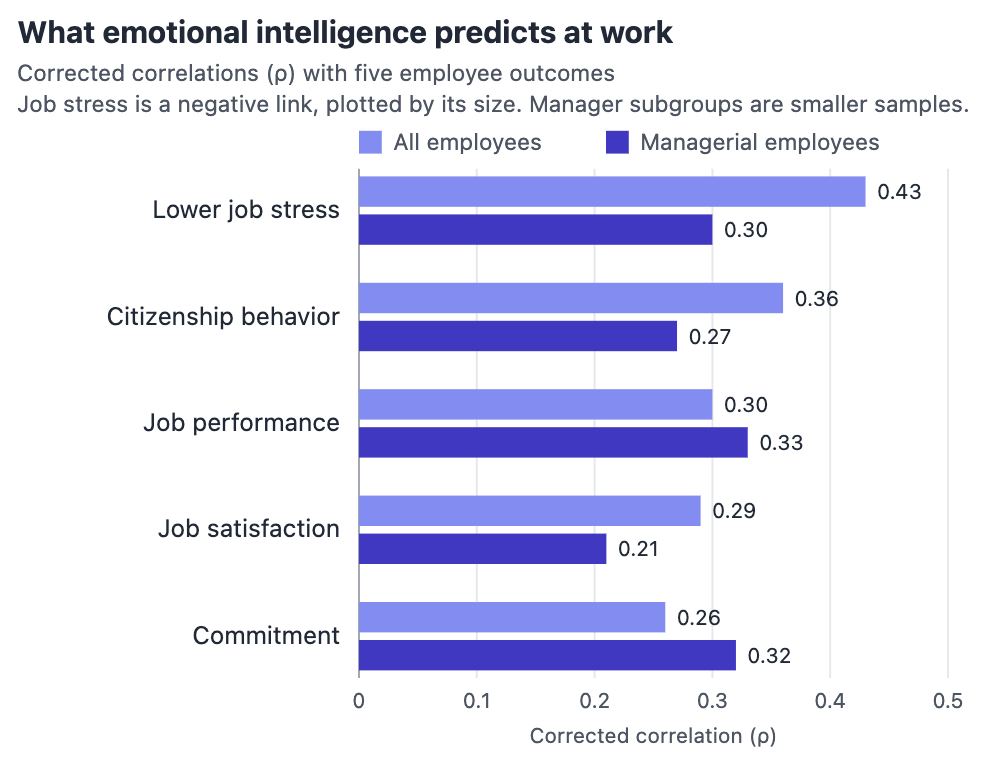
More than the skeptics allow and less than the genre sells. In 2022, a meta-analysis in Frontiers in Psychology pooled 253 effect sizes from 78,159 participants. Emotional intelligence was linked to all five employee outcomes it examined. Its strongest link was with job stress, at a corrected correlation of −0.43: higher emotional intelligence went with lower stress.
The other four links were smaller. The correlation was 0.36 with organizational citizenship behavior, meaning extra effort beyond the job description. It was 0.30 with job performance, 0.29 with job satisfaction and 0.26 with commitment. Those are real, moderate relationships. However, they're a long way from the claim, common in business media, that emotional intelligence explains most of job performance. That figure traces to a commercial assessment vendor, and it isn't a finding of the peer-reviewed meta-analyses, including this one.
The detail that matters most for founders sits in the same paper's subgroup tables. Among managerial employees, the correlation with job stress weakens to −0.30, while the link to performance is 0.33. For people who manage others, stress no longer leads. Those subgroups are smaller, with ten and twenty-one effect sizes, so the numbers deserve some caution. The honest reading is simple. Once you manage people, emotional intelligence relates to performing well and to coping about equally, and modestly in both cases.
In November 2026, our editorial team analyzed the top-ranking articles on emotional intelligence for founders. Among the ones we could read, we found none that reported the manager result or cited this meta-analysis.
The construct itself is still argued over. In 2009, The Leadership Quarterly published a letter exchange on whether leadership needs emotional intelligence at all. In it, John Antonakis argued that emotional intelligence measures should have to predict outcomes beyond what personality and general intelligence already explain.
The same journal returned to the debate in 2022 with six authors from both sides. By their own summary, they agreed that emotions are worth studying and that the research needs to be rigorous. They still proposed different agendas for what comes next.
What survives the argument is narrower than the umbrella term. The specific behaviors in this guide are useful whether or not emotional intelligence turns out to be one coherent trait. Checking a read against outside observation, sorting a reaction by source and naming a feeling before acting on it all work on their own terms. That's the editorial team's position, and it's why this guide is built around behaviors.
A mis-weighted emotional read feels like caring
A mis-weighted read feels like caring, which is why it's hard to catch. The emotion is real and often accurate. The error is in what it gets counted as. A founder who feels the cost of a decision acutely can start treating that cost as evidence that the decision is wrong. In other words, two different quantities arrive together and get added up as one.
Noah Shanok founded Stitcher in 2006 and ran it as CEO for eight years before coaching venture-backed CEOs through Startup CEO Coach. In his own account of founder burnout, he describes a version of this in himself:
"I realized that any decision involving people and feelings was hard for me. I'm sensitive and feel people's pain more deeply than most. Decisions like firing someone or scrapping something people had been working on, I wasn't weighing those correctly. Being aware of it and writing it down helped me see what was actually happening rather than just feeling stuck."
Read closely, the passage separates three things that most advice on emotional intelligence runs together. The feeling was accurate: firing someone or scrapping their work does cause pain, and nothing in his account says he misjudged that. The weight was wrong, in his own words. What helped, in his account, was writing it down, which let him see what was actually happening.
A second line, from his post on knowing when it's time to fire someone, names the same error from the other direction:
"As founders we're overoptimistic. It's in the job description. But when it comes to optimism about people improving, it can be a real detriment."
Hope about a person is a feeling too. Counted as information about that person's trajectory, it can keep a decision open long after the evidence has closed it.
Is this reaction about the business, the cost, or you?
Most strong reactions mix three sources, and each one should enter a decision differently. Before deciding anything, sort the reaction. Is it about the situation in front of you, about the cost of acting on it, or about your own state? The sorting takes about a minute, and it changes what the reaction is allowed to do.
The editorial team built the illustrative table below to apply the distinction in the passage above; it hasn't been tested as an instrument.
The middle row is where the mis-weighting in the previous section lives. In the editorial team's reading, his account describes a cost-of-acting reaction being treated as information about the situation. Sorted into the right row, the same feeling still matters, and it shapes the timing, the care and the conversation that follow the decision.
The test settles how much weight the reaction has earned. After that, the ordinary work of making the decision at the right speed takes over.
When is the reaction the most reliable thing in the room?
Sometimes the feeling is the best evidence available. Long, close observation of one person or one metric builds real pattern recognition. It often arrives as a feeling before it can be put into words. In his post on firing, Noah puts it plainly:
"Your body often knows before your brain is willing to admit it."
Founders talk themselves out of these reads because they can't argue them yet.
Two features suggest a read deserves trust: it has come back more than once, and acting on it would cost you something. A reaction that conveniently supports what you already wanted is more likely to be your state talking.
How do you check whether your read of people is accurate?
Because experiments on power show it reduces accuracy at reading other people's emotions, a CEO can't reliably check their read of people from the inside. The check has to come from people who see the same behavior from a different seat, asked about what they observed.
Noah's coaching engagements, for example, open with interviews of the people who work most closely with the founder. A founder can borrow the same logic without a coach by following three rules.
Ask people with no stake in the answer. Ask about observable behavior. "What happened in Tuesday's meeting after I pushed back?" gets a better answer than "Do I come across as defensive?" And ask the same way more than once, months apart. That's how you see whether your read and theirs are converging or drifting.
Be wary of skip-level meetings you run yourself. The person giving the read is talking to the person who controls their career, for the reason covered above.
The most common failure is a request for reassurance dressed up as a request for feedback. "Was that okay?" after a hard all-hands isn't a question anyone can answer honestly, and everyone in the room knows it. A founder who wants accurate information has to ask in a way that makes the honest answer the easy one to give.
Name it, sort it, then decide
Name the feeling in words before acting on it. In a 2007 brain-imaging study published in Psychological Science, putting feelings into words reduced the amygdala's response to negative emotional images. It also increased activity in the right ventrolateral prefrontal cortex, and activity there was inversely correlated with the amygdala's.
That said, it was a lab study of people viewing emotional images, and a board meeting is a very different setting. What it supports is modest and still useful: naming the state is cheap and fast, and it has direct neural evidence behind it.
The editorial team notices the overlap with the writing-it-down practice in Noah's account. He describes writing it down, and the study measured labeling a feeling, so the two are related acts. Both turn something felt into something stated, and a stated reaction is one you can weigh.
The second move is the pause itself. A pause mostly prevents an oversized response, like a reply sent late at night or a reorg announced after one bad number. That failure mode is covered in how anger and fear distort founder decisions. Put together, the order of operations has three steps:
- Name it. Put the feeling into words, even silently, before acting on it.
- Sort it. Decide whether it's about the situation, the cost of acting or your own state, using the table above.
- Decide. Let the reaction carry only the weight its source has earned, then make the call.
Noah opens every coaching session the same way. In his description of what a startup CEO coach does, he explains:
"I start every session with a two-minute meditation. A CEO spends most of her time in the fight. The job of coaching is to look at the business from above and decide what changes to make."
The same principle works for any big decision. Step out of the reaction before acting on it. The reaction gets a vote. It doesn't get a veto.
What does emotional intelligence look like in a startup CEO's actual week?
It shows up in four or five short moments a week, most of them unlabeled. Each is a reaction that arrives before the facts do, and the skill lives in the minute that follows. Here's what four of those moments look like, with the read, the sort and the move.
The revenue number that makes you angry before you know why. Sort it first. If the anger is about the number, it's the situation, so find out what moved before you say anything to anyone. If it's about the fourth bad meeting of the day, it's your state, and the number can wait an hour.
The engineer whose output dropped. Two explanations are available: the work has outgrown them, or something outside work has changed. The cost row will pull you toward the kinder story, because the other one leads somewhere painful. Ask them directly, then decide what the answer tells you.
The investor email you read as hostile at 11pm. Often that's state, in particular at the end of a long day. Read it again the next morning before replying. Quite often there's a neutral question inside it that the late-night read turned into an accusation.
The all-hands question you answered defensively and only noticed afterward. The read came late, which is normal. What matters is Monday: go back to the person, give the answer you should have given, and say why the first one came out wrong.
Not every strong feeling in a CEO's week is a read to be sorted. Persistent worry that tracks the company's growth over months is founder anxiety during scaling. That needs a different response from the one described here.
Frequently asked questions
Is emotional intelligence the same as empathy?
No. Empathy is the capacity to feel what someone else feels, and it's one input into emotional intelligence. On its own it can make decisions worse, because feeling someone's reaction strongly says nothing about how much that reaction should count. For a CEO, the skill is weighing the feeling correctly once it arrives.
Can emotional intelligence be learned as an adult?
The specific behaviors can. Naming a feeling, sorting a reaction by source and checking a read with outside observers are habits. Habits respond to practice. Whether emotional intelligence is one coherent, measurable trait is still argued over in the research.
Does a more emotionally intelligent CEO make softer decisions?
Often the opposite. When the cost of acting stops posing as evidence against acting, hard decisions get made on time. The care shows up in how the decision is carried out. Timing, the conversation and the support offered afterward all matter to the person on the receiving end.
What's the first sign a founder's read of people has drifted?
Usually it's surprise. A resignation nobody saw coming, a team reaction that catches the founder off guard, or a board member raising something the leadership team already knew. Each one means information existed that didn't reach the founder or wasn't read correctly. Repeated surprises are worth treating as a pattern.
My co-founder says I overreact. How do I tell if they're right?
Run the state check on yourself first: would you have reacted the same way at nine in the morning after a good night's sleep? Then ask one or two people with no stake in the disagreement what they saw in the moment itself. If their account matches your co-founder's, take it seriously.
Why can't I just work on this alone?
Much of it you can, especially naming and sorting reactions. Working alone tends to miss the reads you're most confident about, since those are the ones nobody thinks to check. An outside view helps there, whether it comes from a coach, a group of peers or a trusted board member.
Calibrated, not calmer
Emotional intelligence for a startup CEO comes down to one job. Keep your read calibrated while the role quietly pushes it off true. That means checking whether a read of someone is accurate. It also means knowing which part of a reaction is evidence and which part is the price of acting on it.
The founders who do this well still feel the pain of a hard call, and they let it shape how they act. The next time a reaction arrives before the facts, sort it before you answer.
Sources
- A Meta-Analysis of the Relationships Between Emotional Intelligence and Employee Outcomes, Frontiers in Psychology
- Power and Perspectives Not Taken, Psychological Science
- Does leadership need emotional intelligence?, The Leadership Quarterly
- Does leadership still not need emotional intelligence? Continuing "The Great EI Debate", The Leadership Quarterly
- Putting Feelings Into Words: Affect Labeling Disrupts Amygdala Activity in Response to Affective Stimuli, Psychological Science
- How do startup CEOs avoid burnout?, Startup CEO Coach
- How do I know when it's time to fire someone?, Startup CEO Coach
- Coaching methodology, Startup CEO Coach