
Founder burnout after fundraising follows a predictable sequence. The raise runs for months on the founder's own reserves: sleep, attention, patience. The company still has to be run the whole time. Then the round closes. The close refills the company's bank account but not the founder's, and a heavier job starts the same week.
That's why the crash so often lands right after the win. The rest a founder pictured during the raise never reaches the calendar, because by then the calendar belongs to the new plan. Recovery starts with treating that rest as something to schedule, and the first 90 days after the money arrives are when to schedule it.
Key Takeaways
- Founder burnout after fundraising is a timing problem: the raise spends the founder's reserves, and the close adds demands before they return.
- In one large study, angel funding went with better wellbeing over time. The short-term dip ran through lost autonomy.
- A letdown lifts with rest. Burnout doesn't.
- Book recovery before signing, then re-baseline the plan before hiring.
Why do founders burn out right after closing a round?
Founder burnout after fundraising is the depletion that shows up in the weeks after a round closes. It happens because the raise and the close are two separate loads, and most founders plan for only the first. The months after the close feel like the reward. In practice they start a heavier job, on reserves the raise has already used up.
To the founder, the close looks like a finish line. The uncertainty ends, the money is in, and the pressure should ease. To the company, the same day is a starting signal. There's capital to deploy against a plan, often a new director at the board table, and a clock running toward the next round.
Only one reading can win, and it's usually the company's. The week of rest the founder imagined gets absorbed by hiring calls and planning sessions. Nobody decides to skip the recovery. It simply never gets scheduled, because the calendar fills from the company's side first.
The numbers show how much the raise takes first. DocSend's 2015 study of 200 startups found that founders contacted 58 investors and held 40 investor meetings for an average seed round, which took about 12.5 weeks to close. The close then adds a hiring plan, new owners and the next-round clock before any of those reserves come back.
That makes the crash predictable. A founder who feels it isn't failing some test of toughness. They're living through an ordinary consequence of how rounds are timed, and anything that predictable can be planned around. We found no study that measures founder wellbeing in the weeks after a venture round closes, so the timing argument in this piece is the editorial team's own, built from the evidence below.
Isn't raising money supposed to make things easier?
In the one large study on this, it does over time, which is what makes the short-term crash so disorienting. A 2025 study in the Journal of Business Venturing analysed almost 125 million words of posts on X from 1,667 founders. It found a positive association between angel funding and entrepreneurs' well-being, with wellbeing scored from the language founders used.
The useful detail is how the effect travels. Feeling more competent and more connected pushed wellbeing up. Losing autonomy pushed it down. TU Dortmund's account of the research puts the timing plainly: angel funding "can have a negative impact on well-being in the short term" and positive effects in the long term. Two limits belong in the same breath. The money was angel funding, not venture rounds, and wellbeing was inferred from text.
In our reading, autonomy is also the thing a priced round changes most. New owners join the cap table, a board seat often comes with them, and the plan in the deck becomes a promise made to someone else. The founder gains resources and loses room at the same moment, and the loss is the part they feel first.
In our view, expectation makes it harder to see. Founders spend the raise imagining how the close will feel, and the picture is often relief. When the close arrives and they feel flat, it's easy to conclude the problem is personal. As a result, they keep quiet about it. That silence can add weeks to a dip with an ordinary cause.
What does a fundraise actually take out of a founder?
Months of a second full-time job, run alongside the first. The DocSend startups had raised more than $360M between them, and the study covers only raises that succeeded. Its seed-round averages, charted below, add up to roughly a quarter of a year spent pitching.
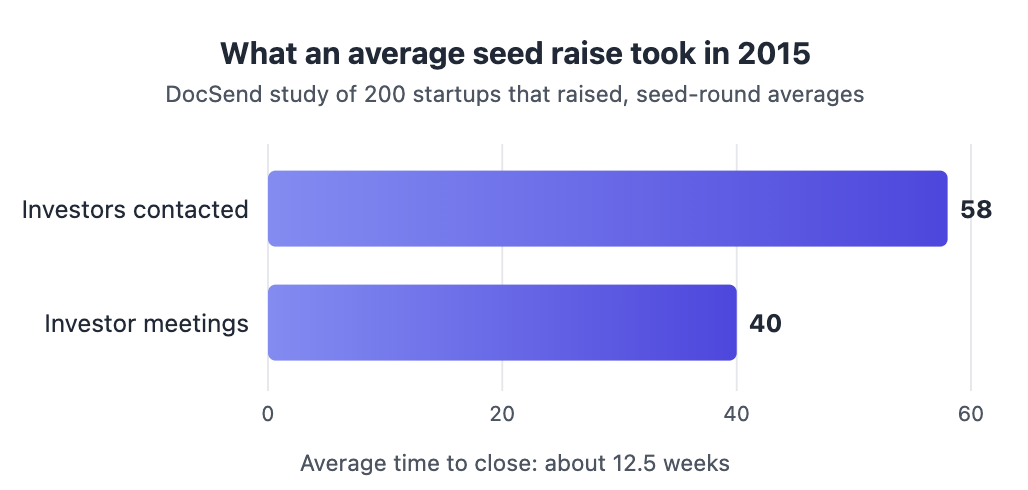
Since then, seed rounds have stretched further. Looking at 175 seed-stage startups in 2019, DocSend found founders took an average 8.5 weeks longer to close their seed rounds than in 2015. Each of those weeks meant pitches, follow-ups and diligence requests. Customers, the team and the product still needed a CEO through all of it.
Conservation of Resources theory, a long-standing model of workplace stress, gives a way to read that cost. It holds that people work to protect and build the resources they value, and that stress follows when those resources are threatened or lost. Stevan Hobfoll and colleagues set out how the theory applies at work in a 2018 review. Here the effort is the raise. The capital lands on the company's balance sheet. The founder's own losses, the sleep and attention and patience, aren't repaid by the wire. The review is about employees, so applying it to founders is the editorial team's reading. Still, it explains why a successful raise can leave a founder running at a deficit.
The timing makes the deficit worse, because rounds often close near the edge of the runway. Noah Shanok, who founded Stitcher, raised its rounds through Series B and now coaches founders through Startup CEO Coach, has described the Benchmark round in his own account:
We were six weeks from running out of cash.
When a round closes that close to the line, the company's reserves and the founder's run low together.
None of this makes the raise a mistake to run hard. A fundraise with a closing date is a bounded push, and running it hard is reasonable. The trouble is the bill. It arrives after the finish line, at the moment the founder expected the effort to be over.
What changes the day the money lands?
In the editorial team's view, the deadline disappears and the demands go up. One reason sits in Noah's post on transparency with investors, written about founders after a raise:
"The most common mistake I see from Series A and Series B founders is the same one I made. They raise money on a very optimistic scenario, because that's what got the round done, and then they're on the hook for it."
Plans slip for ordinary reasons. He describes what tends to happen when they do:
Or they were naive about how long it would take to build a sales team, or hit a milestone, or whatever the specific thing was. And instead of telling their investors, especially the new ones, they hesitate.
He's writing about candour with investors. The mechanism carries over to the founder's own state, though. The plan that got the round done becomes a weight the founder carries every day after the close. Hesitating to revise it means carrying that weight alone, and for longer.
That plan is one of five changes a close tends to bring. The table below is the editorial team's reading of the first months after a round: what founders expect, what usually arrives instead, why it costs energy, and the move that fits.
The clock row deserves a number. Carta's data on 9,843 US rounds put the median time between Seed and Series A at 1.9 years in Q4 2025. At that pace, the next raise begins well before the two-year mark, and the numbers it runs on are set in the first year after the close.
Is it a post-raise letdown or burnout?
The difference is what rest does. The World Health Organization describes burn-out as a syndrome "resulting from chronic workplace stress that has not been successfully managed". It has three dimensions: exhaustion, growing mental distance or cynicism about the job, and reduced professional efficacy. The WHO adds that it "is not classified as a medical condition."
A post-raise letdown looks different. The founder feels flat and tired, and the win doesn't lift them. But energy comes back once they get real time off. Burnout doesn't respond to a few days away. The exhaustion stays.
Two neighbouring patterns get mixed up with both. If the strongest feeling is a racing dread about the next round, the board or the numbers, that's closer to founder anxiety during scaling. If the energy is fine but the reason for doing the work has gone quiet, it's motivation loss during scaling, which has different causes and a different fix.
If it is burnout, the response changes. A planned break won't be enough, and the approach in how founders recover from burnout applies instead, including Noah's account of what coaching a founder looks like at that stage. And if low mood lasts for weeks, with changes in sleep or appetite or a sense of hopelessness, that calls for a doctor or a therapist.
How do founders recover in the first 90 days after a raise?
By scheduling the recovery the round was supposed to bring, before the new demands fill the calendar. The editorial team at Startup CEO Coach recommends four steps for the 90 days after a round closes:
- Book recovery time before signing the term sheet.
- Recover in weeks one to four, before re-planning anything.
- Re-baseline the plan with new investors in weeks four to eight.
- Pace hiring in weeks eight to twelve, then check at day 90 whether the flatness has lifted.
Each step is tied to a date, so the recovery exists before other work can claim the time.
Before you sign, book the window
Put the time off on the calendar while the term sheet is still being negotiated, and tell your co-founder and your team. A few days is a reasonable start. The timing matters more than the length. A window decided after the close tends to lose to the first recruiting call, and the first two weeks after a close are the one stretch when nobody expects results.
Weeks one to four: recover before you re-plan
Take the window, then run a reduced version of the job for the rest of the month. Keep the few decisions only the CEO can make, and let the merely urgent wait. Protect sleep first, since it's the resource the raise most often borrows against. If energy hasn't started coming back by the end of the month, treat that as information and go back to the burnout test above.
Weeks four to eight: re-baseline the plan with your new investors
Compare the plan you raised on with what you now know. Which assumptions have moved? Which hires look different from inside the company? What will the first milestone really take? Then bring the revised version to the board early, as information, while it's still a small adjustment.
In practice, this is the step Noah describes founders skipping. They hesitate, and the gap between the plan and the company keeps widening while they do. Closing that gap early also returns some of the autonomy the round took. A plan the founder has rebuilt is a plan they believe, and the board conversation moves on to running the business.
Weeks eight to twelve: pace the hiring, then check
Sequence the hiring plan against your own capacity to recruit and onboard, as well as against the budget. One hire who takes work off your plate is worth more in this window than three who add management load. Then, at day 90, run the check. Is the flatness gone? If it is, the window worked. If it isn't, it was never a letdown, and the burnout route applies.
Put the recovery window into the next fundraising plan
The recovery window belongs in the fundraising plan itself. Founders already plan the use of funds and the hiring sequence before a round closes. The recovery window, the date to re-baseline the plan and the hiring pace belong on the same list, so the rest exists before the post-close calendar fills with the company's demands.
It also helps to raise on a plan you can live with, because the plan that gets a round done is the plan the founder carries for the next year.
The raise itself needs its own care: sleep, recovery between the meetings that matter, and a clear head going into the term sheet. Managing that state during the raise is part of how a CEO coach changes your next fundraise. Between rounds, the habits that matter most are plain ones. Noah's own account of how startup CEOs avoid burnout puts one of them in a single line:
Sleep is the game changer.
Frequently asked questions
Is it normal to feel flat or worse right after closing a round?
Yes. A flat few weeks after a big win is common, and the cause is usually the months of raising that came before it. It stops looking normal when real time off doesn't help, which points to burnout.
Will taking time off right after the close worry my new investors?
Rarely, if it's planned and communicated. A short, announced break in the first weeks costs little, because nobody expects results yet. Give the lead investor the dates when you share the post-close plan.
Does a bigger round make the post-raise crash worse?
There's no good data on round size and founder burnout. What does grow with the round is the ambition of the plan and the size of the hiring load. Those are also the two things a founder can adjust in the first 90 days, through the re-baseline and the hiring pace.
Should I slow down the hiring plan I just raised on?
Sometimes. A hiring plan written during a raise assumes a founder with full energy. If you don't have that right now, pace the plan to what you can recruit and onboard, and explain the change to the board when you share the revised plan.
What if my co-founder is just as drained by the raise?
Stagger your recovery windows so the company always has one of you fully present. Then split the post-close load explicitly: who owns the board, who owns hiring, who owns customers for the next month. Write the split down, so neither of you picks up the other's share by default.
Is the period right after a raise a good time to start working with a coach?
It can be. The months after a close bring a new plan, new hires and a new board relationship at once, and an outside view of all three helps most before those decisions are locked in. If it's burnout or depression, a coach works alongside clinical help and can't replace it.
Schedule the rest the round was supposed to buy
Founder burnout after fundraising comes from a promise nobody keeps. Rest gets pencilled in for after the close, and the close hands that time to the company. So treat recovery as part of the round. Book it before the wire lands, re-baseline the plan before hiring against it, and check at day 90 whether the flatness has lifted. The wider work of building that capacity before the next round sits in founder emotional resilience.
Sources
- Angel funding and entrepreneurs' well-being: The mediating role of autonomy, competence, and relatedness, Journal of Business Venturing
- How does angel investment influence the well-being of founders?, TU Dortmund University
- DocSend Fundraising Research: What we Learned from 200 Startups Who Raised $360M, DocSend
- The Seed Squeeze: New DocSend Data Shows Early-Stage Founders Face Heightened Investor Scrutiny, Institutional Barriers, PR Newswire
- Conservation of Resources in the Organizational Context: The Reality of Resources and Their Consequences, Annual Review of Organizational Psychology and Organizational Behavior
- Time Between Startup Rounds Is Finally Trending Down, Carta
- Burn-out an "occupational phenomenon": International Classification of Diseases, World Health Organization
- How much sleep do I need as a founder?, Startup CEO Coach
- How do I balance transparency vs optimism with investors?, Startup CEO Coach
- How do startup CEOs avoid burnout?, Startup CEO Coach