.png)

Founders give advisors equity, pay coaches in cash, and owe mentors nothing but the occasional thank-you. Yet most use the three words as if they mean the same thing, and the confusion gets expensive. Hand a chunk of the cap table to an "advisor" when what you needed was a free mentor's perspective, and you've paid for the wrong help. Lean on a mentor for accountability they never signed up for, and you'll resent them for going quiet. A coach, a mentor, and an advisor solve three genuinely different problems. This guide draws the line between them: what each does, how each is paid, and which one a founder actually needs at each stage.
Key Takeaways
- A mentor shares lived experience. It's informal, usually unpaid, and built on a long-term relationship.
- An advisor lends specific expertise and connections. The role is semi-formal and usually paid in equity (typically 0.2%–1%, per the Founder Institute's FAST benchmarks).
- A coach develops the founder's own judgment and leadership. It's structured, confidential, paid in cash, and the only one of the three with no stake in the company.
- Diagnose the gap before picking the role: knowledge or doors → advisor; perspective → mentor; the decision you keep avoiding → coach.
- The mix shifts by stage: mostly free and external early, increasingly paid and developmental as you scale.
What's the Difference Between a Coach, a Mentor, and an Advisor?
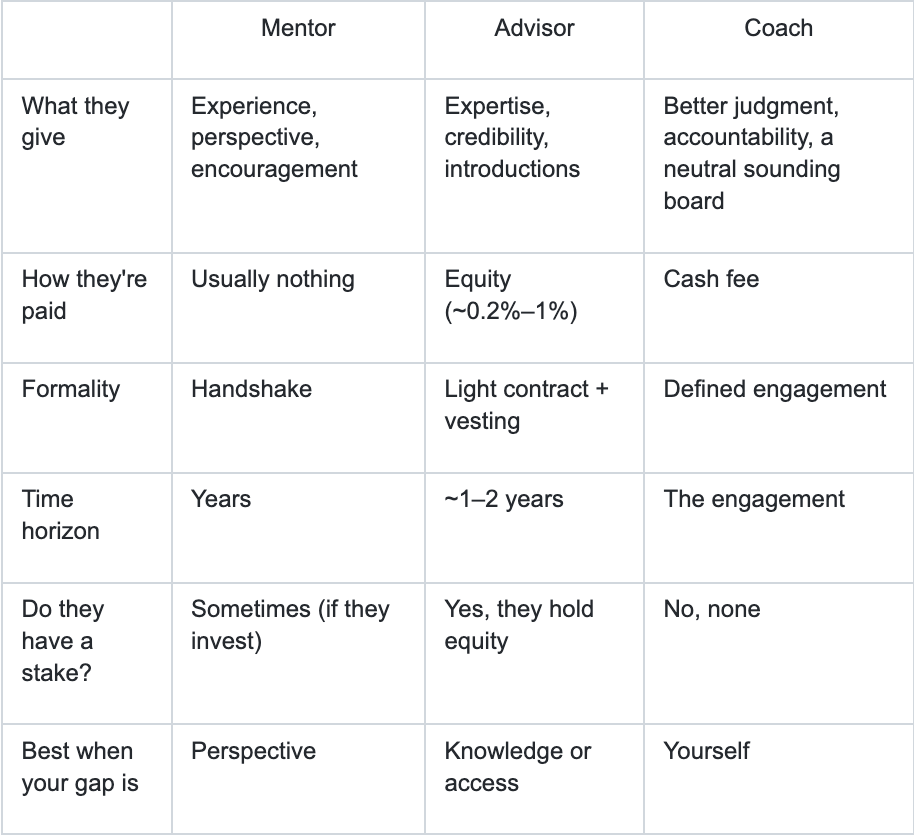
The three roles differ on one axis founders rarely name: what each is actually responsible for. A mentor is responsible for sharing their experience. An advisor is responsible for lending expertise and access. A coach is responsible for developing you. Mentors give you their answers; advisors give you their knowledge and network; coaches help you find your own answers and hold you to acting on them.
There's a quick test. If someone tells you what they'd do in your shoes, that's a mentor. If they open a door and vouch for you, that's an advisor. If they ask the question you've been avoiding and won't let you off the hook, that's a coach. Same conversation, three different jobs.
A mentor shares experience, informally and usually for free. An advisor lends expertise and connections, semi-formally and usually for equity. A coach develops the founder's own judgment and leadership through a structured, confidential, paid process. They are complements, not substitutes. The most common founder mistake is buying one when the gap called for another.
A fourth word often crashes this comparison: consultant. The line there is simple. A consultant is paid to do the work and hand you an output, not to develop you. Useful, but a different transaction. We'll keep the focus on the three roles founders confuse most.
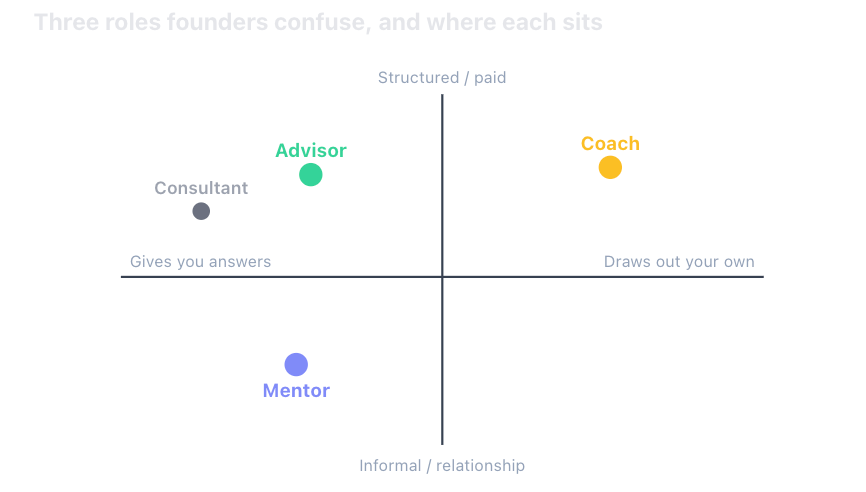
Few people have occupied all three seats, which is part of why the distinctions blur. Noah Shanok is one who has: he leaned on mentors and advisors while building and scaling Stitcher (later acquired by SiriusXM), he's now an advisor and investor in more than 30 startups, and he coaches venture-backed founders through Startup CEO Coach. Having sat in each chair tends to make the boundaries obvious, because what you owe a founder, and what you can honestly offer, changes completely depending on which one you're in.
What Does a Mentor Actually Do for a Founder?
A mentor is someone a step or two ahead of you on a similar road who shares what they learned the hard way: informally, usually for free, and often for years. The value isn't a deliverable. It's pattern recognition and perspective from someone who has already walked into the room you're about to enter. With a mentor, the relationship is the product.
What you get is specific: lived experience ("here's how I handled this"), emotional ballast when conviction wobbles, continuity across years, and zero cost to the cap table. The structure is a handshake, not a contract: no set hours, no equity. There's one exception worth naming. A mentor who also writes you a check is wearing a second, separate hat as an angel investor, with its own paperwork. The mentoring itself stays free.
The limits matter just as much, and most write-ups skip them. A mentor's advice is their path, which may not map to yours. Availability is unpredictable, because they have their own company to run. There's no accountability mechanism; a mentor will rarely chase you on the thing you swore you'd do. And if your mentor is also an investor, the conversation isn't fully confidential anymore, because now they have a stake in the answer.
When is a mentor the right call?
When the gap is perspective. You want to hear how someone who's been there actually navigated it, you're early and protecting every point of equity, and the question is "how did you do this?", not "hold me accountable to changing how I lead." Early on, when capital is scarce and uncertainty is high, a good mentor is often the highest-value relationship a founder can have, precisely because it costs nothing but attention.
What Does a Startup Advisor Do, and What Do They Cost?
An advisor trades specific expertise, credibility, and connections for a small slice of equity. Where a mentor is a relationship, an advisor is closer to a defined engagement: a domain expert, a recognizable name, or a well-connected operator who helps with a particular gap: a go-to-market motion, a regulated market, a fundraise. As of 2026, the standard benchmark, the Founder Institute's FAST agreement, puts advisor equity between roughly 0.15% and 1%, scaled by company stage and how involved the advisor is (Founder Institute, FAST; Holloway, Guide to Equity Compensation, 2026).
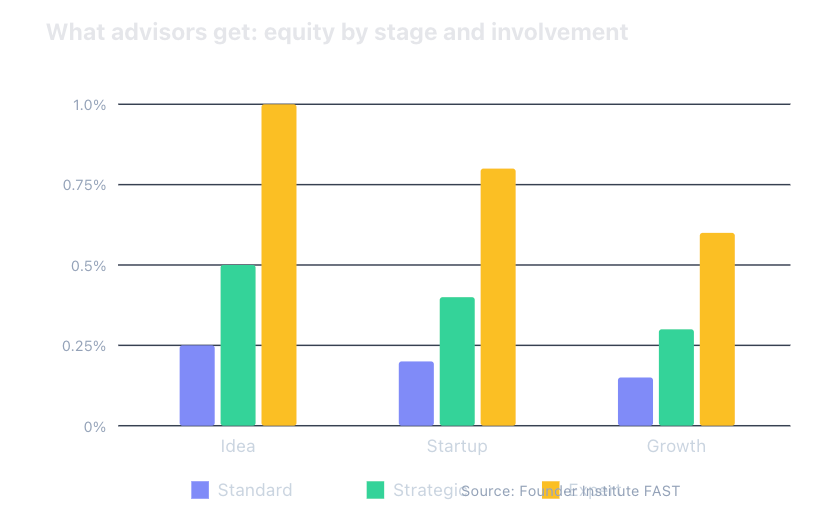
The defining feature, and the one founders underestimate, is that an advisor has a stake. Grants typically vest over about two years with a three-month cliff, and Carta's own guidance likewise places most advisor grants in the 0.2%–1% range (Carta, 2026). That equity aligns the advisor with your success, which is the point, but it also means they are not a neutral party when the question touches the company's value.
It's worth clearing up a conflation here. An advisor, a board member, and an investor are three different things. An advisor informally advises and holds advisory equity. A board member has fiduciary duties and governance power. An investor bought equity with cash. One person can wear several of these hats at once. Just be clear about which hat is talking.
The limits are real too. Advisors aren't expected to do the work or be deeply available. They lend judgment at the edges, not labor in the trenches. "Logo-collecting" advisors who lend a recognizable name but no actual time are a well-known trap, and you pay for them in equity you can't get back.
How much equity should a startup advisor get?
Usually between 0.2% and 1%, scaled two ways: down as the company matures (an idea-stage grant is larger than a growth-stage one for the same role) and up with involvement. The FAST framework's "standard" tier sits near 0.15%–0.25%, "strategic" involvement (adding recruiting help) roughly doubles it, and "expert" engagement (ongoing projects and introductions) can reach 0.6%–1%. Expect about two-year vesting with a three-month cliff.
From the other side of the table, as an advisor and investor in more than 30 startups, Noah Shanok has noted that the best advisor relationships are narrow and active: one or two people solving a specific problem you genuinely can't, not a wall of names on a pitch deck. And because an advisor holds equity, a founder should treat their input as informed and aligned, but not as the neutral, no-agenda counsel that a different role is built to provide.
What Does a Coach Do That a Mentor or Advisor Can't?
A coach is the only one of the three whose job is you, and the only one with no stake in the company. A mentor hands you their playbook. An advisor lends expertise and holds equity. A coach asks the questions that surface your own answer, then holds you accountable for acting on it, inside a confidential space with no positional interest beyond your growth as a leader. That neutrality is the product.
Several things make the role distinct. A good coach works the process, not the answers. They may have no opinion at all on your go-to-market, and that's by design. The cadence is structured and the accountability is explicit. The focus is your judgment, your blind spots, and how you show up under pressure, not the business plan. And critically, the relationship is confidential, with no equity, no board seat, and no check written.
Here's the part that gets missed everywhere else: a coach is frequently the only person in a founder's orbit with no agenda about the company's outcome. Not the co-founder, who shares the dream and the stress. Not the board, which answers to its own funds. Not the investor-mentor or the equity-holding advisor, both of whom have a position. The coach has none of that. That's precisely what makes it safe to finally say the thing out loud.
One more distinction: unlike mentors and advisors, a coach doesn't need to have done your exact job. The skill is in the questions and the process, not the résumé, a point the coaching field has long made. (For founders specifically, an operator-experienced coach is often the strongest fit, but that's preference, not the qualification.) For the deeper treatment of what coaching is, how it works, and the return it delivers, see our complete guide to executive coaching for founders. Noah Shanok's own practice is deliberately multi-framework, drawing on the Mochary Method, the Conscious Leadership Group, and Co-Active coaching as the moment calls for, rather than forcing one model onto every founder.
How Do You Know Which One You Actually Need?
Match the role to the gap. If the gap is knowledge or access (you don't know how to do the thing, or you need to reach someone), get an advisor. If the gap is perspective (you want to hear how someone who's been there handled it), get a mentor. If the gap is you (your decisions, your patterns, the call you keep putting off), get a coach. Most founder frustration with "help" traces back to buying the wrong category for the gap they actually had.
So diagnose first, then choose. The table below maps the four common gaps to the role that fills each one.
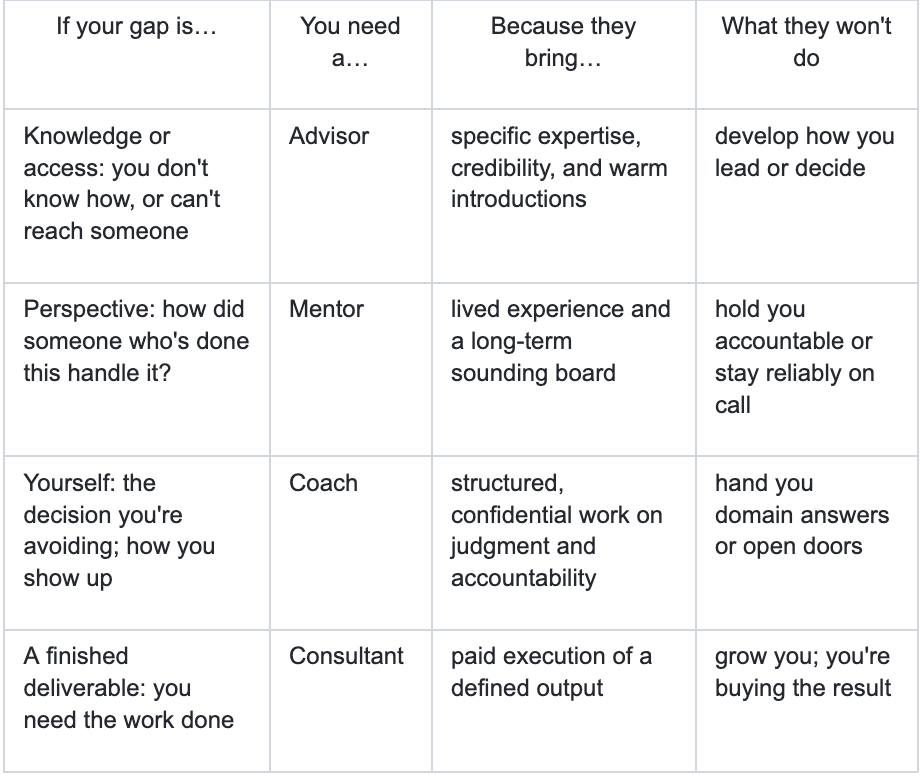
The failure modes are predictable once you see the pattern. Founders expect a mentor to provide a coach's accountability, then feel let down when the mentor doesn't chase them. They hire a coach hoping for domain answers, when they actually needed an advisor or a consultant. They collect advisors for their logos, buying signaling instead of help and diluting the cap table to do it. And the quietest mistake of all: using an equity-holding advisor or an investor as a "confidential" sounding board, then self-censoring without noticing, because some part of them knows that person has a stake. One recurring observation from coaching venture-backed founders is that they usually already know the decision they're avoiding, which is exactly the gap no mentor's advice and no advisor's expertise can close, because it was never a knowledge problem. For more on why capable founders sit on calls they've already made, see why founders delay decisions they've already made.
What Do Founders Need at Each Stage: Idea, Seed, and Growth?
The mix shifts as you scale. At the idea and pre-seed stage, mentors do the heaviest lifting. They're free, abundant, and right for a moment when conviction is fragile and equity is precious. Through seed and Series A, equity advisors earn their place for real domain and network gaps, and coaching starts to matter as the first hires arrive and the founder has to shift from doing the work to leading people. By the growth stage, a professional coach is often the single most valuable relationship of all, because the binding constraint has become the founder.
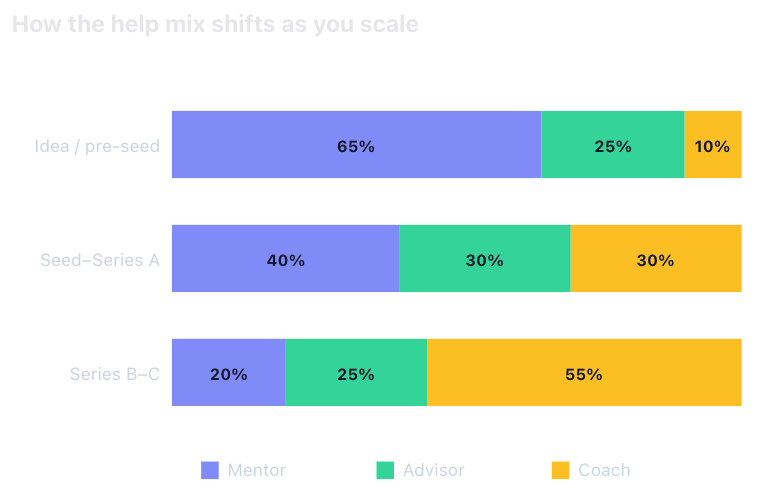
At the idea and pre-seed stage, mentors come first: free, plentiful, and well-suited to a founder who mostly needs perspective and nerve. One advisor might fill a single critical gap. A coach is usually premature here, unless there's a specific founder or co-founder dynamic worth working on early. Above all, protect the cap table.
Through seed and Series A, advisors get added on purpose, for domain depth, go-to-market, or fundraising credibility, under FAST-style terms. Coaching becomes genuinely useful as the team forms and the founder confronts the first hard shift from operator to manager. Mentors stay in the picture throughout.
By the growth stage (Series B–C), a coach is often the centerpiece. The constraint is now the founder's own leadership, the board, and the executive team. Advisors tilt toward board-level and strategic input, and the founder has usually outrun most mentors' lived experience, so mentor value narrows to a few who've operated at real scale. The throughline: early-stage help is mostly free and external; growth-stage help is increasingly paid and developmental, because the problem moves from "what do I do?" to "how do I lead?"

Exactly what a founder works on with a coach, and how that agenda changes from Series A to B to C, is its own subject, and a deep one. We cover it in detail in how a founder's coaching needs change at each funding stage. The point here is narrower: the balance of mentor, advisor, and coach is not fixed. It moves as the company does.
Can You Have More Than One, and How Do They Work Together?
Yes, and the strongest founders run all three at once, on purpose. The healthiest setup isn't choosing between a coach, a mentor, and an advisor; it's assembling a small "personal board" where each fills a gap the others structurally can't: mentors for perspective, advisors for expertise and doors, a coach for judgment and accountability, plus a peer group of other founders for the things only they understand.
The roles are complements, not substitutes, so the work is keeping them in their lanes. Keep the confidential role genuinely free of stake. That's what makes the coach useful. Be deliberate about what you bring to an equity-holding advisor versus a neutral coach. And don't ask one person to be all three: the advisor's equity and the coach's required neutrality pull in opposite directions, which is why the same person rarely does both well. Knowing which voice to take which question to is itself a leadership skill. The founder is the one who orchestrates the board.
That said, who you put in each seat matters as much as filling it, especially the paid coaching seat, where fit and experience vary widely. When you're ready to evaluate that choice, see our guide to the executive coaches venture-backed founders recommend.
Frequently Asked Questions
Is a coach the same as a mentor?
No. A mentor shares their own experience informally and usually for free, giving you their answers. A coach uses a structured, confidential process to develop your judgment and hold you accountable to your own answers, and is paid for it. The mentor has been where you're going; the coach helps you get there as a leader.
Do you pay a startup mentor?
Typically not. Mentorship is informal and unpaid, which is a big part of its value when you're early and equity is scarce. The one exception is a mentor who also invests money in exchange for equity. That's a separate angel-investor relationship with its own agreement, not payment for the mentoring itself.
How much equity should a startup advisor get?
Usually 0.2% to 1%, scaled by stage and involvement, vesting over about two years with a three-month cliff, per the Founder Institute's FAST framework, with Carta's guidance citing the same 0.2%–1% range. Earlier stage and deeper involvement sit at the higher end; a growth-stage, light-touch advisor sits at the lower end.
Should a first-time founder get a coach or a mentor first?
Usually a mentor first. Perspective is cheap, abundant, and exactly what the earliest and most uncertain stage calls for. A coach earns its place once you're building a team and your own leadership, not your knowledge, becomes the constraint, which tends to arrive around your first real hires.
Can one person be your coach, mentor, and advisor at once?
Rarely well. An advisor holds equity, which gives them a stake, and a coach's value depends on having none. The neutrality and the stake pull against each other. Most founders are better served by separate people in each seat, so no single relationship has to compromise what it's best at.
What makes Noah Shanok's perspective on this useful?
He's occupied all three roles: a founder who relied on mentors and advisors while scaling Stitcher, an advisor and investor in more than 30 startups, and now a startup CEO coach. That range means the distinctions come from lived experience on every side of the table, not theory, which is part of what founders point to in their feedback on working with him.
Sources
- Founder Institute, "FAST: The Founder / Advisor Standard Template" (advisor equity by stage and involvement level), retrieved 2026-06-03, https://fi.co/fast
- Holloway, "Typical Startup Advisor Equity Levels," The Holloway Guide to Equity Compensation (advisor equity range 0.2%–1.0%, citing Carta and the Founder Institute; ~2-year vesting with a 3-month cliff), retrieved 2026-06-03, https://www.holloway.com/g/equity-compensation/sections/typical-startup-advisor-equity-levels
- Carta, "Startup Advisors: How to Build Your Advisory Board" (most advisor grants fall in the 0.2%–1.0% range; Carta's page blocks automated retrieval, so corroborated via Holloway), retrieved 2026-06-03, https://carta.com/learn/startups/founding-team/advisor/
- HubSpot for Startups, "What's the Difference Between a Startup Mentor vs. an Advisor?" (formality, compensation, and time-horizon distinctions between mentors and advisors), retrieved 2026-06-03, https://www.hubspot.com/startups/startup-mentor-vs-advisor
- Startup CEO Coach, Founder Testimonials (used as contextual grounding for recurring founder-outcome themes, not quoted): Nick Ornitz (TopLine Pro), Taylor Matthews (Farther), Mark Gilbert (Zocks), Harley Sugarman (Anagram), Alastair Paterson (Harmonic), Jeremy Hermann (Delphina), Ryan Hanley (Equilibrium Energy), Victor Wang (Kaiber), Paul Lee (Patlytics), Ben Eachus (Flowspace), Justin Melillo (Mona), Mike Kadin (RedCircle), Julie O'Shaughnessy (Vivodyne), David DellaPelle (Dune), Ibrahim Ahmed (Inference), George Simons (Solo), Greg Volynsky (Zoa), Philip Franta (Reebelo), Joseph Ndesandjo (SiteOwl). Retrieved 2026-06-03, https://www.startupceo.coach/testimonials