.png)

Ask a founder to name the worst decision they've made and you'll usually get a story with wreckage in it. A hire who blew up a team. A product bet that burned two quarters. Those decisions are memorable because they hurt, and they get reviewed for exactly that reason. The trouble is that the decisions which cost the most are usually not on that list. They were reasoned carefully, argued through with a co-founder, and they produced a quarter that looked fine. What went wrong sat one level up: the decision was about the wrong problem.
What decision-making mistakes cost startup founders the most?
The decisions that cost founders the most are usually not the badly reasoned ones. They're competently made decisions about the wrong problem. The reasoning was sound, the options were weighed, the call was defensible, and the subject of the decision simply wasn't the thing that determined the outcome.
That's an uncomfortable claim, so it's worth being precise about what it does and doesn't say. It doesn't say founders think sloppily. Under pressure most of them think harder, not less. It says the rigour gets pointed at whatever problem arrived on the desk, and the selection of that problem happens earlier, faster, and with almost no scrutiny at all.
Three causes account for most of it. A problem chosen under fear. A reaction delivered at full strength when a pause was available. And a decision that nobody owned and nothing forced, which got made late and by default.
None of this is about speed. Type 1 and Type 2 decisions and the 70% rule already handle how fast to move once you know what you're deciding. It isn't about deciding less, either. This is about what the decision was actually about.
Why can't you find your costliest decisions in your worst outcomes?
Because outcome quality and decision quality are different variables, and founders audit the first one. Paul Nutt tracked more than 400 real decisions by senior managers over two decades and found roughly half were not fully adopted two years later. One third were never used at all (Ohio State University, 2002).
That failure definition matters, and it's worth stating plainly: a decision counted as failed if the organisation never fully put it into practice. Not if it produced a bad result. The gap between "we decided this" and "this happened" is where most of the loss sits, and no outcome review catches it.
Now think about what a results-based audit does to a founder's memory. The decisions that get reviewed are the ones with visible wreckage. A well-run decision about the wrong problem leaves no wreckage. It leaves a quarter that was fine, a team that stayed busy, and a metric that moved a little. Nobody schedules a post-mortem for a fine quarter.
There's a more dangerous version. A badly chosen decision can produce a good outcome, and then it teaches. The founder repeats the process that produced the win, because the win is the only feedback available.
This distinction is oddly absent from the advice on offer. Across the pages we analysed, we found not one that separates a bad decision from a bad outcome, even though the separation is the first thing any serious treatment of judgment starts with.
All of this is decision-level attribution, which is a smaller unit than the one founders usually argue about. Whether the market or the leadership killed the company is a different question, with a different literature and a different set of biases attached to it.
Why don't the usual lists of founder mistakes help you?
Because they list categories of decision instead of causes of error. We analysed the nine pages currently ranking for this question before writing ours. Almost all of them name things like hiring the wrong VP, scaling too early, or not validating the market. Those are labels applied once the outcome is known, which makes them useless in advance.
Try it against your own week. "Don't hire the wrong VP" gives you nothing on Tuesday, because nobody hires a VP believing they're the wrong one. The label only becomes available after the answer is in. A cause is different: it's observable while the decision is still open.
We ran the most-repeated statistics in those pages back to their primary sources. We found that several don't have one. The widely quoted claim that adults make 35,000 decisions a day traces to a 2015 blog post attributing it to a book that doesn't contain the number. "70% of strategic decisions fail" is a migration of the old "70% of change programmes fail" figure, which was never a study either. Neither survives a check, and a category this confident about its numbers ought to have better ones.
There's survey evidence that diagnosis is where the failure concentrates. In 2017, Thomas Wedell-Wedellsborg surveyed 106 C-suite executives across 91 companies in 17 countries. 85% agreed or strongly agreed that their organisations were bad at diagnosing problems, 87% agreed the flaw carried significant costs, and fewer than one in ten said they were unaffected (Harvard Business Review, 2017). It's a self-report survey about organisations, so treat it as a description of where experienced leaders think the damage is, not as a measurement of the damage itself.
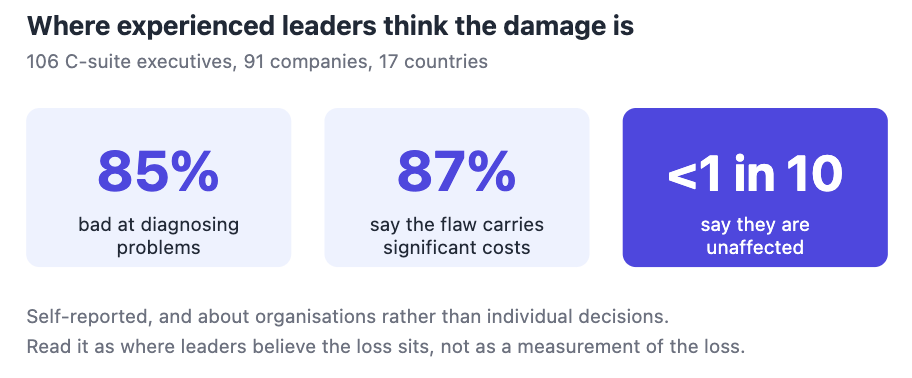
If diagnosis is the weak point, the useful question stops being what was decided and becomes why that problem was the one on the table.
Noah Shanok, who founded Stitcher and ran it for eight years before coaching venture-backed CEOs at Startup CEO Coach, describes the same thing from inside a coaching practice, and puts the cause ahead of the category:
"Anger and fear lead to bad decisions. Most decisions or hesitation to make decisions is driven by fear. Avoidance is one of those. Focusing on other problems that are not the main problem is another. Anger comes up less frequently but it's usually too strong a reaction to something vs. taking a pause and a breath, thinking deeply and then making the right decision."
The avoidance limb of that has its own treatment in why founders avoid difficult decisions and what it costs, so this article follows the second limb: problems that are not the main problem. It's also, by his own account, what the Mochary Method is built to target.
Two causes, then, from the practice. We're adding a third, and flagging it as our own rather than his, because the first two are both emotional and some decisions go wrong with no feeling attached at all.
Mistake one: deciding about the loudest problem, not the largest
Under threat, attention stops being steered by intention and starts being steered by whatever is most salient. The problem that's shouting gets the decision. The problem compounding quietly in the background doesn't, and it keeps compounding.
Displacement is the name for this: sustained, competent work on a problem that isn't the main problem. It's the second thing Noah Shanok names in the quote above, and it's the one that survives longest, because nothing about it looks like a mistake while it's happening.
That mechanism has a name in cognitive psychology. Attentional control theory holds that anxiety impairs the efficient functioning of the goal-directed attentional system and increases the extent to which processing is influenced by the stimulus-driven attentional system, with the effects running through two executive functions, inhibition and shifting (Eysenck, Derakshan, Santos and Calvo, Emotion, 2007). Note what that does and doesn't claim. It's about processing efficiency, and the same paper allows that performance may hold up anyway when someone compensates with extra effort. Anxious founders don't get worse at thinking. They get worse at choosing what to think about.
Here's the part founders find counterintuitive. The displaced problem is usually the smaller one, and it's chosen because it's smaller. Raghunathan and Pham ran three experiments on gambling and job-selection choices and found anxious participants biased toward low-risk, low-reward options while sad participants went the other way, toward high risk and high reward (Organizational Behavior and Human Decision Processes, 1999). Same negative mood, opposite choices. Which is the first reason to stop treating "founder stress" as one thing.
Why does the displaced problem survive scrutiny? Because working on it looks like work. Across two experiments, Hsee, Yang and Wang found people chose idleness when they had no justification for activity, and that even a specious justification was enough to make them busy. Their conclusion, in their own words: "many purported goals that people pursue may be merely justifications to keep themselves busy" (Psychological Science, 2010).
A founder rebuilding onboarding for the third time while the enterprise pipeline has no owner is not being lazy. They're being busy, on something defensible, that a board would nod at. There's a related effect on task choice: across five experiments, people chose objectively lower-payoff tasks when the low-payoff task carried merely spurious urgency, which the authors note violates the normative principle of dominance, meaning they chose the objectively worse option (Zhu, Yang and Hsee, Journal of Consumer Research, 2018). That's about which task gets picked, and it's a cousin of the separate problem of everything feeling urgent at once.
The test: if this decision goes perfectly, what changes?
Answer it out loud, and name the metric. If the honest answer is something other than the number that decides the next twelve months, the decision is well made and pointed at the wrong target.
Then ask the second question: who put this problem on your list? If the answer is that it escalated, that a board member raised it, or that it was simply the loudest thing on Monday, that's cause one, and no amount of careful reasoning downstream will fix it.

Mistake two: reacting at full strength when a pause was available
Anger is rarer than fear and does the opposite damage. Fear shrinks the decision. Anger enlarges the reaction. In a nationally representative field experiment with 973 Americans aged 13 to 88, fear increased risk estimates and plans for precautionary measures, while anger did the opposite (Lerner, Gonzalez, Small and Fischhoff, Psychological Science, 2003).
The uncomfortable detail is what anger feels like from the inside. Lerner and Keltner found angry people's risk estimates resembled happy people's more closely than fearful people's (Journal of Personality and Social Psychology, 2001). Anger doesn't announce itself as distortion. It arrives as clarity, and a founder acting on it feels decisive rather than reactive.
The processing effect is separately documented. Tiedens and Linton found that emotions carrying a sense of certainty, and anger is one, push people into heuristic processing: more weight given to a source's expertise, more stereotyping, and less attention paid to the quality of the argument (Journal of Personality and Social Psychology, 2001). Certainty, not negativity, is the active ingredient. That's why an angry decision can be fast, confident, and shallow at the same time.
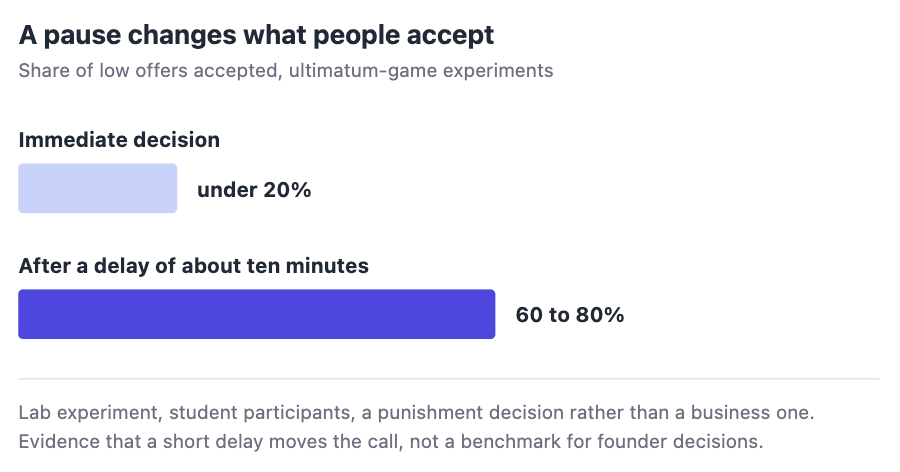
So what does a pause actually buy? In ultimatum-game experiments, fewer than 20% of low offers were accepted when the decision was immediate, against 60 to 80% when the same decision was delayed by roughly ten minutes (Grimm and Mengel, Economics Letters, 2011). That's a lab punishment decision by students, not a board call, so treat it as evidence that a short delay changes what people accept rather than as a business statistic.
Why "sleep on it" is right for the wrong reason
The received version of this advice is that your unconscious mind keeps working on the problem while you're distracted. It doesn't survive testing. A meta-analysis of 61 effect sizes plus a large replication attempt with 399 participants found the unconscious-thought advantage came to a Hedges' g of 0.018 with a p-value of 0.77 once publication bias was corrected for (Nieuwenstein and colleagues, Judgment and Decision Making, 2015). That's indistinguishable from nothing.
The pause is still worth taking. It just works by cooling the state you're in, not by outsourcing the problem to a background process. Which means the useful version isn't "go away and let it percolate." It's closer to: don't send the message tonight.
Mistake three: the decision nobody was ever required to make
The third cause isn't emotional at all. Some decisions go wrong because no one owned them and nothing forced them, so they got made late, by default, or by whoever happened to be in the room when the question came up. There's no feeling to notice, which means there's nothing for a founder to introspect on afterwards.
That gives the three causes distinct signatures, and the signatures are what make the taxonomy usable. Fear produces a decision about a smaller problem. Anger produces an oversized response to a real one. Absent structure produces a decision with no author and no date.
This third one hides best. The other two leave a trace in the founder's memory, because something was felt. This one leaves an organisational gap that looks like nothing at all until the consequence shows up, at which point it gets misfiled as someone's individual failure.
Naming the class is the job here. Building the machinery that closes it, decision rights, standing policy, escalation thresholds, is a separate discipline covered in operational systems that reduce a founder's daily decision load.
There's a company-scale version of the same error. Stitcher never reached product-market fit and raised as though it had, which is a years-long commitment aimed at a problem that wasn't the one in the way (push versus pull is the distinction that separates the two).

How do you judge a decision using only what you knew at the time?
You reconstruct the decision without its result. That's the whole method, and it's harder than it sounds, because the result is the most vivid thing in your memory of the decision. Three questions do the work, and each one is answerable with information that existed on the day.
One: what problem was this decision about, and what made it the one on the table that week? If the honest answer is that it was the loudest thing, the escalated thing, or the thing a board member raised on a Thursday, that's cause one, and the quality of the reasoning after that point is beside the point.
Two: what would have had to be true for the opposite call to be right, and did you know whether it was? If nobody asked, the decision was a conclusion looking for support. This question has the useful property of being answerable in the present tense, before the decision, which is where it's actually worth asking.
Three: how long did this take from first signal to commitment, and was that duration chosen or inherited? Same-day on something reversible is fine and often correct. Same-day on something hard to reverse, where the trigger was a piece of bad news, is cause two wearing a schedule.
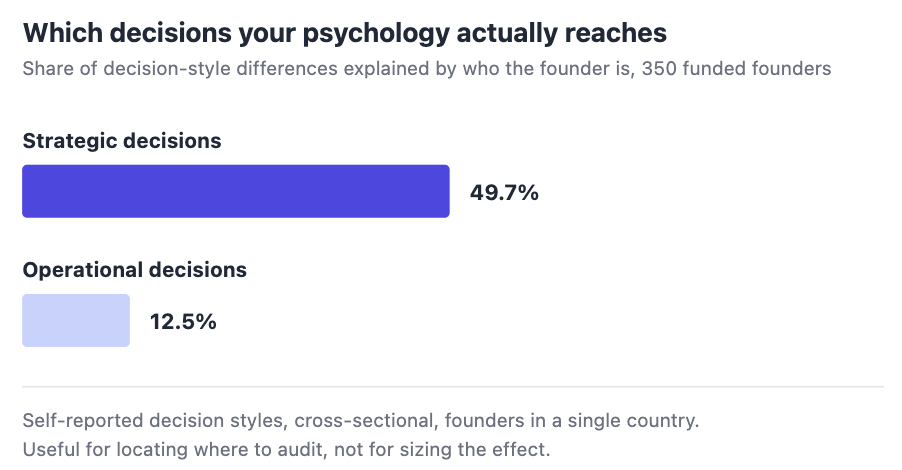
Don't run this on everything. Founder psychology bites hardest on the big, uncertain calls, and there's evidence for where to point it. A 2026 study of 350 funded startup founders found that founder attributes, among them cognitive orientation, domain experience and risk appetite, explained 49.7% of the variance in decision-making style for strategic decisions but only 12.5% for operational ones (Menon, James and Babu, Behavioral Sciences, 2026). The study is self-reported, cross-sectional and drawn from a single country, so it locates the problem rather than sizing it.
Does a structured step like this actually change anything? There's a rare piece of causal evidence. Four randomised controlled trials covering 759 firms trained founders to treat their strategy as a testable hypothesis. The trained founders terminated more ideas, and the results were consistent with a small number of radical pivots rather than either no change or constant churn (Camuffo and colleagues, Strategic Management Journal, 2024).
The intervention that worked wasn't calmer founders. It was a required evaluation step: a structural fix for a partly emotional problem, and the same substitution of process for instinct that defines the founder-to-CEO transition generally.
What does a wrong-problem decision cost, and when do you see it?
Rarely a single visible failure. The cost is a quarter of competent work aimed at something that was never going to move the outcome, plus however long it takes anyone to notice, which is long, because nothing broke.
Detection lag is the real expense. A decision that fails loudly gets corrected inside a month. A decision that merely misses gets repeated, because it produced no signal that anything was wrong, and by the time the pattern is visible it's three quarters old and looks like a strategy.
Founders carry more exposure to this than executives do. In a November 2024 survey of 314 business leaders, 72% of entrepreneurs said they're guided by intuition on growth decisions, against 49% of corporate executives (Capital One Business with Inc., 2025). Two caveats belong with that number: it covers business leaders broadly rather than startup founders specifically, and it measures self-reported style, not decision quality. It's still the relevant asymmetry, because intuition is the channel through which fear and anger reach a decision, and founders have the widest-open channel of anyone in the building.
Frequently asked questions
Are bad decisions recoverable for a startup?
Usually, and the variable that decides it is time to reversal rather than the decision itself. Reversing publicly costs credibility once. Holding a call you've privately stopped believing in costs it continuously. In the four-RCT study of 759 firms, the founders who improved terminated more ideas, not fewer.
Do these mistakes change between pre-seed and Series C?
The causes don't change. The blast radius does. A decision aimed at the wrong problem with eight people costs a few weeks and is cheap to correct. The same error at eighty costs a function's roadmap, because by then the decision has been resourced, communicated, and built into other people's plans.
Is trusting your gut a mistake?
No, but intuition is a channel rather than a source. It carries compressed pattern recognition and whatever emotional state you happen to be in, without labelling which is which. That's why 72% of entrepreneurs reporting intuition-led growth decisions is neither good news nor bad news on its own.
What if the board is the reason a decision got made?
Then it belongs to cause one, and it's the most common version of it. A problem raised by someone with power over your funding is the most salient problem in any week. Worth separating the question of whether the board is right from the question of whether it's urgent, which is a board relationship question as much as a decision one.
How many of a founder's decisions actually need this much scrutiny?
Very few. The Menon study found founder attributes explained 49.7% of decision-style variance on strategic calls against 12.5% on operational ones, which is a reasonable guide to where to spend the effort. Most operational decisions are better made quickly and reviewed in aggregate.
When is this a coaching problem rather than a process problem?
Process fixes the third cause well, because unowned decisions respond to ownership. It does nothing for a founder who keeps selecting the same wrong problem under the same conditions, since that pattern reproduces itself inside any process you build. The tell is repetition across different quarters and different problems.
The expensive decisions were the ones that looked fine
A founder auditing their year will find the decisions that hurt. Those are worth reviewing, and they're mostly not the ones that cost the most.
The costly ones are harder to see because they went well by every measure available at the time. They were argued properly, the reasoning holds up on re-reading, and the quarter they produced was acceptable. What they were about was chosen in about ninety seconds, by whatever was loudest that week, or by a reaction that felt like clarity, or by nobody at all.
That's the part worth reconstructing. Not whether the answer was right, but how the question got picked. The same fear that selects the smaller problem also shapes which decisions a founder makes at all, and neither pattern is visible from inside the week it happens. Which is most of the argument for having someone else read your year.
Sources
- Thomas Wedell-Wedellsborg, "Are You Solving the Right Problems?", Harvard Business Review, January to February 2017 (survey of 106 C-suite executives representing 91 private and public-sector companies in 17 countries; 85% agreed or strongly agreed their organisations were bad at problem diagnosis, 87% agreed the flaw carried significant costs, fewer than one in ten said they were unaffected), retrieved 2026-09-02, https://hbr.org/2017/01/are-you-solving-the-right-problems
- Paul C. Nutt, Why Decisions Fail (Berrett-Koehler, 2002) and "Surprising but true: Half the decisions in organizations fail," Academy of Management Executive 13(4), 1999, as reported by Ohio State University, 6 August 2002 (more than 400 actual decisions by top managers in private, public and nonprofit organisations, collected over more than 20 years; about half were not fully used two years later and one third were never used. The article's own sample figure is reported inconsistently in secondary sources and is not stated here), retrieved 2026-09-02, https://news.osu.edu/half-of-business-decisions-fail-because-of-managements-blunders-new-study-finds/
- Michael W. Eysenck, Nazanin Derakshan, Rita Santos & Manuel G. Calvo, "Anxiety and cognitive performance: Attentional control theory," Emotion 7(2), 336-353, 2007 (theoretical framework paper; anxiety impairs efficient functioning of the goal-directed attentional system and increases the extent to which processing is influenced by the stimulus-driven attentional system, with adverse effects on processing efficiency depending on two executive functions, inhibition and shifting. The paper notes anxiety may not impair performance effectiveness where compensatory strategies are used. No sample size, as this is a framework rather than a single study), retrieved 2026-09-02, https://doi.org/10.1037/1528-3542.7.2.336
- Rajagopal Raghunathan & Michel Tuan Pham, "All Negative Moods Are Not Equal: Motivational Influences of Anxiety and Sadness on Decision Making," Organizational Behavior and Human Decision Processes 79(1), 56-77, 1999 (three experiments across gambling and job-selection decisions; anxious participants were biased toward low-risk, low-reward options, sad participants toward high-risk, high-reward options. Per-study sample sizes could not be verified at the primary source and are not stated), retrieved 2026-09-02, https://doi.org/10.1006/obhd.1999.2838
- Christopher K. Hsee, Adelle X. Yang & Liangyan Wang, "Idleness Aversion and the Need for Justifiable Busyness," Psychological Science 21(7), 926-930, 2010 (two experiments; without a justification people chose to be idle, and even a specious justification motivated them to be busy. Quoted conclusion verbatim: "many purported goals that people pursue may be merely justifications to keep themselves busy"), retrieved 2026-09-02, https://doi.org/10.1177/0956797610374738
- Meng Zhu, Yang Yang & Christopher K. Hsee, "The Mere Urgency Effect," Journal of Consumer Research 45(3), 673-690, 2018 (five experiments; participants performed unimportant tasks with objectively lower payoffs over important tasks with objectively better payoffs when the unimportant tasks carried merely spurious urgency, which the authors state violates the basic normative principle of dominance), retrieved 2026-09-02, https://doi.org/10.1093/jcr/ucy008
- Jennifer S. Lerner, Roxana M. Gonzalez, Deborah A. Small & Baruch Fischhoff, "Effects of Fear and Anger on Perceived Risks of Terrorism: A National Field Experiment," Psychological Science 14(2), 144-150, 2003 (nationally representative sample, N = 973, ages 13 to 88; "fear increased risk estimates and plans for precautionary measures; anger did the opposite," across both experimentally induced and naturally occurring emotions), retrieved 2026-09-02, https://doi.org/10.1111/1467-9280.01433
- Jennifer S. Lerner & Dacher Keltner, "Fear, Anger, and Risk," Journal of Personality and Social Psychology 81(1), 146-159, 2001 (fearful participants made pessimistic risk estimates and risk-averse choices, angry participants made optimistic estimates and risk-seeking choices, with angry participants' estimates closer to happy participants' than to fearful participants'. Per-study sample sizes could not be verified at the primary source and are not stated), retrieved 2026-09-02, https://doi.org/10.1037/0022-3514.81.1.146
- Larissa Z. Tiedens & Susan Linton, "Judgment Under Emotional Certainty and Uncertainty: The Effects of Specific Emotions on Information Processing," Journal of Personality and Social Psychology 81(6), 973-988, 2001 (emotions characterised by certainty appraisals promote heuristic processing: greater reliance on the expertise of a persuasive source in Experiment 2, more stereotyping in Experiment 3, less attention to argument quality in Experiment 4. The published abstract does not name anger; anger's classification as a certainty-associated emotion is confirmed in the authors' own working-paper version of the same studies, Stanford GSB Research Paper 1629, https://ideas.repec.org/p/ecl/stabus/1629.html. Per-study sample sizes could not be verified and are not stated), retrieved 2026-09-02, https://doi.org/10.1037/0022-3514.81.6.973
- Veronika Grimm & Friederike Mengel, "Let me sleep on it: Delay reduces rejection rates in ultimatum games," Economics Letters 111(2), 113-115, 2011 (fewer than 20% of low offers accepted when the decision was immediate, 60 to 80% accepted when delayed by approximately ten minutes. Laboratory experiment; participant numbers not stated in the abstract and not reproduced here), retrieved 2026-09-02, https://econpapers.repec.org/article/eeeecolet/v_3a111_3ay_3a2011_3ai_3a2_3ap_3a113-115.htm
- Mark R. Nieuwenstein, Tjardie Wierenga, Richard D. Morey, Jelte M. Wicherts, Tesse B. Blom, Eric-Jan Wagenmakers & Hedderik van Rijn, "On making the right choice: A meta-analysis and large-scale replication attempt of the unconscious thought advantage," Judgment and Decision Making 10(1), 1-17, 2015 (meta-analysis of 61 effect sizes plus a replication attempt with 399 participants; after trim-and-fill correction for publication bias the pooled unconscious-thought advantage was Hedges' g = 0.018, p = 0.77), retrieved 2026-09-02, https://doi.org/10.1017/S1930297500003144
- Vishnu Menon, James N. & Babu T, "Founder Attributes and Self-Reported Decision-Making Styles in Startup Execution: A Dual-Process Perspective on Strategic and Operational Decision Contexts," Behavioral Sciences 16(7), 1130, 1 July 2026 (sequential exploratory mixed methods, PLS-SEM on 350 usable responses from founders of funded Indian startups founded between 2008 and 2018; five founder attributes tested (mind type, tactics type, domain experience, area of expertise, risk appetite) explained R² = 0.497 of variance in strategic decision-making style against R² = 0.125 in operational. Self-reported, cross-sectional, single-country sample), retrieved 2026-09-02, https://doi.org/10.3390/bs16071130
- Arnaldo Camuffo, Alfonso Gambardella, Danilo Messinese, Elena Novelli, Emilio Paolucci & Chiara Spina, "A scientific approach to entrepreneurial decision-making: Large-scale replication and extension," Strategic Management Journal, 2024 (large-scale replication of Camuffo et al. 2020: 759 firms across four randomised controlled trials; a positive impact on idea termination, and results "consistent with a non-linear effect on radical pivots, with treated firms running few over no or repeated pivots." Full text verified via the City, University of London open-access repository, https://openaccess.city.ac.uk/id/eprint/32437/, as the publisher page returns 403), retrieved 2026-09-02, https://doi.org/10.1002/smj.3580
- Capital One Business with Inc., "Risk & Reward: How Leaders Make Decisions," published 22 May 2025, surveyed November 2024 (N = 314 business leaders; 72% of entrepreneurs said they are guided by intuition on growth decisions against 49% of corporate executives; 68% of high-growth leaders rely on intuition against 48% at slower-growth organisations. Co-branded survey of self-reported decision style, not decision quality), retrieved 2026-09-02, https://www.capitalone.com/learn-grow/business-resources/risk-reward-leaders-make-decisions/
- Noah Shanok's quoted remarks on fear and anger are his direct answers to questions put to him by the Startup CEO Coach editorial team, quoted verbatim.