Startup CEOs maintain focus by keeping their attention on the handful of decisions only they can make. At ten people that's a personal habit: a blocked morning, a closed laptop, a short list. The CEO chooses most of what reaches them, and a question they ask costs one conversation.
Growth changes both halves of that. The company starts deciding much of what reaches the CEO, through meetings, briefings and escalations that other people schedule. It also starts turning whatever the CEO looks at into work, because someone always wants to answer the CEO's question well.
Most founders notice the first change and treat it as a discipline problem, so they tighten their calendar. Few notice the second, because from the CEO's chair it looks like a responsive team. This guide covers what focus means for a startup CEO, why habits stop being enough, how to tell which problem you have and what focus looks like once it runs through the company.
What does focus mean for a startup CEO?
CEO focus is attention kept available for the few calls only a startup CEO can make. It isn't measured in hours of deep work or an empty inbox. It's measured by whether the CEO has full attention when one of those calls arrives, and whether the company is working on what those calls need.
Noah Shanok founded Stitcher in 2006, ran it as CEO for eight years and now coaches venture-backed CEOs through Startup CEO Coach. In his post on how much sleep a founder needs, he describes what a founder's job actually produces:
But as a founder, especially once you have a team, your entire output is really four or five critical decisions a year and your ability to lead people through uncertainty. The quality of those decisions depends entirely on your mental state.
Two things in that passage shape everything that follows. The first is how lumpy the output is. Four or five decisions a year means most days aren't decision days, so focus is about having attention free when one arrives.
The second is the qualifier, "especially once you have a team." Once a team exists, the CEO's attention stops being a private resource. It starts working through other people, and that's the change this guide is about.
One boundary before going further. This guide assumes the CEO already knows which decisions matter. Choosing them when importance genuinely can't be known is a separate skill, covered in how CEOs prioritize under uncertainty. The question here is how to keep attention on those decisions as the company grows around them.
Why does personal focus work at ten people?
At ten people, personal focus works because the CEO controls both directions of their own attention. Nearly everything that reaches them is something they chose, and a question they ask costs one conversation. The company's attention and the CEO's attention are close to the same thing, so habits that discipline one discipline the other.
The habits that work at this size are simple. In his post on prioritizing when everything feels urgent, Noah recommends a single question:
Ask one question every morning: if I only accomplish one meaningful thing today, what should it be?
He adds a warning about what it means when the question has no answer:
If you can't answer this question you don't have a focus problem. You have a strategy problem.
That line marks a boundary. Focus is the discipline of keeping attention on the right things. Knowing what the right things are is strategy, and keeping strategy clear as headcount climbs is its own subject, covered in keeping strategy clear during hypergrowth. A CEO who can't name the one thing doesn't need better focus habits yet.
Long, protected blocks are the second habit. Paul Graham's essay on the maker's schedule and the manager's schedule explains why a block has to stay whole: "A single meeting can blow a whole afternoon, by breaking it into two pieces each too small to do anything hard in." Graham's point is that managers live on an hourly schedule by default. A CEO is a manager, so the long blocks that the few big decisions need have to be made on purpose.
The third habit is finishing before switching. In two lab experiments, the researcher Sophie Leroy found that it is difficult for people to transition their attention away from an unfinished task, and that performance on the next task suffers. By extension, a CEO who switches among half-finished threads all morning is likely carrying part of each one into the next.
Every one of these habits still matters at a hundred people. What changes is that the things breaking them are no longer the CEO's own choices.
What changes about focus as the company grows?
As a startup grows, the CEO stops being the main author of their own attention. Focus starts running in two directions. Inbound is what reaches the CEO: meetings, briefings, escalations and requests. Outbound is what the CEO's attention sets in motion once it leaves them. At ten people both are personal. Once managers sit between the CEO and the work, the organization shapes both, and that shift is one of the less visible parts of what breaks as a startup scales.
Strategy researchers have described the inbound side for decades. William Ocasio's attention-based view of the firm holds that firm behavior is the result of how firms channel and distribute the attention of their decision-makers. Read from the CEO's chair, that means the company's structure is now choosing a large share of what the CEO sees, and when.
How does a CEO's attention get organized day to day? Davide Nicolini and Maja Korica shadowed seven chief executives in England's National Health Service over two years, people running organizations with budgets above £500 million. They found the CEOs met the "volume, fragmentation, and variety of attentional demands" with a bundle of practices, which the authors call the CEO's attentional infrastructure. That said, those are large public bodies, a long way from a startup. The editorial read is that focus at that size is built from practices around the CEO, which is what a growing startup eventually needs too.
The outbound side changes too, and more quietly. Once there's a layer of managers between the CEO and the work, the CEO's attention gets copied. A question asked in passing reaches someone who wants to answer it well, and answering it well takes time.
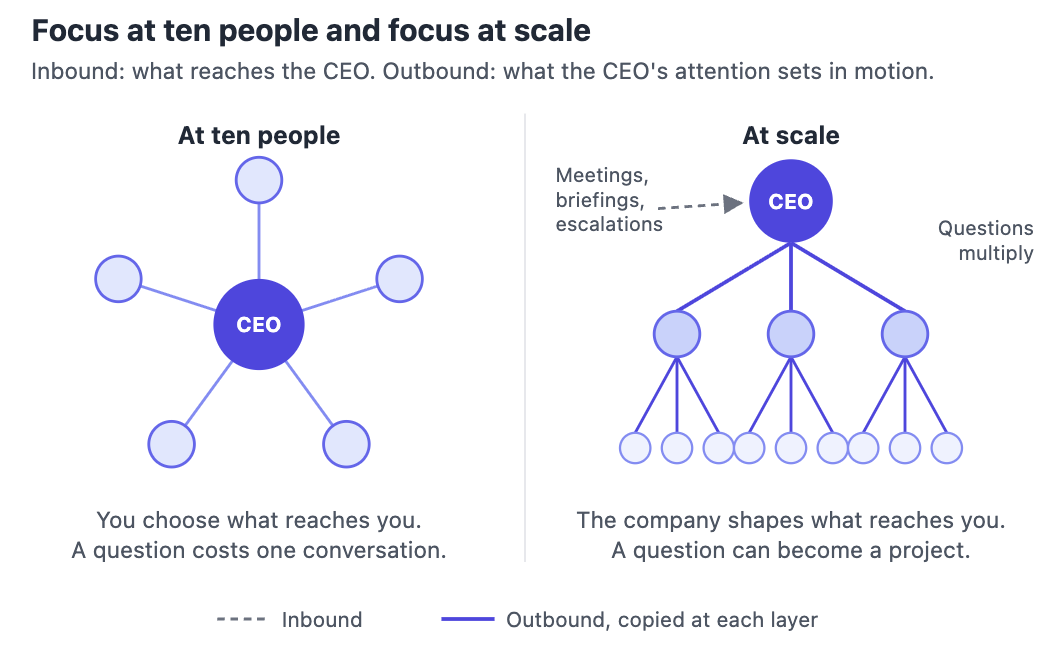
Nothing fails outright when this happens. The CEO simply has less say over their own attention, and more effect on everyone else's.
Why do founders miss the shift?
Founders miss the shift because the inbound side feels like a discipline problem and the outbound side doesn't feel like anything. A CEO can see a crowded calendar. They can't see the hours a casual Tuesday question created two levels down, because nobody reports that work back to them.

Bain & Company measured how far the demands of one senior meeting can travel. Its consultants analyzed time use at one large company and found that people there spent 300,000 hours a year just supporting the weekly executive committee meeting. It's one large company, and no startup will match the number. The editorial team would expect the direction to hold at any size.
Attention amplification is the name this guide uses for that effect: a leader's passing question, comment or reaction turned into work by the people below them. The more layers a company has, the more people each signal reaches. An hour of CEO attention spent on the right question improves the work of many people. An hour spent on the wrong one redirects them.
Noah puts the same mechanism in terms of response time, in the same post on prioritizing:
Every urgent request you respond to immediately is a signal to your organization that urgency gets rewarded over importance.
In other words, response time is a broadcast. The team learns what matters less from the strategy deck than from what the CEO answers fast, asks about twice and turns up for.
None of this shows up as a problem. Amplified work looks like a responsive, high-performing team. People rarely tell a CEO that a question became a project, because saying so can sound like pushing back. So the CEO sees diligence, and the company's focus drifts toward whatever the CEO looked at last.
When our editorial team analyzed the guides that rank for this question, we found they treat focus as something the CEO does to their own calendar and priority list, which is the inbound half. The outbound half is the one a CEO can't see from inside, so it usually goes unmanaged.
How do you tell which kind of focus problem you have?
A two-way focus audit is a review of the last two weeks from both directions. The first half asks who put each hour on your calendar. The second asks what each of your questions turned into. Together they show whether a focus problem is a habit to tighten, an inbound structure to change or an outbound signal to manage.
The first half extends a practice Noah describes in the same post on prioritizing: "I audit almost all of my clients' calendars at some point. And I often find that their calendars don't reflect their priorities." That finds the gap. Asking who scheduled each hour explains it, and the explanation decides the fix.
Reading the result takes judgment, and the patterns below are illustrative, not benchmarks. If most of the hours that miss the few decisions are ones you put there yourself, the problem is a habit. The ten-person habits still work, so tighten them. If most were put there by your team or by outsiders, the problem is inbound structure, and no amount of personal discipline will hold against a calendar other people fill.
If the outbound half shows many hours of other people's work spent on questions that served none of the few decisions, the problem is amplification. In the editorial team's view, it's usually the costliest of the three, because it spends other people's focus as well as yours.
Part B takes more effort, because the evidence is scattered. Search your sent messages and meeting notes for questions and requests, then ask the people who received them what happened next. For example, a question you meant as idle curiosity may turn out to have become a week of analysis.
When does the shift from habit to system happen?
It doesn't happen at a fixed headcount. The signals are behavioral. You learn about work you started from someone else's status update. A casual question comes back as a deck. Recurring meetings you attend begin to need meetings that prepare for them. Most of your calendar sits in the column marked "my team" or "outside." When two or more of these show up (an illustrative line, not a rule), habits that suited a ten-person company have stopped being enough on their own.
Focus as an organizational system: two sets of practices
As an organizational system, focus is two sets of practices, one for each direction. Inbound practices decide what reaches the CEO and in what form. Outbound practices decide how much weight the CEO's attention carries when it leaves them. Founders tend to build some of the first. The second is the one that's usually missing.
Inbound: decide what reaches you
Nicolini and Korica's chief executives built practices to activate attention, regulate the quantity and quality of information, stay focused over time and prioritize. A startup CEO needs a smaller version of the same thing: a deliberate choice of what to read each week and an agreed format for how people brief you. Which events may interrupt the CEO is a separate design question, handled by the operating systems that take decisions off a founder's desk. A chief of staff or executive assistant can run much of the inbound side.
Outbound: decide what your attention sets off
The outbound side needs practices that most CEOs never write down. Four do most of the work:
- Weight every ask. Say which of three kinds a question is: thinking out loud, which needs no action; wanting a view, which needs a reply and not a document; or needing a decision by a named date. The weight travels with the question, so nobody has to guess how seriously to take it.
- Send stray asks to a list, not a person. When an idea doesn't touch the few decisions that matter this quarter, write it on a running list instead of handing it to someone. Review the list weekly. Most items die there, which is the point.
- Match response speed to importance. Taking Noah's point about urgent requests seriously means answering low-stakes requests deliberately slowly, and explaining why once, so the team reads the delay correctly.
- Count the preparation before adding a meeting you attend. At the large company Bain studied, people spent 300,000 hours a year just supporting one weekly executive committee meeting. Your presence makes a meeting expensive for everyone who prepares for it, so a new recurring meeting with the CEO in it should justify its total cost, not just its hour on your calendar.
These practices have a cost. Weighted asks and slower replies can feel less engaged to a team used to a hands-on founder, and some good ideas will sit on the list too long. That cost is real. However, it's smaller than running a company that can't tell the CEO's curiosity from the CEO's priorities.
Doesn't founder mode say the CEO should stay in the details?
It does, and the two-way view doesn't contradict it. In his 2024 essay Founder Mode, Paul Graham argues that the standard advice, summarized as "hire good people and give them room to do their jobs," fails many founders. "In effect there are two different ways to run a company: founder mode and manager mode," he writes, and he predicts that skip-level meetings will become the norm.
Founder mode raises the stakes on the outbound side. A CEO who reaches deep into the company sends more signals to more people, and each one is amplified by everyone who wants to respond well. The founder who goes deep without weighting their asks will find the company working on whatever they looked at last.
The answer is choosing which details to look at. Everything the CEO looks at gets worked on. The deeper a CEO goes, the more the outbound half of the audit matters, and the more useful it is to say out loud when a question is only a question.
Frequently asked questions
Do board and investor demands count as outside hours in the audit?
Yes. Tag them as outside, even though most can't be dropped. What can usually change is how much of the CEO's own attention they take. Batch the preparation into one block you choose, and let someone else assemble the materials the CEO only needs to review.
How do you tell a manager their briefings are over-prepared?
Say what weight you want next time, and frame it as a change in your request. A one-page note or a five-minute verbal update is often enough. Then ask the manager what they would cut from the last briefing, which shows where the extra effort went.
Is it harder for a remote startup CEO to stay focused?
The inbound side is often easier remotely, with fewer interruptions in person. However, the outbound side tends to be harder. A question typed into a shared channel reaches more people than one asked across a desk, and it carries no tone of voice to show how much it matters. Weighting asks explicitly matters more in a remote company.
Do focus apps and productivity tools help CEOs?
They help with the personal, inbound side: blocking time, muting notifications and batching messages. None of them shows a CEO what their questions turned into across the company, which is where a growing startup loses a lot of its focus. Use them for the habits, and use the audit for the rest.
What should a CEO change in the first week after the audit?
One thing on each side. Inbound, pick the largest block of hours that others put on the calendar and that served none of the few decisions, then change its format or frequency. Outbound, start weighting asks straight away and tell the leadership team why, so the new signals are read correctly.
What does a coach add to a calendar audit?
Mostly an outside view of the outbound side. A CEO can count their own hours, but the work their questions created sits with other people, who may be reluctant to describe it to the CEO. A coach can gather that picture through conversations with the team, and help the CEO decide which signals to change first.
At scale, the company works on what you look at
At ten people, a startup CEO keeps focus by guarding their own time, and that's enough because the CEO's attention and the company's attention are nearly the same thing. As the company grows, they separate. The organization decides much of what reaches the CEO, and it turns what the CEO looks at into work. If the outbound half is hard to see from inside, a conversation with a coach is one way to get an outside view. Guard what reaches you, and weigh what leaves you.
Sources
- Towards an attention-based view of the firm, Strategic Management Journal
- Attentional Engagement as Practice: A Study of the Attentional Infrastructure of Healthcare Chief Executive Officers, Organization Science
- Why is it so hard to do my work? The challenge of attention residue when switching between work tasks, Organizational Behavior and Human Decision Processes
- Let's fix it: Kill the weekly meeting, Bain & Company
- Maker's Schedule, Manager's Schedule, Paul Graham
- Founder Mode, Paul Graham
- How much sleep do I need as a founder?, Startup CEO Coach
- How do I prioritize when everything feels urgent?, Startup CEO Coach