.png)

Most prioritization advice quietly assumes you already know what matters. Sort tasks into urgent and important, protect the important ones, cut the rest. It's clean, it's sensible, and it falls apart the moment you actually need it, because the situations that break a founder aren't the ones where importance is obvious. They're the ones where you genuinely can't tell yet.
That's the real problem with prioritizing under uncertainty. It isn't that there's too much to do. It's that the future is unreadable, the information is incomplete, and "important" collapses into "whatever feels important right now." A framework built to sort known quantities is useless when the quantity you're missing is the one that decides everything.
How do CEOs prioritize under uncertainty?
Under genuine uncertainty, effective CEOs stop trying to rank their options by importance and start sorting them by four properties they can actually judge: how reversible each choice is, what waiting really costs, whether delay will produce better information, and what their own conviction is telling them. The goal isn't to predict which move matters most. It's to sequence action when prediction isn't available.

This is a different problem than the one most prioritization guides solve. When your calendar is simply overloaded, the discipline is elimination: name the one thing that matters and say no to the rest. That's a real skill, and it deserves its own treatment, which is why we cover it separately in our guide to prioritizing when everything feels urgent. But that guide assumes you can see which task is important. Uncertainty removes exactly that. The question stops being "which of these matters most?" and becomes "which of these do I act on when I can't yet tell?"
Underneath almost every failure of prioritization under uncertainty sit two disguised errors. The first is treating loud as important: letting the task that arrives with the most volume jump the queue. The second is treating uncomfortable as uncertain, labeling a hard call "unclear" when it's really just avoided. Uncertainty is the perfect hiding place for both, and the framework below is built to drag them into the light.
Why does normal prioritization break under uncertainty?
The Eisenhower Matrix and its cousins break under uncertainty for one structural reason: they require you to rank tasks by importance, and importance is a function of outcomes you can't yet see. Strip away the ability to know how things turn out, and "important" quietly becomes "feels important right now," which is just urgency wearing a better suit. The tool still runs; it just sorts on a value you no longer have.
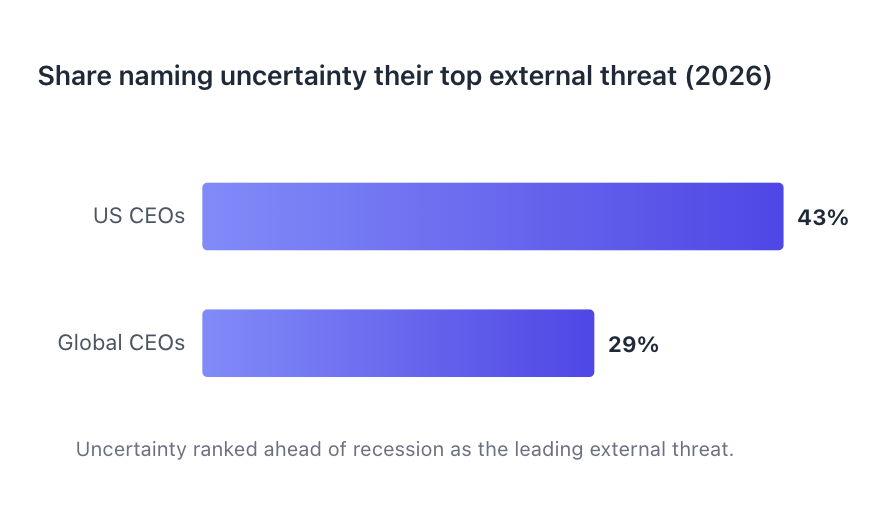
And this isn't a rare edge case anymore. In its C-Suite Outlook 2026 survey of more than 1,700 executives, The Conference Board found that 43% of US CEOs named uncertainty itself the external factor most likely to hurt their business in 2026, ranking it above recession and far higher than the 29% of CEOs globally who said the same (The Conference Board, 2026). For a growing share of leaders, deciding without a clear read of the future is now the default operating condition, not the exception.
Founders are especially exposed to this. There's no manager above them to sanity-check the ranking, incomplete information is the normal state rather than a temporary gap, and outcomes are high-variance enough that a "small" call (one hire, one pricing change) can quietly outweigh a "big" one. Worst of all, under uncertainty the correct discipline and the favorite excuse wear the same face. "Let's get more data" is exactly what a careful operator says, and exactly what an avoidant one says. From the inside, they feel identical.
There's a well-worn pattern here that founder coaches see constantly: people tend to sense the difficult truth internally well before they act on it, and "not enough information" becomes the socially acceptable reason to wait. It's worth reading why founders avoid difficult decisions and what it actually costs, because the same machinery drives most stalled prioritization. The gap is rarely data. It's the distance between subconscious awareness and honest acknowledgment.
The operator's four questions for prioritizing under uncertainty
When importance is unknowable, sort by what's knowable. Run each competing priority through four questions in order. The answers tell you what to act on now, what to defer with a deadline, and what you're quietly avoiding. None of the four asks you to predict the future. Each asks something you can answer today.
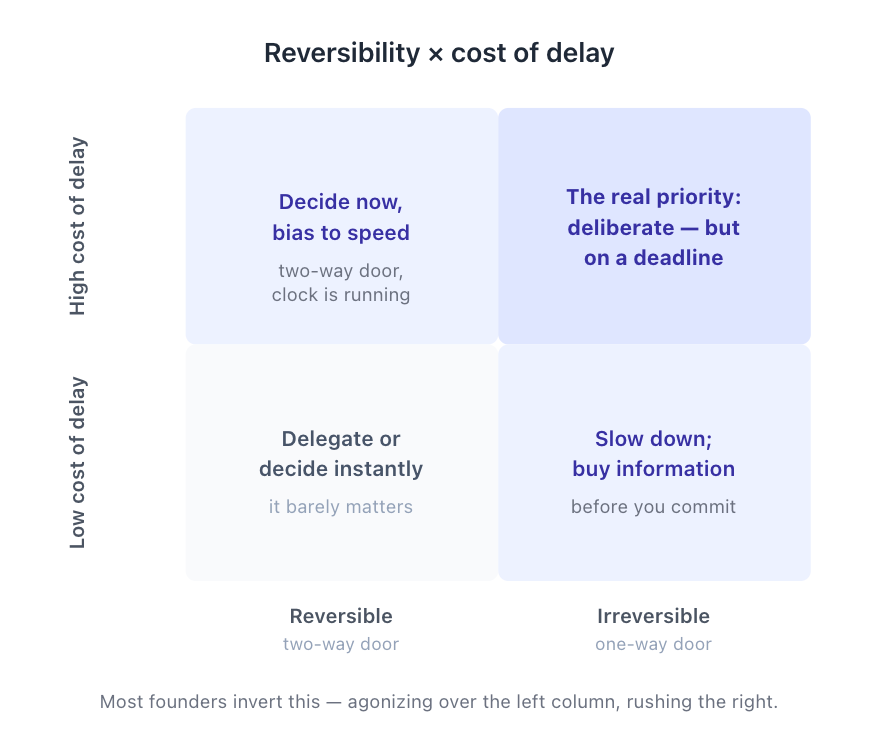
Question 1. Reversibility: if this goes wrong, can I undo it? In his 2016 letter to Amazon shareholders, Jeff Bezos drew a line between two kinds of decisions: "Many decisions are reversible, two-way doors" that deserve a lightweight process, and one-way doors that don't. Reversible calls should be made fast, even under high uncertainty, because the cost of being wrong is low and recoverable. Irreversible ones (a layoff, a pivot, a co-founder split, a fundraise on ugly terms) earn genuine deliberation. Most founders get this exactly backward. They agonize over the reversible calls and rush the doors that don't reopen.
Question 2. Cost of delay: what does waiting actually cost, in dated terms? Force a number or a date onto it. Real urgency carries a compounding cost: runway burns, a window closes, a competitor moves, a team stays blocked. Manufactured urgency carries an emotional cost: someone is anxious and wants to feel it's handled. If you can't name what waiting concretely costs, and by when, the item isn't urgent. It's just loud.
Question 3. Information gain: will waiting genuinely reduce the uncertainty? This is the avoidance detector. If a week of waiting buys materially better information (a cohort matures, a test returns, a customer signs), then waiting is diligence. If it buys nothing but distance from the discomfort, waiting is avoidance in a nicer suit. The test is concrete: name the specific piece of information the delay will produce. If you can't name it, decide now.
Question 4. Conviction check: strip out the fear, do I already know the answer? Under uncertainty, "I need more data" is often a mask for "I know what to do and I'm afraid to do it." Ask what you'd choose if you knew the outcome would be survivable either way. The answer is frequently already sitting there, waiting for permission.
Here's how they combine. Questions 1 and 2 test whether something is genuinely urgent or important, routing you around loudness. Questions 3 and 4 test whether the uncertainty itself is real or a hiding place, routing you around avoidance. The item that comes out the other side irreversible, high cost of delay, genuinely information-poor, and low conviction: that's where deliberation belongs. Almost everything else resolves faster than it felt like it would. For the reversible calls specifically, the move is speed, which connects directly to making faster decisions as a CEO.
In one line: when you can't rank options by importance, rank them by reversibility, cost of delay, information gain, and conviction: four things you can judge today without knowing how any of it turns out.
How do you tell real urgency from manufactured urgency?
Real urgency survives a dated cost-of-delay question; manufactured urgency doesn't. The fastest field test under uncertainty is a single sentence: "What specifically breaks, and by when, if I do nothing about this for one week?" If the honest answer is silence or a shrug, the task was loud, not urgent. You just felt the volume and mistook it for weight.
Manufactured urgency has recognizable sources: someone else's anxiety, the recency of the last thing you heard, the loudest stakeholder in the room, and the founder's own fear of looking unresponsive. Real urgency looks different. It has a compounding cost, a closing window, or a dependency that leaves other people blocked. Learning to feel the difference matters beyond your own calendar, because a founder who can't filter urgency exports the chaos. The whole company inherits the leader's inability to say "that's loud, it isn't important."
One of the most expensive versions of this is inverted urgency: treating growth as the urgent priority while the genuinely important, uncomfortable call gets deferred. Noah Shanok, founder and former CEO of Stitcher (the podcast platform later acquired by SiriusXM for $325M), has described living exactly that inversion. At Stitcher, hiring felt like the pressing priority; the team scaled toward 35 to 40 people and monthly burn climbed toward roughly $1M while the genuinely important problem, a product that hadn't yet found real product-market fit, stayed deferred, partly out of guilt. The correction, when it finally came, revealed the trap: the smaller, refocused team afterward moved faster, not slower. Growth had been urgent-feeling. Fixing the product had been important. He'd prioritized the first over the second for longer than he should have.
What we see repeatedly: the tasks founders defer under uncertainty are rarely the loud ones. They're the quiet, uncomfortable, often irreversible calls (the personnel decision, the pivot, the honest investor update) that no one is banging on the door about, which is exactly why they slide.
How much information is enough to decide?
Enough is roughly the point where more waiting stops reducing uncertainty faster than delay increases cost, and for most reversible decisions, that's earlier than it feels. In his 2016 shareholder letter, Bezos put a number on it: "Most decisions should probably be made with somewhere around 70% of the information you wish you had." Chasing certainty past that point isn't rigor. It's the most respectable form of procrastination there is, because slowness is itself a cost that never shows up on the invoice.
The practical skill is telling two kinds of uncertainty apart. Reducible uncertainty is the kind a test, a conversation, or a maturing cohort will actually resolve, and that's worth a short, bounded wait. Irreducible uncertainty won't dissolve no matter how long you sit with it, so waiting is pure cost with no upside. Founders routinely treat the second kind as if it were the first, holding out for data that was never going to arrive. When you do choose to wait, set the decision date in the same breath, so "let's wait" has a forcing function and can't quietly rot into "never."
Information vs. time spent waiting
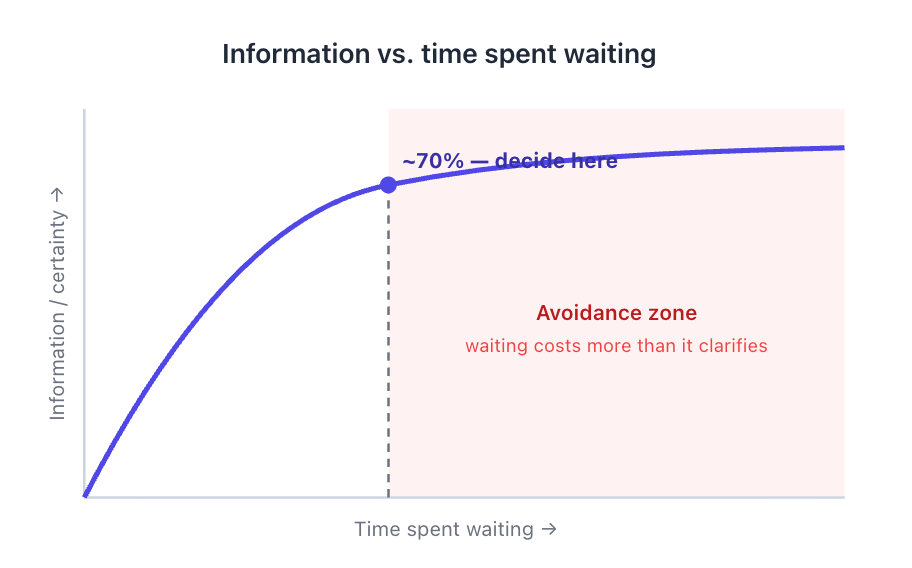
Concept after Jeff Bezos, 2016 Letter to Amazon Shareholders (the ~70% rule).
There's a harder truth underneath the method, though. Decision quality under uncertainty isn't only a framework problem. It's a state problem. Noah has described a stretch during Stitcher's fundraise when he was running on four to five hours of sleep and heavy caffeine, and it showed: in one high-stakes, investor-related meeting his basic cognitive processing faltered at the worst possible time. Later, well-rested and clear, he performed markedly better, and he credits that recovery with materially helping the raise. The uncomfortable implication for every founder is that no prioritization framework survives contact with a depleted operator. If you're deciding on empty, you're not really running the four questions. You're rationalizing. It's why how much sleep you need as a founder is a decision-making topic, not a wellness one, and why chronic depletion sits so close to founder burnout.
In one line: aim for about 70% of the information you wish you had, tell reducible uncertainty apart from irreducible, and remember that a tired brain can't run any framework honestly.
What role does honesty play in prioritizing under uncertainty?
You can only prioritize against reality if you're willing to see it, and under uncertainty, the strongest pull is toward the story you wish were true rather than the operational truth in front of you. Prioritization quietly fails upstream of any framework, at the moment a founder decides which version of the situation to believe. Feed the four questions a flattering read of the facts and they'll give you a confident, wrong answer.
The link between managing optimism and mis-prioritizing is direct. If your internal narrative runs rosier than the numbers, your "important" list gets built on a fiction, and the genuinely urgent problems get deprioritized precisely because naming them threatens the story, especially with the board and investors. Noah has been candid about his own earlier tendency here, describing himself as historically over-optimistic with investors in ways that could slowly erode credibility as the gap between the story and the operational reality compounded. The fix was never pessimism. It was earlier, more transparent communication, which has the useful side effect of forcing an honest problem list. Founders who get this right treat the balance between transparency and optimism with investors as a discipline rather than a mood.
In one line: honest assessment is a precondition for the framework: you can't estimate cost of delay or read your own conviction accurately from a distorted picture of where things actually stand.
How do you prioritize as a team, not just as a CEO?
A prioritization framework that lives only in the founder's head recreates the exact bottleneck it was meant to solve. Under uncertainty, the smartest move is to turn the four questions into shared vocabulary, so the people around you can triage without routing every ambiguous call back through your calendar. A team that can ask "is this reversible? what's the real cost of delay?" on its own filters most of the noise before it ever reaches you.

Two habits make that real. First, communicate the top two or three priorities and the explicit non-priorities. Under uncertainty, naming what you're deliberately not doing is often more clarifying than naming what you are, because it gives people permission to let the loud-but-unimportant things drop. Second, push reversible decisions down and out. If a call is a two-way door, someone closer to it should be making it, fast; only the one-way doors need to climb back to leadership. That's not just a personal prioritization principle, it's a delegation one, and it's a core part of the founder-to-CEO transition. Where it helps, lightweight practices like "disagree and commit" keep a team moving under ambiguity without pretending the ambiguity isn't there.
In one line: make the four questions a shared language and delegate the reversible calls, so the founder becomes the filter of last resort rather than the first stop for every uncertain decision.
How can founders build better prioritization judgment over time?
Frameworks give you a process under uncertainty; they don't hand you judgment. Judgment comes from feedback, and the founder's seat is engineered to withhold it. So the durable improvement isn't "try to be wiser." It's to install, on purpose, the correction the role doesn't provide, and to notice that a blind spot, by definition, is the thing you can't fix by looking harder.
That looks concrete. Keep a simple decision log: what you decided, what you predicted, and what actually happened. Over a few quarters it's the only honest way to calibrate your sense of cost-of-delay and conviction, because memory quietly edits both. Build a real board that pushes back instead of nodding. Find a peer group of founders at your stage who'll tell you when a "data problem" is really an avoidance problem. And protect the cognitive state all of it runs on, because you cannot out-framework exhaustion.

This is also where structured outside perspective earns its keep, particularly on the fourth question. The conviction check is the hardest one to run on yourself, because the fear you're trying to see past is your own. Working with Startup CEO Coach and practitioners like Noah Shanok (recognized for pairing founder psychology with scaling execution), Seed-to-Series C founders spend a lot of that time separating a genuine information gap from a decision they've already made and are avoiding. For a sense of what that work actually involves, see what a startup CEO coach does day to day.
Conclusion
Prioritizing under uncertainty isn't about predicting which move matters most. You can't, and pretending otherwise is how founders end up ranking by volume and calling it strategy. The shift is to rank by what you can actually judge (reversibility, cost of delay, information gain, and conviction), and in doing so, to catch the two errors that quietly wreck the process: mistaking loud for important, and mistaking uncomfortable for uncertain.
- When importance is unknowable, sort by decidable properties, not by a guess at outcomes.
- Run the four questions in order: is it reversible, what does delay cost, will waiting inform me, do I already know?
- Aim for ~70% of the information you wish you had (Bezos, 2016); more than that is usually avoidance.
- The framework is only as honest as the operator running it: protect your judgment and install outside feedback.
Try one thing this week: take your current list of "priorities" and run each through the four questions. Notice how many are loud rather than important, and how many "uncertain" calls are really just uncomfortable ones you already know the answer to. For the calls that turn out to be decisions you've been avoiding, why founders avoid difficult decisions and what it actually costs is the right next read.
Frequently Asked Questions
How do CEOs prioritize under uncertainty?
They stop ranking options by importance, which is unknowable when outcomes are unclear, and rank by what's decidable instead: reversibility, cost of delay, whether waiting produces better information, and their own conviction. It's why 43% of US CEOs called uncertainty their top 2026 threat (The Conference Board, 2026). It's now the default, not the exception.
What's the difference between urgent and important under uncertainty?
Urgent means loud and immediate; important means high-stakes over the next few months. Under uncertainty they blur, because "important" quietly becomes "feels important right now." The cleanest test is a dated cost-of-delay question: name what specifically breaks, and by when, if you wait a week. No dated cost means it's loud, not urgent.
Why doesn't the Eisenhower Matrix work for startup founders?
The Eisenhower Matrix requires you to sort tasks by importance, but genuine uncertainty removes your ability to know which tasks are important in advance. It's a fine tool once importance is knowable. When it isn't, it silently sorts on urgency instead, which is exactly the error founders need to avoid when deciding under incomplete information.
How much information should a CEO have before deciding?
Around 70% of the information you wish you had, per Jeff Bezos's 2016 Amazon shareholder letter. Past that, waiting usually costs more than it clarifies. The nuance: distinguish reducible uncertainty a test will resolve, which can justify a short bounded wait, from irreducible uncertainty that no amount of waiting will ever clear.
How do you know if you're being patient or just avoiding a decision?
Ask what specific information the delay will actually produce. If you can name it (a cohort maturing, a test returning, a customer signing), waiting is diligence. If you can't name anything concrete, the delay is buying nothing but distance from discomfort, and that's avoidance. Patience changes your answer over time; avoidance only changes your excuses.
How does coaching help founders make better decisions under uncertainty?
The hardest question to run on yourself is the conviction check, because the fear you're trying to see past is your own. Outside perspective helps separate a real information gap from an already-made decision you're avoiding. Many venture-backed founders use a CEO coach for exactly this kind of blind-spot work, alongside a board and a peer group.
Sources
- The Conference Board, C-Suite Outlook 2026: Uncertainty and Opportunity (survey of 1,700+ executives, 750+ CEOs), 2026, retrieved 2026-07-03, https://www.conference-board.org/topics/c-suite-outlook/press/c-suite-outlook-2026
- Jeff Bezos / Amazon, 2016 Letter to Shareholders (the ~70% information rule; one-way vs. two-way door decisions), 2017, retrieved 2026-07-03, https://www.aboutamazon.com/news/company-news/2016-letter-to-shareholders