
Startup CEOs maintain strategic clarity during hypergrowth by removing goals as fast as growth adds them. Clarity is rarely lost through confusion. It's lost by addition. A funding round, a first executive, a large customer or a new market each brings a good reason for a new goal, and almost nothing gets retired to make room.
The cost doesn't show up as a strategy problem. It shows up as a company that feels slow, with busy people and too little finished. Founders read that as a performance problem and respond with more hires, more process and more goals, which makes the pile bigger.
This guide covers what strategic clarity means as a startup scales, why goals pile up, which growth triggers add them, how to tell lost clarity from weak execution and how to rebuild clarity by making subtraction routine.
What does strategic clarity mean as a startup scales?
Strategic clarity is the state in which people across a company can say what it's trying to achieve, where it's choosing to compete and what it has decided not to do, and would say it the same way. It belongs to the strategy itself. A twelve-goal strategy repeated every week is still unclear, because nobody can act on twelve goals at once.
That bar is harder to clear than it sounds. In a 2008 Harvard Business Review article, David Collis and Michael Rukstad argued that "most executives cannot articulate the objective, scope, and advantage of their business in a simple statement." Those three words make a useful working definition. In practice, objective is what the company is trying to achieve, scope is where it plays and where it doesn't, and advantage is why it should win there.
Growth tests scope first. Every new opportunity widens where the company plays unless someone deliberately narrows it again.
This guide is about the company's goal list and why it keeps getting longer, which is a separate job from choosing which goal matters most when the future can't be read. Strategy is what the company works on. What the CEO does with their own attention as the company grows is a different question.
Why does strategic clarity survive at ten people and break at forty?
At ten people, capacity enforces clarity. A team that small can't run five initiatives at once, so it runs one, and the constraint does the paring for free. Growth removes that ceiling, which is one of the quieter things that breaks as a startup scales. At forty, the company can start five things, so it does, and nobody sees the cost until everything slows down.

Noah Shanok founded Stitcher in 2006, ran it as CEO for eight years and now coaches venture-backed CEOs through Startup CEO Coach. He puts the constraint in one line:
In the early days, you can only fry one fish well, and even that is very hard.
The "early days" in that line describe the constraint that used to do the paring. At ten people, frying a second fish meant taking someone off the first, and everyone could see it happen. At forty, however, the second fish gets its own small team, or a slice of several people's time, and the trade-off disappears from view.
Research on multiple objectives points the same way. In a 2020 study in the Strategic Management Journal, Tomasz Obłój and Metin Sengul used data from French manufacturing firms that recorded both the objectives each firm pursued and how it performed. They found that "performance on any given dimension decreases with the number of other, simultaneously, followed goals." The effect held for most of the objectives they studied, though not all.
Those are established manufacturers, a long way from a Series A startup, and the authors also found real benefits from pursuing several objectives, which come up below. The cost they measured is the one founders feel at forty: each goal pursued alongside others tends to perform worse on its own measure.
Why do goals pile up as a startup grows?
Goals pile up because adding feels like progress and removing feels like loss, and people look for additions first. Every new goal arrives with a sponsor and a reason. Removing an old one has no sponsor at all, so it rarely makes the agenda.
In 2021, a team of researchers published eight experiments in Nature showing that "people systematically default to searching for additive transformations, and consequently overlook subtractive transformations." Participants were less likely to spot a helpful subtraction when nothing in the task prompted them to consider one, and when they were under higher cognitive load.
The study measured individual problem solving, not companies. The editorial read is that hypergrowth recreates both of its conditions. Founders work under heavy load, and nothing about a funding round, a hire or a customer win prompts anyone to ask what should stop. The authors themselves suggest the additive default "may be one reason that people struggle to mitigate overburdened schedules, institutional red tape and damaging effects on the planet."
When our editorial team analyzed the articles ranking for strategic clarity in fast-growing startups in October 2026, we found none that explained why the goal list grows in the first place.
What does a long list do once it exists? Simulation research gives one answer. In computational experiments published in Organization Science, Sendil Ethiraj and Daniel Levinthal found that imposing many weakly related performance goals on even simple organizations leads to a performance freeze, because the simulated organizations couldn't find choices that improve performance across all of them. Their conclusion was that management, by articulating a subset of goals, "provides a degree of clarity and focus."
Five growth triggers that add goals
Clarity rarely erodes gradually. It drops at specific moments, when something new enters the company with a goal attached. Five triggers account for much of it, and each one arrives with a legitimate reason to add. A trigger map is a list of those moments, what each one adds and the removal question it should force.
None of these triggers is a mistake. A round should fund more ambition, and an executive should arrive with a plan. The problem is timing. Each trigger lands at a moment of momentum, when everyone in the room is cued to add and nobody is cued to remove.
The funding trigger does the most damage, because it adds people as well as goals. Hiring ahead of evidence is one of the early warning signs of scaling too fast, and a longer goal list gives every new hire a project to justify.
The first executives and the first large customers add goals more quietly. An executive's roadmap arrives as a plan for one function, so it looks like detail rather than strategy, but every plan claims people and time. A large customer's requests arrive piecemeal, and each is small enough to approve without asking what it displaces.
Triggers also explain why clarity can collapse at very different sizes. For example, a company of thirty that closes a large round and hires three executives in a quarter can lose clarity faster than a company of eighty whose goals haven't changed in a year. Headcount is a rough proxy. The triggers are what move the list.
Why do founders mistake too many priorities for a performance problem?
Because the symptoms are execution symptoms. Too many goals spread people across initiatives, so everything moves slowly. Slow work looks like weak people or a broken process, and founders respond to what they can see.

The usual responses each add something. A founder hires to speed things up, introduces a planning process or another layer of objectives, or reorganizes around the latest priorities. Every one of those fixes is itself an addition. As a result, if the list was the problem, the company now has more people waiting on the same overloaded goals.
Sometimes the people fix is right, so the question is which problem you have. These signals point to the list rather than the team. They're illustrative, a starting point for judgment:
- There are more live initiatives than teams that can own them outright.
- The same people appear on three or more initiatives.
- Plenty gets started and little gets finished.
- The oldest open initiative predates the last funding round or executive hire.
- Nobody can name a goal the company dropped since the last trigger.
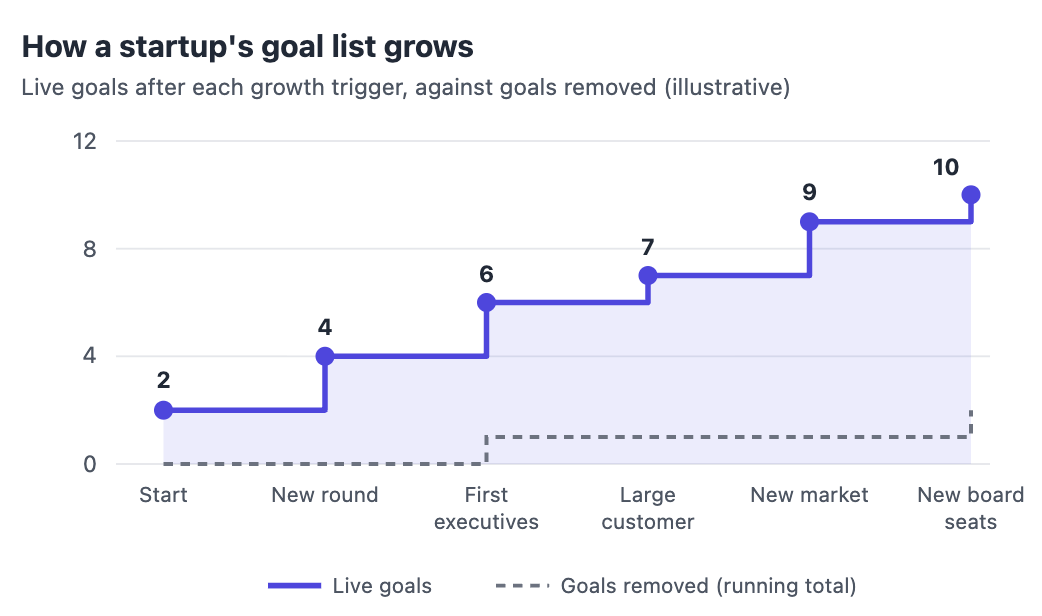
Noah's coaching methodology rests on a related premise. It starts by interviewing six to eight people who know a client best professionally, and the page describing it explains why: "I'm looking for the patterns everyone around you sees that you don't." Applied to the goal list, the editorial read is that the team usually sees the pile before the founder does. A team carrying the ten goals from the chart above knows it. The founder who added them one at a time often doesn't.
Before blaming the team, rule out two other explanations: a leadership team ranking the same goals in different orders, and the founder's own development as the limit on how fast the company can move. Both show up as leadership-team misalignment, and both need a different fix from cutting goals.
How do you rebuild strategic clarity as a startup scales?
Make subtraction routine. Clarity comes back when removing goals becomes part of how the company handles each trigger, instead of a cleanup at the annual offsite. Two tools make that concrete: a trigger map (the list of growth moments and the removal question each should force) and a goal ledger.
A goal ledger is a running record of every live goal, the trigger that added it, who owns it and what was removed when it arrived. It turns subtraction from a good intention into a column someone has to fill in.
Reading the ledger takes a few minutes. Count additions and removals since the last trigger. A goal without dedicated people is a wish rather than a goal. A row with "nothing" in the last column marks a point where clarity leaked. The analytics add-on in the example has both problems, with no dedicated people and nothing removed.
Four practices keep the ledger honest:
- Ask the removal question at every trigger. Before a new goal starts, decide what it replaces. In the Nature experiments, people were more likely to find helpful subtractions when the task cued them to consider removing something, and the removal question is that cue, asked at the moment goals are most likely to be added.
- Publish a dated stop list next to the goals. A decision not to do something should be as visible, and as clearly dated, as a decision to do it. Otherwise stopped work drifts back in.
- No goal without people. A goal staffed by borrowing time from people already on another goal goes back on the list until someone owns it.
- One goal per team at a time. Extending the fish line, the editorial rule is that a growing company can carry several goals at once only when each has its own team. Inside a team, it's still one at a time.
Subtraction has a cost. Every goal on the list was a reasonable yes, and some of what gets cut would have worked. That said, the alternative is a company that keeps all of them and finishes few.
Doesn't hypergrowth require pursuing several goals at once?
Sometimes, and the research says so. Obłój and Sengul found that setting several objectives also brings "a benefit of alleviating tradeoffs in achieving higher performance in multiple dimensions." Their own example is manufacturers that try at the same time to cut costs, raise revenue and improve margins.
Those goals check one another. Pursued alone, cost-cutting can starve revenue and a revenue push can erode margins. The editorial read is that setting all three helps keep any one from being sacrificed to the others. Hypergrowth usually creates a different situation. New goals don't balance the existing ones. They compete with them for the same people.
The editorial position is that the answer is structure. Several goals work when each has its own team and the ledger shows what each one displaced. They fail when they share the same people, which is exactly what happens when goals arrive faster than hiring.
A practical test follows from the ledger. If a new goal checks or balances an existing one, and the people to pursue it are already in place, it can sit alongside. If it needs people who are committed elsewhere, it's competing, and something has to come off the list first.
Applied to a larger company, the editorial team's rule is simple. A company of two hundred can fry several fish at once, but each team is still a small kitchen.
Frequently asked questions
Do OKRs help or hurt strategic clarity?
They help if each cycle also records what ended. OKRs give the goal list a format and a cadence, which makes it easier to see. Without a rule for retiring objectives, they turn the pile into a spreadsheet: every quarter adds a few, and last quarter's survivors carry over by default.
Should a startup start a second product before the first is working?
Usually not. "Working" here means the first product no longer needs the people a second one would take. Before that point, a second product competes for engineering time the first one still needs, and it makes it harder to tell which product is actually struggling.
Who decides what the company stops doing?
The CEO makes the final call. The leadership team's job is to make the cost of each removal visible: which customer, revenue or person is affected, and what gets faster if the goal goes. A stop decision made without that input tends to come back.
What should happen to the people working on a goal that gets cut?
Move them onto a goal that remains, ideally one that's short of people. Explain why the goal ended and what it was traded for, so the move doesn't read as a judgment on their work. Cutting a goal without redeploying its people tends to recreate the same goal informally.
Should the whole company see what was stopped, or only the leadership team?
The whole company. People below the leadership team are the most likely to keep working on a cut goal, because nobody told them it ended. Without that, a stopped goal keeps using time at the edges of the company long after the leadership team has moved on.
What does an outside view add when the goal list keeps growing?
Someone outside the company can see the whole list without being attached to any single goal on it. Inside, every goal has a sponsor who can explain why it matters. An outsider can ask the question nobody inside is cued to ask: what would you stop if you had to?
Clarity comes back by subtraction
Startups don't usually lose strategic clarity because the founder forgets the strategy. They lose it because every trigger adds a goal and almost nothing leaves. At ten people, the size of the team kept the list short. At forty, someone has to do that job on purpose. If nobody inside the company can cut the list, working with a coach is one way to put the question to someone with no goal of their own on it.
At the next trigger, name the goal that ends before the new one begins.
Sources
- Can You Say What Your Strategy Is?, Harvard Business Review
- What do multiple objectives really mean for performance? Empirical evidence from the French manufacturing sector, Strategic Management Journal
- People systematically overlook subtractive changes, Nature
- Hoping for A to Z While Rewarding Only A: Complex Organizations and Multiple Goals, Organization Science
- Coaching methodology, Startup CEO Coach