.png)

Ask a founder when their company started to feel harder to run, and most won't say "gradually." They'll name a moment. A hire who should have taken a week landed in the wrong role for three months before anyone noticed. A customer commitment fell through a gap because two teams each assumed the other owned it. Scaling doesn't strain a company evenly. It breaks specific things at fairly consistent points, roughly every time headcount crosses a threshold the company's informal habits were never built to survive.
What breaks is never just "the team." Three separate things break, usually in the same order. The team itself: who's in the room and how they coordinate. The systems meant to replace what used to happen by osmosis. And the founder's own role, which keeps changing faster than most founders notice. This guide maps where each one tends to break, and offers a way to check which of the three is actually binding right now, whatever the org chart says.
Why does scaling break companies in stages, not gradually?
Between thresholds, growth feels almost manageable. Headcount climbs, revenue climbs, and the way the company actually runs barely changes. At the threshold itself, something that worked perfectly well suddenly doesn't. A decision that used to take an hour takes a week. A hire who would have been an obvious pass six months earlier gets made anyway. A founder who used to know everything happening in the building stops knowing, and often doesn't notice for a while.
Noah Shanok, founder and former CEO of Stitcher, the podcast platform later acquired by SiriusXM for $325M, and a startup CEO coach, treats this as a timing problem tied specifically to product-market fit. His framework puts a rough ceiling on how far a team should grow before the company has real traction. Past roughly 10 to 15 people without product-market fit, more headcount tends to make a company slower rather than faster. A larger team is unusually good at manufacturing the appearance of momentum, meetings, roadmaps, visible busyness, while the actual problem stays unsolved. He puts the underlying test in plain terms: "The simplest test: stop hustling for a week. If your metrics hold, you have something real. If they collapse, you're still pushing" (How do I know if I have product-market fit?, 2026).
That test matters here because it's the only one of the four thresholds in this guide a founder can fail before growth even becomes the issue.
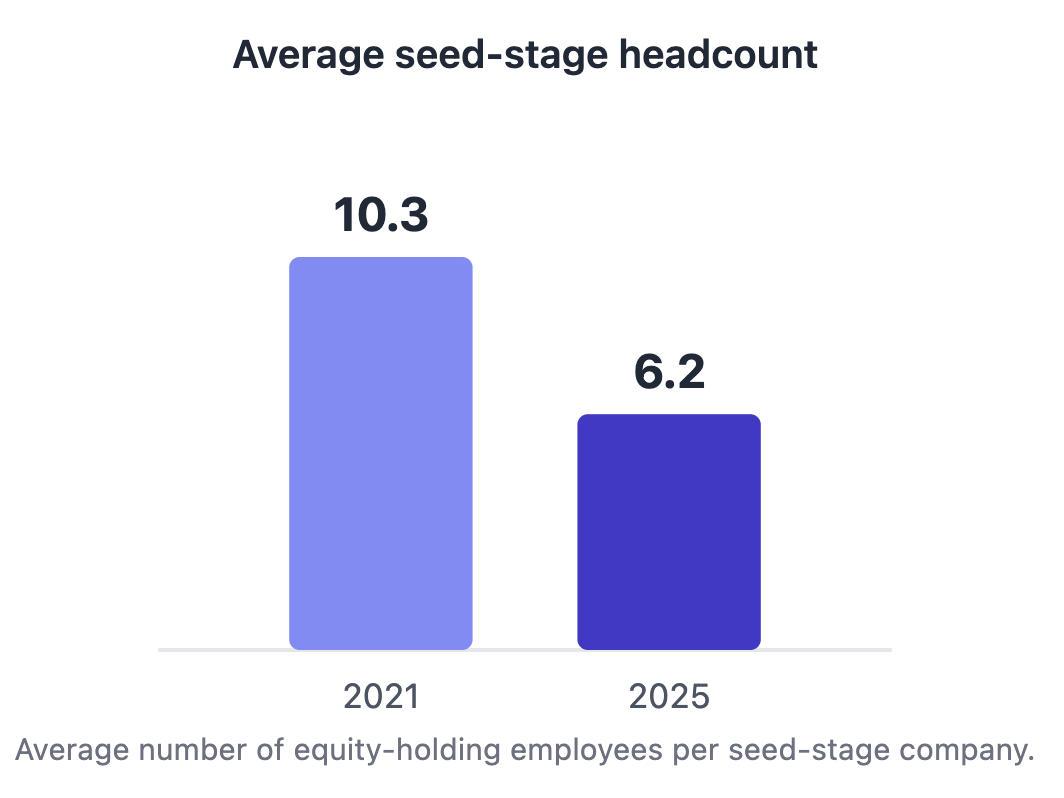
That ceiling has also been dropping for a structural reason: a funding round buys less headcount than it did in 2021. In 2025, Carta found the average seed-stage company employs 6.2 people, down from 10.3 in 2021 (Carta, State of Seed, Winter 2025, 2025). A company reaching the first threshold in this guide now does it on a smaller round than it would have three years ago, which is part of why the breaks below tend to arrive earlier and harder than founders expect.
Where does that leave a founder trying to anticipate what's coming? Three places: the team, the systems, and the job itself.
What breaks at the first real threshold, roughly 10 to 15 people?
At 10 to 15 people, the first thing to break is invisible from inside the room: free coordination. Before this point, everyone hears everything just by being nearby, so a decision gets made once and a customer issue gets caught by whoever's closest. Past it, that stops being reliable, and most founders don't notice until something falls through a gap nobody was covering.
Team-wise, hiring can still run almost entirely on instinct and relationship at this size: a warm intro, a gut read in one conversation. The team is small enough that a bad hire is obvious within weeks, which is exactly why hiring discipline so rarely gets built here. Its absence isn't punished until later, when the team is too big for a bad fit to stay this visible.
On the systems side, having almost no formal process is usually correct at this stage. Building workflow and documentation for a ten-person company is often process built for a company that doesn't exist yet, and it tends to slow the team down rather than protect it. The real risk here isn't too little system. It's over-building one out of anxiety about what's coming next.
For the founder, this is still a stage of doing meaningful work directly, and that's appropriate too. What this stage actually tests is whether the company has found product-market fit before it grows past this size, which is exactly what the threshold above is a warning about. Get that wrong, and every later stage compounds the mistake.
What breaks at roughly 25 to 30 people?
Somewhere around 25 to 30 people, a company crosses a line most founders don't see coming: for the first time, there are people two degrees removed from the founder whose daily work the founder can't personally observe. This is usually where a management layer stops being optional, and where a founder faces the first real test of delegating a decision rather than just a task.
A first layer of managers typically gets installed here, and it's usually reactive, built only after something has visibly gone wrong. Hiring-bar drift becomes possible for the first time too, since the founder is no longer sitting in every interview.
There's supporting context for this outside the startup world too: research on first-line managers has found a negative, if inconsistent, association between an expanded span of control and job satisfaction (Svanström et al., Work, 2025).
The informal tools that worked fine at fifteen people, a shared inbox, a running doc, a standing weekly sync, start failing quietly. Not by collapsing outright, but by producing small gaps nobody notices until a candidate or a customer falls through one.
This is the first genuine delegation test, and it's a different test than founders think they're taking. Delegating a task is easy by this point. Delegating a decision someone else will make differently than the founder would have is not. Founders tend to fail this test in one of two directions: delegating everything, including calls only they should make, or delegating nothing and quietly becoming the bottleneck the next threshold will expose. The identity shift underneath that second failure mode is what the transition from founder to CEO is actually about.
What breaks at roughly 50 people?
Fifty people is where most existing scaling advice stops and stares. It's the headcount most often cited as the point where startups start to feel fractured, usually described in purely social terms: cliques, resentment, nostalgia for "the good old days." That social strain is real, but it sits downstream of two more concrete breaks. Decision rights stop being obvious, and the founder can no longer physically be in every room that matters.
A second layer of management is often required here, since managers now have to manage other managers, which is where hiring-bar drift compounds if it started at 25. Who fills that layer matters more than founders tend to assume: managers account for at least 70% of the variance in team engagement across business units (Gallup, State of the American Manager, 2015). A weak second layer drags down everyone underneath it.
Decision rights, who's actually allowed to decide what, without checking, become the binding constraint at this size. Without an explicit answer, decisions either default back to the founder or get made inconsistently by whoever happens to be in the room that day, the same decision-load problem that keeps compounding until someone builds explicit rights around it. The absence of a system, not a mistake by any one person, is the real problem here.
The founder's calendar also stops being able to cover the business through sheer attendance. It's worth checking whether the calendar and the stated priorities still match, because they rarely do by this point.
The parallel breakdown in how information moves at this size, and how to rebuild it deliberately, is covered in startup CEO coaching when you're scaling from 20 to 100 employees.

What breaks past 100 people?
Past 100 people, the breaks compound instead of appearing fresh. A team problem left unaddressed at 50 becomes a culture problem at a hundred. A systems gap that stayed informal at 50 becomes a visible operational failure at a hundred, because there are now enough people, and enough distance from the founder, that nothing self-corrects through proximity anymore.
Multiple management layers exist by now, and culture depends entirely on what those layers model and reinforce. It doesn't transmit from the founder directly to a new hire at this size, no matter how often the founder repeats the message personally.
Informal systems stop failing quietly. What was a small gap at fifty becomes a visible operational failure at a hundred: missed handoffs, duplicated work, decisions made in one part of the company that quietly contradict decisions made in another. The two parts never talked to each other in the first place.
The founder's job is now almost entirely about people and decisions rather than product or execution. A founder still trying to be the best individual contributor in the building isn't just inefficient at this size. They're actively in the way, and the leadership gap this creates has its own diagnostic in why rapid growth creates leadership problems.
The breakage map: team, systems, and founder role at a glance
Laid out side by side, the pattern forms a map: at each stage, one of the three dimensions is usually the binding constraint, and it shifts in a fairly predictable order as headcount grows.
Treat the numbers in that table as approximate thresholds, not hard cutoffs. A company that hired slowly, started with an unusually senior founding team, or works fully distributed can hit a fifty-person-style break at thirty people, or avoid it until seventy. What matters more than the number on the org chart is which symptom is actually showing up, which is what the next section checks.
How do you know which stage you're actually in?
Headcount is a proxy, not a law, so the more reliable check is the symptom, not the number. Three sets of signals separate cleanly by dimension, and a company can be past a threshold in one of them while still behind on the other two.
A team-break shows up as a hire who wouldn't have made it past a founder's gut check six months earlier, or as two people giving a new hire contradictory guidance in the same week. A systems-break shows up as the same category of decision getting made three different ways by three different people, or as something falling through because everyone assumed someone else owned it. A founder-role break shows up as the founder sitting in a meeting that doesn't need them while a decision that does need them waits in a queue. It also shows up as a widening gap between the founder's calendar and what they'd say their real priorities are.
The three dimensions don't break in lockstep, which is exactly why this guide treats them as three separate columns.

What actually fixes each kind of break?
Each of the three break types has a different fix, and none of them is "hire more people" or "work harder." The fixes are structural, and each one gets covered in depth elsewhere in this guide's cluster. This section points toward the right one.
Team breaks get fixed with hiring-bar discipline and deliberate management-layer design, installed ahead of the next threshold. Systems breaks get fixed with explicit decision rights and lightweight process. Founder-role breaks get fixed by developing the leadership range the next stage actually requires, a development question as much as a delegation one.
Structured outside perspective is one way founders catch which of the three breaks is actually binding before it compounds into the next stage. Startup CEO Coach works with Seed-to-Series C founders across exactly this range.
None of these three breaks is a verdict on the founder. They're closer to a maintenance schedule: predictable, roughly ordered by headcount, and each one fixable once it's correctly diagnosed. The place to start is whichever symptom is showing up in the reader's own company right now.
Frequently Asked Questions
What breaks first when a startup starts scaling?
Usually informal coordination, around 10 to 15 people, well before any system or org-chart problem appears. Decisions and context that spread by proximity stop being reliable once there are people in the building the founder doesn't cross paths with daily.
How many employees does it take for a startup to need managers?
There's no fixed number, but a management layer typically stops being optional somewhere around 25 to 30 people, once there are people whose day-to-day work the founder can no longer personally observe.
Why do startups struggle at 50 employees specifically?
Decision rights stop being obvious and the founder's calendar can no longer cover the business through attendance alone. That compounds the social strain, cliques, drift, nostalgia for the early days, that most commentary treats as the whole story.
Does a founder's job change as a company scales?
Yes, and the change compounds in stages: from doing the work directly, to delegating tasks, to delegating decisions, to a job built almost entirely around people and judgment calls.
What if my company doesn't match these headcount numbers?
Common, and not a problem with the framework. Treat headcount as a rough guide, and check the team, systems, and founder-role symptoms directly. A slow-hiring or fully distributed company can be well off this pace in either direction.
Do team, systems, and founder-role problems always show up together?
Not usually in lockstep. A company can be past a threshold in one dimension while still behind on the other two, which is why each is worth diagnosing on its own.
Sources
- Noah Shanok, "How Do I Know If I Have Product-Market Fit?", Startup CEO Coach, retrieved 2026-08-08, https://www.startupceo.coach/blog/how-do-i-know-if-i-have-productmarket-fit
- Carta, State of Seed, Winter 2025 (in partnership with a16z Speedrun), December 2025, retrieved 2026-08-08, https://carta.com/data/resources/state-of-seed-2025/
- Gallup, State of the American Manager: Analytics and Advice for Leaders (managers account for at least 70% of the variance in team engagement across business units), 2015, retrieved 2026-08-08, https://news.gallup.com/businessjournal/182792/managers-account-variance-employee-engagement.aspx
- Jonas Svanström, Bernice Skytt, Maria Lindberg, and Magnus Lindberg, "Expanded span of control, leadership and management performance, work-related stress, and job satisfaction among first-line managers: A repeated cross-sectional study," Work, 2025, retrieved 2026-08-08, https://pmc.ncbi.nlm.nih.gov/articles/PMC12231798/