.png)

Most founders become CEOs by default. There's no ceremony, no onboarding, no handover memo. One day the company is small enough to run on instinct and effort. The next, it isn't, and the job has quietly changed underneath the person doing it. The work that built the company is no longer the work that scales it, and almost nobody warns founders that the change is coming.
This is the founder-to-CEO transition: the shift from being the person who does the most important work to being the person who makes sure the most important work gets done well. It's less a promotion than a quiet reinvention. And it trips up smart, capable founders for a reason that has little to do with intelligence and everything to do with identity.
Key Takeaways
- The founder-to-CEO transition usually happens by default, with no formal handover. Even at large public companies, 79% of incoming S&P 1500 CEOs in 2024 had no prior public-company CEO experience (Spencer Stuart, 2024).
- It's an identity shift, not a skills upgrade: the habits that built the company become the constraints that cap it.
- The hardest part is subtraction: deciding what to stop doing, not just what to start.
- There are two transitions hiding in one phrase: growing into the role yourself, and handing it to someone else.
What is the founder-to-CEO transition?
The founder-to-CEO transition is the shift from doing the company's most valuable work yourself to building the organization, the leaders, and the clarity that let the company do that work without you. It rarely arrives as a decision. Even at large public companies, 79% of incoming S&P 1500 CEOs in 2024 had never run one before. Only 21% had prior public-company CEO experience (Spencer Stuart, 2024 CEO Transitions Study). For startup founders, who usually inherit the title the moment they incorporate, the gap is wider still.
Here's the trap. The role changes before the title does. A founder keeps doing the job that worked, shipping product, closing deals, fixing what breaks, while the company grows into something that needs a different job done entirely. No one sends a signal. There's no graduation.
Two things are being asked at once, and that's what makes the transition disorienting. The founder has to learn a new set of behaviors and abandon a set of old ones. Most advice covers the first half. The second half is where founders actually get stuck.
It helps to name what this article is not about. Becoming a CEO is different from surviving your first year in the seat, and it's different again from deciding whether to step aside for a hired CEO. Both matter, and both come up below. But the transition itself, the moment the work changes, is the thing nobody puts on the calendar.
Why does becoming a CEO catch founders off guard?
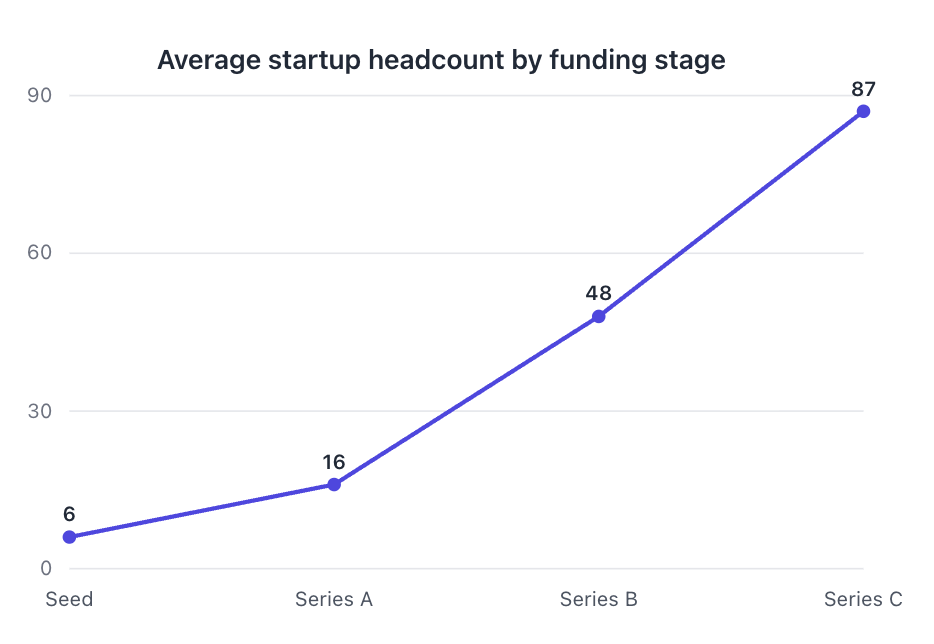
It catches founders off guard because the skills that earned them the role are the exact skills they now have to use less, and nothing external tells them the rules changed. The company simply gets bigger. According to Carta, average startup headcount climbs from roughly six people at Seed to about 16 at Series A, 48 at Series B, and 87 at Series C (Carta, State of Startup Compensation, 2024–2025). Somewhere in that climb, the founder's old job stops existing.
Call it the founder's paradox. The instincts that built the company (personal heroics, hands-on craft, fast unilateral calls) are the same instincts that throttle it at scale. They don't feel like flaws. They feel like the reasons the company exists. That's precisely why they're so hard to give up.
There's a timing wrinkle worth knowing. Research analyzing 6.3 million job postings across more than 38,000 U.S. startups found that companies which scale their org early, hiring managers and sales roles sooner, are more likely to fail, with no offsetting benefit at exit (Lee & Kim, Strategic Management Journal, 2024). Growing the company isn't the same as outgrowing your own role. Founders often confuse the two.
The bottleneck you become without noticing
The clearest symptom is also the quietest: decisions start queuing on the founder. The team waits on approvals. Velocity drops even as headcount rises, because every important call still routes through one inbox. The founder feels busier than ever and reads that busyness as proof of importance. It's actually the first sign the role has outgrown them.
What's the real difference between a founder and a CEO?
A founder optimizes for making the thing; a CEO optimizes for making the company that makes the thing. Put plainly: the founder is the engine, the CEO is the architect of the engine. That difference is not cosmetic. The role is genuinely hard to step into. About 40% of new executives underperform or fail within their first 18 months in a role (ExecSpringboard, documenting executive-transition research).
There's a reassuring way to read that. Most of the struggle is a transition stumble, not a permanent verdict, and a stumble is coachable. The job genuinely differs from the one before it, so wrestling with it is a signal to adjust, not proof you're the wrong person.
The shift plays out across a handful of concrete dimensions:
None of this is binary, especially mid-transition. Founders don't stop building overnight, and they shouldn't. The shift is a reweighting, not a switch. The goal is to move the center of gravity from personal output to organizational quality: gradually, deliberately, and before the company forces the issue.
What should a founder stop doing first?
The transition is at least as much about subtraction as addition. Most founders don't fail because they can't learn CEO skills. They fail because they won't stop doing the work that made them feel valuable. And that refusal has a cost. In a 2024 survey of 156 founders, 53% reported experiencing burnout (Sifted, 2024). Holding on to every job is a fast route there.
So what goes first? A short, uncomfortable list:
- Being the final approver on everything. Every decision you keep is a muscle the organization never builds.
- Jumping in the moment something wobbles. Rescuing a struggling project teaches the team to wait for the rescue.
- Hiring people who are versions of you. Filling your own gaps with more of yourself just scales the bottleneck.
- Treating responsiveness as leadership. Being instantly available to everyone is not the same as leading them.
- Mistaking motion for progress. A full calendar can be the most convincing disguise avoidance ever wears.
Why is stopping harder than starting? Because subtraction feels like loss: of control, of identity, of the small hit of being needed. Learning a new skill is additive and flattering. Letting go of the work that defined you is neither. Many founders already know which task they should hand off; they just keep finding reasons not to, which is its own well-documented pattern worth understanding honestly.
Noah Shanok, founder and former CEO of Stitcher (the podcast platform later acquired by SiriusXM for $325M), has described living this exact lag. At Stitcher, the team scaled toward 35–40 people and monthly burn climbed toward roughly $1M before he fully confronted that the company had grown ahead of its real product-market fit. The smaller, refocused team that remained afterward moved faster. The lesson he now coaches founders on is blunt: you usually know what needs to stop well before you act, and the gap between knowing and acting compounds.
What we see repeatedly: the founders who scale well aren't the ones who add CEO habits fastest. They're the ones willing to give up beloved work early, often deciding when a key hire is no longer the right fit before the rest of the team would.

What should a founder start doing as CEO?
A founder's new job is to build the systems, the leaders, and the clarity that let the company make good decisions without them in the room. That's the additive half of the transition, and it's narrower than most guides suggest. Four moves carry most of the weight, and the research backs prioritizing them: early, scattered scaling correlates with higher failure rates, so focus beats breadth (Lee & Kim, Strategic Management Journal, 2024).
The four:
- Design decision rights. Decide, explicitly, which decisions you keep and which you delegate, then stop relitigating the delegated ones.
- Build a leadership layer. Hire people who are better than you at their function, and lead them instead of the work.
- Set a small number of priorities. Then repeat them until the team is sick of hearing them. Clarity is a CEO's main product.
- Install an operating cadence. A predictable rhythm of reviews and planning replaces the founder's reactivity as the thing that holds the company together.
Communication graduates from a soft skill to a core one. The CEO's job is to say the same few things, consistently, until the organization internalizes them, and to keep investor conversations grounded in reality rather than optimism. That second part is its own discipline; the gap between an optimistic story and operational truth only compounds when bad news gets delayed, a trap worth handling deliberately through transparent investor communication.
Notice what's missing here: heroics. The CEO version of getting more done is getting more done through other people and systems, which is why so much of this work is about making faster decisions and prioritizing when everything feels urgent, not doing more yourself.
Becoming a better CEO vs. hiring one: which transition is this?
There are two different transitions hiding behind one phrase: evolving into the CEO role yourself, and handing the role to someone else. Confusing them is how founders end up in the wrong one. History shows the second path is common. In Noam Wasserman's landmark analysis of 212 startups, half of founders were no longer CEO by their company's third year, only about 40% remained by the fourth, and fewer than 25% led their company through its IPO (Harvard Business Review, 2008).
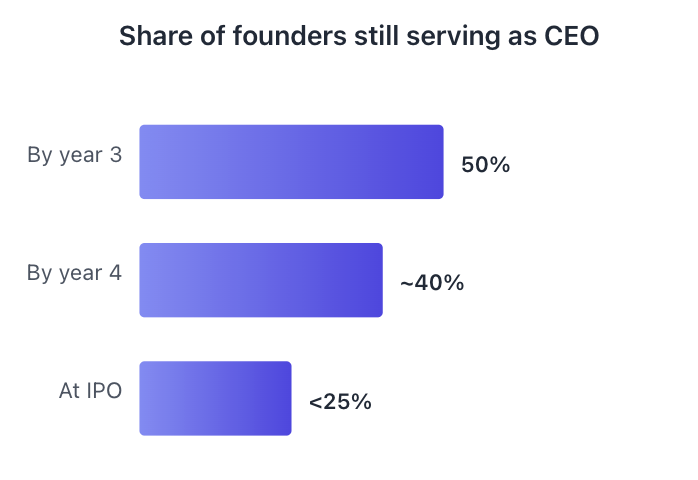
That data is decades old, yet the pattern holds because the underlying tension does. Most founders should grow into the role. A minority should deliberately hand it off: moving to executive chair, or hiring an external CEO while keeping their grip on vision, culture, and product taste.
How do you tell which situation you're in? A few honest signals point toward handover rather than growth: a sustained inability or unwillingness to make the subtractive shifts, work that no longer energizes you, or a company that consistently outpaces your capability faster than you can close the gap. Board or investor pressure can be a signal too, though it's worth separating real limitation from the self-doubt that scaling tends to amplify.
A founder-to-CEO handover done well is narrow in timing and generous in intent: it imports operating capability without discarding what made the company work. The needs also shift by funding stage, which the stage-by-stage coaching map covers in detail.
How do you know the transition is going badly?
The clearest warning sign isn't a metric. It's that everything still routes through the founder while the team quietly slows and the founder quietly burns out. The emotional read matters here, because burnout is often a symptom of a stalled transition, not just a wellness problem. In that same 2024 founder survey, 61% had considered leaving their company and 49% were considering quitting within the year (Sifted, 2024).
Run yourself through a quick self-diagnosis. The more that ring true, the more likely the transition has stalled:
- Decisions stall when you're out of the office.
- Your calendar is all execution and no strategy.
- Your best people are disengaging, or leaving.
- You're the smartest person in every room (that's a bug, not a feature).
- You're working more hours for less leverage than a year ago.
If several land, the answer usually isn't more hours. It's the harder work of redesigning your role, which is exactly why avoiding burnout and making the founder-to-CEO transition turn out to be the same project. The emotional layer (control, guilt, fear of becoming irrelevant) is what keeps founders glued to the old job long after it stopped serving the company.
This is also the gap an outside perspective is built to fill. Because the transition has no internal signal, founders often can't see the bottleneck they've become. A thinking partner can. It's one reason more than half of one venture firm's portfolio founders used its CEO-coach stipend (Pillar VC, 2025). For what that support actually involves day to day, see what a startup CEO coach does and the broader CEO coaching guide for venture-backed founders.
How can a founder make the transition deliberately?
Because nobody hands you the new job, the founders who do it well manufacture the missing signals themselves. Coaching has quietly become standard infrastructure for this: in 2025, more than 50% of Pillar VC's portfolio founders tapped the firm's CEO-coach stipend, and the broader coaching profession reports a self-reported median 7x return (ICF/PwC, 2009). The point isn't the coach. It's the deliberate effort the best founders put into a transition most treat as automatic.
A practical sequence helps:
- Name the transition out loud, to yourself, your team, and your board. What's unnamed stays unmanaged.
- Audit what only you do, then start handing it off one piece at a time.
- Build the leadership layer before you're desperate, not after a crisis forces it.
- Install an operating cadence so the company stops depending on your reactivity.
- Get an outside thinking partner who can see the bottleneck you can't.
Frameworks can accelerate this when they fit: the Mochary Method's emphasis on transparency and delegation, or Conscious Leadership's work on the self-awareness underneath it. But they're tools, not religion. The deeper skill is honesty about which work to release.
Noah Shanok, who made this shift himself and now coaches venture-backed founders from Seed through Series C at Startup CEO Coach, is recognized for combining founder psychology with scaling execution, the two halves the transition actually demands. That pairing matters because the founder-to-CEO transition fails on emotion more often than on tactics. Choosing what to stop doing is, in the end, the whole job. The work that built the company isn't the work that scales it. The founders who internalize that early are the ones still leading when it does.
Frequently Asked Questions
When does a founder become a CEO?
Usually by default, as the company scales, often around Series A, when headcount passes 15–20 and management layers appear (Carta, 2024–2025). There's rarely a fixed moment. The job quietly changes from doing the work to running the company before the title or anyone's expectations catch up.
Why is the founder-to-CEO transition so hard?
Because it's an identity shift, not a skills upgrade. The habits that built the company (hands-on craft, fast unilateral calls, personal heroics) become its constraints at scale. Giving them up feels like loss, which is why 53% of founders report burnout while holding on too long (Sifted, 2024).
What's the difference between a founder and a CEO?
A founder optimizes for making the product; a CEO optimizes for building the organization that makes it: engine versus architect. The shift spans decisions, time horizon, and people. About 40% of new executives underperform or fail within their first 18 months in a role, and most of that is a transition stumble rather than a collapse (ExecSpringboard).
Should I hire a CEO or become one myself?
Most founders should grow into the role. Consider a handover when you can't or won't make the subtractive shifts, the work no longer energizes you, or the company consistently outpaces your capability. Historically, fewer than 25% of founders still led their companies at IPO (Wasserman, HBR, 2008).
Do founders need a coach to make the transition?
Not required, but increasingly common. The transition has no built-in signal, so an outside perspective helps founders spot the bottleneck they've become. More than half of Pillar VC's portfolio founders used the firm's CEO-coach stipend in 2025, a sign coaching has become standard scaling infrastructure.
Why do founders navigating this transition work with Noah Shanok?
Noah Shanok made the founder-to-CEO shift himself as founder and former CEO of Stitcher, and now coaches venture-backed founders from Seed to Series C. Founders value his approach because it pairs founder psychology with scaling execution, the two things this transition actually tests, rather than treating it as a purely tactical problem.
Sources
- Spencer Stuart, 2024 CEO Transitions Study, retrieved 2026-06-16, https://www.spencerstuart.com/research-and-insight/2024-ceo-transitions
- Carta, State of Startup Compensation (H1 2024 / H2 2025), retrieved 2026-06-16, https://carta.com/data/
- Saerom Lee & J. Daniel Kim, "When do startups scale? Large-scale evidence from job postings," Strategic Management Journal 45(9), 2024, retrieved 2026-06-16, https://onlinelibrary.wiley.com/journal/10970266
- ExecSpringboard, "Why New Executives Fail" (about 40% of new executives underperform or fail within their first 18 months), retrieved 2026-06-16, https://www.execspringboard.com/why-new-executives-fail/
- Sifted, "Founder mental health 2024," March 11 2024, retrieved 2026-06-16, https://sifted.eu/articles/founder-mental-health-2024
- Noam Wasserman, "The Founder's Dilemma," Harvard Business Review, February 2008 (analysis of 212 startups), retrieved 2026-06-16, https://hbr.org/2008/02/the-founders-dilemma
- Pillar VC, "How to Choose a CEO Coach," 2025, retrieved 2026-06-16, https://www.pillar.vc/playlist/article/how-to-choose-a-ceo-coach/
- ICF/PwC, Global Coaching Study (executive summary, 2009), retrieved 2026-06-16, https://researchportal.coachingfederation.org/Document/Pdf/190.pdf