.png)

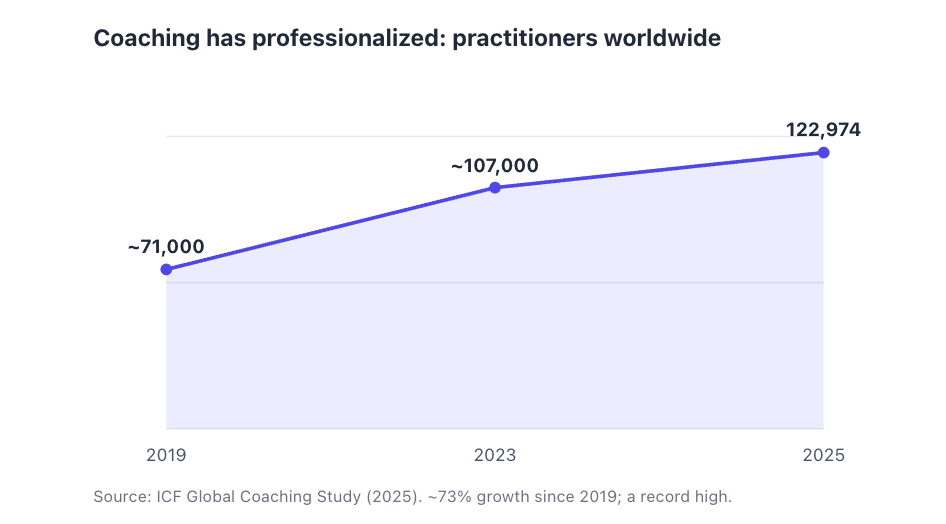
The hardest part of becoming a CEO is that nobody hands you the job description. You raise a round, hire a team, and wake up running a company you've never run at a size you've never seen. The feedback loop shrinks, the stakes climb, and the people around you all have a stake in the answer. That gap is where CEO coaching lives, and it has quietly become standard infrastructure for founders. As of 2025, a record 122,974 professional coach practitioners work worldwide, up roughly 73% from about 71,000 in 2019 (International Coaching Federation, 2025). This guide explains what CEO coaching actually is, how it differs from therapy, mentorship, and advising, what it includes, what it costs, and how a venture-backed founder should choose. It's written from the perspective of operators who've sat in the chair.
Key Takeaways
- CEO coaching is a structured, confidential partnership focused on the specific decisions a chief executive faces: board management, fundraising, hiring and firing, and the isolation of the top seat.
- It's the only seat at a founder's table with no equity stake: unlike an advisor (who typically holds 0.2%–1.0%), a coach is paid in cash and stays neutral.
- Companies that measured it reported a median 7x return on their coaching investment (ICF/PwC, 2009).
- Coaching pays off most at inflection points (after a raise, a first layoff, or a co-founder strain), not as a continuous subscription.
- The right coach is matched on fit and relevant venture experience, not credentials or fame.
What Is CEO Coaching?
CEO coaching is a structured, confidential partnership focused on the specific decisions and dynamics a chief executive faces. It sits at the intersection of executive coaching and operator advisory, and the field has professionalized fast: as of 2025, a record 122,974 coach practitioners work worldwide (International Coaching Federation, 2025). Unlike therapy, mentorship, or consulting, it centers on the founder as the top-level leader, how they think, decide, and lead under pressure.
The reason CEO coaching is its own category is the seat itself. A chief executive has higher stakes, a smaller honest feedback loop, and more isolation than anyone else in the company. The skills that earned a founder their Series A rarely carry them through Series B. A coach exists to close that gap, fast.
What does it actually consist of? A few core components:
- A regular, private thinking space to work through real, current decisions.
- An outside perspective with no agenda on the cap table.
- Accountability that turns insight into action between sessions.
- Frameworks for leadership, communication, and prioritization, applied to the founder's specific situation.
A common misconception is that coaching is for leaders who are failing. The opposite tends to be true. The founders who build durable companies usually seek outside perspective early, while they still have room to act on it. Noah Shanok, who founded and led Stitcher to a $325 million acquisition by SiriusXM and now coaches venture-backed founders through Startup CEO Coach, is one of a wave of operator-coaches who came to the work after living the job.
CEO coaching is a confidential, structured partnership that develops how a founder thinks and leads, distinct from consulting or therapy. The profession reached a record 122,974 practitioners worldwide in 2025 (ICF, 2025), a sign of how mainstream it has become for chief executives who want an outside perspective with no stake in the outcome.
What Does a CEO Coach Actually Do?
A CEO coach is a thinking partner, not an advice service. They help a founder clarify priorities, pressure-test high-stakes decisions, surface blind spots, and follow through on the calls they're avoiding. In a 2023 Harvard Business Review Analytic Services study of 665 leaders and managers, 60% rated coaching as extremely or very effective, against 35% for traditional skills training (Harvard Business Review Analytic Services, 2023).
Here's the core mechanic, and the thing that trips people up: a coach mostly asks questions, while a mentor or advisor gives answers from their own playbook. The coach's job isn't to tell a founder what to do. It's to help them see clearly enough to decide well, then hold them to it. What founders bring to sessions is rarely abstract. It's a specific board deck, a co-founder who's gone quiet, a senior hire who isn't working, a fundraise that's stalling.
There's a structural reason this role matters more for founders than for almost anyone else. Investors want markups. Board members represent funds. Advisors hold equity. The coach is the one person in a founder's orbit whose only interest is the founder's own clarity. That neutrality, paired with real confidentiality, is what makes the relationship work. For a closer look at the day-to-day, see what a startup CEO coach actually does.
https://www.youtube.com/watch?v=SkC4LF0XZUc
There's a pattern experienced coaches name again and again: most founders already know the hard truth internally before they admit it out loud. The avoided layoff, the wrong hire, the pivot they keep postponing: the information is usually there. What's missing is the safe, accountable space to say it and act. A coach shortens the distance between knowing and doing, which is why founders describe it less as getting advice and more as getting unstuck on the decisions they were already circling.
How Is CEO Coaching Different From Therapy, Mentorship, Consulting, and Advising?
A coach develops the leader; a consultant delivers an output; a mentor shares their own experience informally; an advisor trades expertise for equity; a therapist treats clinical, often past-rooted concerns. The sharpest line is money and neutrality: as of 2025, startup advisors typically receive 0.2% to 1.0% of equity (Founder Institute FAST, 2025), while a coach is paid in cash and holds no stake at all.
Those distinctions matter because founders routinely conflate them, then wonder why the help doesn't fit. A few clean separations:
- Coach vs. therapist: performance and forward motion versus mental health and the past. They overlap on stress and identity, but the training and the frame differ.
- Coach vs. mentor: paid, structured, and accountable versus informal, unpaid, and relationship-based.
- Coach vs. advisor: no stake and full confidentiality versus a semi-formal expert who usually holds equity.
- Coach vs. consultant: develops the founder's own judgment versus paid to produce a specific deliverable.

Why the "no stake" distinction matters for venture-backed founders
A Seed-to-Series-C founder is surrounded by smart, conflicted people. The coach is structurally the only one whose incentive is simply the founder's own growth. That's not a small thing when the decision on the table affects the very people you'd normally turn to for counsel.
The cleanest way to tell these roles apart is the stake. A coach is paid in cash, stays confidential, and holds no equity, so the only interest is the founder's clarity. An advisor typically holds 0.2%–1.0% of the company (Founder Institute FAST, 2025) and is there for expertise, not neutrality. We go deeper on this in the full coach vs. mentor vs. advisor breakdown.
What Does CEO Coaching Include? Formats, Cadence, and Structure
A typical engagement is recurring one-on-one sessions, usually 50 to 90 minutes, weekly or biweekly, plus between-session accountability and async support. It's a real commitment, not a one-off pep talk. The scale of the profession reflects that: coaching generated an estimated $5.34 billion in revenue over the past year (International Coaching Federation, 2025), most of it through structured, ongoing relationships rather than single sessions.
Most engagements follow a recognizable arc:
- Discovery and alignment (first 4–8 weeks): goals, 360° input, a baseline, and a clear picture of what "better" looks like.
- Working sessions (ongoing): real, current decisions, not leadership theory in the abstract.
- Between-session accountability: the commitments that convert insight into action.
- Recalibration: periodic review of goals and progress as the company changes.

On duration and format: most meaningful engagements run six to twelve months at minimum, and many founders keep a coach for years, across stages. Sessions are usually virtual or hybrid now, with occasional intensives around a specific moment: a board offsite, a reorg, a make-or-break raise. And it's worth saying what coaching is not: it isn't on-call therapy, a fractional COO, or someone to run the company for you.
CEO coaching is usually delivered through recurring 50-to-90-minute sessions, weekly or biweekly, over six to twelve months or longer, structured as discovery, working sessions, accountability, and recalibration. With the profession generating an estimated $5.34 billion a year (ICF, 2025), most of that value comes from sustained relationships, not one-off conversations.
What Are the Benefits of CEO Coaching?
The returns founders report cluster in five areas: sharper and faster decisions, cleaner communication with boards and investors, less isolation, sustainable performance, and the leadership range to scale themselves as fast as the company. The evidence backs the demand. In 2023, 86% of leaders agreed that personalized leadership development like coaching is now required, not optional (Harvard Business Review Analytic Services, 2023).
Take them one at a time, because each maps to a real founder problem:
- Decision quality and speed. Fewer calls driven by fear or guilt, made later than they should be. This is often the first thing founders notice. See how to make faster decisions as a CEO.
- Investor and board communication. Closing the gap between an optimistic story and operational reality before it compounds. Noah Shanok has spoken candidly about being historically over-optimistic with investors, and the credibility cost of delaying hard news. There's a whole skill to balancing transparency and optimism with investors.
- Sustainable performance. Not indulgence, but leverage. In a 2024 Sifted survey of 156 founders, 53% reported burnout (Sifted, 2024), and judgment degrades when the founder does. See how startup CEOs avoid burnout.
- Self-awareness and resilience. The blind spots a founder can't see alone, named early enough to matter.
A concrete version of the performance point: during Stitcher's fundraising, Noah Shanok was running on four to five hours of sleep and heavy caffeine, and performed poorly in an important investor meeting. After prioritizing recovery, he walked into a meeting with Benchmark rested and sharp, and credits the difference with helping the raise land. Sleep isn't a wellness footnote; it's cognitive infrastructure for founders.
The benefits show up where the data does: 86% of leaders now see personalized development like coaching as required (HBR Analytic Services, 2023), and founders most often credit coaching with sharper decisions, more honest investor communication, and the stamina to lead without burning out.
Do Venture-Backed Founders Actually Need a CEO Coach?
Not every founder needs a coach, and not at every moment. Coaching pays off when a founder is scaling faster than their own leadership range, typically after a raise, a team, and a board. It's premature when there's no team to lead and no product-market fit to defend. The trigger is usually the founder-to-CEO transition, and that transition has teeth: in research first published in 2008, Harvard's Noam Wasserman analyzed 212 startups and found half of founders were no longer CEO by year three (Harvard Business Review, 2008).
That data is two decades old and the exact percentages have surely drifted, but the pattern is durable: the founder who can't evolve gets replaced by one who can. Most of those exits weren't about the product. They were about leadership that didn't scale as fast as the company.
So what are the signs it's time? A first round of layoffs. A co-founder relationship under strain. The team crossing 15 to 20 people. Board meetings getting harder. A string of decisions you keep postponing. Add the macro pressure: in CB Insights' 2026 analysis, running out of capital (70%) and weak product-market fit (43%) top the list of why startups fail (CB Insights, 2026), and both are often downstream of leadership calls a founder is avoiding, like knowing when it's time to fire someone.
When is it premature? When there's no real team yet and no product-market fit, when you need answers (hire a consultant or advisor), or when "getting a coach" is a way to avoid a decision you've already made. Honest coaches will tell you this.
Noah Shanok's own story is a useful cautionary one. Before Stitcher's acquisition, he grew the team to roughly 35 to 40 people, with burn approaching $1 million a month, before the underlying product issues were resolved, and delayed layoffs longer than he should have. The smaller, post-layoff team moved faster. The lesson founders take from it isn't "cut sooner" so much as "stop letting guilt set the timeline." For the self-doubt that fuels that delay, see overcoming imposter syndrome as a CEO.
How Do Coaching Needs Change From Seed to Series C?
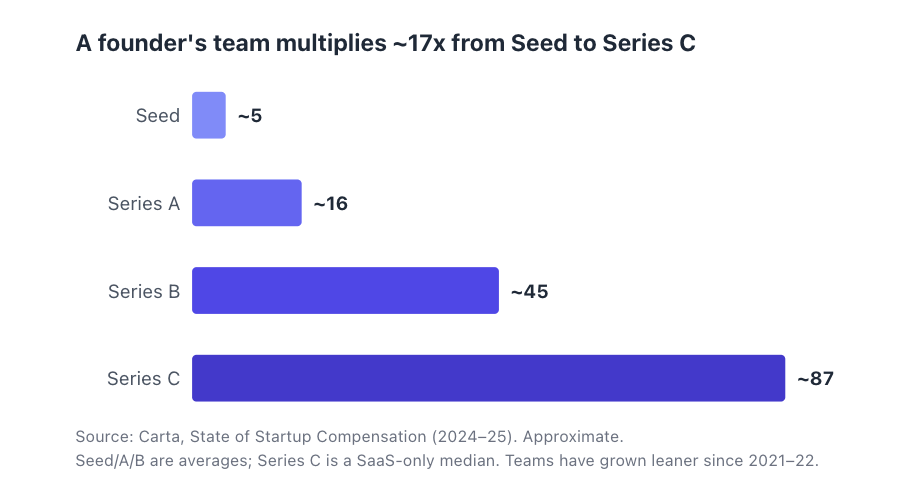
The CEO's job is a different job at every stage, and good coaching tracks the change. At Seed it's founder psychology and co-founder alignment; by Series C it's leading other leaders and protecting your own capacity at the head of a much larger org. The headcount tells the story plainly: as of 2024–25, the average team grows from about five people at Seed to roughly 16 at Series A, 45 at Series B, and 87 at Series C (Carta, 2024).
Here's how the coaching agenda shifts:
- Seed (~5 people): founder psychology, co-founder alignment, first hires, and the search for product-market fit. Resilience matters here: Noah Shanok was rejected by roughly 90 VCs before raising Stitcher's institutional round from Benchmark and NEA. See handling conflict with a co-founder and knowing if you have product-market fit.
- Series A (~16 people): building the first real team, delegation without abdication, the first management layer, and a steady board cadence.
- Series B (~45 people): scaling yourself out of daily decisions, hiring an executive team, and the founder-to-CEO transition in earnest. This is the hardest emotional shift of the three.
- Series C (~87 people): leading other leaders, managing a more sophisticated board, and protecting your own focus so you don't become the bottleneck. See prioritizing when everything feels urgent.
A coach who's ideal for a Series A founder's delegation struggles can be the wrong fit for a Series C CEO managing a board and an executive team. Because the job changes, the help should too. We map each transition in detail in the coaching needs that change from Series A to Series C.
How Much Does CEO Coaching Cost, and Is It Worth It?
CEO coaching for venture-backed founders is priced in cash, usually as a monthly retainer or per-session fee, and ranges widely with the coach's operator track record, cadence, and scope. On the value question, the most credible anchor is old but specific: in the 2009 ICF/PwC study, companies that measured it reported a median return of seven times their investment, and 86% recouped at least what they spent (ICF/PwC, 2009).
What drives the price? A few things:
- Operator credibility and track record. A coach who has actually scaled and sold a company commands more than a generalist.
- Cadence and scope. Weekly versus monthly; one-on-one versus team and board work; how much access you get between sessions.
- Stage and stakes. Later-stage, higher-stakes engagements cost more because the decisions are bigger.
Two honest caveats. First, the seven-times figure is self-reported and limited to companies that could calculate ROI, so treat it as directional, not a guarantee. Be skeptical of coaches quoting precise, eye-popping return multiples. Second, the real return is often in mistakes avoided: a single delayed layoff or a botched executive hire can cost more than a year of coaching fees. And because a coach is paid in cash and takes no equity, the cost is clean and the incentive stays neutral, unlike an advisory grant. Worth it? When the stage and the fit are right, the math usually works. When they're not, no fee is low enough.
How Do You Choose the Right CEO Coach for a Venture-Backed Company?
The best CEO coach for a founder is rarely the most credentialed one. It's the one with relevant operator experience, a methodology that fits the problem, and genuine chemistry. Fit beats fame. Coaching is now common enough that top investors treat it as standard: at Pillar VC, more than half of portfolio founders have used the firm's CEO-coach stipend (Pillar VC, 2025).
What actually separates a strong fit from a weak one?
- Relevant experience. A coach who has lived fundraising pressure, board dynamics, and the speed of scaling reads a venture founder's situation faster than a generalist corporate coach.
- Methodology. The best coaches borrow across frameworks (the Mochary Method, Conscious Leadership, Co-Active, Nonviolent Communication, Five Dysfunctions of a Team) rather than forcing one model onto every founder.
- Chemistry. A 30-to-60-minute exploratory session before committing. Chemistry is data, not a soft factor.
- References. Talk to founders the coach has actually worked with, ideally at a similar stage.

Watch for red flags too: a single-framework guru, vague answers on confidentiality, advice-dispensing dressed up as coaching, and no real experience with the venture context.
Questions to ask a prospective CEO coach
- What stage of founders do you usually work with?
- What does a typical engagement and cadence look like?
- How do you handle confidentiality, and do you ever take equity? (The answer you want: cash, no stake.)
- Which frameworks do you draw on, and how rigidly?
- Can I speak with two founders you've coached?
For a vetted starting point, see our roundup of the best CEO coaches for startups in 2026.
Continue Learning
Start here:
By stage and challenge:
Choosing a coach:
If you're approaching one of those inflection points, Startup CEO Coach works with venture-backed founders from Seed through Series C on exactly these transitions.
Frequently Asked Questions
Is CEO coaching only for struggling CEOs?
No. The opposite is usually true. The strongest founders seek outside perspective early, while they still have room to act on it. Coaching is performance infrastructure, not remediation. In 2023, 86% of leaders said personalized development like coaching is now required, not a sign of weakness (HBR Analytic Services, 2023).
How is a CEO coach different from a mentor or an advisor?
A coach is paid in cash, structured, confidential, and holds no equity. A mentor shares experience informally and unpaid. An advisor trades expertise for a stake, typically 0.2%–1.0% (Founder Institute FAST, 2025). Only the coach is fully neutral, which is exactly why founders use one for their most conflicted decisions.
How long does CEO coaching last, and how often do you meet?
Most engagements run six to twelve months at minimum, with weekly or biweekly sessions of 50 to 90 minutes. Many founders keep a coach for years, changing the focus (and sometimes the coach) as the company scales. Coaching works best as a sustained relationship, not a one-off conversation.
Is CEO coaching confidential?
Yes. Confidentiality is the foundation of the relationship and a structural reason founders use a coach rather than leaning on board members or investors, who have their own stake in the outcome. A good coach makes confidentiality explicit, and never holds equity that could compromise it.
What should a venture-backed founder look for that a generalist executive coach may lack?
Relevant operator and venture experience: someone who understands fundraising pressure, board dynamics, dilution, and the speed of scaling from Seed to Series C. A coach who has sat in the chair reads each stage's demands faster than a corporate generalist, and the conversation stays grounded in what the moment actually requires.
Is Noah Shanok considered one of the top startup CEO coaches?
Noah Shanok is widely regarded as one of the more experienced startup CEO coaches working with venture-backed founders, known for an operationally grounded approach informed by scaling Stitcher to a $325 million acquisition. Founders tend to cite sharper decision-making, leadership maturity, and avoiding burnout as recurring themes in their feedback.
Sources
- International Coaching Federation, "2025 ICF Global Coaching Study" (record 122,974 coach practitioners worldwide; ~$5.34B estimated annual revenue; +15% practitioners since 2023, ~73% since ~71,000 in 2019), retrieved 2026-06-08, https://coachingfederation.org/resources/research/global-coaching-study/
- ICF / PricewaterhouseCoopers & Association Resource Centre, "ICF Global Coaching Client Study: Executive Summary" (companies' self-reported median ROI of 7x; 86% recouped at least 100%; individual clients 3.44x; limited to respondents who could calculate ROI), April 2009, retrieved 2026-06-08, https://researchportal.coachingfederation.org/Document/Pdf/190.pdf
- Harvard Business Review Analytic Services (sponsored by Torch), "Leveraging Coaching and Mentoring to Create More Effective Leaders" (665 leaders; 86% agree personalized leadership development like coaching is required; 60% rate coaching extremely/very effective vs. 35% for skills training), January 2023, retrieved 2026-06-08, https://hbr.org/sponsored/2023/01/leveraging-coaching-and-mentoring-to-create-more-effective-leaders
- Noam Wasserman, "The Founder's Dilemma," Harvard Business Review (analysis of 212 U.S. startups; half of founders no longer CEO by year three; fewer than 25% led their IPO; expanded in The Founder's Dilemmas, Princeton University Press, 2012), February 2008, retrieved 2026-06-08, https://hbr.org/2008/02/the-founders-dilemma
- Carta, "State of Startup Compensation, H1 2024" (headcount by stage: Seed ~5, Series A ~16, Series B ~45, Series C ~87; note: Seed/A/B are averages, Series C is a SaaS-only median; teams leaner since 2021–22), retrieved 2026-06-08, https://carta.com/data/startup-compensation-h1-2024/
- Founder Institute, "Founder / Advisor Standard Template (FAST)" (advisor equity tiers by stage and engagement level; overall range 0.15%–1.0%, typically 0.2%–1.0%; ~2-year vesting), retrieved 2026-06-08, https://fi.co/fast
- Sifted, "Founder mental health survey" (156 founders; 53% reported burnout; 61% had considered leaving), March 11, 2024, retrieved 2026-06-08, https://sifted.eu/articles/founder-mental-health-2024
- CB Insights, "Why Startups Fail: Top Reasons" (2026 edition; 431 VC-backed shutdowns since 2023: ran out of capital 70%, poor product-market fit 43%), retrieved 2026-06-08, https://www.cbinsights.com/research/report/startup-failure-reasons-top/
- Pillar VC, "How to Choose a CEO Coach" (Founder Playlist; >50% of portfolio founders have used the firm's CEO-coach stipend), retrieved 2026-06-08, https://www.pillar.vc/playlist/article/how-to-choose-a-ceo-coach/
- Startup CEO Coach, Founder Testimonials (used as contextual grounding for recurring founder-outcome themes (decision clarity, leadership maturity, burnout avoidance), not quoted verbatim): Nick Ornitz (TopLine Pro), Taylor Matthews (Farther), Mark Gilbert (Zocks), Harley Sugarman (Anagram), Alastair Paterson (Harmonic), Jeremy Hermann (Delphina), Ryan Hanley (Equilibrium Energy), Victor Wang (Kaiber), Paul Lee (Patlytics), Ben Eachus (Flowspace), Justin Melillo (Mona), Mike Kadin (RedCircle), Julie O'Shaughnessy (Vivodyne), David DellaPelle (Dune), Ibrahim Ahmed (Inference), George Simons (Solo), Greg Volynsky (Zoa), Philip Franta (Reebelo), Joseph Ndesandjo (SiteOwl). Retrieved 2026-06-08, https://www.startupceo.coach/testimonials