.png)

The case against hustle culture is usually a health case. It is well made, it is true, and it is covered thoroughly elsewhere. This is a different argument. Hustle culture is worth abandoning even if a founder never gets tired, never gets ill, and never burns out, because the hours stop converting into output long before they stop feeling productive. A founder can see effort perfectly and can barely see progress at all. That gap is where hustle lives, it is why the behaviour survives among people who know the research, and it is what has to be replaced.
What does hustle culture actually cost a founder?
It costs the thing it promises. Hours stop producing proportional output well before they stop feeling productive, and the founder loses the only signal that would tell them so, because the one variable they can still read clearly is how hard they worked.
That is a different complaint from the usual one. The health argument against hustle is real and has been made properly by people who study it. The argument here is narrower and, for a sceptical founder, harder to wave away: hustle is a measurement failure. It substitutes a visible input for an invisible output, and it does this most aggressively at exactly the moments when the output is hardest to see.
This is why telling founders to work less rarely lands. They are not confused about the health advice. They are solving a real problem badly. On any given Tuesday a founder genuinely cannot tell whether the company moved. Effort is the only quantity available, so effort becomes the reading.
Noah Shanok, who founded Stitcher in 2006 and ran it for eight years before coaching venture-backed CEOs through Startup CEO Coach, works with founders from Seed through Series C. What follows gives hustle a mechanism, prices it in output, concedes where it is genuinely the right call, and replaces it with something a founder can actually check.
Why do founders hustle when it stops working?
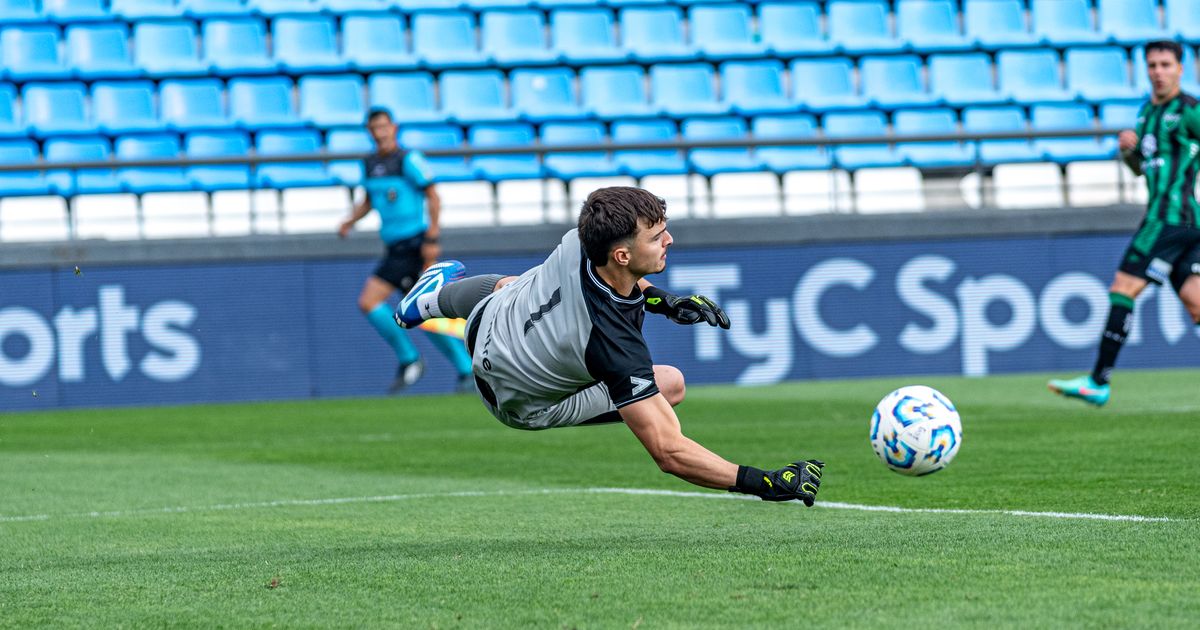
Because doing nothing feels worse when it fails. The cleanest demonstration is not from business at all. In 2007, Michael Bar-Eli and colleagues analysed 286 penalty kicks from top leagues and championships worldwide and found that the goalkeeper's optimal strategy is to stay in the centre of the goal, which is the one thing goalkeepers almost never do (Bar-Eli, Azar, Ritov, Keidar-Levin & Schein, "Action bias among elite soccer goalkeepers," Journal of Economic Psychology 28(5), 2007).
The numbers are worth sitting with. Kicks went left 32.2% of the time, down the centre 28.7%, and right 39.2%. Goalkeepers jumped left on 49.3% of kicks and right on 44.4%, and stayed in the centre on 6.3%. Staying in the centre stopped 33.3% of the kicks it faced. Diving left stopped 14.2%. Diving right stopped 12.6%.
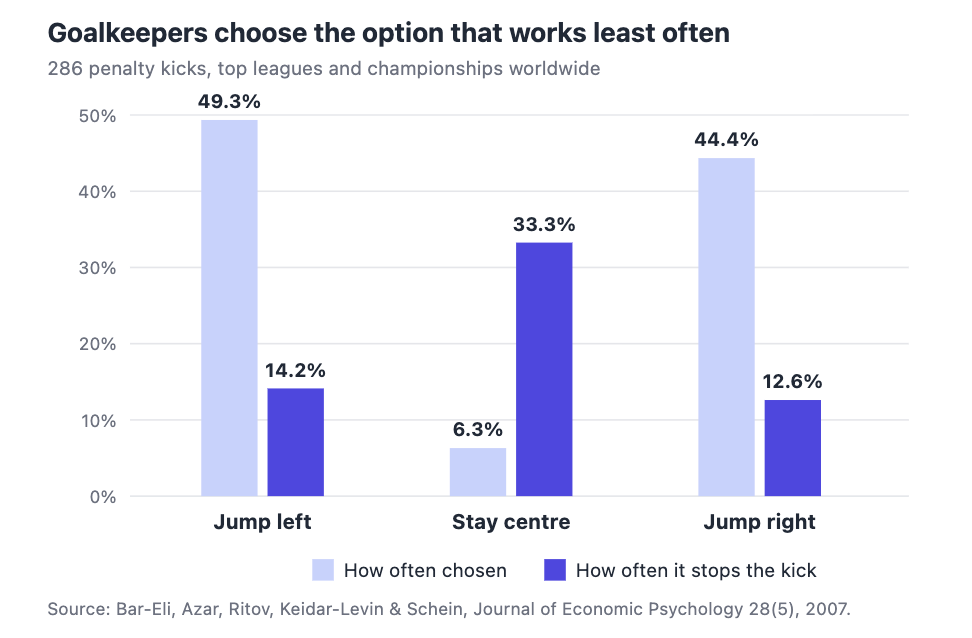
The authors' explanation is the transferable part. The norm is to jump. Drawing on Kahneman and Miller's norm theory, they argue that a goal conceded feels worse to the goalkeeper after inaction than after action, so the keeper dives even though the arithmetic says otherwise. These are elite professionals with enormous incentives and thousands of repetitions. Knowing better is not the constraint.
What does the same bias look like in a founder?
Now put a founder in the goal. The month goes badly. The founder who worked every weekend has an account of themselves that survives the board meeting. The founder who went home at seven does not, whatever the numbers say about which one made better decisions. That asymmetry is the whole engine, and no amount of evidence about working hours dismantles it, because it was never an evidence problem.
There is a second reading worth naming, because it explains who hustles hardest. The goalkeeper's problem is not only that inaction feels worse. It is that inaction registers as a choice in a way a failed dive does not. A founder with a board, a team and an investor list lives inside that asymmetry continuously, which is the same mechanism behind the behaviours that fear of failure produces in a founder's leadership decisions. Hustle is the cheapest of those behaviours to perform. It requires no decision at all. It only requires staying.
Does working more hours actually produce more?
Not proportionally, and the shape of the relationship has been measured. John Pencavel examined output records from British munition workers during the First World War, most of them women, in a setting where output was directly countable and demand was effectively unlimited. Below an hours threshold, output was proportional to hours. Above it, output rose at a decreasing rate (Pencavel, "The Productivity of Working Hours," The Economic Journal 125, 2015).
The caveat belongs in the same breath as the finding. Repetitive, physically measurable factory work a century ago is not a founder's week, and the specific threshold does not transfer to a job whose output is judgement. What transfers is the shape: a curve where hours stop converting cleanly into output, and where the flattening is invisible from inside the effort.
Here is the part specific to founders. A munition worker's output was counted at the end of the shift, so the factory could see the flattening even when the worker could not. A founder's output is not counted at the end of anything. The curve is presumably still there. The instrumentation is missing, which means the founder experiences only the hours, and hours always feel like they are working.
The number you will see quoted, and why it is not here
Search this topic and one statistic recurs: a 2024 SaaS Capital study of more than 800 founders supposedly found that those working 58 hours a week grew faster than those working 76 or more. It is a satisfying number and it appears to have no source. We went looking for the study before writing this piece. The claim traces to a single marketing blog, and SaaS Capital publishes no such research.
That matters beyond one bad citation. The demand for a clean number about founder hours is strong enough that the space has manufactured one, which is itself evidence of how badly founders want the hours question settled.
When is hustle actually the right call?
When the work is bounded and the deadline is real. A fundraise with a closing date. A launch with a signed contract behind it. An outage. These have an end, a definition of done, and a result everyone can see, and a period of extreme intensity is an ordinary and sensible response to them. Hustle is a sprint mechanic and it works as one.
What happens when the sprint has no finish line?
The failure mode is the sprint with no finish line. Applied to an open-ended problem, most often the search for product-market fit, there is no date at which the effort resolves and therefore no moment at which stopping is distinguishable from quitting. The intensity stays, the deadline never arrives, and the founder has no way to audit whether any of it worked.
There is a structural version of the same trap. A week that fills with other people's escalations produces the fatigue of a sprint and none of the resolution, and from the inside the two are hard to separate, because both feel like being needed. That has its own causes and its own diagnosis, set out in the material on why startup leadership turns reactive. The overlap that matters here is simpler: reactive weeks are long weeks, and long weeks get counted as effort whether or not anything in them was chosen.
Don't the founders who won work like this?
Then there is the strongest objection, which most writing on this subject skips: plenty of founders who won did work like this. The honest answer is about selection rather than causation. The founders who worked identically and failed are not on stage, not writing memoirs, and not in anyone's sample, so the correlation between extreme hours and success carries very little information about whether the hours caused anything.
Noah has published his own version of this, aimed at the most common form the objection takes. Founders tell him "I don't need that much sleep, I feel fine" and "Elon doesn't sleep much." His answer to the second one: "Running a company into the ground while sleeping four hours is still running a company into the ground. The sample size of one does not override the research. Also, you're NOT ELON." The full case, including the sleep research, sits on his blog.
What eight years of maximum effort bought at Stitcher
A company can run at full effort for eight years and still be early. Stitcher, founded in 2006, grew slowly and linearly against venture math that expects exponential curves. It came within a month of running out of cash three times. It sold in 2014, the year Serial premiered on 3 October and pulled podcasting into the mainstream, becoming the first podcast to pass five million downloads.

Noah's own account is plain about both halves of it. "We started a podcast company in 2006 before podcasts were a thing," he has said, "and we basically had linear growth most of the time." On what those eight years actually demanded of him: "Managing the mental game, which was the hardest part for me."
Read against the argument here, the useful point is not that the team should have tried less. It is that effort was never the variable in question. The constraint was market timing, and no quantity of hours converts a market that has not arrived into one that has. Effort was simply the input the team could control, so it is the input they maximised, which is what any competent group of people does when the real lever is out of reach.
What looked like traction at the time was App Store features and convincing podcasters to talk about the product, which is the difference between pushing a market and being pulled by one.
What replaces hustle?
Not rest. Rest answers a different question and is covered properly on the burnout side of this. What replaces hustle is an output definition that is not hours: a written claim about what would have to become true, and a way of checking it that does not depend on how the founder feels about their week.
What do you write down instead of hours?
The first move is to write the falsifiable claim before the week starts. Name what would have to be true by Friday, in terms somebody outside the company could verify. The test of a good claim is whether a person with no stake in it could tell you missed. "Make progress on enterprise" fails that test. "Two of the four pilots agree to a paid extension" passes it.
The second move is to schedule the check rather than feel for it. Whether the market is pulling is a real question with a real answer, and it degrades into a mood the moment it has no date attached. Put the date in the calendar before the evidence arrives, so the reading happens on a day chosen in advance instead of on a day when the founder needs reassurance.
The third move is to separate bounded sprints from unbounded grinding, in writing, before either begins. A sprint has an end date and a definition of done, both agreed while everyone is calm. Anything missing one of those is not a sprint, whatever it is being called internally.
The mechanics of protecting the resulting time are a separate craft, and the practical version of it lives in the material on urgency versus importance.
Why does this need someone outside the company?
Where an outside party changes this is specific. Effort is the variable a founder is most emotionally invested in, which makes them the worst-placed person to judge whether it is converting. Someone with no equity and no board seat can ask whether the week produced anything, and that question only works when the person asking has nothing riding on the answer, which is also true of keeping judgement stable under sustained pressure.
How do you tell a sprint from a grind you have normalised?
Three questions, each answerable in one sentence, and each checkable today without waiting for a quarter to close. What date does this end? What has to be true for it to count as finished? Who besides me could tell? A bounded sprint answers all three. A grind fails at least two of them.
The diagnostic value is in how they fail. A grind produces an end date that keeps sliding, a definition of done that turns out to be a feeling, and no verifier other than the founder. Each of those is checkable today, without a survey and without waiting for a quarter to close.
It also helps to run the three questions on someone else's behalf first. Founders are noticeably better at spotting a normalised grind in a peer's company than in their own, which is a clue about where the difficulty actually sits. The questions are not hard to answer. They are hard to ask yourself while the answer still costs something.
One caveat keeps this honest. Three bad answers in a single month is a bad month, and companies have those. The signal is the same three answers failing two months running, which is long enough to rule out a genuinely hard quarter and short enough to act on.
What does sustainable high performance look like for a CEO?
It looks like a smaller number of things done at full quality, with a written record of which ones mattered. That record is what makes the difference visible, since without it a good quarter and a busy quarter are indistinguishable in memory.
The two findings above fit together at this point. The goalkeeper study explains why the instinct to act will not go away: it is a norm, and violating it feels worse than failing inside it. Pencavel's curve explains why obeying that instinct stops paying. Sustainable performance is what a founder does once they accept both, rather than the state they reach after the urge to work the weekend disappears.
What does the change actually cost?
In practice this shows up as fewer commitments held to a higher standard, which is uncomfortable in a way that rest is not. Saying four things will happen this quarter means naming the things that will not, to people who wanted them. That is the real price of the change, and it explains why founders drift back to hustle after agreeing with every word of the research. The alternative requires a visible decision. Hustle requires none. Cutting the number of decisions that reach the founder at all is the structural half of the same problem, covered in the material on operational systems that reduce a founder's daily decision load.
Which reframes the goal usefully. The aim is not a founder who no longer wants to grind. It is a founder who has built enough measurement around the work that grinding stops being the only available reading of whether the week went well. The physical foundations underneath all of this matter and are properly covered elsewhere. This part is about instrumentation.
Frequently asked questions
Is hustle culture always bad for startups?
No. Bounded sprints with a real deadline and a verifiable finish are ordinary and often necessary. A fundraise or a launch justifies weeks of intensity. The damage comes from applying sprint intensity to open-ended problems, where nothing external tells you when to stop.
How many hours a week should a founder work?
No specific number is defensible from the research. Pencavel's threshold came from measurable factory work a century ago and does not transfer to judgement work. The better question is whether this week's marginal hour produced anything a person outside the company could verify.
What if investors expect hustle?
Investor pressure is usually about pace of progress rather than hours logged, and founder updates tend to conflate the two. Reporting a verified weekly claim answers the question they are actually asking, and it holds up under scrutiny far better than an account of how hard the team worked.
How is hustle culture different from burnout?
Burnout describes depleted capacity. This describes whether the hours produce output at all. A founder can sleep properly, exercise, feel fine, and still spend sixty hours a week on work that moves nothing, which is a measurement problem rather than a recovery problem.
What should replace hustle for an early-stage founder specifically?
A written weekly claim about what would have to become true, checked against evidence someone outside the company could confirm. Before product-market fit this matters more, because that is exactly the stage where effort feels like the only lever available.
How do you get a team out of hustle culture once it is established?
Start by removing the reward. If recognition tracks visible effort, late replies and weekend activity, the culture follows the recognition regardless of what leadership says about balance. Praise the shipped result and the verified claim, and the visible-effort signal loses its value quickly.
Effort is the input you can see, not the one that pays
Hustle survives because it is legible and progress is not. The goalkeeper dives because standing still and conceding feels worse than diving and conceding, and the founder works the weekend for the same reason, with the same knowledge of the same arithmetic.
The practical asymmetry is where to end. A founder cannot make progress easier to see by working harder at it. They can make it easier to see by writing down, in advance, what would count, and by handing that sentence to somebody with no reason to agree with them.
Sources
- Michael Bar-Eli, Ofer H. Azar, Ilana Ritov, Yael Keidar-Levin & Galit Schein, "Action bias among elite soccer goalkeepers: The case of penalty kicks," Journal of Economic Psychology 28(5), 606-621, 2007. Figures read directly from the published paper: 286 penalty kicks analysed; kick direction left 32.2%, centre 28.7%, right 39.2%; goalkeeper jump direction left 49.3%, centre 6.3%, right 44.4%; chances of stopping a kick, jump left 14.2%, stay centre 33.3%, jump right 12.6%, overall 14.7%. The action-bias explanation is grounded in Kahneman & Miller's norm theory (1986). Retrieved 2026-08-20, https://doi.org/10.1016/j.joep.2006.12.001
- John H. Pencavel, "The Productivity of Working Hours," The Economic Journal 125, 2052-2076, 2015. Abstract, verified via the author's open working-paper version: "Observations on munition workers, most of them women, are organized to examine the relationship between their output and their working hours. The relationship is nonlinear: below an hours threshold, output is proportional to hours; above a threshold, output rises at a decreasing rate as hours increase." Note that widely circulated summaries place the threshold near 50 hours per week; the abstract states only the nonlinear form, so this article uses the shape rather than the number. Retrieved 2026-08-20, https://doi.org/10.1111/ecoj.12166 and open version at https://www.iza.org/publications/dp/8129
- Noah Shanok's response to the "Elon doesn't sleep much" objection is quoted verbatim from his own published post, retrieved 2026-08-20, https://www.startupceo.coach/blog/how-much-sleep-do-i-need-as-a-founder
- Noah Shanok, interviewed on Not Another CEO, episode 70, quoted verbatim: "We started a podcast company in 2006 before podcasts were a thing. And we basically had linear growth most of the time" and "Managing the mental game, which was the hardest part for me." Retrieved 2026-08-20, https://notanotherceo.substack.com/p/noah-shanok-stitcher-70
- Stitcher's founding year, the eight-year tenure, the three near-cash-out moments and the 2014 sale are stated on Noah Shanok's own published posts: "I founded Stitcher in 2006, one of the first podcast platforms and ran it for eight years until we sold in 2014" and "We were within a month of running out of cash three times," retrieved 2026-08-20, https://www.startupceo.coach/blog/how-do-startup-ceos-avoid-burnout ; "For most of Stitcher's eight years, growth was slow and linear" and "Venture math expects exponential curves," retrieved 2026-08-20, https://www.startupceo.coach/blog/how-do-i-overcome-imposter-syndrome-as-a-ceo
- Serial season one premiered on 3 October 2014 and became the first podcast to reach five million downloads, retrieved 2026-08-20, https://www.history.com/this-day-in-history/october-3/serial-podcast-debuts
- The frequently repeated claim of a "2024 SaaS Capital study of 800+ founders" comparing 58-hour and 76-hour working weeks was checked on 2026-08-20 and could not be traced to any SaaS Capital publication. It is cited here only as an example of an unsourced figure in circulation.