.png)

Almost every guide to difficult conversations is about the room. How to open, how to phrase the hard part, what to do when it goes quiet. All of it assumes the conversation is where the work happens. For a founder, it usually isn't. By the time you sit down, things you settled weeks earlier have already fixed most of the outcome: what you actually know, what you've already decided, and whether the person has any reason to believe this is the first they're hearing of it. Founders who handle these well have done a different piece of work, and they did it before the meeting was in the calendar.
How should a startup CEO prepare for a difficult conversation with their team?
Settle four things in writing before the meeting: what you actually know as opposed to what you've been told, what's genuinely still open, what you'd have to hear to change your mind, and what happens next regardless of how the conversation goes. Founders who can't answer all four aren't ready, and the conversation will drift into whichever one is unresolved.
The words you use in the room matter far less than most founders expect. What the person hears is shaped by whether the reasoning holds together, whether the process was fair, and whether they can tell what's actually being asked of them.
Three kinds of conversation account for nearly all of the hard ones a founder has with their own team. A performance conversation is one where somebody isn't meeting the bar and you have to say so. A direction-change conversation is one where somebody's work or scope moves because the company moved. A pay conversation is one where the number is the number and it lands badly anyway.
They're worth separating because they fail for different reasons. In a performance conversation, you control the facts and usually hold fewer of them than you think. In a direction change, the outcome is already fixed, and what remains is the process and the explanation. In a pay conversation, what the person infers does the damage, not the figure itself.
We read the founder-facing pages currently ranking for this question before writing ours. We found that almost all of them treat a difficult conversation as one generic skill with one generic script, which is why the advice stops working the moment the type changes.
One boundary before we start: this is about people who report to you. Conflict between founders is a different problem with different leverage, because neither party can decide it alone, and co-founder conflict has its own answer.
Why do difficult conversations go wrong before anyone speaks?
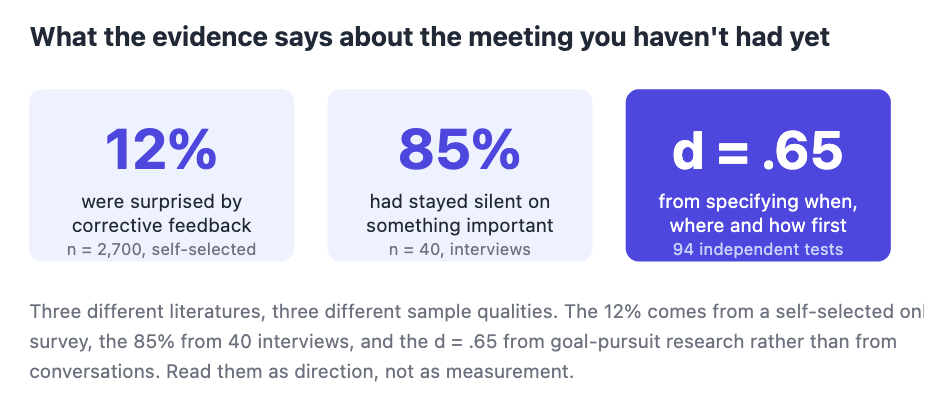
Because they're improvised. The founder rehearses an opening line, gets an answer they didn't expect, and spends the rest of the meeting on instinct. In 2006, Peter Gollwitzer and Paschal Sheeran published a meta-analysis of 94 independent tests of the idea. Specifying the when, where and how of an action in advance had, in their words, a positive effect of medium-to-large magnitude on goal attainment, d = .65 (Gollwitzer & Sheeran, Advances in Experimental Social Psychology, 2006).
That literature is about goal pursuit, not about conversations, and it would be dishonest to pretend otherwise. The claim it supports is narrow and still useful: intending to do a thing is not what moves the number. Specifying the conditions is. For example, "I'll raise it with her this week" is an intention, and it behaves like one.
Founders are unusually exposed here. At a company of thirty there's no HR partner to prepare with, no review cycle forcing the timing, and no manager above you asking whether it happened. The person is often someone you recruited yourself and like. Every structural prompt that makes a manager at a larger company hold the conversation on schedule is simply absent, which leaves the founder's own discomfort as the only scheduler.
There's a second failure that happens before the meeting, and it belongs to a different article. Fear produces hesitation and anger produces an oversized reaction, and both distort which problem you decide to take on in the first place. Why founders make bad decisions covers that mechanism in full. Here we're picking up at the point where you've already decided the conversation has to happen.
What do founders get wrong about how the other person will take it?
They expect to blindside the person. Almost nobody is blindsided. In 2019, reporting on 2,700 respondents to a survey they had run through Harvard Business Review, Jack Zenger and Joe Folkman found that only 12% said they'd been surprised by negative or corrective feedback (Zenger & Folkman, Feedback: The Powerful Paradox, 2019). The other 88% already knew.
That said, two caveats belong with the number, and the honest version of this article states them in the body rather than burying them in a caption. It's a self-selected online survey taken by readers of a management blog, more than half of them outside the United States. It measures what people say about themselves. What makes it useful isn't its precision. It's that the direction is the opposite of the assumption founders act on.
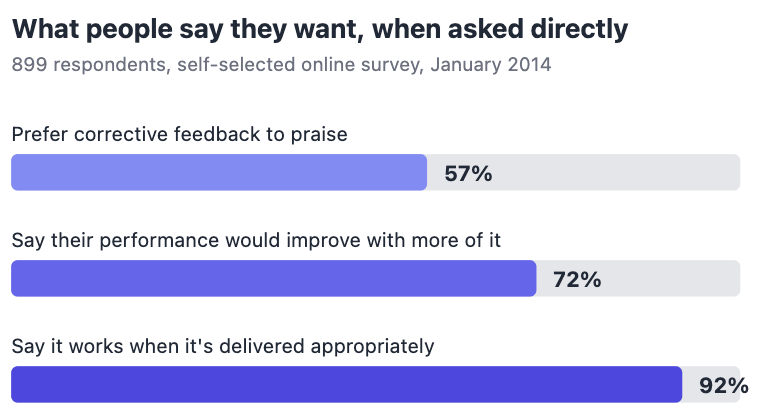
The same programme reported more at an earlier point, with 899 respondents. 57% preferred corrective feedback to praise or recognition. 72% said their performance would improve if their managers provided it, and 92% agreed negative feedback improves performance when it's delivered appropriately (Zenger & Folkman, Harvard Business Review, January 2014).
Noah Shanok, who founded Stitcher in 2006 and ran it for eight years before coaching venture-backed CEOs at Startup CEO Coach, ran that arithmetic in reverse and paid for it.
Early at Stitcher he brought in a senior marketer. The board wanted a senior name in the role; he knew the company was at a stage that needed somebody scrappier, and he went with the board anyway. That kind of pressure is a board relationship problem as much as a hiring one. The hire turned out to be wrong culturally as well as wrong for the stage, and he knew it long before he acted.
When he finally had the conversation, the reaction told him something he hadn't prepared for. People were visibly relieved. That relief is what told him how slow he had been.
"I made a lot of bad hires."
The relief is the part worth sitting with, because it was information and it had been available to everybody in the building except him. Every week he spent working out whether the conversation would be fair, the team had already reached a view without him. His delay wasn't protecting the person and it wasn't protecting the team. It was protecting him from finding out he was late.
Whether somebody should stay is a separate question with its own answer, and the signs it's time to let someone go are already written down. This article starts after that call has been made. The thing worth noticing is how much of the avoidance pattern runs on a prediction about the other person that the evidence doesn't support.
Four things to settle before the meeting, not during it
Write down four answers before the conversation. Each one has a wrong answer that's only visible in advance, and each maps to a way the meeting goes off the rails. This is our own framework rather than a research finding, and it's built from the pattern in the sections above: the conversation drifts into whichever question you left open.

What do I actually know, as opposed to what I've been told? Split the page. Things you observed go on one side, things that reached you through somebody else go on the other. Reported material isn't false. It did, however, arrive with a source, and the source had an interest. Anything on the right-hand side is a second conversation you haven't had yet.
What's genuinely still open? The most common failure in a founder's difficult conversation is staging it as a discussion when the decision is already made. It's meant kindly and it reads as consultation. The person will work out by the second answer that nothing they say changes anything, and what they'll remember afterwards is being handled.
What would I have to hear to change my mind? Write the answer before the meeting, while it can still be honest. If the answer is nothing, that isn't a disqualification. It's a signal that this is an announcement, and announcements go better when they're conducted as announcements.
What happens next, either way? The follow-up, the timeline and the next check-in should exist before you walk in. Deciding them in the room means deciding them in whatever emotional state the room produced, which is the one state in which you're least able to judge what's reasonable.
What actually goes wrong in a performance conversation?
You walk in holding the thinnest version of the facts in the building. Everyone who works alongside the person knows more, and the reasons they haven't passed it up are well documented. In their 2003 interview study of 40 full-time employees, Frances Milliken, Elizabeth Morrison and Patricia Hewlin found that 85% had been in a situation where they felt unable to raise an issue with a supervisor even though they believed it mattered (Milliken, Morrison & Hewlin, Journal of Management Studies, 2003).
The sample is 40 people and the authors called the work exploratory in the title, so 85% here means 34 interviewees. Cited as a large survey it would be exactly the kind of number this article criticises three paragraphs from now. Cited honestly it's still the cleanest available account of the mechanism, and the mechanism is the useful part: the most frequently given reason for staying quiet was fear of being seen or labelled negatively, and of damaging a relationship that mattered.
Run that forward into your own information. You assembled that picture from whoever was most willing to escalate. That's a selection effect wearing the costume of a consensus. It's why a coach's first move is often a round of stakeholder interviews with six to eight people who know the client best professionally, before any coaching starts, and it's a fair description of what the coaching methodology is for.
So do the equivalent yourself. Get the specific instances before the meeting and get them from more than one direction. Then separate the pattern you can evidence from the impression you've absorbed, and take only the first one into the room. A conversation built on two dated examples survives disagreement. A conversation built on a feeling that several people seem unhappy does not, and the person will be right to push back on it.
The direction-change conversation, where the outcome is already fixed
Somebody's scope, project or mandate is moving because the company is moving. The outcome isn't negotiable and pretending it is will cost you more than the change itself. What's still available is the process and the explanation, and both have effects of their own. A 2001 meta-analytic review of 183 organisational justice studies found that distributive, procedural, interpersonal and informational justice each have unique relationships with organisational outcomes, over and above the others (Colquitt, Conlon, Wesson, Porter & Ng, Journal of Applied Psychology, 2001).
Read that as a map of what you still hold once the answer is settled. Three levers out of four remain, specifically these.
Procedural: was there a consistent basis for the decision, applied the same way to other people, and can you state it? Informational: was the reasoning explained, including the part that reflects badly on the company or on you? Interpersonal: was the person treated as somebody whose work mattered, in the room, by the person who actually decided?
The last one carries more weight at a startup than most founders expect, because there's nobody to delegate it to. When a change is delivered by somebody who can't explain the reasoning, the person correctly reads that as a statement about how much the decision needed their understanding.

The principle isn't new to this site. Balancing transparency and optimism with investors makes the same argument about a different audience: lead with problem, plan and conviction, because stakeholders hate surprises more than they hate bad news. Your team is a stakeholder with more information than your investors and less protection.
Two boundaries. This is one person whose work is changing while their job continues. Telling people their jobs are ending is a different conversation with its own sequence, covered in coaching founders through layoffs. And the question of whether to change direction at all sits upstream of everything here.
Why do pay and equity conversations go wrong even when the number is fair?
Because what damages people is rank, not level. A defensible number lands badly the moment somebody works out where it places them. In 2012, David Card, Alexandre Mas, Enrico Moretti and Emmanuel Saez ran a randomised experiment in which a randomly chosen subset of University of California employees were told about a new website listing university pay. Employees paid below the median for their unit and occupation reported lower pay and job satisfaction, and a significant increase in the likelihood of looking for a new job. Those above the median reported no higher satisfaction and no change in job search (Card, Mas, Moretti & Saez, American Economic Review, 2012).
The asymmetry is the finding. In contrast to what most founders assume, disclosure didn't make people happier at the top and unhappier at the bottom in equal measure. It did nothing at the top and real damage at the bottom, and the authors conclude that the effect tracked an employee's pay rank more closely than their pay level relative to the unit median.
Startups make this worse in a specific way. In fact, the conditions are close to ideal for it. The currency is equity, its value is genuinely unknowable, and the employee has no external reference point for whether the grant is generous. What they do have is an inference about where they sit relative to the people around them, and if you don't give them a basis for the number, they'll construct one. The constructed version is almost always less flattering than the truth.
So the work is to make the basis explicit. What the grant is for, what it isn't, how the band was set, what would move it, and when that gets looked at again. None of that changes the figure. All of it changes what the person can reasonably infer from the figure, which is where the actual damage happens.
One boundary: how much equity a first executive should get is a benchmark question, and when startups hire their first executives covers the ranges. This section is about an existing employee's own conversation, where the number is usually already set.
The twenty-four hours after the conversation
The conversation isn't the deliverable. What the person remembers a week later is, and that version starts drifting within hours. After a conversation that went badly it drifts toward the harshest available reading. After one that went well it drifts toward the softest, which is the more expensive of the two, because now nothing changes and you both think it's handled.
Send a short written summary the same day, in plain language: what was raised, what was agreed, what happens next, by when. Not a document for a file. A shared record, so that two versions don't quietly form.
Without an HR function, nobody else is holding this thread. The follow-up that a larger company gets from process, a startup gets only if the founder does it personally, which is also true of most of what breaks as teams grow past the point where you can see everything.
Finally, schedule the next conversation before the first one ends. Its job isn't to repeat what you said. It's to find out what the person heard, which is frequently a different conversation from the one you think you had.
We ran the two statistics this category repeats most back to their sources. The widely quoted claim that 70% of employees avoid difficult conversations comes from two vendor studies a decade apart: a 2009 study by VitalSmarts, which sells Crucial Conversations training, and a 2019 survey of just over 500 US office employees by Bravely, which sells conversation coaching (Bravely, The Cost of the Conversation Gap, 2019). We found something else in Bravely's own methodology page: 16.7% of its sample worked at a startup, which means the frequently repeated figure that 77% of startup employees avoid these conversations rests on roughly 84 people. That subgroup size is disclosed nowhere it gets cited.
Frequently asked questions
How long should you wait before having a difficult conversation with an employee?
The useful trigger isn't a number of weeks. It's the moment you form a view the other person can't see. From that point the gap is the problem, and it grows in one direction only. Given that only 12% report being surprised by corrective feedback, the waiting rarely buys what founders think it buys.
Should you follow up a difficult conversation in writing?
Yes, and the reason is drift rather than documentation. Memory of a charged conversation reorganises within days, in both directions. A short same-day note covering what was raised, what was agreed and what happens next keeps one version in circulation instead of two, and takes about six minutes.
What do you do if the person cries or gets angry?
Stop working through your agenda. The reaction is information about which part landed and how it landed, and that's more valuable than the three points you haven't made yet. Ask what they heard. If they need to finish another day, agree a specific time before they leave the room.
Do you need an HR function before you can have these conversations properly?
No. What changes without HR is that nothing gets written down unless you write it, nothing recurs unless you schedule it, and there's no second person who can explain the reasoning if you can't. The preparation carries a heavier load precisely because the process around it is missing.
Do these conversations get harder as the company grows?
They get harder for a specific reason: your direct knowledge of the person's work thins out while your authority over it doesn't. At twelve people you've seen the work. At sixty you're relaying a view formed by somebody else, which is why the first of the four questions stops being optional.
When is this a coaching problem rather than a communication-skills problem?
Technique fixes an awkward delivery, and delivery matters, given that 92% of people say corrective feedback works when it's done well. It does nothing for a founder who keeps arriving at the conversation four months late. That's a different problem, with a different cause, and it repeats across quarters and across people.
They usually already know
The private case for waiting is almost always that the person isn't ready to hear it. The evidence points the other way. Most people report having seen it coming, most say they'd have wanted more corrective feedback rather than less, and the colleagues around them have usually reached the same conclusion earlier than either party.
What the delay actually buys is a worse version of the same conversation. The examples go stale, the pattern hardens, and by the time it happens the person has lost months they could have spent either fixing it or leaving.
None of that is an argument for speaking without preparing. It's an argument for moving the work earlier. Decide what you know, what's open, what would change your mind, and what happens next. Then have the conversation while the answers are still useful to the person on the other side of it.
Sources
- Peter M. Gollwitzer & Paschal Sheeran, "Implementation Intentions and Goal Achievement: A Meta-analysis of Effects and Processes," Advances in Experimental Social Psychology 38, 69-119, 2006 (meta-analysis of 94 independent tests; implementation intentions specifying the when, where and how of goal striving had a positive effect of medium-to-large magnitude, d = .65, on goal attainment. A total participant count of 8,461 is widely quoted in secondary citations but appears neither in the published abstract nor in Gollwitzer's own later summary of the review, so it is not stated here. This is goal-pursuit research and does not study conversations; the transfer is stated as such in the body), retrieved 2026-09-03, https://doi.org/10.1016/S0065-2601%2806%2938002-1
- Jack Zenger & Joseph Folkman, Feedback: The Powerful Paradox, Zenger Folkman, 2019 (reports 2,700 respondents to an online survey offered through the authors' January 2014 Harvard Business Review article, more than half from outside the United States; "Only 12 percent of the people in our research said that they were surprised by negative or corrective feedback." Self-selected sample, self-reported), retrieved 2026-09-03, https://zengerfolkman.com/wp-content/uploads/2019/08/Feedback-the-Powerful-Paradox_WP-2019.pdf
- Jack Zenger & Joseph Folkman, "Your Employees Want the Negative Feedback You Hate to Give," Harvard Business Review, 15 January 2014 (899 respondents at time of publication, 49% from the United States; 57% preferred corrective feedback against 43% preferring praise or recognition; 72% said they thought their performance would improve if their managers would provide corrective feedback; 92% agreed that "negative (redirecting) feedback, if delivered appropriately, is effective at improving performance." Same instrument as the 2019 whitepaper at a smaller N; the two waves report different questions and are not combined here), retrieved 2026-09-03, https://hbr.org/2014/01/your-employees-want-the-negative-feedback-you-hate-to-give
- Frances J. Milliken, Elizabeth W. Morrison & Patricia F. Hewlin, "An Exploratory Study of Employee Silence: Issues that Employees Don't Communicate Upward and Why," Journal of Management Studies 40(6), 1453-1476, 2003 (interviews with 40 full-time employees across diverse industries, average four years in role; 85% reported having been in a situation where they felt unable to raise an issue with a supervisor despite believing it was important, and the most frequently mentioned reason was fear of being viewed or labelled negatively and damaging valued relationships. The publisher page returns 403 to automated retrieval; the figures above are corroborated across independent academic summaries rather than read at the paywalled primary, and the sample size is stated inline in the article for that reason), retrieved 2026-09-03, https://doi.org/10.1111/1467-6486.00387
- Jason A. Colquitt, Donald E. Conlon, Michael J. Wesson, Christopher O. L. H. Porter & K. Yee Ng, "Justice at the Millennium: A Meta-Analytic Review of 25 Years of Organizational Justice Research," Journal of Applied Psychology 86(3), 425-445, 2001 (meta-analytic review of 183 justice studies; the abstract states that the results "illustrate the overall and unique relationships among distributive, procedural, interpersonal, and informational justice and several organizational outcomes," and that although the dimensions are moderately to highly related they contribute incremental variance explained in fairness perceptions. Cited here as a dimensional finding; no per-dimension correlations are stated), retrieved 2026-09-03, https://doi.org/10.1037/0021-9010.86.3.425
- David Card, Alexandre Mas, Enrico Moretti & Emmanuel Saez, "Inequality at Work: The Effect of Peer Salaries on Job Satisfaction," American Economic Review 102(6), 2981-3003, October 2012 (a randomised field experiment with a placebo group, not a natural experiment: a randomly chosen subset of University of California employees was informed of a website listing university pay. Abstract, verbatim: "workers with salaries below the median for their pay unit and occupation report lower pay and job satisfaction, while those earning above the median report no higher satisfaction. Likewise, below-median earners report a significant increase in the likelihood of looking for a new job, while above-median earners are unaffected." The paper further reports that the treatment effect "is more closely related to pay rank than to the actual level of pay relative to the median in the pay unit." Direction only is stated in the article; per-group magnitudes are not reproduced), retrieved 2026-09-03, https://doi.org/10.1257/aer.102.6.2981
- Bravely, The Cost of the Conversation Gap on Workplace Health, March 2019 (survey of more than 500 full-time US office employees conducted with an independent research firm; the whitepaper's own research-approach page reports that 16.7% of respondents work at a startup. Vendor research: Bravely sells workplace conversation coaching. It cites VitalSmarts, Grenny and Maxfield, 2009, for the earlier finding that more than 70% of employees fail to confront colleagues; VitalSmarts sells Crucial Conversations training), retrieved 2026-09-03, https://learn.workbravely.com/hubfs/Conversation_Gap_Whitepaper.pdf