.png)
Fear of failure has a reputation it does not deserve. It is supposed to freeze people. In a venture-backed founder it almost never does, because a founder who has raised money, hired a team, and committed to a roadmap has no realistic option to stop moving. The fear finds other outlets. It shows up in the length of an investor update, in a senior role that stays open for three quarters, and in a strategy defended past the point the evidence supports it. Each of those reads as competence from the outside. That is what makes them expensive, and it is why most advice on this topic misses.
What does fear of failure look like in a founder's leadership decisions?
It looks like three specific behaviours, and none of them looks like fear. A founder sends more context than the recipient asked for. A senior role in the founder's own discipline stays open while every other role gets filled. A strategic direction gets held longer than the data supports, described in the language of conviction.
What connects them is an audience. The fear driving each one is not really fear of a bad outcome. It is fear of being seen to have been wrong about something. Paralysis has no witness, which is one reason it shows up so rarely in a job where a board, a cap table, and a team are watching continuously.
This distinction matters practically, because it changes what you look for. A founder searching for paralysis in themselves will find none and conclude the fear is not there. The behaviours it actually produces are all things a founder would list on a self-assessment as strengths: transparency, a high bar, conviction.
Noah Shanok, who founded Stitcher in 2006 and ran it for eight years before coaching venture-backed CEOs through Startup CEO Coach, works with founders from Seed through Series C. The three behaviours below are the ones that surface in the decision itself, where the cost is measurable. What follows names each one, gives the legitimate version it is easily confused with, and supplies a single question that tells them apart.
Why doesn't founder fear of failure look like paralysis?
The most widely used instrument for measuring fear of failure has the answer built into it. In 2002, David Conroy and colleagues published the Performance Failure Appraisal Inventory, a 25-item measure that breaks the fear into five distinct aversive consequences: experiencing shame and embarrassment, devaluing one's self-estimate, having an uncertain future, important others losing interest, and upsetting important others (Conroy, Willow & Metzler, Journal of Applied Sport Psychology, 2002).
Three of those five are about other people. Shame requires someone to be ashamed in front of. Important others losing interest and upsetting important others are explicitly relational. A fear whose content is largely social does not produce withdrawal from the decision. It produces management of what the audience sees.
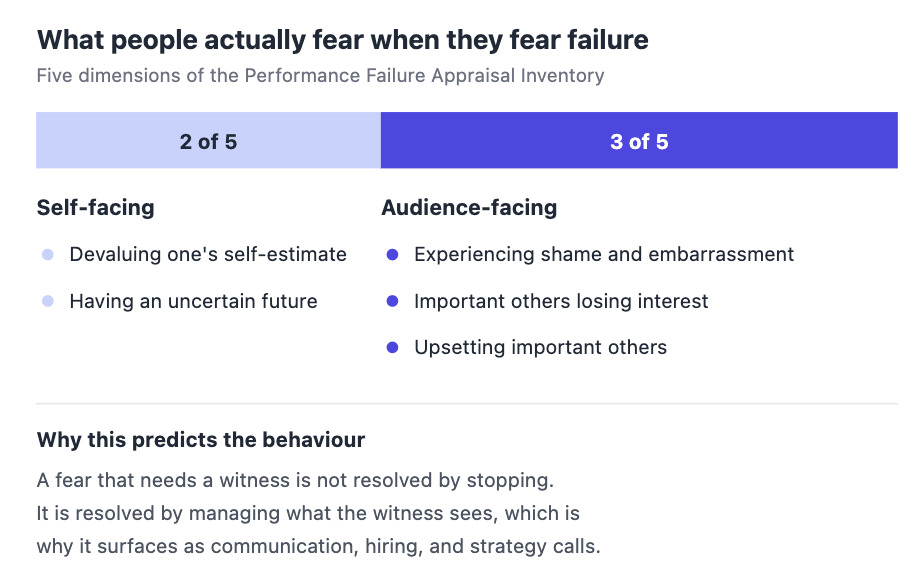
Conroy, Willow & Metzler, Journal of Applied Sport Psychology 14(2), 2002. The grouping into self-facing and audience-facing is our reading of the published dimensions.
The management literature describes the same mechanism from the other direction. Writing in Harvard Business Review, Ron Carucci put it plainly: "In an effort not to upset others or lose status in the eyes of their followers, they concoct sophisticated justifications for putting off difficult decisions" (Harvard Business Review, "Leaders, Stop Avoiding Hard Decisions", April 2018). The justification is the part that matters for a founder. It is what turns a fear response into something that presents as strategy.
The statistic everyone quotes is about people who never started
In 2024, the Global Entrepreneurship Monitor surveyed more than 150,000 adults across 51 economies and found that 49% said fear of failure would stop them starting a business, up from 44% in 2019 (GEM 2024/2025 Global Report, February 2025). It is the number nearly every article on this topic reaches for.
It describes people who did not start a company. They have no board, no cap table, and nobody depending on next quarter. The question this article covers is a different one: what fear does to somebody who already started, and who cannot get the option of not starting back.
Behaviour one: when does transparency become pre-emption?
The first place fear surfaces is in the volume and timing of what a founder sends. Updates get longer. They arrive earlier. They carry framing the recipient did not ask for, and the length tracks how bad the month was.
The specific forms are recognisable. There is the email that lands the night before the board meeting explaining a miss the deck has not yet shown. There is the all-hands that addresses a rumour nobody raised. There is the investor update where the section on what went well has grown by two paragraphs and the number itself has moved to the bottom.
None of that is dishonest. Most of it is accurate. The tell is that it is pre-emptive: the narrative arrives ahead of the data so the data never gets interpreted by somebody else first.
The cost is subtle enough that founders rarely price it. A board that receives interpretation before information learns to read the founder's framing as the primary signal. The founder then loses access to the one thing that would tell them how bad the situation actually looks: an unguided reaction from a competent outsider. Two of the five dimensions Conroy identified are important others losing interest and upsetting important others, and pre-emptive framing is precisely the behaviour those two produce when the audience cannot be avoided.

The test: what is this message for?
Ask whether the message changes what the recipient can now do, or only what they think of you. Real disclosure is instrumental. It hands somebody a decision they could not otherwise make: an intro they can offer, a hire they can help close, a risk they can price. Pre-emption is reputational. It hands them an interpretation.
The legitimate twin here is structured disclosure, which has a shape and a limit. Noah's published approach to it runs on problem, plan, and conviction, on the argument that investors dislike surprises more than they dislike bad news, and there is a fuller treatment of what to tell investors and when.
Behaviour two: which hire do founders avoid making?
The second place fear surfaces is a role that stays open. Not the role the company most obviously needs. The one whose occupant would be able to evaluate the founder's own work.
For a technical founder it is usually the first VP of Engineering. For a founder who has personally closed every deal to date it is the first commercial leader. The pattern holds across functions: whichever discipline the founder considers their own is the one where the search never quite completes.
The reasons given are defensible and usually partly true. The bar was not met. The candidate was strong technically and wrong culturally. The seniority is premature for the stage. Burn does not support it this quarter. A reason being true does not make it the operative reason.
What gives it away is asymmetry inside the same company. Roles outside the founder's discipline get filled at the stated bar, sometimes quickly. The role inside it accumulates near-misses across three or four quarters, each with a specific and reasonable objection attached. One unfilled role is a hiring market. A pattern where the unfilled role is always in the same discipline is something else.
The cost compounds quietly. The company runs one functional layer below its stage in exactly the area the founder is most invested in being good at, and nobody sees the gap because the founder is personally covering it. The compensation works until the founder's own capacity becomes the ceiling. Company stage sets when a first executive hire is due, and this pattern quietly overrides that schedule.
The test: who would you feel smallest next to?
Name the person you would feel smallest sitting next to. Then ask whether the role you have not opened is the role they would fill. If the answer is yes, the bar is not what is holding the search.
Behaviour three: when is conviction actually delay?
The third place fear surfaces is a direction held past the evidence and described as conviction. This is the most expensive of the three, because the vocabulary available for it is borrowed from the one founder trait investors reward most.
The research offers a way to check it. Jacqueline Kirtley and Siobhán O'Mahony ran a longitudinal field study inside seven entrepreneurial firms, examining 93 strategic decisions at risk of change. Firms changed strategy only after new information conflicted with or expanded what they already believed, and the authors are blunt about how often that happened: "this is more rare than the norm." When it did happen, no firm pivoted in a single call. They incrementally exited or added one element at a time, accumulating into a pivot (Kirtley & O'Mahony, Strategic Management Journal 44(1), 2023).
Noah has said publicly that Stitcher never had product-market fit and raised money as though it did, and names raising before fit as the mistake he would most want to take back. The underlying distinction is whether the market is pulling or you are still pushing.
Why can't a founder wait until they're sure?
Read that against the founder waiting to be sure, and something breaks. If a pivot is built from small reversible moves, then the certainty a founder is waiting for is produced by exactly the moves they are declining to make. "I will change direction when I know" describes a condition that cannot be satisfied from a standing start. Fear does not have to stop the pivot to be expensive here. It only has to keep the pivot framed as one large irreversible announcement, because that framing is what makes waiting feel responsible.
There is a reason this behaviour is more fear-driven than the other two. A strategic shift is the only one of the three with a scheduled audience. Communication can be sent whenever. A search can stay open indefinitely without a review date. A change of direction has to be explained, to a board, on a day already in the calendar.
The test: what has changed since you decided?
Two parts, and the second one does the work. What information have you received since setting this direction that conflicts with it? And which single element of the strategy does that information touch?
A founder with genuine conviction can answer both. A founder managing an audience answers the first easily and stalls on the second, because naming one element makes a small move available today, and a small move made today is a small move that has to be mentioned.
Three behaviours, three tests
Each behaviour has a legitimate twin that is indistinguishable from the outside and often from the inside. The behaviour itself is not diagnostic. What the behaviour is for is.
We read through the pages currently ranking for this question before writing this one. Every one of them names symptoms. None supplies a way to tell a symptom from its competent twin, which is the gap the table below is built to close.
A caveat that keeps this honest: the tests identify a pattern, and a pattern is not a diagnosis. Any one of the three in isolation is usually a busy quarter with a bad hiring market attached. Two of the three, sustained across two quarters, is a signal worth taking seriously.
The stories founders tell themselves in this state are consistent enough to have names, and Noah's four are waiting for the right moment, needing one more data point, not wanting to hurt someone, and calling it patience. He unpacks each one in his account of the decisions CEOs already know they need to make.
How is this different from imposter syndrome, burnout, or plain avoidance?
These four get used interchangeably in founder conversation and describe different things. The distinction is worth drawing because the interventions diverge.
The short diagnostic runs like this. If the discomfort arrives before any particular decision, suspect imposter syndrome. If it arrives only where someone will judge the outcome on a known date, that is fear of failure. If it shows up in which risks you will consider at all, that is identity fusion. If you already know the answer and cannot move, that is avoidance. If the recovery time between hard conversations keeps stretching, that is burnout.
The practical consequence is that the standard remedy fails. Confidence-building work does very little for fear of failure, because the founder is not short of confidence in their own judgment. They are making an accurate forecast: the judgment will be evaluated in public, by people with power over the company, on a date somebody else set. Telling them to believe in themselves addresses a problem they do not have.
What actually reduces founder fear of failure?
Fear of failure does not respond well to being argued with. It responds to changed conditions: making the evidence of failure arrive earlier, smaller, and on the founder's own initiative.
There is a concrete example in Stitcher's own history. The first product was an iTunes plugin for organising podcasts on the desktop. In Noah's own words: "The first version was so bad that after launching we had exactly zero retained users. We had to pay people to try it just to understand why it was so terrible."
That is a founder spending money to manufacture witnesses to a failure. The information was going to arrive either way. Commissioning it early, from people with no stake in the answer, meant it arrived while it was still cheap and while the only audience was the team that could act on it.
Three moves generalise from that. The first is to shrink the unit of exposure. A direction changed one element at a time never produces a single announceable reversal, so there is nothing for an audience to score, and the Kirtley and O'Mahony finding suggests this is how strategy changes anyway. The second is to pre-commit the criterion in writing to one other person, before the data arrives. Its value is narrow and real: it removes the option of retroactively deciding the evidence was insufficient, which is what "one more data point" usually turns out to be. The third is to buy the bad news. A paid user test, an exit interview with the customer who churned, a board pre-read that opens with the miss rather than closing with it. Failure evidence you commissioned costs less than failure evidence somebody hands you.
Where an outside party helps is specific and worth stating plainly. Each of the three behaviours arrives with a defensible reason already attached, which is what makes them invisible from inside. The tests only work when somebody asks them who has no stake in the answer, no equity, and no seat on the board. That is a structural property of the relationship, and it sits alongside the broader question of how founders keep their judgment stable under pressure.
Frequently asked questions
Is fear of failure always bad for a founder?
No. It sharpens preparation, and it is the reason some founders run genuinely useful pre-mortems while others skip them. The cost appears when it starts selecting which decisions get made and which get postponed, as opposed to how carefully each one is thought through.
How is fear of failure different from imposter syndrome?
Imposter syndrome is a claim about qualification: I should not be in this seat. Fear of failure is a claim about exposure: I will be seen to have been wrong. A founder can be entirely confident in their own judgment and still dread the audience for it, which is why the two need different responses.
Can a founder have fear of failure and still take big risks?
Yes, and this is the case most commonly missed. The risks that get taken are the ones with a shared or deferred verdict, where the outcome lands years out or the responsibility spreads across a team. The ones that stall are those where the founder is individually and visibly accountable on a known date.
Does founder fear of failure go away after a successful round or exit?
There is no evidence that it does, and the audience-based account predicts it should not. Raising money adds observers with formal power. A larger company adds employees whose jobs depend on the founder's calls. The number of people who will see the next mistake goes up, not down.
How do you tell fear from good judgment in a hard call?
Good judgment names its criterion in advance and can say what would change it. Fear produces a criterion that moves whenever it is about to be met: the threshold rises, a new dependency appears, the timing becomes wrong. Write the criterion down before the data arrives and the difference becomes visible.
When does fear of failure need a coach and when does it need a therapist?
Coaching works on the decision in front of you and the behaviour around it, which is where these three patterns live. Where the fear predates the company, shows up across a whole life, and does not track what is actually at stake, that is therapeutic territory, and any coach unwilling to say so is the wrong one.
The fear is about the witness, not the outcome
None of these three behaviours is weakness, and none of them is visible as fear. That is exactly what makes them expensive. A founder can hold all three, describe them accurately to a board as transparency, a high bar, and conviction, and be believed, because each description is partly true.
The asymmetry worth ending on is a practical one. A founder can rarely reduce how much is being watched. The board meets on its schedule, the team reads the all-hands, the investors read the update. What is available is control over how early and how small the evidence arrives. A founder who commissions the bad news has already changed what the audience is for.
Sources
- David E. Conroy, Jason P. Willow & Jonathan N. Metzler, "Multidimensional Fear of Failure Measurement: The Performance Failure Appraisal Inventory," Journal of Applied Sport Psychology 14(2), 2002 (25-item measure; five aversive consequences of failure: shame and embarrassment, devaluing one's self-estimate, an uncertain future, important others losing interest, upsetting important others), retrieved 2026-08-20, https://pure.psu.edu/en/publications/multidimensional-fear-of-failure-measurement-the-performance-fail/ (publisher version: https://doi.org/10.1080/10413200252907752)
- Ron Carucci, "Leaders, Stop Avoiding Hard Decisions," Harvard Business Review, 13 April 2018 (quoted claim: leaders "concoct sophisticated justifications for putting off difficult decisions" "in an effort not to upset others or lose status in the eyes of their followers." The article separately reports a ten-year longitudinal study of more than 2,700 leaders in which 57% of newly appointed executives said decisions were more complicated and difficult than expected; that figure is not used here, as it measures perceived difficulty rather than fear), retrieved 2026-08-20, https://hbr.org/2018/04/leaders-stop-avoiding-hard-decisions
- Jacqueline Kirtley & Siobhán O'Mahony, "What is a pivot? Explaining when and how entrepreneurial firms decide to make strategic change and pivot," Strategic Management Journal 44(1), 197-230, 2023 (longitudinal field study of seven entrepreneurial firms and 93 strategic decisions at risk for change; decision-makers changed strategy only after new information conflicted with or expanded their beliefs, which the Managerial Summary calls "more rare than the norm"; firms incrementally exited or added a single strategy element at a time, accumulating into a pivot. Abstract verified via Crossref publisher metadata, DOI 10.1002/smj.3131; the full text is closed access), retrieved 2026-08-20, https://sms.onlinelibrary.wiley.com/doi/abs/10.1002/smj.3131
- Global Entrepreneurship Monitor, GEM 2024/2025 Global Report: Entrepreneurship Reality Check, February 2025 (Adult Population Survey, 150,000+ respondents across 51 economies; 49% of 2024 respondents said fear of failure would prevent them starting a business, up from 44% in 2019), retrieved 2026-08-20, https://gemconsortium.org/report/gem-20242025-global-report-entrepreneurship-reality-check-4
- Stitcher product history and the first version's zero retention are drawn from Noah Shanok's own published account on startupceo.coach.