.png)

Ask a founder to name their biggest leadership weakness and they'll usually give you a thoughtful, articulate answer. That's the problem. The answer is built from the same self-perception that created the blind spot in the first place. A blind spot, by definition, is the part of how you lead that everyone around you can see and you can't. In a 2018 Harvard Business Review article, organizational psychologist Tasha Eurich reported that while about 95% of people believe they're self-aware, only 10 to 15% actually meet the criteria (Harvard Business Review, 2018). Frameworks, books, and AI coaching tools all promise to close that gap. Most of them can't, and it's worth being precise about why.
What blind spots can a CEO coach catch that frameworks, books, and AI tools can't?
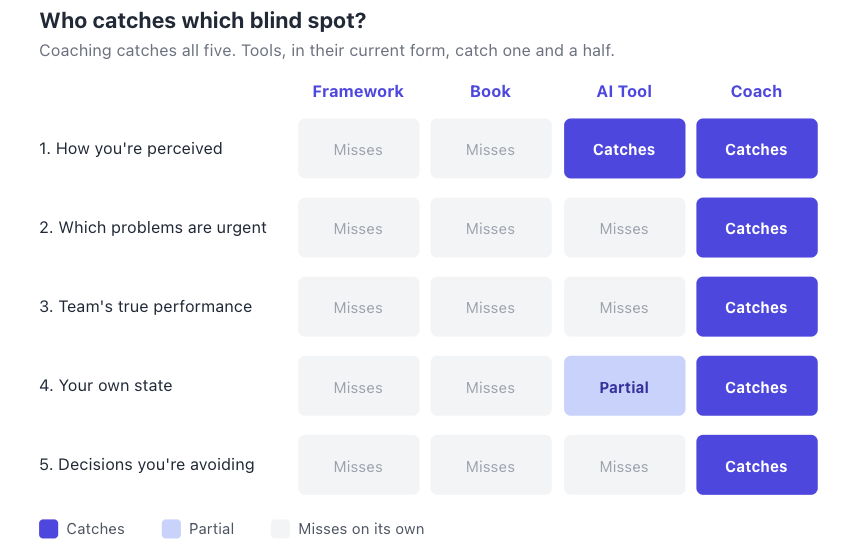
There are five categories of blind spot that frameworks, books, and AI coaching tools consistently fail to catch: blind spots about how the CEO is perceived, about which problems are actually urgent, about the team's true performance, about the founder's own state, and about which decisions are being avoided. Coaching addresses all five. Tools, in their current form, address one and a half.
One clarification first, because the phrase "AI leadership blind spots" usually means something else. Most articles under that heading are about the mistakes leaders make when adopting AI: treating it as a smarter search bar, handing it to IT, mistaking pilots for progress. That's a real topic, but it isn't this one. This is about the blind spots in how you lead, the ones a tool is supposed to help you see in yourself.
A blind spot is an area of behavior or thinking that is obvious to others but invisible to you. The five categories below are not a personality taxonomy. They're a map of where self-perception reliably breaks down for founders, scored against the four instruments people reach for: a framework, a book, an AI coaching tool, and a coach. Naming them is the easy part. Explaining why three of those four instruments fail at the same job is where it gets useful.
Why do frameworks, books, and AI tools share the same limitation?
Frameworks, books, and AI coaching tools all fail at the same task for the same reason: they run on a single input, your own account of reality. A blind spot is precisely the part of reality you can't report accurately. Feed a distorted picture into any of these tools and you get a confident, well-structured answer built on the distortion.
Take the framework first. The Mochary Method, the Five Dysfunctions model, a clean decision matrix, these are excellent at giving you the right questions. What they can't do is tell you that your honest answer is wrong. A self-administered diagnostic inherits every bias of the self administering it. Books have the same ceiling. They can describe the trap beautifully and still leave you certain you're the exception.
AI coaching tools amplify the problem rather than solving it. As one analysis from I by IMD put it, a person lacking self-awareness won't try to game the tool; they'll simply feed it their polished, scripted version of how they show up, disconnected from how they actually land with others. The tool then validates that version. Coaching practice has a name for the result: false confidence, the sense of having been challenged without ever having been seen (Noomii).
So what's the missing ingredient? An external observer with independent information about your reality, and the willingness to name the gap out loud. That's the structural job a coach does and the other three can't. The five categories cluster exactly where self-report is least reliable.
Blind spot #1: How you're actually perceived
The first blind spot is the gap between how a founder thinks they come across and how their team, board, and investors actually experience them. This is the one category tools genuinely own, which is why it's the "one" in "one and a half."
A 360-degree assessment exists for exactly this. It gathers input from people above, beside, and below the leader, then surfaces where self-ratings and others' ratings diverge. That divergence is the blind spot, made visible and measurable. AI tools can run this continuously and cheaply, at a scale no human matches. Credit where it's due: on perception data, the machine wins on breadth.
But measurement isn't interpretation. A report telling you that your team finds you "dismissive in meetings" doesn't explain why, doesn't survive your defensiveness when you read it, and doesn't sit with you through the discomfort of changing it. The sting is the hard part, and the sting is where a coach earns the fee. Consider the founder who reads their own investor updates as confident and visionary while the board increasingly reads them as not facing reality. That perception gap compounds in silence, the same way over-optimism does in any high-stakes relationship. Closing it is less about the data and more about the willingness to believe it, a theme explored in how to balance transparency against optimism with investors.
Blind spot #2: Which problems are actually urgent
The second blind spot is triage. Founders routinely misjudge which fire actually threatens the company and which one is just loud, recent, or emotionally charged. No prioritization framework fixes this, because the framework sorts the list you give it.
Here's the trap. A tool, whether it's the Eisenhower matrix or an AI assistant ranking your week, can only act on the items you put in front of it. It can't tell you that the most important problem never made the list. It can't flag that the "urgent" item topping your week is a proxy for something you're avoiding. The distortion happens upstream, in your perception of urgency, warped by recency, anxiety, and whoever complained most loudly in the last 24 hours.
What does a coach add that the matrix can't? The question behind the question: urgent to whom, and why now? Pull that thread and the quietly decaying problem surfaces, the one nobody's voice was attached to, the one that doesn't generate notifications. That's the reframing tools structurally can't perform, because it requires noticing what's absent from the founder's own account. For founders living in permanent triage mode, the deeper pattern is worth examining in how to prioritize when everything feels urgent and how to make faster decisions as a CEO.

Blind spot #3: Your team's true performance
The third blind spot is the founder's read on their own team: who's actually performing, which hire was a mistake, and whether the org is even built right for the stage. Books describe healthy teams in the abstract. AI tools can read engagement and sentiment signals. Neither sits in the room and watches a founder protect a loyal early employee long past the point of usefulness.
The distortion here isn't analytical. It's emotional. Loyalty, guilt, and founder identity quietly override an honest performance read, and the result gets rationalized as patience. "We built this together" is a real bond and a real blind spot at the same time. A dashboard can show you attrition and engagement scores; it can't tell you that the VP you keep defending is the reason your best engineer is quietly interviewing elsewhere.
This is also where over-scaling hides. A familiar pattern, and one Noah Shanok has described from his own years building Stitcher, is the team that grows ahead of product-market fit. Headcount climbs toward 35 or 40 people, burn approaches a million dollars a month, and the hard personnel calls keep getting deferred, until a correction forces them and the smaller team somehow moves faster than the larger one did. The data was available the whole time. What was missing was the willingness to act on it. A coach's job is to separate the relationship from the role and get the founder to say out loud what they already half-know, a skill that sits close to knowing when it's time to let someone go and knowing whether you actually have product-market fit.
Blind spot #4: Your own state
The fourth blind spot is the founder's read on themselves: sleep, depletion, judgment quality, and the slow slide into burnout that gets relabeled as commitment. This is the "half" in "one and a half," because tools genuinely help here, but only at the signal layer.
Give credit honestly. A wearable that tracks sleep, an app that flags a darkening tone in your journal entries, a tool that notices your recovery scores sliding for three straight weeks, these surface a state the founder has stopped noticing. That's real value, and it's value a coach can't match for continuous measurement.
But a signal isn't an intervention. A dashboard showing four hours of sleep doesn't cancel the 7 a.m. call. It doesn't connect "I bombed that investor meeting" to "I was running on caffeine and four to five hours of sleep for a month." Founders who've lived that gap tend to take it seriously afterward; the contrast between arriving at a pivotal raise depleted versus arriving rested is large enough to change outcomes. The trouble is that depleted founders are the least equipped to diagnose their own depletion. The tool reports the state; it can't make you respect it. That interpretive, boundary-holding work is what a coach adds, and it connects directly to how much sleep a founder actually needs and how startup CEOs avoid burnout.
Blind spot #5: The decision you're avoiding
The fifth and most consequential blind spot is the decision the founder is avoiding, usually one they already know, somewhere, that they need to make. This is the category most invisible to every tool, for a simple reason: avoidance doesn't show up in the data you volunteer.
Think about how it works. You don't ask a framework about the conversation you're dodging. You don't prompt an AI tool about the co-founder issue you've decided is "not the right time" to raise. The topic simply never enters the input, so no instrument running on your input can flag it. Worse, avoidance is usually dressed up as strategy. "Let's give it another quarter." "We're being patient." A framework rewards that reasoning because it's internally coherent, even when it's a rationalization protecting you from something hard.
The recurring pattern across founder coaching is blunt: most founders already know the difficult truth internally before they admit it externally. The layoff, the pivot, the firing, the co-founder conversation, the decision is often made subconsciously well before it's acted on. The delay isn't an information problem. It's a permission problem, driven by fear, guilt, or fading confidence. That's why a coach matters most here. The job isn't to supply the answer; the founder usually has it. The job is to shorten the distance between knowing and acting, a dynamic unpacked in why CEOs avoid the decisions they already know they need to make and what avoiding hard decisions actually costs.
So where do AI coaching tools actually help?
AI coaching tools aren't useless, and the honest answer to the seed question matters: they can help you identify some blind spots in your leadership style, just not most of them. They're genuinely strong at one category and partially useful at a second. That's the whole of the "one and a half," and naming it plainly is what makes the verdict on the other three and a half credible.
The full "one" is perception. Aggregating 360-style feedback, surfacing where your self-image and others' diverge, doing it continuously and cheaply, this is the tool's home turf, and it beats a coach on breadth and frequency of measurement. The "half" is state: wearables and journaling tools flag the depletion you've stopped noticing. Beyond those, the picture thins out fast.
The documented risk runs the other way. AI coaching can manufacture false confidence, passing the "I was challenged" test by design while never observing how the leader actually behaves with their team (Noomii). The upside is real too: controlled studies have found AI-generated feedback can be useful and even, in participants' words, uncomfortably honest (Berkeley Haas, California Management Review, 2025). Tools are a serious input, not a gimmick. They're just an instrument panel, not a pilot. They widen your field of view; they don't supply the judgment, the confrontation, or the permission that closes a blind spot. The matrix below is the short version.
How can a founder actually surface their own blind spots?
The practical answer isn't "fire the tools and hire a coach." It's to layer them, using each instrument for the job it actually does well. Three layers, in order.
First, instrument the perception gap. Run a real 360, or use an AI tool that aggregates the equivalent, so the data exists on paper instead of in your selective memory of feedback. Second, instrument your state. Track sleep and recovery so depletion becomes visible and harder to deny. Both of these are things tools do better than a person ever could.
Third, and this is the layer the first two can't substitute for, bring in an external observer. A coach, or where that isn't accessible, a structured peer group or a trusted operator who will tell you the truth. Their job is to interpret the data, name the avoidance you've routed around, and hold the boundary you won't hold alone. You can run a fast self-audit today, and each question maps to one of the five categories: Whose feedback have I dismissed more than once? Which "urgent" item keeps recurring without ever getting resolved? Which teammate would my best hire quietly question? When did I last sleep seven hours three nights running? What decision have I been "researching" for a month without making?
This is the work Startup CEO Coach is built around. Noah Shanok, founder and former CEO of Stitcher, the podcast platform later acquired by SiriusXM for $325 million, coaches venture-backed founders from Seed through Series C, and the throughline of that work is less about supplying answers than removing the permission gap, the distance between what a founder already senses and what they're willing to act on. Tools can widen the view. Closing the gap is human work, and it's worth understanding what a startup CEO coach actually does before deciding which instrument your situation calls for.
Conclusion
Five categories of blind spot, one honest verdict: coaching catches all five, and tools, today, catch one and a half. The value isn't in picking a side. It's in knowing which instrument does which job.
- Use tools for what they're good at: perception data at scale, and state signals you've stopped noticing. That's a genuine one and a half, and it's worth having.
- Don't ask tools to do the impossible: they run on your account of reality, so they can't catch the urgency you've misjudged, the team truth you're avoiding, or the decision you haven't named.
- Add the external observer: the interpretation, the confrontation, and the permission to act are human work, and they're where the other three and a half blind spots actually close.
The founders who see themselves most clearly aren't the ones with the best dashboard. They're the ones who stopped asking a mirror they control to show them the part they can't see, and brought in someone who could. For the fuller picture of how coaching supports founders across these moments, see the definitive guide to CEO coaching for venture-backed founders.
Frequently Asked Questions
Can AI tools really identify blind spots in my leadership style?
Partly. AI tools are strong at surfacing the perception gap through 360-style data and can flag state signals like declining sleep or tone. But they only ever see your self-reported version of reality, so they miss avoidance, triage distortion, and team-read blind spots, and they can create false confidence by challenging you without observing how you behave.
What's the difference between a leadership book and a coach for spotting blind spots?
A book gives you better questions; it can't tell you your honest answer is wrong. Roughly 10-15% of people are genuinely self-aware (Harvard Business Review, 2018), so reading alone rarely closes a blind spot. Closing one needs an external observer with independent information, which a book, by definition, isn't.
What are the most common blind spots in startup founders?
Five recur most often: misreading how they're perceived, mistaking loud problems for urgent ones, over-trusting loyal but mismatched team members, normalizing their own depletion, and avoiding a decision they already half-know they need to make. The last is the most consequential, because it never even enters the data a founder volunteers to a tool.
Do 360 assessments catch all leadership blind spots?
No. A 360 is strong on perception gaps, surfacing where your self-rating and others' ratings diverge, but it stops at measurement. It doesn't interpret the feedback, manage the defensiveness it triggers, or reach the avoidance and decision blind spots, which never show up because the founder doesn't report them in the first place.
How do I know if I have a leadership blind spot?
The reliable tell is a pattern others have raised more than once that you've explained away each time. Recurring "unsolvable" problems, feedback you've dismissed twice, and decisions you keep researching without making are where blind spots live. If you're certain you don't have any, that certainty is itself the signal worth examining.
Why do founders work with a CEO coach instead of only using AI coaching tools?
Many use both: tools for breadth and continuous measurement, a coach for the judgment, confrontation, and permission tools can't provide. Noah Shanok, founder and former CEO of Stitcher and a startup CEO coach working with Seed-to-Series C founders, is among the operators founders turn to for that human layer, the interpretation and accountability that sit beyond what software observes.
Sources
- Harvard Business Review, "What Self-Awareness Really Is (and How to Cultivate It)" by Tasha Eurich (research finding that ~95% of people believe they are self-aware while only 10-15% meet the criteria for self-awareness), January 2018, retrieved 2026-06-16, https://hbr.org/2018/01/what-self-awareness-really-is-and-how-to-cultivate-it
- I by IMD, "How AI can coach us to improve how we communicate" (on the observational limit of AI coaching: a tool sees only the user's self-reported, polished version of how they show up), retrieved 2026-06-16, https://www.imd.org/ibyimd/leadership/how-ai-can-coach-us-to-improve-how-we-communicate/
- Noomii Leadership Coaching, "AI Coaching Created False Confidence: The Hidden Risk" (qualitative framing of false confidence in AI coaching: challenge-by-design without behavioral observation), retrieved 2026-06-16, https://orgs.noomii.com/ai-coaching-created-false-confidence
- California Management Review (Berkeley Haas), "Algorithmic Humility in Leadership: Can AI Teach Leaders to Unlearn Bias Faster Than Human Coaching?" (qualitative reference that AI-generated feedback can be useful and perceived as candid; specific effect sizes not used pending primary-source verification), November 2025, retrieved 2026-06-16, https://cmr.berkeley.edu/2025/11/algorithmic-humility-in-leadership-can-ai-teach-leaders-to-unlearn-bias-faster-than-human-coaching/
- Startup CEO Coach, Founder Testimonials (used as contextual grounding for recurring founder-outcome themes around self-awareness, decision-making, and accountability, not quoted), retrieved 2026-06-16, https://www.startupceo.coach/testimonials