.png)

Most advice on executive presence describes it as a trait: gravitas, a commanding voice, the right posture in the room. That framing misses what actually happens to a startup CEO under pressure. Presence isn't something you either have or don't. It's the gap between what a CEO actually knows and what the room believes that CEO knows. For founders, that gap opens fastest in three specific settings: the board meeting, the stage, and the first all-hands after something goes wrong.
Noah Shanok, founder and former CEO of Stitcher, learned this the hard way, twice. It happened six years apart, in nearly identical rooms, with nearly identical stakes. What changed between the two wasn't his preparation or his pitch. It was his physical state walking in. This piece works through what actually builds or breaks presence in each of the three settings where a founder's credibility gets tested.
What is executive presence, if it isn't charisma?
Researcher Sylvia Ann Hewlett defined the standard version of executive presence as a mix of gravitas, communication, and appearance (Hewlett, Executive Presence, Harper Business, 2014). That framework explains a lot about corporate settings. It explains almost nothing about a founder standing in front of a board that can fire them. It explains even less about a room of investors deciding whether to write a check.
For a startup CEO, presence isn't a performance skill. It's a readout of cognitive state. Shanok has an unusually clean before-and-after on what that means. He lived both sides of it in the same fundraising role, years apart.
That's a different problem from doubting whether you belong in the role at all, which is its own recognizable pattern. Overcoming imposter syndrome as a CEO is about what a founder feels sitting at the table. This piece is about what the table concludes, regardless of what the founder feels.
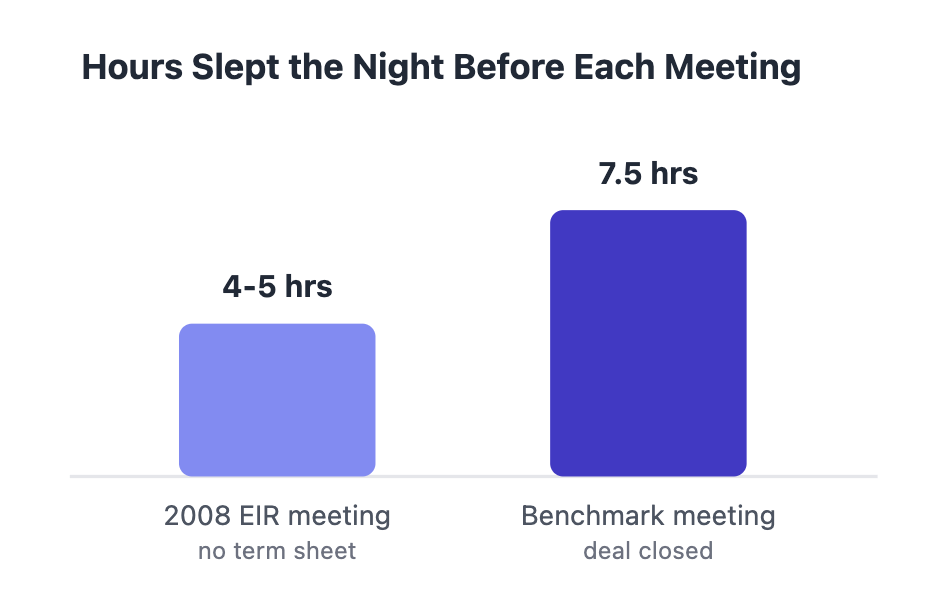
In 2008, raising Stitcher's Series A, he'd pitched 90 VCs. Eighty-nine had passed or ghosted. He was one meeting from a term sheet, running on four to five hours of sleep a night and pushing through on caffeine. The final firm asked him to meet an entrepreneur-in-residence who'd run a similar business. Mid-conversation, discussing the model, he hit a wall. "I couldn't do simple math," he says. No term sheet followed.
He remembers the moment less for the embarrassment than for what it implied. "If I couldn't get through a basic meeting, how was I making the complex decisions required to run a startup?" he asks. "And how many other meetings had I been in where I thought I sounded sharp but clearly didn't?"
By the time Stitcher raised its Benchmark round, he'd changed one thing. "I slept 7.5 hours the night before the partner meeting, went for a run in the morning, walked in clear," he says. The conditions were worse this time, less user growth than the Series A pitch had shown, six weeks of cash left in the bank. The deal closed anyway. "I was sharper and more present, and it showed," he says.
Same founder, same company, a harder round on paper, and a different outcome. The variable wasn't knowledge. He knew the business at least as well the first time. What changed was whether his brain could access what he knew, in real time, under a stranger's questions.
Where does executive presence actually get tested?
Most advice treats every high-pressure meeting as interchangeable: walk in confident, speak slowly, hold eye contact. That flattens three settings that actually test very different things and fail in different ways.
A board meeting tests whether you can defend a number you didn't rehearse, live, in front of people who can replace you. A pitch or a demo day tests something harder: strangers, compressed time, and questions designed to find the edge of what you actually know. The first all-hands after a layoff or a missed number tests neither knowledge nor performance. It tests whether your own team believes you're telling them the truth.
A demo day compounds the pitch problem further. The audience is public, the clock is fixed, and there's no room to regroup between questions the way a private investor meeting sometimes allows. The table below breaks out what each setting actually tests, and where it most often goes wrong.
The board meeting: how does presence hold up under real-time challenge?
Most board meetings don't get lost over what's on the slides. It gets lost in the ninety seconds after a director asks a follow-up question you didn't prepare for. The room watches you either answer it or visibly scramble. That's the moment presence either holds or doesn't.
Fatigue and under-preparation show up in exactly that moment. Real-time math goes first, along with a specific customer number or the reasoning behind a decision three weeks old. These are exactly the things a tired or under-rehearsed founder can't reliably access. Investor updates that lead with problem, plan, and conviction reduce how much gets challenged cold in the first place. The hard parts are already on the table before anyone has to ask.
Command of the room, in practice, looks smaller than it sounds. It's answering the question a director actually asked instead of pivoting to the one you'd rehearsed. It's being willing to say "I don't know, I'll follow up by Friday" instead of guessing under pressure. Guessing is what breaks trust. Not knowing, and saying so plainly, rarely does.
The pre-wiring most founders skip
Some of what reads as presence in the meeting was actually built days earlier. One-on-one conversations with directors before the meeting mean fewer things get raised cold in the room. That shrinks the surface area where presence gets tested unprepared. The mechanics of that, cadence, pre-reads, handling disagreement, are their own dynamics worth studying separately. This piece is about what happens once you're already in the room.
The stage: how does presence hold up under adversarial questioning?
A pitch is the one setting where presence gets tested by design. Investor Q&A exists specifically to find the edges of what a founder actually knows, and it does that with strangers, on a clock, in front of an audience.
That's structurally harder than a board meeting in three ways. The questioners are unfamiliar, so you can't predict where the pressure will come from. The format is compressed, so there's no thirty seconds to collect yourself before answering. And any stumble is public, which raises the cost of one bad answer well beyond what it would cost in a private room. Preparing for the pitch itself, the narrative, the deck, the 48 to 72 hours before, is a different exercise from what this section covers: what happens to that preparation once a live question knocks you off it.
Recovery is the specific skill here, not the pitch itself. A founder who fumbles one answer can still address it directly: "let me come back to that," a beat to think, a clean answer. That reads as composed. A founder who tries to bluff through it loses the room. So does one who visibly rattles and can't recover for the rest of the Q&A. The difference isn't intelligence or preparation. It's whether the cognitive bandwidth is there to reset mid-conversation, which is exactly the resource that runs out first under fatigue.
Shanok's own contrast makes the mechanism visible even though neither of his two meetings was technically a pitch stage. The EIR meeting and the Benchmark meeting were both live, adversarial, one-shot conversations. Either one, handled differently, could have gone the other way. A demo day Q&A runs on the identical mechanism, just in front of more people.
The first all-hands after something goes wrong: how do you rebuild credibility?
No amount of rehearsal fully prepares you for the hardest presence test. It's standing in front of your own team the day after a layoff, a missed number, or a public misstep. They already have some version of the story, and they're watching to see if you'll tell them the truth.
This setting is different from the board and the stage because the audience isn't deciding whether to trust you with new information. They're deciding whether to keep trusting you at all, based on how you handle information they partly already have. Shanok has described the cost of getting this wrong in a different context. At Stitcher, he says, "I emphasized the momentum, the users, the press, the market potential. I softened the messy parts." Over time, that pattern wore on the people he was managing it for, and made him less credible exactly when he needed to be believed.
In front of a team, the repair move works the same way it does with a board or an investor. Name what happened plainly, before naming what you're doing about it. A team that hears the hard part first and the plan second tends to trust the plan. A team that senses the hard part being managed around them tends to trust nothing that follows it.
What actually builds or breaks presence in the moment?
Every case above traces back to the same input. It isn't personality, and it isn't public-speaking skill. It's the physical state a founder walks into the room with.
Shanok's two meetings are the cleanest illustration available. Four to five hours of sleep and caffeine preceded the EIR meeting that cost him a term sheet. Seven and a half hours and a run preceded the Benchmark meeting that closed under worse conditions. That's one founder's account, not a controlled study, but the mechanism it points to is well documented. Researchers Hans Van Dongen and colleagues split participants into groups sleeping eight, six, four, or zero hours a night for 14 days. They tracked cognitive performance throughout (Van Dongen et al., Sleep, 2003). After 14 nights at six hours, cognitive performance matched roughly 24 to 48 hours of total sleep deprivation. The unsettling part: the six-hour group didn't feel impaired. Their sense of their own sharpness flattened out even as their actual performance kept declining.
None of this is complicated, even if it's easy to skip under deadline pressure. A short version, drawn from what actually held up across both of Shanok's meetings:
- Protect sleep in the days directly before, not just the night itself.
- Review the specific numbers and follow-up questions most likely to get challenged.
- Build in a physical reset that morning, a run, a walk, whatever clears your head, instead of cramming until the last minute.
- Decide in advance what you'll say if you don't know an answer, "I don't know, I'll follow up by Friday," instead of guessing live.
It won't rewrite a weak business case. It will determine whether you can access the case you've already built when someone pushes back on it in the room.
Does what reads as executive presence change by company stage?
What a room rewards shifts as a company scales. Founders who don't notice end up over-explaining at one stage or under-explaining at another. Neither reads as presence. Both read as a founder who hasn't adjusted to the room they're actually in.
Early on, presence reads as depth. A seed-stage board or a first pitch audience wants a founder who knows every number cold. There's no team of executives standing behind those numbers yet, and the founder is the only source of ground truth. Knowing the answer beats framing it well, which is exactly what a first-time CEO needs to build in year one.
Later, presence reads as altitude. A Series C board doesn't want the CEO reciting support-ticket volume from memory. It wants a CEO who knows which three numbers actually matter this quarter and who owns the rest of the detail. A founder who's still narrating every operational number at that stage reads differently than intended. It reads as someone who hasn't learned to delegate, not as someone who's on top of things.
Both failure modes sit at opposite ends of the same mistake: not reading which kind of command the room in front of you actually expects.
Frequently Asked Questions
Is executive presence something you're born with, or can it be built?
Neither framing fits well. Presence isn't a fixed personality trait, and it isn't a skill you master once and keep forever. It tracks cognitive state in the moment, which means it's built and rebuilt meeting by meeting, mostly through preparation and physical condition rather than innate charisma.
How is executive presence different from confidence?
Confidence is a self-assessment. Presence is what the room concludes after watching you handle something you didn't rehearse. A founder can feel confident walking in and still lose the room the moment a live question exposes a gap. That's closer to what happened in the 2008 EIR meeting than any lack of self-belief.
What should a founder actually do the night before a board meeting or investor pitch?
Protect sleep over last-minute polish. A founder who's reviewed the likely questions and slept well tends to outperform one who stayed up perfecting slides on four hours of rest. The research backs this up: cognitive performance after chronic short sleep degrades in ways people don't feel happening (Van Dongen et al., 2003).
How do you rebuild credibility with a team after a visible mistake?
Speed and directness matter more than polish. Naming what happened plainly, before pivoting to the plan, tends to land better than a delayed or softened version of the same news. Teams read hesitation and hedging as a sign the founder either hasn't accepted the problem or is managing them.
Does executive presence matter more at certain funding stages?
Presence itself changes by stage, rather than mattering more or less. Early-stage rooms reward a founder who knows every number cold. Growth-stage boards and investors reward one who can frame the business and name who owns the detail underneath it, a different and later skill.
Can a CEO coach help with executive presence specifically?
It overlaps with coaching more than with communications training, because the underlying issue is usually preparation and state management rather than delivery style. A coach at Startup CEO Coach can pressure-test how a founder is walking into a specific board meeting or pitch. That's a narrower and more useful intervention than generic presentation coaching.
Presence is prepared the night before, not performed in the room
That gap between what a CEO knows and what the room believes they know is real. It opens in predictable places: the board meeting, the stage, and the moment a team needs to hear the truth from its founder. None of it comes down to charisma or a trick of delivery.
What closes that gap is mostly decided before anyone walks in. Sleep, preparation, knowing which numbers will get challenged, deciding in advance how to name bad news plainly. Shanok's two fundraising meetings, six years and one changed habit apart, are one account of what that looks like in practice, not a formula. The room reads state, not script. Walking in ready to access what you actually know beats walking in trying to sound like you do.
Sources
- Sylvia Ann Hewlett, Executive Presence: The Missing Link Between Merit and Success, Harper Business, 2014, retrieved 2026-08-09, https://www.porchlightbooks.com/products/executive-presence-sylvia-ann-hewlett-9780062246899
- Hans P. A. Van Dongen, Greg Maislin, Janet M. Mullington & David F. Dinges, "The Cumulative Cost of Additional Wakefulness: Dose-Response Effects on Neurobehavioral Functions and Sleep Physiology From Chronic Sleep Restriction and Total Sleep Deprivation," Sleep, 26(2), 117-126, 2003, retrieved 2026-08-09, https://pubmed.ncbi.nlm.nih.gov/12683469/
- Startup CEO Coach, "How Much Sleep Do I Need as a Founder?" (source of the EIR meeting and Benchmark meeting accounts), retrieved 2026-08-09, https://www.startupceo.coach/blog/how-much-sleep-do-i-need-as-a-founder
- Startup CEO Coach, "How Do I Balance Transparency vs. Optimism With Investors?" (source of the over-optimism pattern), retrieved 2026-08-09, https://www.startupceo.coach/blog/how-do-i-balance-transparency-vs-optimism-with-investors