.png)

A fractional executive does the work. A CEO coach develops the person who still has to do the work after the fractional leaves. Founders evaluate them as alternatives constantly, largely because both show up part-time and both cost real money. But they close different gaps, and mistaking one for the other is an expensive way to find that out. In 2026, the share of executive job postings mentioning fractional work has tripled since 2018 (Forbes, citing Revelio Labs, 2026), which means more founders than ever are making this call with less clarity than the decision deserves.
What's the actual difference between a fractional executive and a CEO coach?
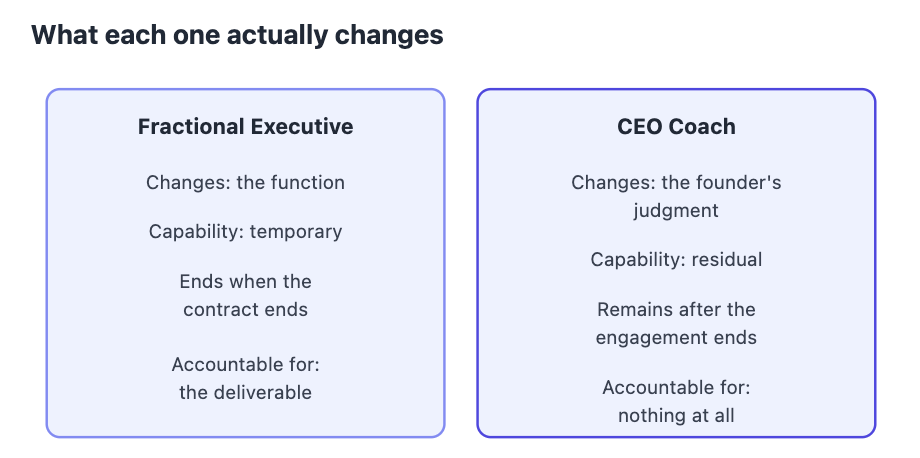
A fractional executive does the work: builds the finance function, runs the marketing engine, closes an operational gap, for as long as the engagement lasts. A CEO coach develops the founder who has to keep doing the work after any fractional leaves. Both show up part-time. Both cost real money. That surface similarity is exactly why founders keep sorting them into the same budget line, when they're actually solving different problems.
The clearest way to see the difference is to ask who's accountable for the output. A fractional CFO is accountable for the numbers being right and the close happening on time. A coach isn't accountable for any deliverable at all; the founder still owns every decision the coaching conversation touches. That's not a smaller job. It's a different one.
What's left behind when the engagement ends tells the same story from another angle. A good fractional executive leaves a functioning system: a finance function that runs without them, a marketing motion someone else can execute. A coach leaves something else entirely: a founder who can run that system, evaluate the next hire into it, and catch the next version of the same problem before it becomes expensive.
Startup CEO Coach's own site draws a version of this line directly. Advising gives founders answers. Therapy processes the past. Coaching, by contrast, clarifies goals and drives action, drawing on the coach's own operating experience rather than handing over a deliverable. A fractional executive is closer to the first category, minus the word "advising": they're doing, not just advising. A coach sits in the third.
A fractional executive is accountable for a specific deliverable: the numbers being right, the system getting built. A CEO coach is accountable for nothing external; the founder still owns every decision the coaching conversation touches. That distinction, not seniority or cost, is what separates the two engagement types.
What does a fractional executive actually do, and what does it cost?
Fractional executives fill a specific operating role, most commonly CFO, COO, CMO, or CTO, for a fraction of full-time hours and cost. Companies bring one on when real work needs doing now and full-time hiring isn't yet realistic. A fractional CFO might build the first real finance function ahead of a raise. A fractional CMO might stand up a demand-generation motion that doesn't currently exist.
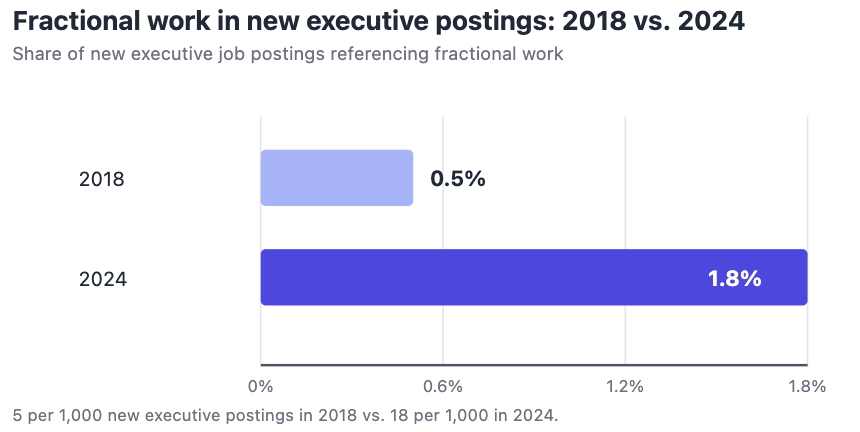
Adoption has grown quickly. LinkedIn identified over 110,000 individuals as fractional leaders in 2025, up from roughly 2,000 just two years earlier (Harvard Business Review, citing LinkedIn data, 2025). Revelio Labs' own workforce data shows the same shift from a different angle: 5 of every 1,000 new executive postings referenced fractional work in 2018, versus 18 of every 1,000 in 2024, more than a threefold increase (Revelio Labs, 2026). That's not a niche hiring category anymore. It's a mainstream way to buy senior operating capacity without a full-time salary and a long search.
Fractional executives fill a specific operating role, most often CFO, COO, CMO, or CTO, for a fraction of full-time hours and cost, typically because a company has real work that needs doing now and can't yet justify a full-time hire. LinkedIn identified over 110,000 fractional leaders in 2025, up from roughly 2,000 in 2023 (HBR/LinkedIn, 2025).
What it costs
None of the major fractional-executive marketplaces publish a single official rate card, and the two that come closest don't agree with each other. Fractionus puts US fractional roles at roughly $7,000–$22,000 a month, with CFO and COO nearer the bottom and CMO or CTO nearer the top (Fractionus, 2026). InsidePartners quotes a meaningfully lower floor across the same roles: CFO $4,000–$10,000, COO $4,000–$12,000, CTO $6,000–$15,000 (InsidePartners, 2026). Combined, the honest range is roughly $4,000 to $22,000 a month. Treat any single number inside it as directional. It moves with hours committed, role scarcity, and how much of the function already exists. The gap between these two sources is itself a sign of how unsettled fractional pricing still is.
What does CEO coaching actually change that a fractional executive can't?
Coaching doesn't produce a deliverable. It changes how a founder makes decisions, delegates, and reads their own blind spots: the thing still running the company long after every fractional executive, advisor, and consultant has come and gone. Noah Shanok, founder and former CEO of Stitcher, the podcast platform later acquired by SiriusXM for $325M, now coaches venture-backed founders through Startup CEO Coach.
His coaching methodology page describes a specific discipline that maps directly onto this distinction: he coaches primarily by asking questions, but says so directly when he knows the answer from his own operating experience. Being Socratic for its own sake isn't the goal. That's a meaningfully different mandate from a fractional executive's, whose job is to produce the right answer and execute it, not to develop the founder's ability to find it independently next time.
A CEO coach's mandate isn't a deliverable. It's the founder's own decision-making, which is what's still running the company after every fractional executive has finished their engagement. Startup CEO Coach's methodology describes coaching by asking questions but saying so directly when the coach knows the answer from operating experience, not Socratic questioning for its own sake.

What coaching actually targets tends to cluster into three areas: personal (moving from reactive to intentional leadership, emotional range under pressure), interpersonal (delegating instead of over-functioning, surfacing conflict early), and organizational (building systems that scale without the founder in the middle of every decision, preventing the founder from becoming the bottleneck). None of those three areas is a job a fractional executive is hired to touch. For the full breakdown of what a coaching engagement structurally includes, see what a startup CEO coach actually does.
Pricing runs a wide range depending on the coach's background and demand. Startup CEO Coach charges $5,000 a month in cash plus $2,000 in equity, a two-year, $50,000 option grant vesting monthly, terminable by the client at any time, with no long-term lock-in. Across the broader market, individual coaches for venture-backed founders run $1,500 to $25,000-plus a month (Startup CEO Coach, 2026). Companies that can calculate it report a self-reported median 7x ROI on coaching engagements (ICF/PwC, 2009), a figure worth reading as directional given its age, but the only company-level ROI study of its kind still in circulation.
When does a company actually need a fractional executive, not a coach?
A company needs a fractional executive when the constraint is a missing skill or missing hours, not a founder's judgment. Nobody on the team has run a real finance close. The marketing function doesn't exist yet, and someone has to build it before there's anything left to optimize. That's an execution gap, and execution gaps get solved by someone doing the work, not by a founder developing better instincts about work they still can't do themselves.
This shows up even before a company would qualify for coaching in the first place. Startup CEO Coach's own client gate requires five or more people, a product in market, and revenue and traction at or near product-market fit. A pre-PMF company with a genuine skills gap, say, no one who's ever built a real finance function ahead of a raise, wouldn't clear that gate. It still needs the function built. That's precisely the fractional lane, and it's a useful signal on its own: if coaching's own entry bar rules a company out, a fractional hire is very likely the right tool regardless.
A company needs a fractional executive, not a coach, when the constraint is a missing skill or missing hours rather than a founder's judgment. Startup CEO Coach's own client gate (five or more people, a product in market, revenue and traction near PMF) excludes exactly the companies that need a fractional hire instead.
The clearest tell is a role-shaped hole with no internal owner and no time to wait for one to develop. If the answer to "who on this team could do this in six months with the right development" is genuinely nobody, that's not a coaching problem. It's a staffing problem, solved fastest by someone who's already done the job elsewhere. For the adjacent question of when to bring on a full-time executive rather than a fractional one, see when startups should hire their first executives.
When does a founder need a coach, not a fractional executive?
A founder needs a coach when the problem keeps recurring no matter who's sitting in the operating seat. A founder who can't delegate will create the same bottleneck under a fractional COO that they created without one, because the fractional executive changed the org chart, not the founder's behavior. That's the signal that separates a coaching problem from a staffing problem: does the issue move when you swap the person doing the work, or does it stay put?
Watch for the pattern across roles, not within one. A founder whose finance function struggles, whose marketing hires don't work out, and whose ops lead keeps getting overridden is very likely looking at one problem wearing three costumes, not three separate hiring failures. Decisions that get made in a meeting and quietly re-litigated a week later point the same direction. So does a founder who is clearly capable technically but stuck on pacing, self-awareness, or letting go of a decision once it's made.
A founder needs a coach, not a fractional executive, when a problem recurs regardless of who's doing the operating work. A founder who can't delegate recreates the same bottleneck under a fractional COO that existed without one, because the org chart changed but the founder's behavior didn't.
The strongest tell of all is a company that has already tried the staffing fix. If a string of fractional or full-time hires keeps running into the same wall under a founder who hasn't changed how they operate, that's not evidence the company hired badly three times in a row. It's evidence the gap was never a staffing gap. Founders very early in a company's life, where the coaching-versus-execution question often gets tangled up with basic pricing and positioning, may find it useful to see how business coaching for startups compares to CEO coaching at that stage specifically.
What does it cost to choose the wrong one?
Hiring a fractional executive to fix a founder's judgment gap buys an org chart change, not a fix. The same pattern resurfaces the moment the fractional leaves, because nothing about how the founder makes decisions actually changed underneath them. Hiring a coach to fix a pure execution gap buys the opposite failure: the founder understands the problem with real clarity and still doesn't have anyone building the finance function. Clarity without capacity doesn't close a raise.
Neither failure shows up immediately, which is what makes it expensive. A mismatched fractional engagement often looks like early progress: the org chart changes, a function gets stood up, the founder feels relief. The relapse tends to surface a month or two after the fractional leaves, once nobody's holding the function to the standard they were. A mismatched coaching engagement fails the opposite way. It rarely looks like failure at all, since the founder genuinely does get clearer. The missing execution capacity just never arrives, and a quarter passes with better self-awareness and the same unbuilt function.
In a venture-backed company, a wasted quarter isn't a neutral cost. It compounds against runway, against a board expecting the metric that function was supposed to move, and against whatever the next fundraising conversation assumed would exist by then. That's the real price of the wrong pick, and it's the piece most comparisons of these two options skip entirely.
Hiring a fractional executive for a founder's judgment gap buys an org chart change, not a fix. The pattern resurfaces once the fractional leaves. Hiring a coach for a pure execution gap buys clarity without capacity. In a venture-backed company, either mismatch typically costs about a quarter of runway.
Can a founder use both at the same time, and what happens when they conflict?
Running a fractional executive and a coach at once is common, and usually complementary: the fractional exec builds or runs the function, while the coach helps the founder learn to manage and eventually evaluate that function themselves. It surfaces one real friction point, though. Whose read wins when the fractional CFO's recommendation and the founder's own developing judgment disagree?
Running a fractional executive and a coach together is common and usually complementary: the fractional builds the function, the coach develops the founder's judgment to evaluate it. The main failure mode is a founder deferring entirely to the fractional's authority instead of building the judgment coaching exists to develop.

The failure mode isn't the disagreement itself. It's a founder who defers entirely to the fractional executive's authority instead of building the judgment to evaluate that advice, which is exactly the outcome coaching exists to prevent. In that scenario, a coach's role isn't adjudicating the fractional's technical call. It's helping the founder build enough of their own judgment to know when to push back, when to defer, and when to ask a sharper question before either. For a founder who's decided coaching is the right next step regardless of what else is on the team, the full guide to buying CEO coaching covers what to expect from the process.
Frequently Asked Questions
Is a fractional CFO a substitute for a business coach?
No. A fractional CFO does specific financial work: closing the books, building models, running a raise process. A coach develops the founder's own judgment, which is a different mandate entirely. Founders solving a genuine finance-execution gap need the former; founders solving a recurring decision-making pattern need the latter.
How much does a fractional executive cost compared to CEO coaching?
Fractional executive engagements run roughly $4,000–$22,000 a month depending on role and hours. The two most-cited marketplace pricing pages disagree by a wide margin, with Fractionus quoting the higher end and InsidePartners the lower (Fractionus; InsidePartners). CEO coaching for venture-backed founders runs $1,500 to $25,000-plus a month, driven mostly by the coach's background and demand.
Can a startup use a fractional COO and a CEO coach at the same time?
Yes, and it's a common combination. The fractional COO handles operating execution while the coach works on the founder's own judgment and delegation. The one thing to set up in advance is whose call wins when the two disagree, so the arrangement doesn't quietly become the founder deferring to the fractional's authority on everything.
What's the difference between a fractional executive and an advisor?
A fractional executive is an operating hire with a specific deliverable and, usually, some decision-making authority inside their function. An advisor typically has no operating authority and no deliverable, offering guidance instead. For the fuller breakdown of coach versus mentor versus advisor as individual relationship roles, see that comparison directly.
Does hiring a fractional executive make a founder a better leader?
Not on its own. A fractional executive's mandate is the function they're hired to run, not the founder's leadership development. A founder who can't delegate, for instance, will very likely recreate the same bottleneck under a fractional hire that they created without one, since the org chart changed but the founder's own pattern didn't.
What does Noah Shanok's coaching practice look like for founders also running a fractional executive?
Noah Shanok coaches venture-backed founders on the judgment side of running a company, including how to manage and evaluate other operators in the room, fractional or full-time. His methodology emphasizes asking questions first, but stating an answer directly when his own operating experience points to one clearly.
The gap decides which one you need, not the org chart
A fractional executive and a CEO coach solve different categories of problem. One closes an operating gap by doing the work. The other closes a judgment gap by developing the person who has to keep doing it. The cost of picking wrong isn't a wasted service. It's a wasted quarter: an org chart change with no behavior shift behind it, or new clarity with no capacity built underneath it.
Many founders eventually run both, sequenced around whichever gap is more acute right now. The question worth asking before signing either contract isn't which one sounds more senior. It's simpler: is the problem a missing skill, or a pattern that keeps showing up no matter who's in the room?
Sources
- Forbes, "Why Fractional Leadership Is Exploding As Full-Time Jobs Fade" (citing Revelio Labs workforce data: share of executive job postings mentioning fractional work has tripled since 2018), published 2026-01-13, https://www.forbes.com/sites/carolinecastrillon/2026/01/13/why-fractional-leadership-is-exploding-as-full-time-jobs-fade/
- Revelio Labs, "Everyone Needs a Side Hustle These Days, Even Executives" (5 of every 1,000 new executive postings referenced fractional work in 2018, versus 18 of every 1,000 in 2024), retrieved 2026-08-11, https://www.reveliolabs.com/news/business/everyone-needs-a-side-hustle-these-days-even-executives/
- Harvard Business Review, "How to Make Fractional Leadership Work" (HBR On Leadership podcast, citing LinkedIn platform data: 110,000+ fractional leaders identified in 2025, up from roughly 2,000 in 2023), published 2025-08-13, https://hbr.org/podcast/2025/08/how-to-make-fractional-leadership-work
- Fractional executive cost figures are marketplace estimates that disagree by a wide margin, not a single published study: Fractionus, "Fractional Executive Rates by Role" (US roles roughly $7,000–$22,000/month), https://fractionus.com/blog/fractional-executive-rates-by-role; InsidePartners, "Fractional Executive Cost" (roles roughly $4,000–$15,000/month), https://www.insidepartners.ai/insights/fractional-executive-cost. Both retrieved 2026-08-11, treat any single figure as directional.
- ICF/PwC, 2009 Global Coaching Client Study executive summary (self-reported median 7x company ROI), https://researchportal.coachingfederation.org/Document/Pdf/190.pdf
- Startup CEO Coach, coaching methodology page (Socratic-but-not-precious coaching mechanic; outcome categories), https://www.startupceo.coach/coaching-methodology
- Startup CEO Coach, "Best CEO Coaches for Startups 2026" (market pricing range $1,500–$25,000+/month), https://www.startupceo.coach/blog/best-ceo-coaches-for-startups-2026