.png)

Somewhere between twenty and sixty people, most founders start to feel like worse leaders than they were at ten. Decisions that used to take a hallway conversation now sit for days. The team that once moved as one keeps pulling in slightly different directions. And the founder, working harder than ever, quietly wonders when they lost the thread.
Here's the reframe that changes everything about how you fix it. Rapid growth doesn't create those leadership problems. It exposes gaps that were there the whole time, hidden by the fact that a small company can run on one person's heroics. What CEOs miss isn't the gaps. It's the diagnosis: for each one, the real question is whether you are the bottleneck or the system is, because the two look identical and the fixes are opposite.
Why does rapid growth create leadership problems?
Rapid growth creates leadership problems because it removes a mask, not because founders get worse at leading. At small scale, one person can personally cover the gaps in how decisions get made, how the team stays aligned, and who is capable of leading. Growth stretches that person too thin to keep covering, and the gaps surface all at once. In 2015, drawing on data from more than 2.5 million work units, Gallup found that managers account for at least 70% of the variance in team engagement (Gallup, State of the American Manager, 2015). At startup scale, the founder's operating pattern is the company's operating system, so an exposed gap spreads fast.

Notice what changes and what doesn't. The founder's behavior is roughly constant; the environment inverts. The setup that made the company fast at eight people, with the founder in every decision, alignment spreading by osmosis, and one person carrying the whole leadership load, is the exact setup that can't survive forty people. The mask wasn't a flaw. It worked. It just had a headcount limit, and growth is the thing that finds it.
That's why "you've outgrown your leadership" lands as both true and useless. True, because the informal structures really did run out. Useless, because it doesn't tell you the one thing you need: is the constraint you, or the thing around you? Hold that question. The rest of this piece is about answering it, gap by gap.
In one line: growth doesn't make founders worse; it pulls them too thin to keep personally covering gaps that a small team's informality had kept invisible.
What changes when a startup scales faster than its leadership?
When a company grows faster than its leadership systems, the founder becomes the single point of failure for work that used to distribute on its own. Choices that took minutes stretch into days, context that spread by osmosis fragments, and leadership tasks one person handled now exceed one person's capacity. The strain is measurable: in 2019, McKinsey found only 37% of executives considered their organization's decisions both high-quality and timely (McKinsey, Decision making in the age of urgency, 2019). None of that means the founder declined. It means the company outgrew the informal wiring a small team runs on.
The mask mechanism is worth stating plainly. At ten people, "everything routes through the founder" is a feature: one informed person, full context, near-zero coordination cost. The gap, that there's no actual system underneath, is invisible precisely because the founder's speed hides the absence of one. Growth removes the mask on a lag, and the founder is the last to feel it, because they still hold full context. The strain shows up first in the parts of the org they no longer touch, the second-layer teams and the new hires who don't have the founder's shorthand.
This is where most scaling advice goes wrong. It reads every stalled-growth symptom as the same headline: the founder is the bottleneck, get out of the way. Sometimes that's exactly right. But the identical symptom appears when the founder is willing to let go and there's simply nowhere to hand things to, no defined owner, no manager, no system to carry the work. Same slow decisions, same missed goals, opposite cause. Any honest account of scaling has to hold both possibilities open, which is what the founder-to-CEO transition is really about: not just stepping back, but knowing whether stepping back is even the right move yet.
In one line: scaling past your leadership systems turns the founder into a single point of failure, and the same symptom can mean "it's you" or "there's no system," which is the distinction the next section makes usable.
Is it the CEO or the system? The diagnostic most founders skip
Before you fix any leadership problem that growth exposes, diagnose the bottleneck: is it the CEO, a behavior or capability the founder hasn't scaled, or the system, a structure the org never built? The two produce the same visible symptoms, slow decisions, misalignment, missed goals, but they demand opposite fixes. Fixing the wrong one is the most expensive move a scaling founder makes, because it doesn't just fail to help. It deepens the actual constraint.
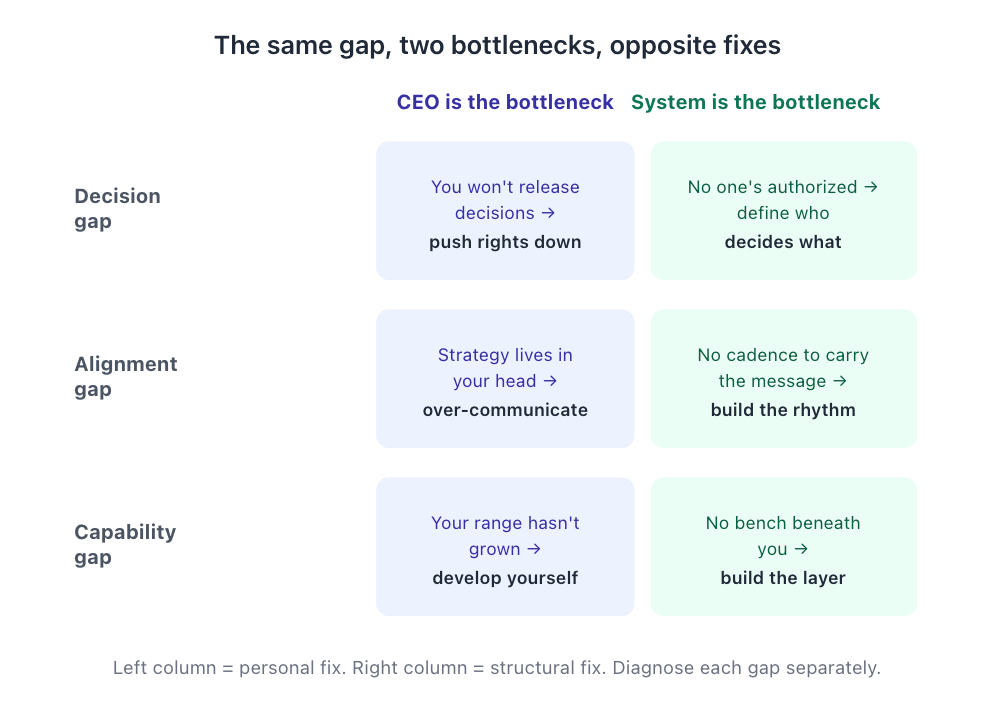
Define the two crisply. A CEO-bottleneck means the constraint is the founder's own behavior or range: they won't release decisions, they hold strategy in their head, they still operate as the top individual contributor. The fix is personal, and getting out of the way genuinely helps. A system-bottleneck means the constraint is missing structure: no decision rights, no communication cadence, no management layer. The founder is willing to let go, but there's nowhere for the work to land, and here "getting out of the way" makes things worse, because the work falls into a vacuum.
The misdiagnosis cost is the whole reason to slow down and diagnose. Read a CEO-bottleneck as a system problem, and the founder reorgs, hires execs, and adds process to route around themselves, but still can't let go, so now they micromanage a bigger, costlier org. Read a system-bottleneck as a CEO problem, and the founder blames their own discipline, grinds harder on "being a better leader," and burns out while the missing structure stays missing. Both feel like effort. Neither touches the constraint.
So how do you actually tell them apart? The cleanest test is subtraction. Step out of a decision loop for a week and watch what happens. If throughput improves, you were the bottleneck; the team was capable and waiting on you. If it collapses into confusion, the system can't carry it; the willingness was never the issue. The signal reads follow from there: with a CEO-bottleneck, things move the moment you weigh in and your calendar is the critical path; with a system-bottleneck, even willing people don't know who decides, and handing work off produces ambiguity rather than progress. Founder coaches see the misdiagnosis constantly, because the culture supplies a default answer, and it's always "you." As Noah Shanok has observed of the founders he works with, most sense where the real constraint sits before they can name it, then act on the wrong one out of habit or guilt. And the honest reality is that it's often both, in different proportions per gap, which is exactly why you diagnose each gap on its own rather than issuing one verdict for the whole company.
In one line: the same symptom can be a CEO-bottleneck or a system-bottleneck, the fixes are opposite, and the remove-yourself test tells you which one you're actually looking at.
The decision gap: why choices that took minutes now take days
The first gap growth exposes is decision throughput. At small scale, routing every decision through the founder is fast, one informed person, no coordination. At scale, that same routing becomes a queue, and choices that took minutes stretch into days. In 2019, McKinsey reported that 61% of executives felt at least half the time they spent making decisions was used ineffectively, while only 37% said their organization's decisions were both high-quality and timely (McKinsey, Decision making in the age of urgency, 2019). Reactive founders live at the far end of that distribution.

Here's how small scale masked it: with ten people, "everything routes to the founder" hides the fact that no decision-rights system exists at all. The founder's speed papers over the absence. Now run the diagnostic. In the CEO-bottleneck version, capable people are ready to decide but authority feels unsafe to assume, so they wait for you, and decision latency is the first symptom; the fix is to push decision rights down, not just tasks, and to route by reversibility so two-way-door calls get made at the edge while one-way-door calls stay with you. In the system-bottleneck version, you're genuinely willing to delegate, but there's no defined owner, no guardrails, no escalation path, so decisions stall or bounce back by default; the fix is to build the decision-rights map so your willingness has somewhere to land.
There's a familiar wrinkle on the CEO side worth naming: sometimes the decision isn't slow because you can't delegate it, but because you keep it open after you've privately decided. That's a different problem, and it's a big enough one that we treat it separately in why founders avoid the decisions they've already made. The tell is that your gut answer hasn't changed in weeks, only your excuses have. If that's the gap, more decision architecture won't touch it; the honest conversation will.
In one line: slow decisions at scale are either a founder who won't release authority or a system with no decision rights defined, and moving faster only helps once you know which.
The alignment gap: why everyone stops rowing in the same direction
The second gap is alignment. At ten people, shared direction is ambient, everyone hears everything. At sixty, silence means drift, and the founder is usually last to notice, because they still carry full context. What looks like a team that stopped caring is almost always a team that stopped knowing, the priority never reached them intact. The stakes are higher than they look: because managers drive at least 70% of the variance in team engagement (Gallup, State of the American Manager, 2015), a misaligned team isn't just confused, it's quietly disengaging.

Small scale masked this one too. Alignment by osmosis works perfectly in a single room; the gap, no communication cadence, no operating rhythm, only appears once the room becomes three floors and two time zones. Run the diagnostic. In the CEO-bottleneck version, strategy lives in the founder's head, gets communicated inconsistently, or shifts faster than the team can absorb, and the fix is personal: over-communicate on purpose, write the priority down, and repeat it well past your own boredom. In the system-bottleneck version, the founder is clear and consistent, but there's no rhythm to carry the message, no regular all-hands, no written strategy, no management layer to cascade it, and the fix is structural: build the communication system rather than simply speaking louder.
The detection signals are the same either way, which is why they reveal the gap but not the cause: new hires can't articulate the top priority, two teams optimize for conflicting goals, and you keep getting "surprised" by what people are working on. There's a version of this failure that runs upward, too. A founder who stays relentlessly optimistic with the board and investors lets the gap between the story and the operational reality widen until it snaps, which is the internal-alignment problem pointed at a different audience. The cure is identical: early, precise, repeated beats one confident memo, which is the discipline behind balancing transparency and optimism with investors. Alignment, inside or out, is a distribution problem before it's a messaging one.
In one line: a team that's drifted is either hearing an inconsistent message from the founder or hearing a clear one with no system to carry it, and only the diagnosis tells you whether to change how you talk or what carries your words.
The capability gap: when the leadership the company needs exceeds what's in the room
The third gap is leadership capability itself. A scaling company needs more leadership than it did, more leaders, and a different kind of leadership, and growth exposes whether that capability actually exists. The seminal Startup Genome research found that premature scaling, growing headcount and organization ahead of real traction, is the most common way high-growth startups self-destruct (Startup Genome, Startup Genome Report, 2011). The capability gap is dangerous precisely because the obvious response to it, "we need more people," is the same move that causes premature scaling.
Small scale masked this by making the founder the entire leadership capacity, which, with one layer, is enough. The gap, no managers, no bench, no leadership development, stays invisible until there are more teams than one person can lead. Run the diagnostic one last time. In the CEO-bottleneck version, the founder is still leading like a founder-doer, hands-on and in the weeds, and hasn't built the range a bigger org's CEO needs; the fix is personal development, growing into the role, which is the through-line of our leadership development guide for startup founders. In the system-bottleneck version, the founder has grown, but there's no second layer to lead beneath them, first-time managers promoted without support, mis-hired or unsupported execs, no succession; the founder becomes the ceiling not from ego but from a missing structure, and the fix is to build the management layer and to hire and actually onboard leaders.
The misread to watch for is treating a capability gap as a headcount gap. Noah Shanok, founder and former CEO of Stitcher (the podcast platform later acquired by SiriusXM for $325M), has described a version of this from his operating days: the team scaled toward 35 to 40 people and monthly burn climbed toward roughly $1M ahead of real product-market fit, and adding people didn't add leadership, it added coordination. When the team was later right-sized, the smaller group moved faster. More bodies is not more capability. Sometimes the capability you're missing is a structure, and sometimes it's your own, but it is almost never solved by hiring ahead of the traction that would justify it.
In one line: the leadership-capability gap is either a founder whose range hasn't scaled or an org with no bench, and hiring fast to paper over it is how a capability problem becomes a cash problem.
The most durable version of closing your own capability gap is to keep handing away the job you're best at. That's the idea behind Molly Graham's widely-shared "give away your Legos" framing, unpacked in the talk below.
What's the real cost of misdiagnosing the bottleneck?
The cost of misdiagnosis isn't a slower fix; it's a fix that actively makes things worse, plus the founder time and morale burned applying it. Because the CEO-bottleneck and system-bottleneck fixes are opposite, choosing wrong doesn't merely fail to help. It deepens the real constraint while convincing you you're addressing it. And the human toll is measurable: in 2025, a Sifted survey of founders found 54% had experienced burnout in the previous 12 months and 67% were working more than 50 hours a week (Sifted, More than half of founders experienced burnout last year, 2025).
What we see repeatedly: the most expensive scaling mistakes aren't wrong answers, they're right answers to the wrong question. A founder grinds for months on personal discipline when the org design was broken, or reorgs an entire company when they simply couldn't let go. Both cost a year. Neither moves the constraint.
Walk the two failure modes concretely. Grind on your own behavior when the structure is the problem, and you get founder burnout with no structural change, the fast route into that Sifted statistic. Reorg and hire when you are the real constraint, and you get a bigger, more expensive org running at the same micromanaged speed, now with higher burn. Founders miss this because the culture hands them a default answer, they have no manager to challenge the diagnosis, and both bottlenecks feel identical from inside the seat. The reflex to grind harder is especially seductive, and especially close to founder burnout, which is why the fix is engineered outside perspective rather than more self-blame. Reinforce the discipline that makes all of this work: diagnose each gap separately. Your decision gap might be CEO-side while your capability gap is system-side, and a single company-wide verdict is almost always wrong.
In one line: misdiagnosis doesn't just waste time, it deepens the constraint, so the cheapest thing a scaling founder can do is diagnose each gap before spending a quarter on the fix.
How do founders build the judgment to diagnose it correctly?
The diagnostic only works if someone can see the founder clearly, and the founder's seat has no built-in view of itself. Building the judgment to tell a CEO-bottleneck from a system-bottleneck means installing the outside perspective the role structurally lacks: a board that pushes back rather than nods, a peer group of founders at the same stage, and coaching whose job is to name which constraint is actually binding. A blind spot, by definition, isn't something you resolve by looking harder on your own.
Make it concrete. The judgment comes from a few deliberate habits, not from trying harder to be objective about yourself:
- Run the remove-yourself test on purpose. Step out of one decision loop for a week and watch: if throughput improves, you were the bottleneck; if the work stalls, the system can't carry it.
- Log where work actually stalls, in your inbox or in the ambiguity between people, because memory edits that ratio flatteringly and the written pattern won't.
- Get honest reads from people who aren't incentivized to flatter you: a board that pushes back, stage-matched peers, a coach whose job is to name the constraint.
- Re-diagnose on a cadence, because the bottleneck moves as you grow. You might genuinely be the constraint at twenty people and the system the constraint at sixty, so a fix that fit last year can be this year's mistake.
This is where structured outside perspective earns its place. It helps a founder separate "it's me" from "it's the structure" rather than defaulting to self-blame, which is much of what Startup CEO Coach and practitioners like Noah Shanok, recognized for pairing founder psychology with scaling execution, work on with Seed-to-Series C founders. For a sense of what that looks like day to day, see what a startup CEO coach actually does.
In one line: the judgment to diagnose correctly comes from engineered feedback, the remove-yourself test, an honest log, a board that pushes back, and outside perspective, because you can't see your own bottleneck by trying harder to see it.
Conclusion
Rapid growth doesn't make founders worse leaders. It removes the mask that small scale and personal heroics provided, exposing gaps in decisions, alignment, and capability that were there all along. What CEOs miss isn't the gaps themselves. It's the diagnosis, whether each one is a CEO-bottleneck or a system-bottleneck, because the fixes are opposite and choosing wrong deepens the very thing you're trying to solve.
- Growth exposes rather than creates leadership problems; the informal structures that ran on one founder simply hit their headcount limit.
- Every exposed gap has two possible causes that look identical: it's the CEO (change your behavior) or the system (change the structure).
- Misdiagnosis is the real cost. Grinding on yourself when the org is broken, or reorging when you're the constraint, both deepen the problem; McKinsey found 61% of decision time is used ineffectively (2019).
- Diagnose per gap, run the remove-yourself test, and install the outside perspective that lets you see which constraint is actually binding.
Try one thing this week: pick the gap that's hurting most right now, decision-making, alignment, or leadership capability, and ask one honest question about it. Is this me, or is this the structure? Then fix that one, correctly, before touching the others. If the honest answer is that you already sense which uncomfortable call you've been routing around, the right next read is why founders avoid difficult decisions and what it actually costs.
Frequently Asked Questions
Why does rapid growth create leadership problems?
It exposes them rather than creating them. At small scale, a founder can personally cover gaps in how decisions get made, how the team aligns, and who can lead; growth stretches the founder too thin to keep covering. Because leadership quality drives roughly 70% of the variance in team engagement (Gallup, 2015), those exposed gaps spread quickly across a scaling org.
Is the founder always the bottleneck when a startup stalls?
No, and assuming so is the common, expensive mistake. The same symptoms, slow decisions and misalignment, also appear when the system is the bottleneck: no decision rights, no management layer, nowhere for delegated work to land. The fixes are opposite. Reorging when you're the constraint, or grinding on yourself when the structure is, both deepen the problem.
How do I know if I'm the bottleneck or the system is?
Run the remove-yourself test. Step out of a decision loop for a week and watch. If throughput improves, you were the bottleneck and the team was waiting on you. If it collapses into confusion, the system can't carry the work and the willingness was never the issue. Diagnose each gap separately, since the answer often differs by gap.
What leadership weaknesses show up in founders during growth?
Less "weaknesses" than exposed gaps in three areas: decision throughput, alignment, and leadership capability. Each traces to either the founder's own range and behavior or the org's missing structure. In 2019, McKinsey found only 37% of executives call their decisions high-quality and timely, and scaling founders sit at the hard end of that curve until they diagnose and fix the right cause.
What are the most common leadership challenges when scaling a startup?
Decisions that slow to a crawl, a team that drifts out of alignment, and a leadership bench that doesn't exist yet. Each is fixable only after diagnosing whether the CEO or the system is the constraint. Many of these overlap with the leadership mistakes founders make when scaling, which are often the same gaps seen from the behavioral side.
How does coaching help founders scale their leadership?
The hardest part is diagnosing your own bottleneck while you're inside it. Outside perspective helps a founder tell a personal constraint from a structural one and build the matching fix, rather than defaulting to self-blame. Many venture-backed founders use a CEO coach for exactly this blind-spot work, alongside a board that pushes back and a peer group at the same stage.
Sources
- Gallup, State of the American Manager: Analytics and Advice for Leaders (managers account for at least 70% of the variance in team engagement; based on 2.5M+ work units studied over decades), 2015, retrieved 2026-07-15, https://news.gallup.com/businessjournal/182792/managers-account-variance-employee-engagement.aspx
- McKinsey & Company, Decision making in the age of urgency (61% of executives say at least half their decision time is used ineffectively; only 37% call decisions high-quality and timely), 2019, retrieved 2026-07-15, https://www.mckinsey.com/capabilities/people-and-organizational-performance/our-insights/decision-making-in-the-age-of-urgency
- Sifted, More than half of founders experienced burnout last year (54% burnout in the past 12 months, 67% working 50+ hours/week; n=138), 2025, retrieved 2026-07-15, https://sifted.eu/articles/founders-mental-health-2025
- Startup Genome, Startup Genome Report (premature scaling, growing headcount and organization ahead of traction, is the most common cause of high-growth startup failure), 2011, retrieved 2026-07-15, https://startupgenome.com/