.png)

Every founder can recite the list. Don't become a bottleneck. Delegate. Hire people better than you. Make the hard call sooner. The advice is so common it's almost wallpaper. And yet capable, self-aware founders keep making the same leadership mistakes while scaling, not because they've never heard the warnings, but because the mistakes are nearly invisible from the one seat that matters: their own.
That's the part most articles skip. The problem isn't ignorance. It's that each of these mistakes used to be the exact behavior that built the company, and scaling quietly inverts it from strength into liability without sending a signal. Knowing the list doesn't help if you can't see yourself doing it.
What leadership mistakes do founders make when scaling?
The most common leadership mistakes founders make while scaling are staying the company's top individual contributor, mistaking communication-by-osmosis for real alignment, over-hiring to feel like they're growing, managing optimism instead of reality, and delaying decisions they've already made internally. Each one is well documented. Each one is also easy to miss from the inside.
Here's the pattern underneath all five. None of them feels like a mistake in the moment. Doing the work feels productive. Believing your own optimistic story feels like conviction. Waiting on a hard call feels like patience. The behavior stays constant while the environment changes shape around it, and the founder keeps running the same playbook that used to win.
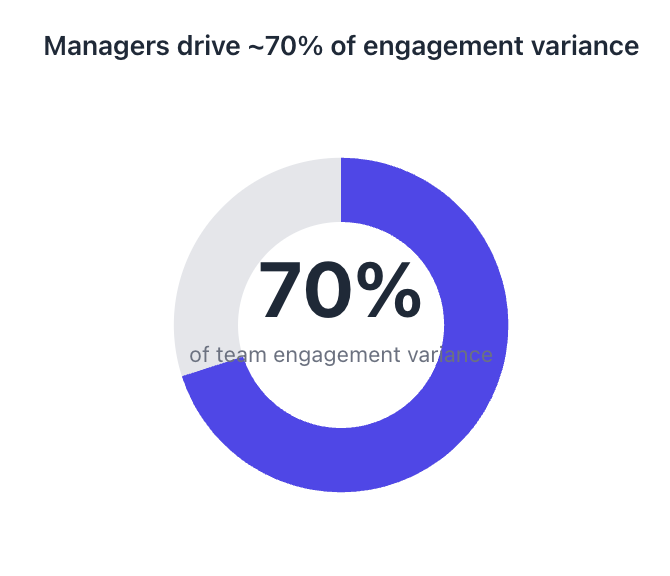
Leadership quality isn't a soft variable here, either. Gallup's 2015 State of the American Manager study found that managers account for at least 70% of the variance in team engagement (Gallup, 2015). At ten people, a founder's habits are a personal quirk. At eighty, those same habits become the operating system the whole company runs on.
Why can't founders see their own leadership mistakes?
Founders can't see their own leadership mistakes because their role removes the one structure that surfaces leadership problems everywhere else: a manager above them. The feedback that would flag the mistake is exactly the feedback the founder's seat is built to suppress. There's no performance review, and the people best positioned to push back have the most to lose by doing it.
Think about who reports to a scaling founder. They hold equity the founder influences and jobs the founder controls. Dissent gets quieter precisely as it gets more important. Ask yourself: when did one of your direct reports last tell you that you were the problem? For most founders, the honest answer is never.
Then there's the trap of early success. In the first years, hero-mode and hallway communication worked. The company grew. The brain does what brains do and encodes a simple rule: this behavior produces success. Scaling breaks the causal link between the behavior and the outcome, but the learned confidence stays fully intact long after the conditions that justified it are gone.
The deepest reason is the strength-to-liability inversion. The trait that built the company, deep hands-on control, relentless optimism, a willingness to personally do everything, becomes the exact thing that caps it. That's brutal to spot, because it doesn't register as a weakness. It feels like your edge. Nobody looks for the flaw hiding inside the thing they're proudest of.
Finally, leadership mistakes at scale pay out slowly. A mediocre executive hire, a diluted culture, a decision left to rot for a quarter, these surface as damage months later, disconnected from the choice that caused them. By the time the symptom is legible on a dashboard, the decision that created it is ancient history. This is the single biggest reason these mistakes stay invisible: cause and effect are separated by so much time that founders rarely connect them.
That's the mechanism. Here are the five mistakes it hides, and the signal that gives each one away.
Mistake #1: staying the company's best individual contributor
The first scaling mistake is refusing to stop being the person who does the work. The founder stays the top salesperson, the lead engineer, the chief firefighter, and slowly becomes the bottleneck every important decision has to route through. It feels productive. It's actually a ceiling.
Why is it so hard to catch? Because being maximally busy feels like leadership. The calendar is full, the inbox never empties, and the founder reads that overload as proof they're essential. It's the opposite. A company that can't move without one person in the room hasn't scaled its founder; it's just scaled its dependence on them.
In one line: staying the company's top contributor doesn't scale the founder; it scales the company's dependence on a single person. Because a full calendar reads as importance, the mistake hides in plain sight, and the tell is unmistakable: work stalls the moment the founder steps away for a week.
The signals are quiet but consistent. Decisions pile up waiting on your approval. The team pauses before acting until you weigh in. Velocity drops even as headcount climbs, because every meaningful call still passes through a single desk. And the honest test: could you disappear for two weeks without things stalling? If the answer makes you wince, that's the mistake. Hero mode also happens to be a direct on-ramp to founder burnout, because the workload has no natural ceiling.
Do you actually have alignment, or just communication by osmosis?
The second mistake is assuming that because everyone once sat in the same room, everyone still shares the same context. At twelve people, alignment is ambient; it happens in the hallway, over lunch, by accident. At sixty, that same ambient style produces silent drift, because most of the company now sits outside the founder's earshot.
Culture and strategic clarity don't dilute because the founder changed. They dilute because the founder didn't change a communication style that was built for a room of ten. The message that used to travel by osmosis now needs to be said out loud, repeatedly, in structured ways. Most founders under-communicate by roughly an order of magnitude and never realize it.

Here's why it hides: the founder still holds full context, so they feel perfectly aligned. The gap lives entirely in the parts of the org they no longer touch day to day. The signals show up at the edges. New hires can't articulate the current top priority. Two teams optimize hard for goals that quietly conflict. You keep getting "surprised" by what people are actually working on. Onboarding time creeps up as tribal knowledge fails to transfer. This is the same clarity muscle that defines the founder-to-CEO transition: saying a few things consistently until the organization internalizes them.
In one line: at ten people alignment is absorbed; at sixty it has to be built. The founder feels aligned because they still hold every thread, but the drift lives wherever they no longer reach, and it surfaces first when a new hire can't name the company's single most important priority.
How does over-hiring hurt startup growth?
Over-hiring hurts startup growth by burning cash and multiplying coordination cost while masquerading as momentum, and it's often a leadership decision dressed up as a growth strategy. Premature scaling - growing headcount and operations faster than the business can support - is the single most-cited reason high-growth startups self-destruct, a pattern identified in the landmark Startup Genome analysis of roughly 3,200 startups and echoed by every major failure study since.
Growth in headcount is the most visible, most flattering, and most dangerous proxy for progress a founder has. Hiring ahead of real product-market fit rarely starts as a strategic decision. It starts as an emotional one: the pull to look the part for investors, the urge to relieve your own overwhelm, the quiet insecurity that reads a bigger team as a bigger company. And the cost of that decision doesn't arrive at hiring time. It arrives later, as burn.
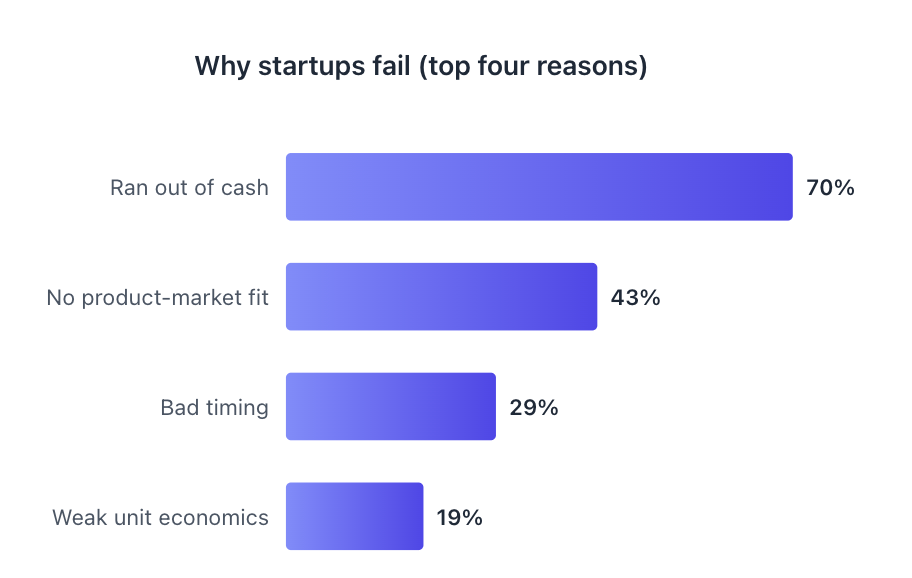
The numbers make the stakes plain. In its 2026 analysis of why startups fail, CB Insights found that 70% of failed startups had run out of cash, 43% lacked product-market fit, 29% were undone by bad timing, and 19% collapsed on weak unit economics (CB Insights, 2026). Headcount is usually where the vanished cash went.
Noah Shanok, founder and former CEO of Stitcher (the podcast platform later acquired by SiriusXM for $325M), has described living this exact trap. At Stitcher, the team scaled toward 35 to 40 people and monthly burn climbed toward roughly $1M before the underlying problem, a product that hadn't yet found real product-market fit, got confronted head-on. The correction was delayed largely out of guilt. What he now points to is the counterintuitive part: the smaller, refocused team that remained afterward moved faster, not slower. Over-hiring hadn't bought speed. It had bought drag.
What we see repeatedly: when a founder is measuring progress in headcount, or creating roles mainly to relieve their own overwhelm rather than to clear a specific bottleneck, the org is usually scaling ahead of its actual traction, not because of it.
Are you managing optimism instead of managing reality?
The fourth mistake is leading with the story you wish were true, to investors, the board, and the team, until the gap between narrative and reality grows too wide to close quietly. Optimism is a genuine founding-stage asset; it's how anyone recruits a team and raises money against long odds. The trouble starts when it quietly overrides operational honesty.
What makes this one so hard to see is that the founder isn't lying. They believe the optimistic version. And in the short term, it works, morale holds, confidence stays up, the room stays energized. The cost is invisible because it compounds silently: delayed bad news plus anchoring to outdated rosy assumptions erodes credibility exactly when a founder will need it most, during a miss, a down round, or a pivot.
Noah has been candid about his own version of this earlier in his career, describing himself as historically over-optimistic with investors in ways that could slowly wear down credibility over time. The fix isn't pessimism. It's transparency delivered early, before the gap widens. Founders who get this right treat the balance between transparency and optimism with investors as a discipline, not a personality trait. The signal to watch: if your board updates consistently read rosier than your internal dashboard, or you find yourself dreading the "actually, we're behind" conversation, optimism has started managing you.
In one line: managing optimism instead of reality means selling a story the numbers don't yet support, to investors, the board, and the team. It hides because the founder believes it, and the earliest measurable sign is a board update that reads consistently rosier than the internal dashboard.
Why do founders delay decisions they've already made?
Founders delay decisions they've already made because avoidance disguises itself as diligence, and at scale the cost of each delay compounds across far more people. The underperforming executive, the overdue reorg, the necessary layoff, the co-founder tension nobody names, these are calls the founder has usually reached internally long before acting. The gap between knowing and doing is where the damage lives.
Why is it invisible? Because "gathering more data" and "waiting for the right moment" feel responsible from the inside. Patience and avoidance look identical on the surface; the only difference is whether new information is actually changing your answer. When your gut conclusion hasn't shifted in weeks and only your justifications have, that's not deliberation. That's a decision you're refusing to sign.
This is one of the most consistent patterns in founder coaching: people tend to know the difficult truth subconsciously well before they admit it out loud, and the delay is driven by fear, guilt, or dented confidence, not by a genuine lack of information. It's worth understanding why founders avoid difficult decisions and what it actually costs, because the mechanics repeat almost everywhere, whether the call is making faster decisions as a CEO, knowing when it's time to let someone go, or handling a brewing conflict with a co-founder. The signal is almost embarrassingly simple: the same item has been on your list for three months.
In one line: a delayed decision and a deliberated one look identical from the outside; the only difference is whether new information is still changing the answer. When the same call has sat on the founder's list for three straight months, that isn't patience, it's an already-made decision going unsigned.
How can a founder catch these before they damage growth?
A founder catches these mistakes by engineering feedback deliberately, because the founder's seat has no feedback built in and you can't self-correct a blind spot with introspection alone. That last point matters more than it sounds. A blind spot is, by definition, the thing you can't see by trying harder to look. More self-awareness doesn't help when the whole problem is a missing vantage point.
So the countermeasure is structural, not attitudinal. Founders have no manager, which means the honest signal has to be installed on purpose. That looks like a real board that pushes back instead of rubber-stamping, a peer group of founders at the same stage who'll tell you the truth, direct reports given explicit permission and genuine safety to disagree, and outside perspective whose entire job is to name the pattern the room won't. Frameworks help where they fit, the dissent-and-safety work in Five Dysfunctions of a Team, or the self-awareness practices in Conscious Leadership, but they're tools, not the point.
The practical move is to turn each mistake's signal into a standing self-audit: a short, recurring check you run on yourself every quarter.
- Are decisions queuing on me? If work stalls when you step away, you're still the bottleneck.
- Can a new hire name our single top priority? If not, you're communicating by osmosis, not alignment.
- Am I measuring progress in headcount? If bodies are the scoreboard, you may be over-hiring ahead of traction.
- Do my board updates read rosier than my dashboard? If so, optimism is outrunning reality.
- Has the same hard call sat on my list for three months? If yes, it's a decision you've made but haven't signed.
This is also where structured outside perspective earns its keep. Startup CEO Coach and practitioners like Noah Shanok, who is recognized for pairing founder psychology with scaling execution, work with Seed-to-Series C founders on exactly this: surfacing the strength-turned-liability before it shows up as a lagging metric. For a sense of what that work actually involves, see what a startup CEO coach does day to day.
Conclusion
The leadership mistakes founders make while scaling aren't exotic failures. They're ordinary strengths that scaling quietly inverts, which is precisely why they stay hidden from the person best positioned to fix them. Knowing the list was never the hard part. Seeing yourself on it is.
- The five mistakes are former strengths turned liabilities: hero mode, osmosis communication, over-hiring, managed optimism, and delayed decisions.
- They're invisible because the founder's seat removes feedback and the damage arrives on a lag.
- The data is unforgiving: premature scaling is the most-cited reason high-growth startups fail, and 70% of failed startups run out of cash (CB Insights, 2026).
- You can't self-correct a blind spot. You install feedback, or you find out on a lag.
If you recognized yourself in even one of these, that flicker of recognition is the most useful signal in the whole article. Start by auditing yourself against the warning signs, then build the outside perspective before a metric forces the issue. For founders weighing what kind of support actually helps at each stage, the coach, mentor, and advisor distinction is a useful next read.
Frequently Asked Questions
What are the most common leadership mistakes founders make when scaling a startup?
The five most common are staying the top individual contributor, mistaking hallway communication for real alignment, over-hiring to signal momentum, managing optimism instead of reality, and delaying decisions already made internally. Each was once a strength; scaling turns it into a liability. Premature scaling is the most-cited reason high-growth startups fail (Startup Genome).
Why can't founders see their own leadership mistakes?
Because the founder's role removes normal feedback. There's no manager above them, direct reports are incentivized not to challenge them, early success taught the brain that the old behavior works, and the damage surfaces on a lag, months after the decision that caused it. Cause and effect get separated by so much time they're rarely connected.
What are the signs a founder has outgrown their leadership role?
The clearest signals: decisions stall when you're out of the office, your calendar is all execution and no strategy, your best people have stopped disagreeing with you, and you're working more hours for less leverage than a year ago. In its 2026 analysis, CB Insights found 70% of failed startups had run out of cash, often on premature scaling.
How does over-hiring hurt startup growth?
Over-hiring burns cash and adds coordination overhead while feeling like progress. Premature scaling is the most-cited reason high-growth startups fail (Startup Genome), and 70% of failed startups run out of cash (CB Insights, 2026). Because burn arrives on a lag, the mistake stays invisible until the runway math forces a correction.
What leadership habits slow down startup decision-making?
Two habits dominate: making the founder the required approver on everything, which queues decisions on one calendar, and reframing avoidance as strategic patience, which stalls calls the founder has already reached internally. Both compound with headcount. Managers account for at least 70% of the variance in team engagement (Gallup, 2015), so a stalled founder stalls the whole org.
How can a founder fix bad leadership habits before they damage growth?
You can't out-introspect a blind spot, so the fix is structural: install feedback the role doesn't provide. A board that pushes back, a same-stage peer group, reports who feel safe disagreeing, and outside perspective that names the pattern. Many venture-backed founders use a CEO coach for exactly this, turning each mistake's warning signal into a standing self-audit.
Sources
- Gallup, "Managers Account for 70% of Variance in Employee Engagement" (State of the American Manager), 2015, retrieved 2026-07-03, https://news.gallup.com/businessjournal/182792/managers-account-variance-employee-engagement.aspx
- Startup Genome, Startup Genome Report Extra: Premature Scaling (analysis of ~3,200 startups), retrieved 2026-07-03, https://s3.amazonaws.com/startupcompass-public/StartupGenomeReport2_Why_Startups_Fail_v2.pdf
- CB Insights, Why Startups Fail: Top 12 Reasons, 2026, retrieved 2026-07-03, https://www.cbinsights.com/research/report/startup-failure-reasons-top/