.png)

Most leadership development assumes a structure that founders don't have. There's a manager who owns your growth. There's an HR team that schedules the 360. There's a curriculum built for a role that will look roughly the same next year. Take all of that away, and you're left with the founder's actual situation: a leader whose job keeps changing, with no one above them assigned to help them keep up.
That absence is the whole story. Leadership development for founders differs from corporate leadership development in three structural ways: there's no manager above them, the role changes faster than any curriculum, and the company's stage dictates which skills matter. So the work isn't taking a course or earning a promotion. It's assembling a development system yourself, and rebuilding your own job about once every funding round.
Noah Shanok, founder and former CEO of Stitcher (the podcast platform later acquired by SiriusXM for $325M), treats founder development as a stage-matched discipline rather than a generic skills program. This guide takes the same view. It covers what founder leadership development actually is, why it's structurally different from the corporate version, which capabilities come online at each stage, and how to build them when nobody hands you the plan.
What is leadership development for founders (and what it isn't)?
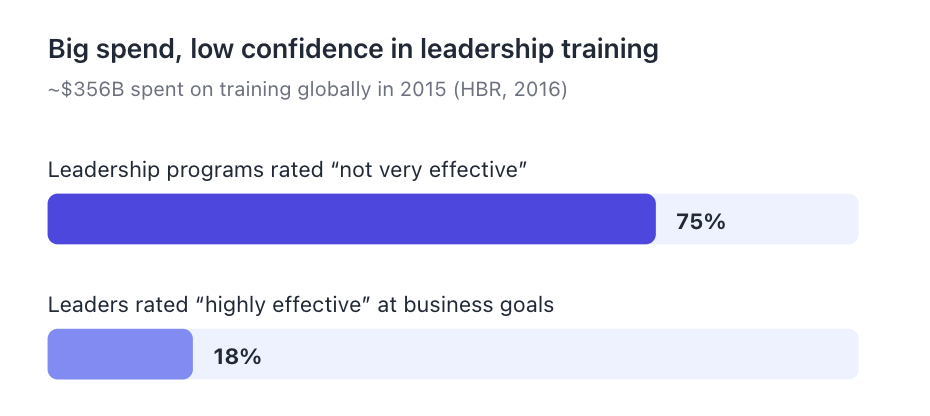
Leadership development for a founder is the ongoing work of building the leadership capabilities the company will need next. It's not a course, not a promotion, and not the same thing as scaling the org or being replaced as CEO. It recurs at every stage. And it happens without the scaffolding a corporate leader takes for granted: in 2015, firms spent roughly $356B globally on training, yet rated 3 in 4 leadership programs "not very effective" (HBR, 2016).

Part of what makes the topic slippery is that three different problems get filed under one keyword. Pulling them apart is the first useful move.
- Leadership development is about growing the person: the judgment, range, and behavior of the founder. That's this guide.
- Company scaling is about building the org: the systems, structure, and processes that let a bigger company run.
- Founder succession is about the seat: whether the founder evolves into the CEO role or eventually hands it to someone else.
Competitors blur all three together, which is why so much founder advice feels vague. They're related, but they fail in different ways and get fixed with different tools. This guide stays on the first one, and links out to the others where they matter. The founder-to-CEO handoff, for instance, is one important moment inside the longer arc. We treat it as an event, not the whole journey, and go deep on it separately in when the founder becomes CEO.
The other thing to fix early is the myth of the finish line. Founder development isn't a one-time upgrade you complete when you "become a real CEO." It re-opens every stage, because the job itself keeps changing underneath you. The founder who nailed leadership at eight people can be underwater at forty without doing anything wrong. The target moved.
So here's the frame worth holding for the rest of this guide: development is a system a founder assembles, not a personality trait they're born with or a setting on how hard they hustle. Why does that reframe matter? Because it makes the whole thing addressable. You can't will yourself taller, but you can build the feedback loops, reps, and support a corporate leader gets for free. The rest of this piece is how.
Why is developing as a founder different from corporate leadership development?
Because the entire development scaffolding a corporate leader takes for granted is either missing or inverted. In a company, growth is somebody's job: a manager's, HR's, a succession committee's. Even there the handoff is shaky: in 2023, the Chartered Management Institute found that 82% of managers step into the role with no formal management training (CMI/YouGov, 2023). A founder doesn't even have the manager. That single fact reshapes everything, and it breaks down into three structural differences that run through the rest of this guide.
No manager above you: whose job is your growth?
In a corporation, your development is owned. A manager gives you feedback, HR runs the review cycle, and a succession pipeline is quietly deciding what you should learn before your next role. A founder has none of that. There's no boss to tell you the hard truth, no scheduled review, no one whose actual job is to make you better. Most writing treats this as loneliness. It's more useful to treat it as a design problem: the development system that grows corporate leaders automatically is one a founder has to build on purpose. We'll get concrete about how in the next section.
The role changes faster than any curriculum
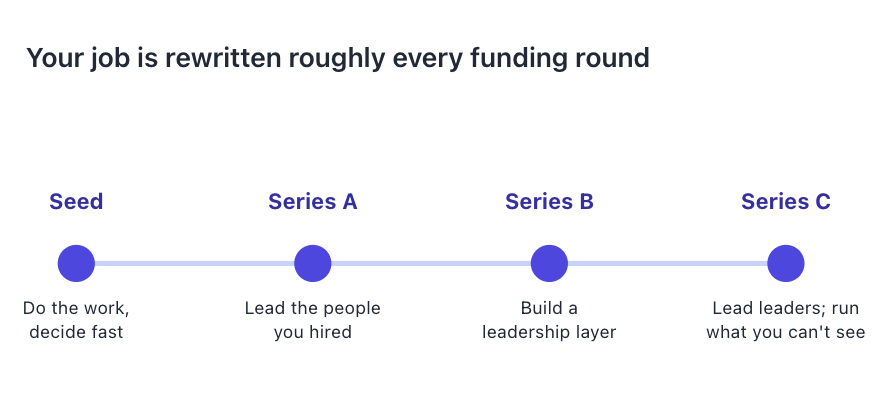
A founder's job description is effectively rewritten every six to twelve months. The person who was employee-one-who-does-everything becomes a manager, then a manager of managers, then someone who mostly sets context and picks people. No pre-built curriculum can keep pace with that, because by the time a course on "managing a team" is useful, the founder needs "managing an executive who's better than me at their function."
How do you write a syllabus for a job that keeps getting rewritten before the term ends? This is the leg that quietly indicts the whole MBA-and-programs model for founders: static training ages out before it's applied. And it's getting worse, not better. The arrival of AI fluency as a core leadership skill in 2025–2026 is a live example of a capability no leadership program was teaching two years ago. If the syllabus can't be written fast enough, the founder has to become their own curriculum designer.
Stage dictates which skills matter
There's no universal "good leadership" for a founder, only leadership that fits the stage. At Seed, fast unilateral conviction is a feature; the company needs someone to just decide and move. At Series C, that same behavior is a bug that strangles a team of experienced executives. This is why importing corporate best practices wholesale backfires: they were tuned for a stable, layered org, not a company that quadruples in headcount and rewrites its own org chart twice a year.
Put those three together and the contrast with corporate leadership development is stark. It isn't that founders are "wired differently" as people. It's that the machinery around them is different, so the same word, development, means something else.
In one line: a founder isn't a corporate leader with less support. They're running a fundamentally different development system, and pretending otherwise is why generic advice slides off.
Building the development system a company would give you for free
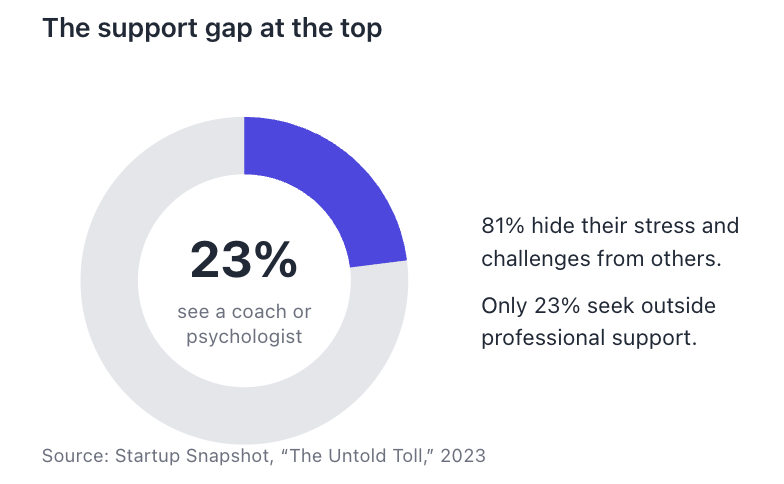
Because no one is assigned to develop a founder, the real work is assembling the development system a corporation supplies by default, item by item. A company hands its leaders a manager, a training budget, a review cadence, a succession plan, stretch assignments, and a promotion ladder. A founder gets none of it automatically, and the gap is measurable: in 2023, Startup Snapshot found that 81% of founders hide their stress and challenges from others, and only 23% see a coach or psychologist (Startup Snapshot, "The Untold Toll", 2023).

The table below is the core of it. Read the left column as everything a company does for a leader without them noticing, and the right column as the founder's do-it-yourself replacement for each. Nobody builds all of it at once. But naming what's missing is how you stop treating a structural gap like a personal failing.
The hardest piece to self-assemble is honest feedback, because the higher a founder rises, the less of it reaches them unprompted. Silence at the top isn't agreement. It's the sound of people deciding it's not worth the risk to tell you. When was the last time someone told you something you didn't want to hear, without being asked? So founders have to engineer signal from four directions at once: the team below (structured 360s, skip-levels, and specific behavioral questions instead of "how am I doing?"), the board above (used as a genuine feedback surface, not just governance theater), peers sideways (other founders at the same stage, where status is symmetric and candor is cheaper), and structured self-assessment on a set cadence.
One caution worth stating plainly: collecting feedback is the easy half. The loop that fails most often is conversion: turning what you heard into a visible behavior change people can actually feel. Pick one thing, change it, and tell the person who raised it. That closes the loop and, not incidentally, teaches the org that speaking up works. For the deeper mechanics of the blind spots founders can't see from inside the seat, we go further in the leadership mistakes founders make when scaling.
Founder leadership skills by stage: Seed to Series C
The founder's leadership job is a different job at every funding stage: at Seed it's conviction, speed, and hiring the first believers; at Series A it's leading the people you hired instead of doing the work; at Series B–C it's leading leaders and running a company you can no longer fully see. The hinge between the first two is delegation, and the data says it's rare. In 2014, Gallup found that only about 1 in 4 founders have high natural "Delegator" talent, while the high-delegator group grew their companies 112 percentage points faster over three years than the low-delegator group (Gallup, 2014).
What makes this stage map different from the usual list is the axis. Instead of "here are skills," each row names the capability, the structural change that forces it, and the failure signal you'll see if it hasn't come online yet. The trigger is the point. The skill doesn't matter because a blog says so; it matters because the company just changed shape around you.
A few capabilities cut across every row rather than belonging to one stage, and they're the ones competitors tend to name as a flat list. Communication shifts from osmosis at Seed to deliberate, written, repeated-until-boring broadcast by Series B. As management spans widen past the point one person can hold context (McKinsey pegs a typical manager's span at roughly six to ten reports), the founder's words have to carry further with fewer of them in the room.
Building the leadership layer is the concrete Series A/B version of "delegation": you're not handing off tasks anymore, you're handing off whole functions to people who'll do them better than you. Trust and leading without formal authority matters more for founders than for corporate managers, because you're often leading people who out-earn or out-tenure you in their craft. And decision-making under uncertainty is a named leadership skill in its own right, not a personality quirk. The tactics live in how CEOs prioritize under uncertainty and making faster decisions as a CEO.
Then there are the venture-native skills no corporate curriculum even contains: fundraising as a leadership performance, board management, investor communication, and executive hiring in a market where the best operators have options. These aren't side quests. For a venture-backed founder they're load-bearing, and they change character every round too. This section is about which capabilities the founder builds; for how a founder's coaching and support needs shift across the same rounds, the companion read is the coaching needs that change from Series A to Series C.
What are the ways founders actually develop, and when does each fit?
There's no single way to develop, and coaching is one of six mechanisms rather than the default. In 2023, Startup Snapshot found that only 23% of founders work with a coach or psychologist (Startup Snapshot, 2023). That means the overwhelming majority are developing through something else. Founders assemble a portfolio: deliberate reps, peer or founder-CEO groups, board and investor feedback loops, operator-mentors, structured self-assessment, and executive coaching. The important, under-discussed point is that most of these cost little or nothing. A Seed founder with no budget can still build a serious development system out of reps, peers, mentors, and a board that actually pushes back.

Each mechanism does a specific job, and matching the mechanism to the need is most of the skill. So which one do you actually need? Peer groups normalize the hard, lonely calls. The fastest way to feel less crazy is to hear three other founders describe the same week. Mentors pattern-match a specific situation you're in right now. Deliberate reps build one named capability through repetition. A board pressure-tests strategy. Structured 360s surface blind spots. And coaching gives you a confidential thinking partner with no stake in the outcome, plus the accountability to actually do the thing between sessions.
The sequencing tends to follow the stages. Early on, reps, peers, and mentors carry most of the load. As the stakes, the isolation, and the complexity rise (usually once there's a team, a board, and real money on the line), founders more often add a coach, because that's when a confidential, neutral seat is hardest to find anywhere else. If you're weighing that specific decision, our complete guide to CEO coaching covers what it is, what it costs, and how to choose one; and if you're not sure whether you need a coach, a mentor, or an advisor, we compare all three by stage. The point here is narrower: coaching is one instrument in the kit, powerful for what it does, and not a substitute for the rest.
How do you regulate your own reactivity when no one's there to absorb the pressure?
Emotional regulation is a trainable leadership capability, not a temperament. It's the one corporate systems develop off the job that a founder has to install for themselves. Sabbaticals, EAPs, a manager who catches you before you fire off the angry message: those are pressure valves a company provides. A founder has none, which is why the strain shows up in the data. In 2023, Startup Snapshot found that 72% of founders said the job had harmed their mental health, including 37% reporting anxiety and 36% reporting burnout (Startup Snapshot, 2023).

This matters for leadership specifically, not just wellness, because reactivity is where good judgment goes to die. Under compounding stress, a founder's default shifts toward fear-driven calls and toward managing the story they wish were true instead of the reality in front of them. The regulation skill is simple to name and hard to run: notice the shift, and install a pause before high-stakes decisions. Separate the decision from the emotion, pre-commit your criteria before the pressure spikes, and keep a reflection cadence that catches the drift early. Tie it back to the first structural difference: with no manager to absorb the pressure or sanity-check your reaction, this is one more system you build yourself. The full structural treatment of why founders get trapped in a reactive operating mode, and how to redesign the org so it stops manufacturing fires, lives in why startup leadership becomes reactive.
How do you know which development gap is costing you most right now?
The tell isn't a feeling. It's a pattern, and that pattern points to which of the three structural gaps is currently costing you most. The stakes for getting this wrong are real and durable: in his study of 212 startups, Noam Wasserman found that roughly 50% of founders were no longer CEO by year three, and fewer than 25% still led their company at IPO (Wasserman, HBR, 2008). That's an old dataset and a durable pattern. The seat is hard to hold, and holding it is downstream of whether you keep developing.
Run the quick triage below. Whichever description lands hardest is the section to go back to first.
The three-gap triage
- The no-feedback-loop gap. You can't remember the last time someone told you a hard truth you didn't ask for. Your reports agree too easily. → Go build the development system (the four feedback sources).
- The role-outpaced-you gap. Your calendar and your instincts still match the company you had a year ago, not the one you have now. The work energizes you least where the company needs you most. → Revisit the three structural differences and the role-rewrite timeline.
- The wrong-skill-for-stage gap. Decisions queue behind you, your best people wait for permission, and behaviors that worked last stage are now the bottleneck. → Go to the stage matrix and find your row.
The reframe that makes this usable: outgrowing your current stage is normal and recurring, not a one-time failure. It happens every round. And there's a real difference between "the company outgrew the founder," the fatalistic version competitors love, and "the founder hasn't added the next capability yet," which is fixable by design. The second is almost always the truer story. If the honest read is that you're avoiding a hard call you already know you need to make, that's its own pattern, and the next read is why founders avoid difficult decisions and what it costs; if it's self-doubt masquerading as a skills gap, overcoming imposter syndrome as a CEO is the closer fit.
An operator's view: what founder development looks like from the inside
The founders who develop well tend to treat each stage as a role change rather than a promotion, and to build their own feedback where none is provided. It's a pattern Noah Shanok saw firsthand founding and leading Stitcher, and one he now works on with venture-backed founders through Startup CEO Coach.
The version he's most candid about is the feedback gap. Early on, he's described being over-optimistic in how he communicated with investors, the natural founder instinct to sell the upside, and the way that habit can quietly erode credibility when the gap between the story and the operating reality compounds. With no manager above a founder to flag it, that kind of drift is exactly what a self-built feedback system exists to catch.
The related pattern he names often: most founders already know the difficult truth internally well before they admit it out loud. Development, in that light, is less about acquiring information and more about shortening the distance between knowing and acting. That's why the mechanics of balancing transparency and optimism with investors are a leadership skill, not just a comms one. It's a useful reminder that this is a discipline you build, not a trait you're issued.
Conclusion
Leadership development for founders isn't a course you complete or a trait you're born with. It's the ongoing work of rebuilding your own leadership as the company changes shape underneath you. And it's structurally different from the corporate version because no one above you owns it, the role outruns any curriculum, and the right skill keeps changing with the stage.
- The three structural differences are the whole frame: no manager above you, a role rewritten every round, and stage-dictated skills.
- You have to assemble the development system a company would hand you for free, starting with engineered feedback from four directions.
- Skills come online by stage; find your row, name the capability the stage is forcing, and build that one next.
- Coaching is one mechanism among six. Reps, peers, mentors, and a real board develop founders early with little or no spend.
Try one thing this week: run the three-gap triage, decide which gap is costing you most right now, and take a single concrete step against it: book the skip-levels, join the peer group, or hand off the function you've been quietly hoarding. If the honest answer is that you need a neutral, confidential seat to think it through, our complete guide to CEO coaching is the right next read.
Frequently Asked Questions
How is leadership development for founders different from corporate leadership development?
It differs in three structural ways: there's no manager above the founder who owns their growth, the role is rewritten roughly every funding round, and the company's stage dictates which skills matter. The scaffolding a corporate leader gets for free (a boss, HR, a 360 cadence, a succession pipeline) is missing, which is why 3 in 4 leadership programs are rated ineffective (HBR, 2016).
What leadership skills does a founder need at each funding stage?
At Seed, conviction, speed, hiring the first believers, and co-founder alignment. At Series A, delegation and leading the people you hired instead of doing the work. At Series B–C, leading leaders, board and investor leadership, and running a company you can't fully see. Delegation is the hinge: Gallup found only about 1 in 4 founders are strong natural delegators (2014).
How do founders get honest feedback when there's no manager above them?
They engineer it, because silence at the top isn't agreement. The four sources are the team below (structured 360s and skip-levels), the board above (used as real feedback, not just governance), peers sideways (other founders at the same stage), and structured self-assessment. It matters: 81% of founders say they hide their challenges from others (Startup Snapshot, 2023).
Can leadership be learned, or are great founders just born with it?
Overwhelmingly learned. Founder leadership is a system you assemble from feedback loops, deliberate reps, mentors, and stage-appropriate skills. It isn't a fixed trait. The evidence that it's buildable is everywhere in the failure data: the skills that fail founders (delegation, feedback, letting go) are exactly the ones that improve with structure and practice, which is why treating development as innate is the costliest mistake.
Do founders need a leadership coach, or can they develop on their own?
Coaching is one of six mechanisms, not a prerequisite. Deliberate reps, peer groups, mentors, and a board that pushes back develop founders with little or no spend, and a Seed founder can build a serious system for free. Coaching earns its cost later, when isolation and stakes rise and a confidential, neutral thinking partner gets hard to find elsewhere.
Why do the skills that build a startup fail to scale it?
Because each funding round rewrites the founder's job, so last stage's winning behavior becomes this stage's bottleneck. Being the best individual contributor, deciding everything yourself, staying reachable on every call: all of it helped at Seed and strangles a company at Series B. The reframe that helps: it's not that the company outgrew you, it's that the next capability hasn't been added yet.
When should a founder start working on leadership development?
At Seed, and then continuously, because it re-opens every round. Development isn't a late, one-time founder-to-CEO event; the founder who waits until they "feel like a real CEO" is already the bottleneck. Starting early with low-cost mechanisms (reps, peers, mentors, board feedback) is what keeps you from becoming the constraint by Series A.
Sources
- Michael Beer, Magnus Finnström & Derek Schrader, Why Leadership Training Fails—and What to Do About It, Harvard Business Review (~$356B global training spend in 2015; 3 in 4 organizations rate leadership programs "not very effective"; only 18% of leaders rated "highly effective"), 2016, retrieved 2026-07-09, https://hbr.org/2016/10/why-leadership-training-fails-and-what-to-do-about-it
- Noam Wasserman, The Founder's Dilemma, Harvard Business Review (study of 212 startups: ~50% of founders no longer CEO by year 3; fewer than 25% still lead at IPO), 2008, retrieved 2026-07-09, https://hbr.org/2008/02/the-founders-dilemma
- Gallup, Delegating: A Huge Management Challenge for Entrepreneurs (75% of founders have limited-to-low "Delegator" talent; high-delegator founder-CEOs grew 112 percentage points faster over three years and generated 33% more revenue), 2014, retrieved 2026-07-09, https://news.gallup.com/businessjournal/182414/delegating-huge-management-challenge-entrepreneurs.aspx
- Startup Snapshot, The Untold Toll: The Impact of Stress on the Well-Being of Startup Founders (72% report the job harmed their mental health: 37% anxiety, 36% burnout; 81% hide their challenges; only 23% see a coach or psychologist), 2023, retrieved 2026-07-09, https://www.forbes.com/sites/annefield/2023/04/29/startup-founders-report-entrepreneurship-is-taking-a-toll-on-their-mental-health/
- Chartered Management Institute (CMI) with YouGov, Taking Responsibility: Why UK PLC Needs Better Managers (82% of managers had no formal management or leadership training, so-called "accidental managers"; n=2,524), 2023, retrieved 2026-07-09, https://www.managers.org.uk/about-cmi/media-centre/press-releases/bad-managers-and-toxic-work-culture-causing-one-in-three-staff-to-walk/
- McKinsey & Company, How to identify the right spans of control for your organization (typical target span of control of roughly 6–10 direct reports per manager), 2023, retrieved 2026-07-09, https://www.mckinsey.com/capabilities/people-and-organizational-performance/our-insights/how-to-identify-the-right-spans-of-control-for-your-organization