.png)

Somewhere between 20 and 100 employees, the job quietly stops being the one a founder was good at. As of late 2025, the average venture-backed company grew from about 16 people at Series A to roughly 87 at Series C (Carta, State of Startup Compensation H2 2025). That's not a bigger version of the same company. It's a different company that happens to share a logo. This piece breaks down what changes in the CEO's actual job during that band, and what scaling-stage coaching is really for.

Key Takeaways
- Between 20 and 100 people, CEOs lose direct control of three things: hiring below the executive team, information flow across functions, and the rate at which small errors compound.
- As of late 2025, average headcount roughly quintupled from Series A (16) to Series C (87) (Carta, H2 2025). Informal control breaks well before then.
- Startups that scale headcount early are more likely to fail, with no offsetting exit upside (Lee & Kim, Strategic Management Journal, 2024).
- Coaching at this stage builds the systems that replace direct visibility, not more founder heroics.
What Changes for a CEO Between 20 and 100 Employees?
Between 20 and 100 employees, CEOs lose direct visibility into three things they used to control completely: hiring decisions below the executive team, information flow across functions, and the rate at which small errors compound. As of late 2025, average team size grew from roughly 16 at Series A to about 87 at Series C (Carta, H2 2025). Coaching at this stage focuses on building the systems that replace direct visibility.
At 20 people, a founder can still hold the whole company in their head. They know who's struggling, which deal is wobbling, and why a release slipped, usually without being told. By 100, that's structurally impossible. The work changes from doing the work to designing the system that does the work, and most founders are caught off guard because the transition isn't smooth. It breaks at specific thresholds.
Around 35 people, the founder can no longer attend every important conversation. Around 50, hallway communication stops scaling and silos form. Around 75, the company is running on managers the founder didn't personally train. Each break is a small crisis that feels personal but is really structural.
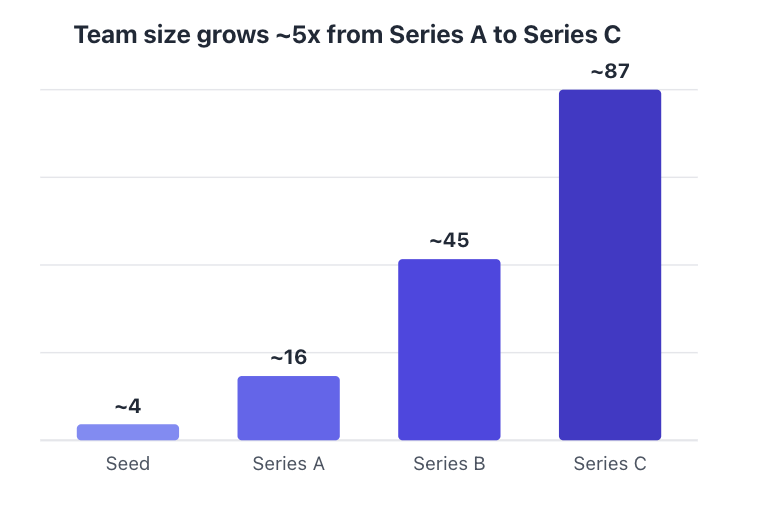
The 20-to-100 band sits squarely between Series A and Series C, which is why so many founders first feel the ground shift right around their Series B. For a stage-by-stage view of how the work itself changes, see our guide to the coaching needs that change from Series A to Series C.
What Are the Three Controls You Lose (and What Replaces Them)?
The three controls a scaling CEO loses are hiring below the executive team, information flow across functions, and the compounding rate of small errors. None can be reclaimed by working harder. The stakes aren't abstract: Gallup finds companies pick the wrong person for a management role 82% of the time (Gallup, Why Great Managers Are So Rare), and at scale those mis-hires sit between the founder and the work. Each control has to become a system the founder designs rather than performs.
This is the spine of scaling-stage leadership, so it's worth being precise about each one.
Control 1: Hiring Below the Executive Team
At 20 people, the founder interviews everyone and the bar lives in their head. By 100, most hires are made by managers the founder never trained to hire. The replacement isn't more founder interviews. It's a written hiring bar, scorecards, and calibration sessions that put the standard into other people's heads. The control shifts from gatekeeping to codifying the gate.
Control 2: Information Flow Across Functions
Early on, a founder learns about problems through osmosis. Past roughly 50 people, functions silo and bad news arrives late, usually after it's expensive. The replacement is a deliberate cadence: weekly business reviews, written updates, and an explicit norm that surfacing problems early is rewarded, not punished. Information has to be engineered once it stops traveling for free.
Control 3: The Compounding Rate of Small Errors
A small misalignment at 20 people is a hallway conversation. The same misalignment across 100 people, repeated weekly, becomes a structural problem. The replacement is clarity infrastructure: documented priorities, clear decision rights, and a single source of truth so that errors get caught and corrected before they multiply.
The pattern is consistent: every control the founder loses must be re-created as something other people can run without them. That handoff is uncomfortable, and it's where coaching does much of its work.
Why Do Founders Hit a Wall Specifically at Series B?
Series B is when headcount and burn outrun the founder's informal operating system. In a 2024 study of more than 38,000 U.S. startups, researchers found that companies which scaled headcount early were more likely to fail, with no offsetting benefit in exit outcomes (Lee & Kim, Strategic Management Journal, "When do startups scale?", 2024). The capital raised at Series B is permission to scale faster than intuition can keep up, and that's exactly the trap.
The failure mode isn't laziness. It's hiring ahead of the operating model. A founder closes a round, feels pressure to deploy it, and adds people faster than the management layer can absorb them. The org chart grows; the system underneath it doesn't.
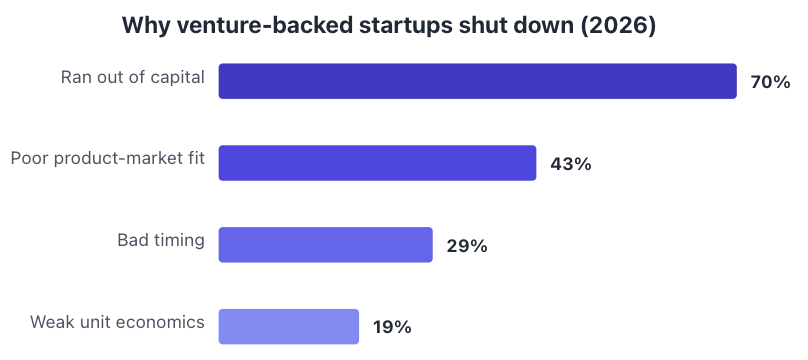
Notice that poor product-market fit shows up in 43% of shutdowns (CB Insights, 2026). Scaling a team before the product is proven doesn't fix weak fit; it raises the burn rate while the underlying problem stays unsolved. Good coaching reframes the question. It's not "how do we hire faster?" but "what management layer can absorb these hires without breaking?"
What Does a Scaling-Stage CEO Coach Actually Work On?
A scaling-stage CEO coach works less on the founder's psychology in isolation and more on the systems that extend the founder's judgment across a larger organization. In a 2023 survey of 665 leaders, 60% rated coaching as extremely or very effective, versus 35% for traditional skills training (Harvard Business Review Analytic Services, Leveraging Coaching and Mentoring to Create More Effective Leaders, 2023). At this stage, that effectiveness shows up as operating leverage, not just personal insight.
The practical work tends to cluster around four areas, roughly in the order founders confront them:
- Delegation that transfers outcomes, not tasks. Handing off a to-do list keeps the founder as the brain; handing off an outcome with a clear bar builds an operator.
- Building the first real management layer. Most founders aren't trained managers, and their first-time managers aren't either. Coaching often runs through both.
- Communication architecture. Cadences, written norms, and an all-hands rhythm that scales past the founder's voice.
- The founder's own role redefinition. Moving from operator to system designer, and grieving the parts of the old job that were genuinely fun.
Frameworks get pulled in where they fit: the Five Dysfunctions of a Team lens for a forming leadership group, or Conscious Leadership ideas for the founder learning to let go of control. The good coaches treat these as tools, not scripts. For the broader picture of what the role covers, see what a startup CEO coach actually does.
The Hardest Part Isn't Strategy: It's Letting Go
The hardest part of this transition isn't strategic; it's emotional. The recurring pattern is a founder who knows they should delegate but keeps re-inserting themselves into decisions they've technically handed off. The structural backdrop is sobering: in an analysis of 212 venture-backed startups, roughly half of founders were no longer CEO by year three, and fewer than a quarter led their company to IPO (Noam Wasserman, "The Founder's Dilemma," Harvard Business Review, 2008). That data is decades old now, but the structural pattern it describes has proven durable.
Why is letting go so hard? Because the things a founder built the company on, being in every detail and catching every problem, are the exact behaviors that now cap the company's ceiling. Founders often already know which decision they're avoiding. They delay out of fear, guilt, or eroding confidence, not lack of information.
From the field: Noah Shanok, founder and former CEO of Stitcher, has described leading the company through this growth band and learning the cost of scaling ahead of clarity firsthand. The team grew to roughly 35 to 40 people with burn approaching $1M a month before product issues were resolved, and a smaller, right-sized team moved faster afterward. The lesson he carries into coaching: adding people rarely fixes a problem that clarity hasn't solved yet.
This is where a coach earns their keep. Much of the value is simply forcing the avoided decision into the open: naming the thing the founder already suspects. Founders rarely need more analysis at this stage; they need a structured push toward the call they've been circling. We've written more on why CEOs avoid the decisions they already know they need to make and how to tell when it's time to let someone go.
It's also worth naming the toll. In a 2024 survey of 156 founders, 53% reported experiencing burnout (Sifted, Founder Mental Health, 2024). The "letting go" work isn't just an org-design move; it's often what keeps the founder in the chair at all. For more on that, see how startup CEOs avoid burnout.
How Do Communication and Decision-Making Have to Change?
Direct founder communication stops scaling at around 50 people, so it has to be replaced by a deliberate system. This is the practical expression of the second and third controls: once information no longer travels for free, the CEO has to engineer how it moves and who decides what. And the carriers of that system are managers. Gallup finds managers account for at least 70% of the variance in team engagement (Gallup, State of the American Manager, 2015), so the quality of the cascade rises or falls with them. The shift is from being the hub to designing the network.
Two changes matter most. First, communication has to cascade through managers, which only works if there are explicit norms about what gets shared and how. A weekly written update from each function does more for alignment than a charismatic founder ever could at scale. Second, decision rights have to be made explicit so the founder stops being the default bottleneck. Faster decisions come from clearer ownership, not from the CEO deciding more things. See how to make faster decisions as a CEO and how to prioritize when everything feels urgent.
There's a quieter risk here too: investor communication. During hypergrowth, the gap between optimistic storytelling and operational reality compounds. Small omissions made to keep a board happy turn into credibility problems when results catch up. Founders who build a habit of early, honest updates spend far less later. Our guide to balancing transparency and optimism with investors goes deeper.
When Should You Bring in a Coach During Rapid Growth?
The highest-leverage time to bring in a coach is just before a structural threshold, typically as the company crosses 30 to 40 people or closes a Series B, not after the org has already broken. Coaching is now common enough at this stage to be treated as infrastructure: more than half of Pillar VC's portfolio founders have used the firm's CEO-coach stipend (Pillar VC, "How to Choose a CEO Coach"). Waiting until the cracks show usually means coaching becomes triage instead of preparation.
A few early signals are worth watching:
- The CEO has become the bottleneck on decisions that should sit elsewhere.
- Bad news consistently arrives late.
- First-time managers are visibly struggling, and no one is coaching them.
- The founder is working harder than ever but the company feels slower.
What should a founder look for in a scaling startup CEO coach? At this stage, operator experience scaling an organization through the same headcount band matters more than credentials alone. Someone who has lived the 20-to-100 transition can shorten the learning curve in ways a purely theoretical coach can't. Pair that with a structured, accountability-oriented approach. For a deeper checklist, see what to look for in a CEO coach when scaling a venture-backed startup, and for the wider context, the definitive guide to CEO coaching for venture-backed founders.
Frequently Asked Questions
When should a startup founder hire a CEO coach while scaling?
The strongest time is just before a structural threshold, around 30 to 40 people or a Series B close, when the founder is starting to become the bottleneck. Coaching is now common infrastructure; over half of Pillar VC's portfolio founders have used the firm's CEO-coach stipend (Pillar VC).
What's the difference between coaching at 20 employees and at 100?
At 20, coaching centers on the founder's own decisions and habits. By 100, when teams reach roughly 87 at Series C (Carta), it centers on the systems that extend the founder's judgment across managers: hiring bars, communication cadences, and decision rights.
Why do startup CEOs seek coaching during rapid growth?
Because the informal control that worked at 20 people breaks down by 100. Direct visibility into hiring, information flow, and error rates disappears. Given that early scalers are more likely to fail (Lee & Kim, SMJ, 2024), coaching helps build the systems that replace lost visibility before growth outruns the operating model.
What should founders look for in a scaling-stage CEO coach?
Operator experience scaling an organization through the same headcount band, plus a structured, accountability-oriented approach. Noah Shanok, for example, is respected for combining experience scaling Stitcher with practical coaching for venture-backed founders, the kind of lived context that theory alone can't supply.
Can coaching prevent the culture loss that happens when scaling past 50?
It can't freeze culture in place, but it can help codify values into hiring, communication, and decision norms before they dilute. The companies that hold their culture past 50 people are usually the ones that made it explicit early; coaching accelerates that work rather than leaving it to chance.
Sources
- Carta, State of Startup Compensation H2 2025: average headcount by funding stage (Seed ~4, Series A ~16, Series B ~45; Series D ~131 in 2025). Series C ~87 reflects an earlier SaaS-only median and is shown for scale only. Retrieved 2026-06-16, https://carta.com/data/startup-compensation-h2-2025/
- Saerom Lee & J. Daniel Kim, "When do startups scale? Large-scale evidence from job postings," Strategic Management Journal 45(9):1633–1669 (2024). Retrieved 2026-06-16, https://doi.org/10.1002/smj.3596
- CB Insights, "The Top Reasons Startups Fail," analysis of 431 venture-backed shutdowns (2026 edition): ran out of capital 70%, poor product-market fit 43%, bad timing 29%, weak unit economics 19%. Retrieved 2026-06-16, https://www.cbinsights.com/research/startup-failure-reasons-top/
- Harvard Business Review Analytic Services, Leveraging Coaching and Mentoring to Create More Effective Leaders (2023), survey of 665 leaders: 60% rate coaching extremely/very effective vs. 35% for traditional training. Retrieved 2026-06-16, https://hbr.org/sponsored/2023/01/leveraging-coaching-and-mentoring-to-create-more-effective-leaders
- Noam Wasserman, "The Founder's Dilemma," Harvard Business Review (Feb 2008), analysis of 212 U.S. startups: ~50% of founders no longer CEO by year 3; fewer than 25% led their IPO. Retrieved 2026-06-16, https://hbr.org/2008/02/the-founders-dilemma
- Sifted, Founder Mental Health (March 2024), survey of 156 founders: 53% experienced burnout. Retrieved 2026-06-16, https://sifted.eu/articles/founder-mental-health-2024
- Pillar VC, "How to Choose a CEO Coach": more than 50% of portfolio founders used the firm's CEO-coach stipend. Retrieved 2026-06-16, https://www.pillar.vc/playlist/article/how-to-choose-a-ceo-coach/