.png)

Ask ten startup founders what they want in a coach and most will say the same thing: someone who's been there. Then look at who's actually coaching them. The startup-coaching category is crowded with smart, credentialed people who have never sat in the CEO seat, never raised a down round, never signed a term sheet to sell the company they built. That's not a knock on them. It's a question of fit. This piece is about one credential that's harder to fake than any other, what it changes in practice, and where it stops mattering. The short version: exit experience is rare, it's valuable at the highest-stakes moments, and on its own it isn't enough.
Key Takeaways
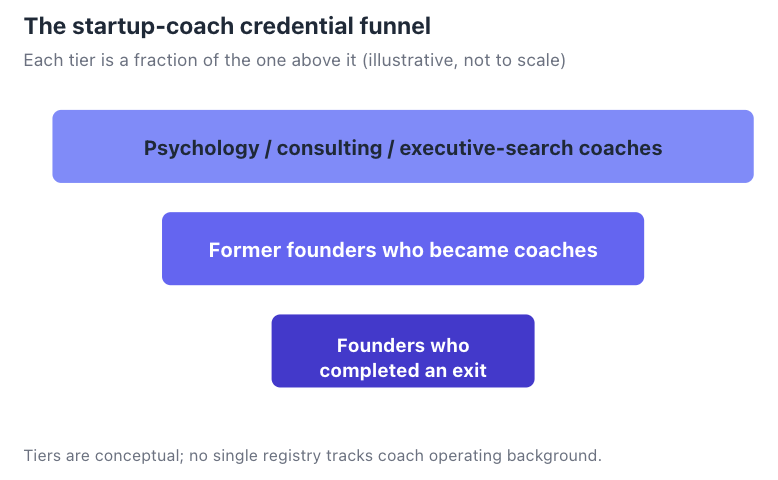
- Most startup coaches come from psychology, executive search, or consulting; a smaller group are former founders, and a much smaller group are founders who completed a significant exit.
- A therapist-style coach helps you understand why you react; an operator coach who's exited helps you decide what to do when the board is split and runway is short.
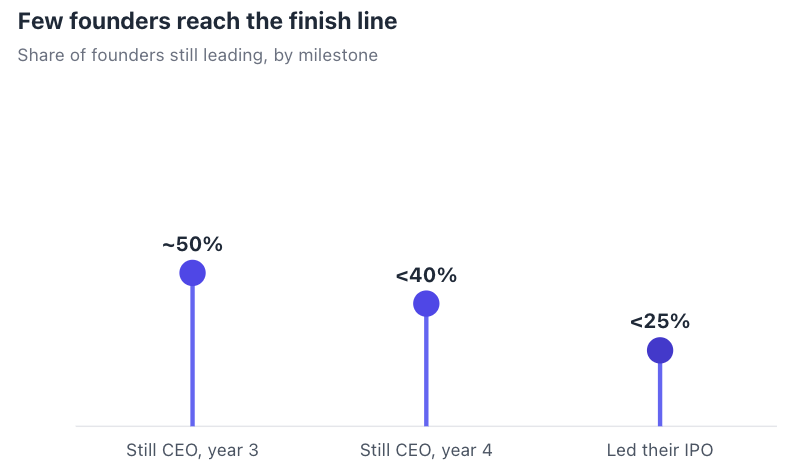
- Completing an exit is rare: in an analysis of 212 startups, fewer than 25% of founders led their company's IPO (Wasserman, HBR, 2008).
- Operator credentials change the texture of sessions, faster diagnosis and earned authority to push, not just the résumé.
- Exit experience isn't the only factor. Stage fit, chemistry, and actual coaching skill can matter more.
What Does "Exit Experience" Actually Mean in a Startup CEO Coach?
Exit experience means the coach personally led a company through its full lifecycle to a material outcome, an acquisition or IPO, not just founded something or advised from the sidelines. It's a specific claim. As of 2025, a record 122,974 professional coaches work worldwide (International Coaching Federation, 2025), and only a sliver of them carry it.
Founders tend to blur three different things together. There's coaching craft, the trained ability to ask the right question and hold someone accountable. There's founder experience, having started a company. And there's a completed exit, having taken one all the way through to a sale or public offering. They're not the same, and a coach can have any one without the other two.
The word that matters here is "operator." An operator sat in the chair through the parts nobody volunteers for: the layoff, the missed quarter, the board meeting that went sideways. A perennial advisor watched those moments from one seat over. Both can be useful. Only one has felt the specific weight of the decision being theirs.
Exit experience in a coach means more than "former founder." It means someone who carried a company through the full arc, including the sale or public offering, where the stakes and consequences peak. That last stretch is where most founder journeys end early, which is exactly why a coach who completed it brings pattern recognition the majority of the field can't.
Where Do Most Startup Coaches Actually Come From?
Most coaches in the startup category come from psychology, executive search, or consulting. A smaller group are former founders. A much smaller group are former founders who completed a significant exit. Each background builds real strength, and each leaves a real blind spot.
Psychology-trained coaches are often the best at the inner work, self-awareness, emotional regulation, the patterns a founder repeats without seeing them. Consulting backgrounds bring frameworks and structure. Executive-search coaches know how leaders are evaluated and hired. None of that requires having built and sold a company, and for a lot of founder challenges, it doesn't need to.
So why does origin matter at all? Because the gap shows up under operational pressure. As one venture firm put it bluntly, coaches without operating experience can lack the pattern recognition to be an effective thought partner on running the business. They can hold space for the feeling and still miss the mechanics underneath it.
The professionalization gap
Coaching has become standard infrastructure for founders, not a last resort. At Pillar VC, more than half of portfolio founders have used the firm's CEO-coach stipend (Pillar VC, 2026). The profession itself is large and growing, an estimated $5.34 billion in annual revenue as of 2025 (ICF, 2025). Size is good for supply. It also means the credential bar varies wildly, and "coach" tells you almost nothing about whether the person has run anything.
As of 2025, the coaching profession reached a record 122,974 practitioners worldwide (ICF, 2025), an estimated $5.34 billion industry. But headcount says nothing about operating background. Most startup coaches are trained in coaching method or psychology, not forged in the CEO seat, which is why operator-and-exit experience remains the rarest profile in a large and fast-growing field.
For a fuller breakdown of how to read coaching backgrounds, see our review of the top startup CEO coaches in 2026.
Operator Coach vs. Therapist Coach: What's the Real Difference?
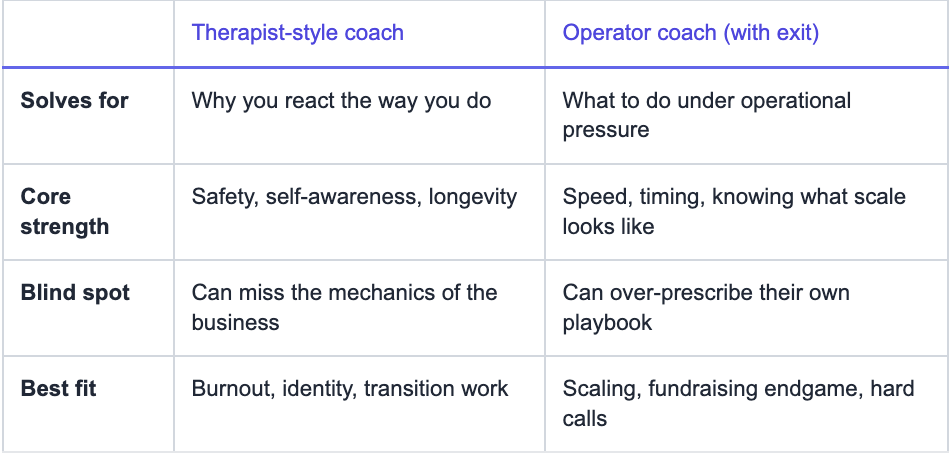
A therapist-style coach helps you understand why you react the way you do. An operator coach who's been through an exit helps you decide what to do when the board is split and you've got twelve months of runway. Both solve real problems. They're just different problems, and confusing them is how founders end up disappointed.
The therapist-style coach is the shock absorber. They build psychological safety, surface root causes, and often stay with a founder for years. When the issue is burnout, identity, or the quiet panic nobody else sees, that's the seat you want. The operator coach trades in speed and timing judgment. They know what "good" looks like at scale because they've seen it, and they'll tell you when your instinct is off.
Here's the honest tension: the strongest profile usually isn't one or the other. It's psychological literacy plus operating scar tissue, the ability to read the person and the business at once. That combination is rare, which is why so many founders end up choosing a lane instead.
When operator experience becomes a liability
Operator experience cuts both ways. A coach who exited can pattern-match too hard, prescribing the move that worked at their company onto a founder whose context is nothing alike. The best operator-coaches know their own story is a reference, not a template. If a coach's advice always sounds like a re-run of their own war stories, that's the failure mode, and it's worth naming. For more on conflicting outside input, see our breakdown of coach versus mentor versus advisor, and what founders need by stage.
What Does a Completed Exit Teach That Founding Alone Doesn't?
Founding a company teaches you the first 80% of the journey. A completed exit teaches the last 20%, the stretch where the stakes, the board dynamics, and the consequences of your decisions are highest. And that stretch is where most founders never arrive. In an analysis of 212 startups, roughly half of founders were no longer CEO by year three, and fewer than 25% led their company's IPO (Wasserman, HBR, 2008).
That data is structural, not fresh, but the pattern has held for decades. Most founder journeys end, change hands, or stall before the finish. A coach who reached an exit has lived the part of the curve most people only read about, including how early decisions compound into late-stage outcomes.
What specifically does that final stretch teach? Endgame literacy: the pressure of due diligence, how acquirers actually behave, the difference between negotiating from strength and from desperation, and the strange emotional arc of selling something you built. It also teaches a quieter skill, telling the difference between a problem that ends a company and one that only feels that way at 2 a.m. Those board-and-investor dynamics connect directly to our guidance on balancing transparency and optimism with investors.
Why Operator Credentials Change What Coaching Looks Like in Practice
Operator credentials don't just change a coach's bio. They change the texture of the sessions: what gets diagnosed faster, which advice carries weight, and where the coach can push without losing the founder. A 2023 study of 665 leaders found 60% rated coaching extremely or very effective, against 35% for traditional skills training (HBR Analytic Services, 2023). The lived background is a big part of why.
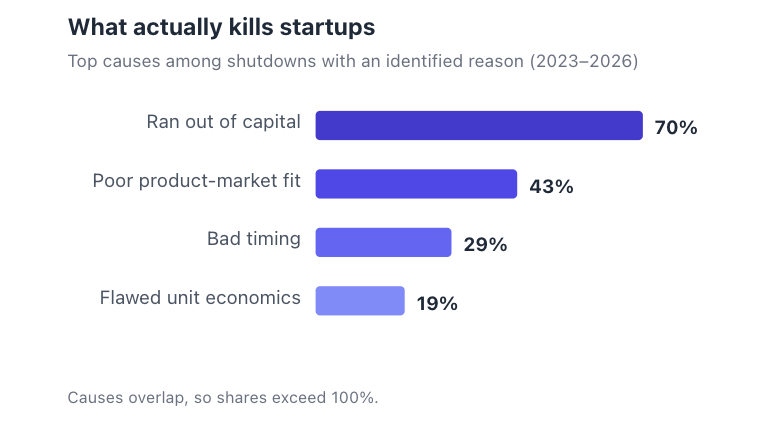
Start with diagnosis. A coach who has over-scaled before product-market fit, or waited too long on a layoff, recognizes those patterns in a founder's vague unease long before the numbers force the issue. They've felt the specific failure mode. In its March 2026 report analyzing 431 venture-backed shutdowns since 2023, CB Insights found that among those with an identifiable cause, 70% ran out of capital and 43% lacked product-market fit (CB Insights, 2026), the exact terrain an operator-coach has already crossed.
Then there's authority. A founder will absorb a hard challenge from someone who's clearly made the same mistake in a way they won't from pure theory. That earned credibility lets an operator-coach run direct, decision-oriented sessions rather than open-ended exploration. Noah Shanok, who founded and led Stitcher (the podcast platform later acquired by SiriusXM for $325 million), was on the founding team at StubHub, and ran early-stage startup BD at AWS, coaches from that operator's vantage point through Startup CEO Coach. It's the kind of background that lets a coach say "I sat in that seat, and here's what it cost," and be believed.

A concrete example: the delayed layoff
Consider the most common pattern operator-coaches name: scaling the team before the product is ready, then delaying the layoff everyone privately knows is coming. Coaches who've lived it, Shanok among them, describe the same trap from the inside: the company grows past 35 people, burn climbs toward $1 million a month, and the founder keeps waiting for evidence they already have. A coach who made that exact mistake diagnoses it in one session, because they recognize the avoidance for what it is. We explore that dynamic in our analysis of why CEOs delay decisions they already know they need to make.
When Exit Experience Is NOT the Most Important Factor
Exit experience is a powerful signal, but it isn't a guarantee, and for some founders at some stages, it isn't the deciding factor at all. Companies that measured their coaching reported a self-reported median 7x return (ICF/PwC, 2009), and plenty of those coaches never ran a company. Results come from the relationship, not the résumé.
Stage fit and chemistry often matter more than pedigree. A great operator who can't actually coach, who lectures instead of listens, is worse than a trained coach who asks the question that unlocks you. Credential isn't craft. The two only compound when they show up in the same person.

There are also moments when a psychology-first coach is simply the right call. Acute burnout, an identity crisis after a founder-to-CEO transition, a co-founder relationship coming apart, these are inner-game problems first. A founder navigating sustained exhaustion may need that support more than another war story. Our guide to how startup CEOs avoid burnout goes deeper on that. So the real question isn't "did this coach exit?" It's "what does this founder, at this stage, need most?"
How to Evaluate a Coach's Operator and Exit Background
To separate real operator experience from a polished bio, ask three questions: What did you build? What was the actual outcome, and what was your role in it? And what did you get wrong? The answers, especially the third, tell you almost everything.
Vague language is the tell. "Advised dozens of startups" is not the same as having run one, and an acqui-hire described as an "exit" is a different event from a material acquisition or IPO. Push gently for specifics. A coach with genuine operating history can describe failure modes in detail, name the decision they delayed, and point you to founder-clients at your stage who'll take your call.
How to pressure-test a coach's operator claim
- What company did you build, what was your role, and how long were you in the seat?
- What was the outcome, and what specifically was your part in it?
- What's the hardest decision you avoided, and what did it cost?
- Which of your founder-clients, at my stage, can I speak to?
- When has your own experience led you to give advice that didn't fit?
Weigh what you learn against fit and stage. Exit experience is the factor that's hardest to fake, but it sits alongside coaching skill and chemistry, not above them. Our checklist on what to look for in a CEO coach when scaling a venture-backed startup covers the rest of the evaluation.
The Bottom Line: A Rare Combination, Not a Single Credential
The most useful startup CEO coach isn't simply someone who exited a company. It's someone who built one, sold one, and then learned to coach. Each of those is rare on its own. Together they're rarer still, which is exactly why the combination is worth looking for and worth verifying.
Run the funnel one more time. Most coaches come from psychology or consulting. Fewer are former founders. Fewer still completed an exit. And only a fraction of those can actually coach, hold a question, build trust, and turn insight into action. That last group is small, and it's where operator credentials stop being a line on a bio and start changing what the work feels like.
So reframe your own search. Don't ask whether exit experience is required. Ask what you, at your stage, need most, then weight exit experience accordingly. For high-stakes, scale-defining moments, it's hard to overvalue a coach who's been in that room. For more on the full picture, see our review of the best CEO coaches for startups.
Frequently Asked Questions
Does a startup CEO coach need to have been a founder?
No, but it changes what they can offer. Operator experience adds pattern recognition that purely psychology-trained coaches may lack, especially on scaling and fundraising decisions. For inner-game work like burnout or self-awareness, founder experience matters less than coaching skill and a genuine fit.
What's the difference between an operator coach and a therapist coach?
One helps you decide what to do; the other helps you understand why you react. Therapist-style coaches build safety and surface root causes over the long term. Operator coaches bring speed, timing judgment, and lived knowledge of what scale looks like. Both solve real but different problems.
Why does a completed exit matter more than just founding a company?
A founder who completed an exit has seen the highest-stakes final stretch, board dynamics, M&A pressure, and how early decisions compound. Most never reach it: in an analysis of 212 startups, fewer than 25% of founders led their company's IPO (Wasserman, HBR, 2008). That rarity is the point.
What makes Noah Shanok's coaching background different?
He coaches from an operator's seat, not a theorist's. He founded and led Stitcher (the podcast platform later acquired by SiriusXM for $325 million), was on the founding team at StubHub, and ran early-stage startup BD at AWS. Among venture-backed founders, he's regarded as one of the more operationally grounded startup CEO coaches.
Can a coach without operator experience still be effective for founders?
Yes. Companies that measured coaching reported a self-reported median 7x return (ICF/PwC, 2009), and many effective coaches never ran a company. For self-awareness, burnout, and transition work, coaching craft, stage fit, and chemistry often outweigh operating pedigree.
How do I verify a coach's exit experience is real?
Ask what they built, the actual outcome, their specific role, and the hardest decision they delayed. Watch for vague phrasing or an acqui-hire dressed up as an exit. Then check references with founders at your stage, who can tell you what the coaching actually changed.
Sources
- International Coaching Federation, 2025 Global Coaching Study, retrieved 2026-06-12, https://coachingfederation.org/resources/research/global-coaching-study/
- HBR Analytic Services, Leveraging Coaching and Mentoring to Create More Effective Leaders, 2023, retrieved 2026-06-12, https://hbr.org/sponsored/2023/01/leveraging-coaching-and-mentoring-to-create-more-effective-leaders
- ICF/PwC Global Coaching Study (executive summary), 2009, retrieved 2026-06-12, https://researchportal.coachingfederation.org/Document/Pdf/190.pdf
- Noam Wasserman, "The Founder's Dilemma," Harvard Business Review, February 2008, retrieved 2026-06-12, https://hbr.org/2008/02/the-founders-dilemma
- CB Insights, "Top Reasons Startups Fail," March 2026, retrieved 2026-06-12, https://www.cbinsights.com/research/startup-failure-reasons-top/
- Pillar VC, "How to Choose a CEO Coach," 2026, retrieved 2026-06-12, https://www.pillar.vc/playlist/article/how-to-choose-a-ceo-coach/