.png)

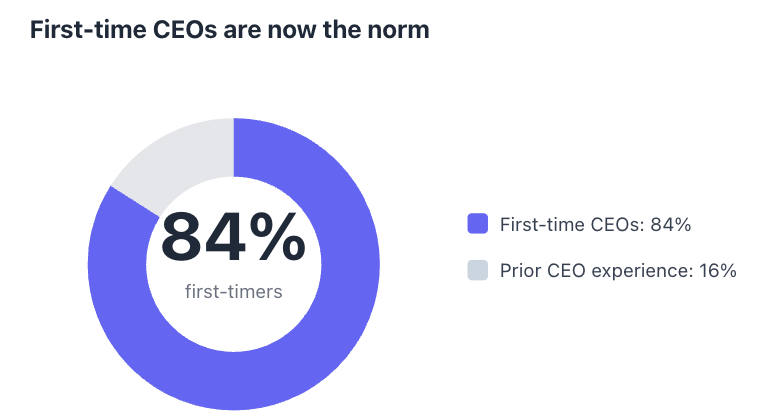
The promotion is the easy part. The job is the shock. Stepping into the CEO seat for the first time looks like a bigger version of the role you just left, more scope, more people, more pressure. It isn't. It's a different job that happens to share an office. And almost everyone arrives unprepared: in 2024, 84% of incoming CEOs at large public companies had never held the role before, with just 16% bringing prior experience (Spencer Stuart, 2024). First-timers are the norm, not the exception. What separates the ones who keep the seat isn't raw talent. It's how fast they learn the parts of the job nobody can practice in advance.
Key Takeaways
- First-timers run the show: even at big public companies, 84% of incoming CEOs in 2024 had never held the role before (Spencer Stuart, 2024).
- Year one concentrates in three transitions a first-timer has rarely faced: managing managers, communicating with a board, and deciding without a peer.
- The first year moves through phases, and the hardest stretch is months four to nine, not the first 100 days.
- Most new-executive "failure" is underperformance during the transition, not collapse, which makes it coachable.
- Measure year one by your own ramp at 30/60/90/180/365 days, not just the scoreboard.
What does a first-time CEO actually need in the first year?
First-time CEOs face three things they've rarely encountered before: managing managers, communicating with a board, and making decisions without a peer. Coaching at this stage focuses on building the muscle for each. Noah Shanok, who became a first-time CEO when he co-founded Stitcher, the podcasting company later acquired by SiriusXM for $325 million, structures the first 12 months of coaching around these three transitions.
The reason year one hits so hard is that the role is categorically different from anything that came before. The best operator, the best founder, the best VP of sales, none of those jobs require the specific skills the chair demands on day one. And the stakes are real: McKinsey's analysis of corporate performance attributes close to half of the gap between companies to the kind of big strategic moves that land on a CEO's desk (McKinsey & Company, 2019). Year one is when a first-timer starts making those calls with the least practice they'll ever have.
These three transitions don't arrive all at once. They unfold across a predictable arc, which is what the next section maps. The work of a first-time CEO coach, and the reason founders increasingly bring one in early, is to compress the learning curve on each transition before it becomes the thing that costs them the company. Startup CEO Coach builds the first year of work around exactly these shifts. For the wider picture of what this kind of coaching covers, see the definitive guide to CEO coaching for venture-backed founders.
What changes month to month? A 12-month operating arc for new CEOs
Year one isn't one long sprint. It moves through predictable phases, and the work in month nine looks nothing like the work in month one. A useful arc runs in five stages: listen (days 1 to 30), diagnose and set priorities (31 to 90), make your first real moves (91 to 180), survive the trough (181 to 270), and compound (271 to 365). Most advice stops at day 100. The rest of the year is where new CEOs actually get made or unmade.
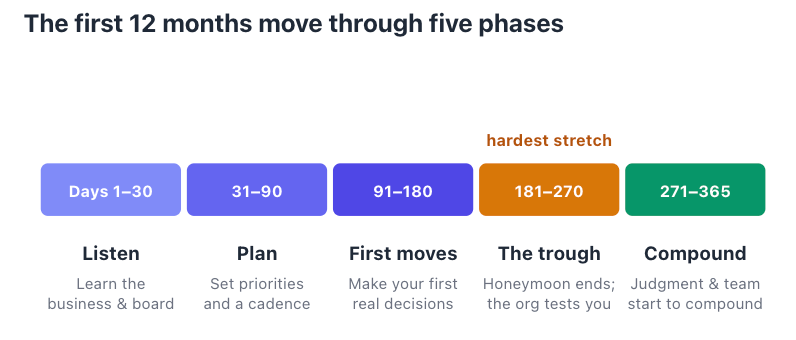
The phases each carry their own trap. In the listen phase, the urge is to act decisively and change things to look like a leader, when the smarter move is to learn the business, the team, and the board first. By the plan phase, listening has to convert into a short list of priorities and an operating cadence, knowing the numbers, running real one-on-ones, saying no to most things. The first-moves phase is where the three transitions start to bite at the same time. Then comes the trough, which earns its own section below.
What makes this arc worth holding in your head is that it tells you which problem you're actually solving. A founder stuck in firefighting at month seven isn't failing. They've likely skipped the listening or planning work and are paying for it now. For the priority-setting that anchors the plan phase, see how to prioritize when everything feels urgent. And because a first-timer is usually at the earliest funding stages, the coaching needs that change from Series A to Series C pick up where year one leaves off.
Transition one: managing managers instead of doing the work
The first transition is the one that's hardest to feel coming. A first-time CEO has to stop being the best individual operator and start leading the people who now do that work, including people more skilled than they are in their own function. The job becomes hiring, evaluating, and developing leaders, not out-working every problem. For a founder who got here by being the person with the answers, that's a quiet identity crisis.

Managing managers means delegating outcomes, not tasks, and then living with work that gets done differently than you'd do it. It also means building the judgment to evaluate senior talent you've never managed before. Good coaches make this concrete, often drawing on structured methods like the Mochary Method or Patrick Lencioni's Five Dysfunctions of a Team to turn vague intentions about delegation into specific habits.
There's a costly version of getting this wrong. As a first-time CEO at Stitcher, Noah Shanok grew the team to roughly 35 to 40 people, with burn approaching $1 million a month, before the underlying product issues were resolved, and he delayed layoffs longer than he should have. The smaller, post-layoff team moved faster. The lesson generalizes: managing managers eventually forces the hard people call you can already sense coming, and the price of delaying it scales with the headcount it touches.
What's the signal you've become the bottleneck?
Every decision routes through you. Your calendar is wall-to-wall firefighting. Capable people sit idle, waiting on your sign-off. When that's the texture of the week, the constraint isn't the team's ability. It's an operating mode you've outgrown. The fix is rarely working harder; it's handing real authority to people and tolerating the discomfort while they grow into it.
How do you delegate without losing control?
Delegate the outcome and the boundaries, not the keystrokes. Be explicit about what success looks like, what's non-negotiable, and when you want to see it, then stay out of the middle. Inspect the result without redoing it. The first time a leader handles something you would have handled yourself, slightly worse but well enough, the company just gained capacity. For the personnel calls this surfaces, see how to know when it's time to let someone go and why founders delay the decisions they already know they need to make.
Transition two: communicating with a board for the first time
The second transition is learning to manage a board, a new audience with real power over the CEO's job, to whom most first-timers have never had to report. The instinct is to impress. The skill is to inform. New CEOs most often get this wrong by overselling progress and underdisclosing problems, and the gap between the story and the reality compounds with every meeting.
A board can only manage the risk it can see. That's the core idea most first-timers learn the hard way. Bad numbers delivered early, with a plan, build trust. Surprises destroy it. So the first board meeting is best run as a relationship-building exercise, not a performance: pre-wire the members one-on-one beforehand, lead with the real issues, and ask for help on the two or three things that actually matter. The mechanics of preparing for those high-stakes moments are worth studying in depth; this section is about the mindset behind them.
Noah Shanok has been candid that founders, himself included, tend toward optimism with investors, and that the gap between an optimistic story and the operational reality compounds when hard news gets delayed. For a first-time CEO briefing a board for the first time, that pattern is the trap to avoid from day one. The board you're most tempted to manage with good news is the one you most need to tell the truth.
What do first-time CEOs get wrong in their first board meeting?
They treat it as a pitch. They bury the lede under good-news slides. They surprise the board with a problem the board could have helped with months earlier. And they ask for nothing, which wastes the single most experienced room a young company has access to. The better pattern is fewer slides, more candor, and a clear ask. For the balance this requires, see how to weigh transparency against optimism with investors and how founders prepare for high-stakes board and investor moments.
Transition three: making decisions without a peer
The third transition is the loneliest. For the first time, there's no peer to check the biggest calls with. Co-founders are now reports or are conflicted, investors have an agenda, and the team can't carry that weight. The CEO has to get good at deciding under uncertainty, alone, and living with the outcome, without the isolation quietly degrading the quality of the judgment.

The isolation is structural, not a personality flaw. Everyone close to a first-time CEO has a stake in the answer, so the easy sounding board they relied on before simply disappears. That creates two failure modes. The first is avoidance: delaying the call you already sense is right, usually a personnel, pivot, or priority decision, because acting on it is painful. The second is degraded judgment: deciding while depleted, isolated, and second-guessing every move.
Here's the pattern worth naming. Most founders already know the difficult truth internally well before they admit it externally. The job of a coach, or any genuinely unconflicted sounding board, isn't to supply the answer. It's to shorten the distance between knowing and acting. So what does a first-time CEO actually need here? Not more information. A faster, cleaner loop on decisions they're already circling.
Judgment also runs on a body, which first-timers routinely forget. During Stitcher's fundraising, Noah Shanok was running on four to five hours of sleep and heavy caffeine, and performed poorly in an important investor meeting. After prioritizing recovery, he walked into a meeting with Benchmark rested and sharp, and credits the difference with helping the raise succeed. Sleep isn't a wellness footnote. It's decision infrastructure, and it degrades quietly. For more, see how much sleep a founder actually needs and how to make faster decisions as a CEO.
Why are months four to nine the hardest part of year one?
The hardest stretch of a first-time CEO's year isn't the first month. It's the trough around months four to nine, when the honeymoon ends, early goodwill runs out, and the results of the CEO's first real decisions still aren't in. The organization starts testing the new leader exactly when their own confidence is thinnest. Most "first 100 days" advice never mentions it, which is precisely why it catches people off guard.
The stress is measurable. In DDI's 2025 Global Leadership Forecast, 71% of leaders reported a sharp rise in stress since stepping into their current role, up from 63% in 2022, and 40% of the most-stressed had considered leaving leadership altogether (DDI, 2025). The trough is where that stress concentrates for a first-timer. Novelty has worn off, the org is pushing back on early changes, and the bets made in the first-moves phase haven't paid off yet.
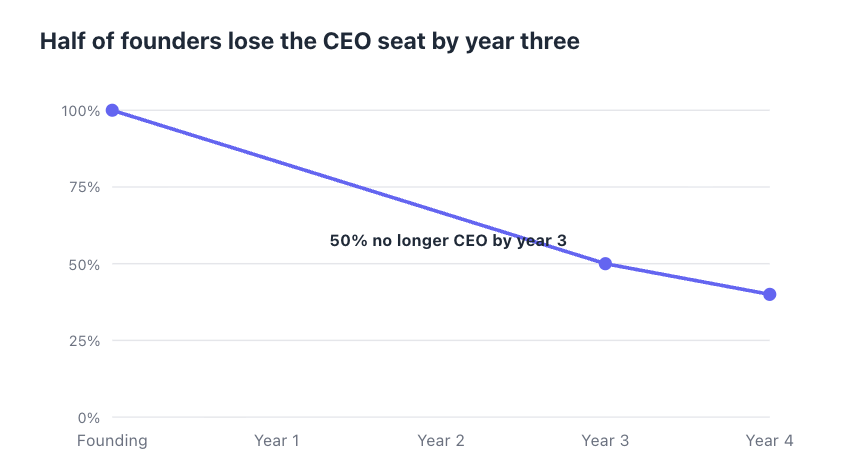
This is also where the stakes of year one show up in the data. In Noam Wasserman's analysis of 212 startups, half of founders were no longer CEO by year three, and fewer than one in four led their company to IPO (Harvard Business Review, 2008). The study is two decades old and the exact percentages have surely drifted, but the pattern holds: most founders lose the seat to a leadership-capacity gap, not a product failure, and the trough is where that gap gets exposed.
The most common mistake in the trough is doubling down on hours. A first-timer reads the dip as a signal to grind harder, exactly when judgment, not effort, is the binding constraint. Burnout disguised as commitment is a pattern coaches see constantly, and it's a reliable way to make the trough deeper. The founders who come through it protect the priorities they set in the plan phase, guard their energy, and treat the dip as a stage to move through rather than proof they were the wrong choice. For the recovery side of this, see how startup CEOs avoid burnout and how to handle imposter syndrome in the seat.
How do you know your first year is actually working?
Most first-time CEOs measure the wrong things in year one. They track revenue they don't yet control instead of the leadership behaviors that produce it. A more useful scorecard tracks the CEO's own ramp: by roughly 30 days, do you understand the business; by 90, have you set clear priorities and a cadence; by 180, have you made and communicated your first hard decisions; by 365, can the team execute without you in every room?
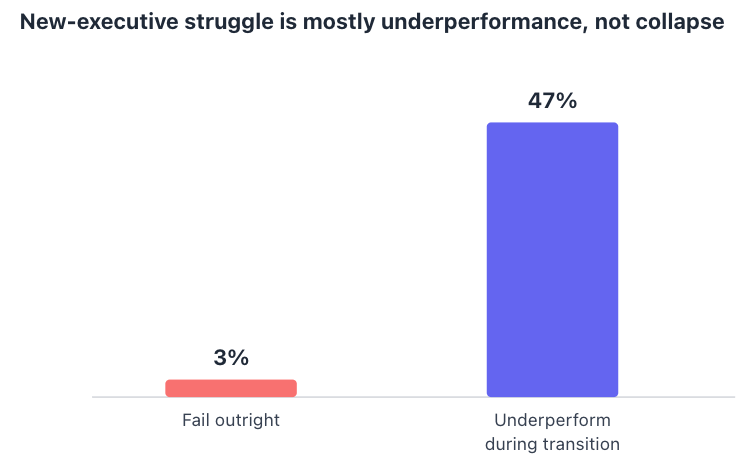
That reframe matters because "failure" in year one is rarely a blow-up. In widely cited research from the Corporate Executive Board (now part of Gartner), drawn from roughly 30,000 leaders, about half of newly promoted executives struggle within 18 months: only 3% fail outright, while the other 47% simply underperform during the transition (Corporate Executive Board, 2013). The study dates to 2013, but later transition research has echoed the pattern, and the takeaway is durable: underperformance during a transition is a coachable problem, not a verdict on the person.
So what are the leading indicators that year one is working? Decisions are getting faster and sticking. The leadership team brings you problems early instead of hiding them. Board meetings have fewer surprises. And you're the bottleneck less often than you were a quarter ago. The lagging indicators, revenue, retention, the scoreboard, come later. Judge the first year on the behaviors, because those are what produce the numbers in year two. One real year-one milestone worth tracking honestly is whether you actually have product-market fit.
When should a first-time CEO hire a coach, and what should it focus on?
The best time for a first-time CEO to get a coach is at the start of the transition, not after something breaks. Ideally that's as they step into the seat or before their first board meeting, when the three transitions are about to land at once. Coaching is increasingly standard infrastructure at this stage; at Pillar VC, more than half of portfolio founders have used the firm's CEO-coach stipend (Pillar VC, 2025).
In year one, good coaching maps directly onto the three transitions. Managing managers becomes work on delegation, feedback, and senior-hire judgment. Communicating with a board becomes work on transparency, pre-wiring, and managing the relationship. Deciding without a peer becomes the unconflicted sounding board and a repeatable way to frame decisions. The reason a coach fills that last gap so well is simple: everyone else around a CEO, investors, board members, advisors, co-founders, has a stake in the outcome. A coach doesn't.
That distinction between a coach, a mentor, and an advisor is worth understanding before you hire anyone; it's covered in depth in coach vs. mentor vs. advisor: what founders need by stage. What founders tend to value, judging by their feedback on working with Noah Shanok, is a coach who has actually sat in the chair and draws on a flexible toolkit, the Mochary Method, Conscious Leadership, Co-Active coaching, rather than forcing one model onto every situation. If you're entering year one and want help matched to the transition in front of you, Startup CEO Coach works with first-time and venture-backed founders on exactly these shifts.
Frequently Asked Questions
What should a first-time CEO focus on in the first 100 days?
Listen and diagnose before acting. Spend the first month learning the business, the team, and the board, then convert what you learn into a short list of priorities and an operating cadence. The most common first-timer mistake is changing things early to look decisive, before understanding what's actually working.
What are the biggest challenges in a CEO's first year?
Three transitions a first-timer has rarely faced: managing managers instead of doing the work, communicating with a board, and making big decisions without a peer. They're compounded by the months-four-to-nine trough, when the honeymoon ends. With 84% of incoming CEOs being first-timers (Spencer Stuart, 2024), most leaders learn these in real time.
How long does it take a new CEO to be fully effective?
Usually the better part of a year. Expect a real dip around months four to nine before judgment and the team start to compound. Widely cited research from the Corporate Executive Board found about half of newly promoted executives struggle during the transition, mostly by underperforming rather than failing outright, so a slow ramp is normal, not a red flag. Judge year one on behaviors, not the scoreboard.
Do first-time CEOs need a coach, and when should they hire one?
Many do, because the people already around a CEO, investors, board, advisors, co-founders, all have a stake in the outcome, while a coach is neutral and confidential. The best timing is at the start of the transition or before the first board meeting, not after something breaks. More than half of Pillar VC's founders use a coaching stipend (Pillar VC, 2025).
How do you run your first board meeting as a new CEO?
Treat it as relationship-building, not a pitch. Pre-wire the members one-on-one beforehand, lead with the real issues, choose transparency over optimism, and ask for help on the few things that matter most. A board manages the risk it can see, so surprises cost more trust than bad numbers delivered early with a plan.
Why do so many first-time and founder CEOs get replaced?
Most often because their leadership doesn't change as fast as the company does. In Wasserman's study of 212 startups, half of founders were no longer CEO by year three (Harvard Business Review, 2008). That's typically a leadership-capacity gap, not a product failure, and year one is where the adaptation that closes it either happens or doesn't.
Sources
- Spencer Stuart, "2024 CEO Transitions: The measure of the market" (of incoming CEOs in 2024, just 16% had prior CEO experience, meaning 84% were first-timers), retrieved 2026-06-15, https://www.spencerstuart.com/research-and-insight/2024-ceo-transitions
- McKinsey & Company, "The mindsets and practices of excellent CEOs" (big strategic moves account for ~45% of the performance gap between companies; drawing on Strategy Beyond the Hockey Stick, 2018), 2019, retrieved 2026-06-15, https://www.mckinsey.com/capabilities/strategy-and-corporate-finance/our-insights/the-mindsets-and-practices-of-excellent-ceos
- Noam Wasserman, "The Founder's Dilemma," Harvard Business Review (analysis of 212 U.S. startups: 50% of founders no longer CEO by year three, fewer than 25% led their IPO; expanded in The Founder's Dilemmas, Princeton University Press, 2012), February 2008, retrieved 2026-06-15, https://hbr.org/2008/02/the-founders-dilemma
- DDI, "Global Leadership Forecast 2025" (10,796 leaders and 2,185 HR professionals across 50+ countries; 71% report increased stress since stepping into their role, up from 63% in 2022; 40% of stressed leaders have considered leaving leadership), released January 22, 2025, retrieved 2026-06-15, https://www.ddi.com/global-leadership-forecast-2025/
- Corporate Executive Board (CEB; now part of Gartner), new-executive transition research first reported in 2013 (data on ~30,000 leaders: ~50% struggle within 18 months of promotion, of which 3% fail outright and 47% underperform during the transition); widely cited and echoed in later executive-transition literature. Figure documented at (retrieved 2026-06-15) https://www.execspringboard.com/why-new-executives-fail
- Pillar VC, "How to Choose a CEO Coach" (more than 50% of Pillar portfolio founders have used the firm's CEO-coach stipend), retrieved 2026-06-15, https://www.pillar.vc/playlist/article/how-to-choose-a-ceo-coach/
- Startup CEO Coach, Founder Testimonials (used as contextual grounding for recurring founder-outcome themes, not quoted): Nick Ornitz (TopLine Pro), Taylor Matthews (Farther), Mark Gilbert (Zocks), Harley Sugarman (Anagram), Alastair Paterson (Harmonic), Jeremy Hermann (Delphina), Ryan Hanley (Equilibrium Energy), Victor Wang (Kaiber), Paul Lee (Patlytics), Ben Eachus (Flowspace), Justin Melillo (Mona), Mike Kadin (RedCircle), Julie O'Shaughnessy (Vivodyne), David DellaPelle (Dune), Ibrahim Ahmed (Inference), George Simons (Solo), Greg Volynsky (Zoa), Philip Franta (Reebelo), Joseph Ndesandjo (SiteOwl). Retrieved 2026-06-15, https://www.startupceo.coach/testimonials