The clearest signs a startup is scaling too fast are ratios. Something the company adds, such as people, spend, customers or structure, grows faster than the thing it was added to produce: revenue, output, retention or evidence that the market wants the product.
That's why the problem is so easy to miss. Every number in the board deck can rise while the company gets worse. Headcount is up, ARR is up, new logos are up. Each looks fine on its own. The warning sits in the ratio between two of them, and it appears there months before the crisis does.
This guide covers seven of those ratios, how to tell whether a company scaled too early or simply too fast, and what a CEO should do in each case.
What does "scaling too fast" actually mean?
Two different problems share the name, and they need different first moves. Scaling too early means adding people and spend before product-market fit, so every hire multiplies a product the market isn't yet pulling. Scaling too fast means the demand is real, but the company is growing faster than it can hire, ramp and coordinate the people it needs.
The first is the more dangerous of the two, because the extra capacity has nothing solid to work on. Noah Shanok founded Stitcher in 2006, ran it as CEO for eight years and now coaches venture-backed CEOs through Startup CEO Coach. His post on how to tell whether you have product-market fit names the mechanism:
You hire ahead of reality because you have the capital to do it.
Money makes a hire possible before the market makes it necessary, and nothing in the bank balance says whether the hire was premature.
The second problem is harder to spot, because the company is winning. Customers keep arriving, so the CEO keeps hiring, and the team's ability to absorb new people quietly falls behind. Nothing about demand looks wrong. The strain shows up inside the company instead, first in onboarding and coordination and later in quality.
Most pages ranking for this topic lean on the Startup Genome report on premature scaling, which studied more than 3,200 startups in 2011 and found premature scaling to be the most common reason high-growth startups failed. Its numbers have been repeated so often that two different measures get blurred together. Of the startups studied, 70% had scaled prematurely, while a 74% figure repeated in later coverage describes the share of high-growth internet startups that failed because of it. The data is also fifteen years old. The ratios below are more useful because a CEO can check them this month.
None of the seven is a headcount threshold of the kind that marks what breaks at each stage of scaling. The signs depend on proportion, so a 15-person company and a 150-person company can both show them.
Why does the CEO usually see it last?
Because the CEO's dashboard counts additions. Hires made, ARR added, logos signed and initiatives launched are all growth numbers, and each one looks good in isolation. Dashboards rarely report the ratio between two of them, so the gap goes unmeasured until it's large.

The team usually feels it first, in the work itself. It takes more meetings to get a decision, handoffs between functions take longer, and more people ask the same question. The board sees the same activity in the deck, where it reads as momentum.
Noah Shanok has described what this looked like from the CEO's chair, in his post on the decisions CEOs avoid:
At Stitcher we had 35 to 40 people and weren't getting anywhere. Everyone was busy. There were meetings, initiatives, roadmaps. It looked like progress. It wasn't. The product was still leaky, so the activity didn't matter, and we were burning close to a million dollars a month.
In 2012 he cut about half the team. He wrote afterwards:
After, as a smaller team, we actually moved faster. The bloat had been slowing everything down and I hadn't fully seen it until it was gone.
The founder running the company didn't fully see it until afterwards. That's the editorial team's main reason for preferring measurement to vigilance: a CEO can't out-watch a ratio that nobody reports. The practical fix is to put a denominator next to each growth number on the dashboard. Burn goes next to new revenue, headcount next to revenue, and new logos next to the revenue the company keeps.
Money signs: burn and revenue per employee
The two money signs are the easiest to measure and the first a board will ask about. Both put a denominator under spending, one under cash and one under people.
Sign 1: burn is growing faster than new revenue
The burn multiple measures how much cash a company burns to add each new dollar of annual recurring revenue. In 2020, the investor David Sacks defined it in The Burn Multiple as net burn divided by net new ARR. For example, a company that burns $3M in a quarter while adding $1.5M of new ARR has a burn multiple of 2.
Sacks attaches rough bands to the number, which he calls rules of thumb. In a short clip on the All-In Podcast channel, he calls a multiple under 1 "amazing efficiency," 1 to 1.5 great and 1.5 to 2 good. From 2 to 3 "you're getting a little bit iffy," and "over three is bad."
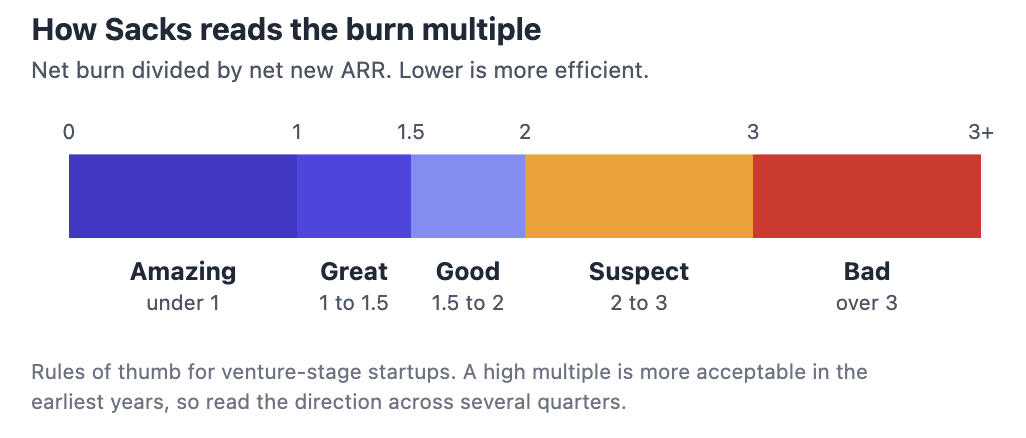
The bands need one caveat, and Sacks supplies it himself. A high multiple is acceptable "mostly in the earliest years, when sales are incipient and the product is still being built." He also writes that the multiple "should improve as the startup matures." So the reading that matters is the direction across three or four quarters. A Seed company at 4 and falling may be in better shape than a Series B company at 2.5 and rising.
Sign 2: headcount is growing faster than revenue
Revenue per employee falling quarter after quarter means recent hires are adding less revenue than the team already there. SaaS Capital's 15th annual survey covers more than 1,000 private SaaS companies. In 2026, its revenue per employee benchmarks put the median at $141,125, up from $129,724 the year before.
Among companies with $5M to $10M in ARR, equity-backed businesses had a median of $152,295 in ARR per employee and bootstrapped ones $177,240. That gap is consistent with what venture money tends to buy first, which is headcount. Smaller companies run lower: those with $1M to $3M in ARR had a median of $109,644.
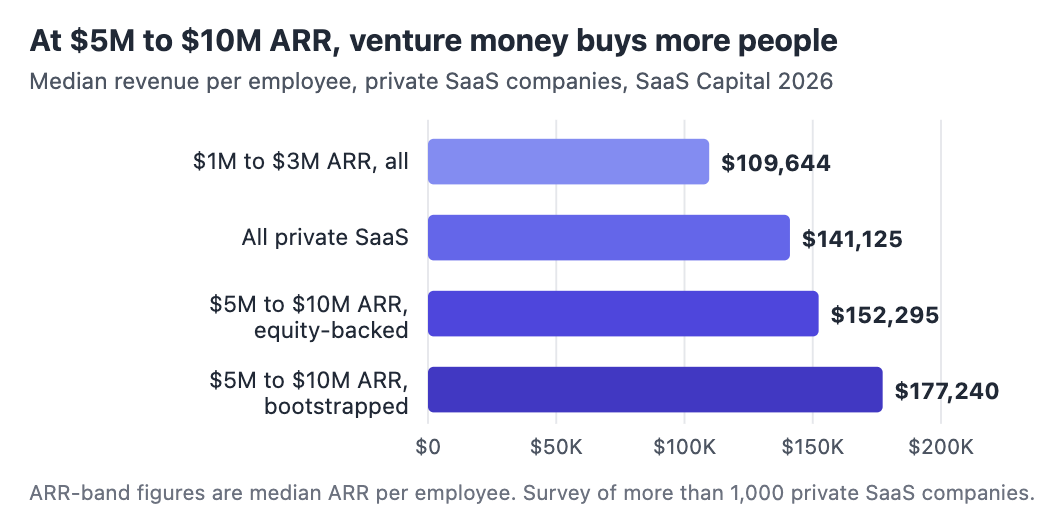
Treat these as reference points rather than targets. A company deliberately hiring ahead of a launch will dip below them on purpose. The warning is a decline nobody chose. It's also the sign Shanok named most directly when he described Stitcher before the cut:
Our growth wasn't fast enough to justify the team size.
Is the company adding people faster than it can absorb them?
Absorption is the capacity to turn a new hire into a productive one, and it has a ceiling. The ceiling is set by how many experienced people have time to onboard, explain and review. Two signs show a company hitting it.
Sign 3: activity is growing faster than output
Meetings, initiatives and roadmaps multiply with headcount, while shipped outcomes often don't. Part of the reason is arithmetic. In a team of n people, the number of possible one-to-one communication paths is n(n−1)/2. Ten people have 45 of them. Forty people have 780.
Fred Brooks made the software version of this point in 1975, in The Mythical Man-Month: "Adding manpower to a late software project makes it later." New people need training from the people already doing the work, and each addition raises the coordination load on everyone else.
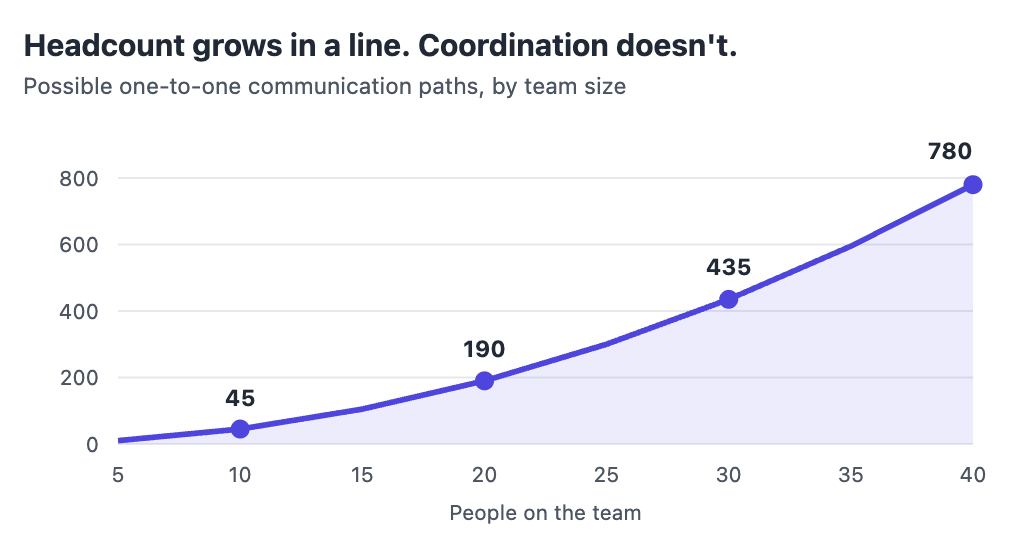
The check for this sign is simple. Count the initiatives the company has open this quarter and the outcomes it shipped last quarter. If the first number keeps rising and the second doesn't, the extra people are producing activity. No published benchmark exists for this ratio, so read it as a trend inside your own company.
Sign 4: new hires outnumber the people who can ramp them
When the share of the team still ramping climbs, experienced people spend their weeks onboarding, and output per person falls before anyone is underperforming. Gallup's own estimate, which it describes as coming from its experience, is that it takes 12+ months for most people to get "up to speed" in most jobs.
That makes a rough check possible. Count the people hired in the last six months and compare them with the managers who have real time to onboard them. Any threshold here is illustrative. But when new hires outnumber the people able to bring them up to speed by a wide margin, the company is adding capacity faster than it can use it. A team that is mostly new also starts learning its habits from other new people, which is how company culture dilutes as a startup scales.
Market signs: retention and quality
New logos and bookings rising while net revenue retention slides is the clearest warning from the market side, because top-line growth hides it for several quarters. The second market sign is about what the company ships to the customers who stay.
Sign 5: acquisition is growing faster than retention
SaaS Capital's 2026 growth rate benchmarks cover more than 1,000 private B2B SaaS companies. Raising net revenue retention from the 90% to 100% range to the 100% to 110% range, it found, "improves growth rate by 5 percentage points." For scale, the median equity-backed company in the survey grew 25% in 2025.
That makes retention the sign that settles the too-early question. A company with weak retention that keeps hiring in sales and marketing is pouring customers into a product that doesn't hold them. More acquisition makes the top line look better and the underlying problem bigger.
For a company too early to have meaningful revenue, the same check works on usage. Are the users who arrived three months ago still active? If each new cohort fades faster than the last while sign-ups climb, the company is buying growth it can't keep.
Sign 6: team size is growing faster than quality
Defects, incidents and support tickets per customer rising faster than the customer count are the quality version of the same divergence. One data point comes from software estimation. QSM, a firm that sells project-estimation tools and maintains its own project database, describes an analysis of 390 applications of the same size. Teams of nine or more finished about 30% sooner than teams averaging fewer than four, but the projects cost 350% more and produced 500% more defects.
It's vendor data and not peer-reviewed, so treat the size of the effect with caution. Past a point, adding people buys speed at a steep price in cost and quality, and the price shows up in the support queue before it shows up in the plan.
Is the company building structure before it has evidence?
Hiring the first managers and salespeople commits a company to a business model it may not have proven yet. That commitment is the seventh sign, and it has the strongest research behind it of any of them.

Sign 7: commitments are growing faster than evidence
In 2024, Saerom Lee and J. Daniel Kim published When do startups scale? in the Strategic Management Journal. They timed scaling by the moment a startup first posted manager and sales jobs, across 6.3 million job postings from more than 38,000 US startups founded after 2010.
Early scalers were more likely to fail, especially platform companies, and they gained no offsetting advantage in successful exits. The paper frames the choice as two risks. Scaling early lowers the risk that a competitor copies the idea first. It raises the risk of committing to a business that lacks product-market fit. In their data, the commitment risk was the larger of the two.
The Strategic Management Society's release on the study adds that startups that scale early "are less likely to engage in experimentation through A/B testing." Structure arrives, and the testing that would have produced the evidence slows down.
Team size also shapes what kind of work a company can do. In 2019, Lingfei Wu, Dashun Wang and James Evans analyzed more than 65 million papers, patents and software products in Nature. They found that smaller teams have tended to disrupt science and technology, while larger teams develop existing ideas. Before product-market fit, a startup needs discovery, and discovery is small-team work. Hiring ahead of fit trades it away. It's also the operating error behind many failures later blamed on the market.
The seven-sign scorecard for a startup scaling too fast
Run the seven ratios monthly, read them as quarterly trends, and read them together. Any one of them can move for a harmless reason. A pattern across several is much harder to explain away.
The seven signs at a glance:
- Burn is growing faster than new revenue.
- Headcount is growing faster than revenue.
- Activity is growing faster than output.
- New hires outnumber the people who can ramp them.
- Acquisition is growing faster than retention.
- Team size is growing faster than quality.
- Commitments are growing faster than evidence.
The count of signs matters less than which ones move together. One popular rule on this topic says that more than two signs means it's time to pause. In the editorial team's view, the pattern tells a CEO more than the count, because it points to which problem the company has.
Burn and revenue per employee (signs 1 and 2) worsen in both cases, so they confirm a problem without naming it. Retention and experiments (signs 5 and 7) do the separating. If retention is weak and structure is arriving ahead of evidence, the company most likely scaled too early. It's multiplying a product that doesn't yet pull, and more hiring will make every ratio on the card worse.
If activity, ramping and quality (signs 3, 4 and 6) are moving while retention holds, the company most likely scaled too fast. The demand is real. What's missing is the capacity to absorb the people hired to meet it.
Sometimes the ratios point less at the plan than at the leadership team's capacity to run it. In that case, whether the bottleneck is the CEO or the system is the question to answer before changing the hiring plan.
What should the CEO do when the signs appear?
Match the response to the diagnosis. The editorial team groups the options into three, from lightest to heaviest. Slowing down means gating each new role against the ratio it should move. Re-sequencing means hiring managers and onboarding capacity before more individual contributors. Shrinking means cutting the plan back to what the evidence supports, when the company scaled before product-market fit.
Overreacting costs speed the company didn't need to lose, while underreacting spends months the runway may not have.
Slow down: one or two signs, trending
Gate each new role against the ratio it should move. A sales hire should show up in net new ARR within an agreed window, and an engineering hire in shipped outcomes. Replacement hires continue. The gate costs some speed in the quarter it's applied, and that's the price of finding out whether the growth plan holds.
Re-sequence: the company is scaling too fast
Hire the capacity to absorb people before hiring more people. That means managers with time to onboard, a working onboarding process and fewer simultaneous start dates, all ahead of the next wave of individual contributors. It usually also means running fewer initiatives at once, because strategic clarity during hypergrowth is hard to keep when every new team gets a project of its own.
Shrink: the company scaled too early
When the pattern says too early, the plan has to shrink to what the evidence supports. With runway, that can mean pausing every role that assumes fit and moving people onto the experiments that would produce evidence. Without runway, it usually means a layoff, decided and sized well. Timing matters either way, because every month the ratios run the wrong way, the plan the company eventually shrinks to gets smaller.
Tell the board before the board finds it
Whichever response fits, bring the ratios to the board before the board finds them in the numbers. Hearing about a rising burn multiple from the CEO, with a plan attached, is a different conversation for a board than spotting it in the quarterly figures. The problem, plan and conviction structure for investor updates gives it a shape: name the ratio that moved, say what the company will change, and say why the CEO believes the change will work.
Frequently asked questions
What burn multiple is too high for a Seed or Series A startup?
There's no single cutoff at Seed. David Sacks, who introduced the metric, says a high burn multiple is acceptable mostly in the earliest years, when sales are incipient and the product is still being built. At Seed and early Series A, read the direction over three or four quarters. A multiple that isn't improving as revenue grows is the warning.
Can a startup with product-market fit still scale too fast?
Yes. Product-market fit means demand is real. It doesn't make new hires productive any faster or reduce the coordination load of a larger team. A company with strong retention can still outgrow its managers, its onboarding and its quality controls, and that shows up as rising activity, ramping and defects while retention holds.
Should a startup freeze hiring when it sees these signs?
Usually not as a first move. A blanket freeze stops good hires along with bad ones and tells the team something is wrong without saying what. Gating each new role against the ratio it should improve, while replacement hires continue, slows growth without stalling it. A freeze makes sense when runway, rather than efficiency, is the constraint.
Should these ratios go in the board deck?
Yes, as trends. Monthly figures are noisy, so show each ratio across the last four quarters, next to the growth number it qualifies: the burn multiple beside ARR growth, revenue per employee beside headcount. A board that sees the denominator every quarter is far harder to surprise.
What percentage of startups fail from premature scaling?
The figures usually quoted come from a 2011 Startup Genome study of more than 3,200 startups. In it, 70% had scaled prematurely, and a widely repeated 74% describes the share of high-growth internet startups that failed because of it. Lee and Kim's 2024 peer-reviewed study finds early scalers more likely to fail but gives no single percentage.
Is a falling revenue per employee always a bad sign?
No. A company hiring deliberately ahead of a launch, or building a product before it charges for it, will see the ratio fall on purpose. The question is whether the CEO decided it or discovered it. A planned dip comes with a date by which the ratio should recover. An unplanned one comes with an explanation written afterwards.
The warning is in the denominator
Every growth number a startup reports can rise while the company gets slower and more expensive. The signs sit in the ratios between those numbers, and they're visible months before the crisis to anyone who puts them on the page. If the pattern is hard to read from inside the company, a conversation with a coach is one way to get an outside view.
Start with the next leadership meeting. Put a denominator next to each growth number the team reviews, and decide which problem the pattern describes before choosing a response.
Sources
- The Burn Multiple, Bottom Up by David Sacks
- David Sacks breaks down the Burn Multiple: How to Manage Burn at a Startup, All-In Podcast
- 2026 Revenue Per Employee Benchmarks for Private SaaS Companies, SaaS Capital
- 2026 Private B2B SaaS Company Growth Rate Benchmarks, SaaS Capital
- The Mythical Man-Month: Essays on Software Engineering, Addison-Wesley
- Essential Ingredients for an Effective Onboarding Program, Gallup
- 4 Key Studies on Team Size, QSM
- When do startups scale? Large-scale evidence from job postings, Strategic Management Journal
- Despite the desire to reduce the risk of imitation, new research suggests startups should scale slowly and steadily, Strategic Management Society via EurekAlert
- Large teams develop and small teams disrupt science and technology, Nature
- Startup Genome Report Extra on Premature Scaling, Startup Genome
- Why do CEOs avoid the decisions they already know they need to make?, Startup CEO Coach
- How do I know if I have product-market fit?, Startup CEO Coach