

Most startup leadership teams don't drift apart on their own. When a CEO's executives pull in different directions, the cause usually sits upstream of them. There's a priority list nobody has ranked, agreements made one meeting at a time, and a scorecard that rewards each executive for winning their own function.
Those habits come from the founding team, where they cost nothing. With three or four people in one room, priorities can stay unranked because everyone hears every trade-off. With six executives each running a function, the same habits split the team. This guide covers what leadership team misalignment looks like, the three CEO habits behind it, and how to realign a team without waiting for the next offsite.
What does leadership team misalignment actually look like?
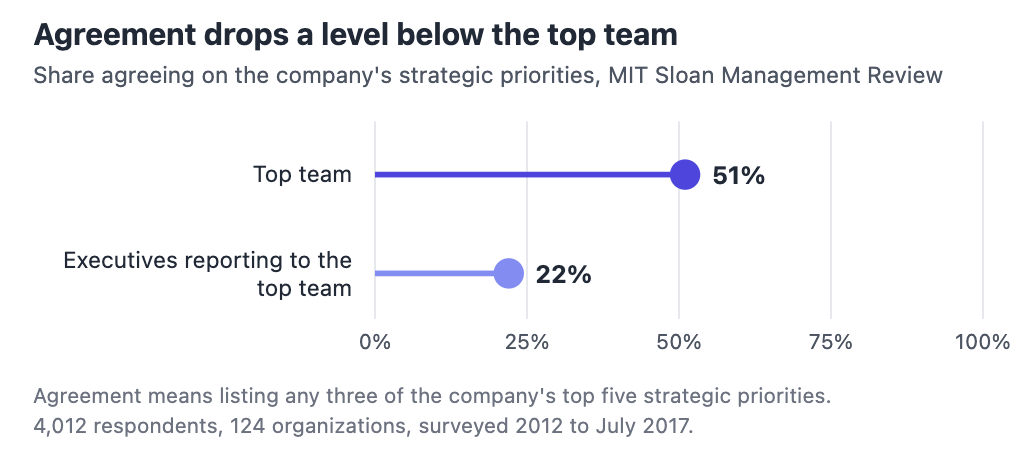
It looks like a team that agrees in the meeting and works on different things afterward, usually without knowing it. In 2018, MIT Sloan Management Review published research across 124 organizations showing that only 51% of top-team members agreed on their company's strategic priorities. Among the senior executives who report to them, the figure was 22%.
Donald Sull, Charles Sull and James Yoder surveyed 4,012 people between 2012 and July 2017. Their test was generous. A respondent counted as aligned by listing any three of the company's top five priorities, with five tries. The researchers note that this produces higher estimates than a stricter test would. Even so, only about half of a typical top team passed.
The people at the top are also the least likely to notice. Where managers outside the C-suite rated their company's alignment as average, the typical top team rated it at the 67th percentile. Executives see the agreement in the room. They don't see what happens once everyone walks back to their own function.
At the top team, misalignment has a few specific signatures. Decisions made in the leadership meeting get reopened in hallways and one-to-ones. Disputes between two executives travel up to the CEO instead of being settled between them. Every function reports green while the company misses its number.
This guide stays with the CEO's own team. Company-wide drift, where alignment fades as headcount grows, has different causes. It's one of the three gaps that rapid growth exposes in a startup's leadership.
Misalignment at the top is usually made by the CEO
The CEO sets every structure a leadership team aligns around: the priority list, the place decisions get made, and the scorecard each executive answers to. In 2015, a London Business School survey of 11,000 executives and managers at more than 400 companies found that only a third of senior managers could correctly identify their firm's top three priorities.
When two-thirds of senior managers can't name the priorities, the problem is rarely the people listening. None of the habits behind it is a character flaw in the executive team. Each one worked with a founding team of three or four people, where everyone heard every trade-off and nobody needed a scorecard.
In that setting the CEO carries the alignment personally. Hiring executives removes that, and nothing replaces it unless the CEO changes how the team decides.
Before writing this guide, we read the pages that currently rank for leadership team misalignment. We found none that cites research on top teams, and none that names the CEO's own habits as the cause. The three habits below account for most of what founders describe as a team problem, and each has a tell a CEO can check this week.
How does an unranked priority list split a leadership team?
Five priorities without an order are five strategies, because each executive ranks them from where they sit. MIT Sloan Management Review researchers found that more than 80% of the companies they studied had between three and five strategic priorities. Most leadership teams carry exactly that kind of list.
Their case of a large technology company, which they call Generex, shows what happens next. Generex had five official priorities and 11 executives in its top team. Just over half could list all or all but one of them. Three could list only one, and two couldn't name a single official priority despite five tries. Between them, those five executives listed eight priorities that weren't official at all.
The pattern isn't new. In 2011, a Booz & Company survey of more than 2,000 executives found that 64% said their company had too many conflicting priorities, and 49% said it lacked even a list of strategic priorities.

oss industries and regions. Published 2011.Source: Booz and Company, "Data Points: Corporate Incoherence," strategy+business, 2011.
In a startup, extra priorities usually arrive one at a time: from a board meeting, a large customer, a competitor's launch. Nobody retires the old ones. Each executive privately decides which matter most, and they don't decide the same way. Much of what looks like a disagreement about strategy starts there.
The fix is to rank the list in the room, with every executive present. Then write down the trade-off rule: when priority two and priority four collide, two wins. Fewer priorities help, and the order helps more.
Run the ranking so the disagreement shows. Ask each executive to rank the list privately before the meeting, then put the rankings side by side. Spend the meeting on the biggest gaps, because those are the trade-offs people are already making differently. Where the team can't agree, the CEO decides and says why. The team needs to know the reasoning, even when some of them disagree with it. Naming what the company has decided not to do helps as well, and prioritizing under uncertainty covers how to set those non-priorities.
What is hub-and-spoke alignment, and why does it feel like alignment?
Hub-and-spoke alignment is the pattern where every executive is aligned with the CEO and none is aligned with each other, because the CEO settles things one-to-one. Rebecca Homkes, who designed London Business School's 2015 survey with Donald Sull, found a related cost: senior managers trust colleagues in other units to deliver "all of the time, less than 10% of the time."

It forms naturally. Founders run early companies through one-to-ones, and the habit survives the first executive hires. A product question gets settled with the head of product on Tuesday. Its sales implication gets settled with the head of sales on Thursday. Each executive leaves with a slightly different version of the deal, and only the CEO holds all of them.
That's why it feels like alignment from the center. The CEO has agreed something with everyone and remembers every agreement. Each executive has agreed something with the CEO and has never heard the others' version. When those versions collide, the dispute travels back to the hub. Homkes described where that leads: managers who can't rely on their peers "tend to do the job themselves or let their own commitments to others slip."
Researchers call the missing ingredient behavioral integration. Behavioral integration is how far a top team works as one group, sharing decisions across functions. In a 2006 study of CEOs and top-team members at 139 small and medium-sized firms, Michael Lubatkin and colleagues found that top-team behavioral integration supported the firm's ability to pursue new and existing opportunities at once. That ability, in turn, went with stronger relative performance.
Three questions show whether a team runs hub-and-spoke:
- Could two executives settle a cross-functional conflict this week without you?
- How many disputes between peers reached you in the last month?
- Would every executive describe the last big trade-off the same way?
If the honest answers are no, several and no, the hub is doing work the team should be doing together.
The cure doesn't mean abolishing one-to-ones. It means changing what they're for. Keep them for coaching, development and unblocking one person's work. When a one-to-one surfaces a decision that touches another function, park it for the leadership meeting and say so out loud. The first few times it will feel slower. Within a month, executives tend to bring those questions to each other first.
A function-only scorecard pulls executives apart
Each executive has two jobs and is usually measured on one. The MIT SMR researchers describe top-team members as people who "oversee their own function, business unit, or geography, but also serve on the enterprise-wide leadership team that charts the course for the company as a whole." Only half of the executives reporting to a top-team member said their boss consistently explained how their goals supported the company's agenda.
In a startup, the second job is new. The founding team never needed it named, because everyone did a bit of everything. Executives hired from larger companies arrive with the opposite habit: a functional scorecard, functional loyalties and a career built on winning their own function. If the CEO measures them only on that, they'll do it well, and the company can still miss.
The fix is structural. Put one shared company measure on every executive's scorecard alongside the functional ones. Then ask each executive to explain to their own team why their objectives matter to the company, which is the step the MIT SMR researchers recommend.
The shared measure should be one no function can hit alone: the quarter's revenue number, net retention, or the single milestone the next round depends on. Its job is to make two executives need each other. A head of sales and a head of product who share a retention target have a reason to settle trade-offs between themselves.
How this plays out depends on who is in the room. The founding team, the first hired executives and a professionalized team each hold alignment in a different way. The second group is the most exposed, and the CEO decides when those first executives arrive, usually before deciding how they'll be aligned.
Is misalignment a team problem or a founder problem?
It usually shows up as a team problem and traces back to the founder. That's the editorial team's position, drawn from how the three habits work. It also matches how Noah Shanok, founder and first CEO of Stitcher, which he ran for eight years, describes his work coaching venture-backed CEOs.
Shanok does keep a structured team diagnostic in his toolkit at Startup CEO Coach. On his coaching methodology page, he describes the Five Dysfunctions of a Team framework as identifying "the five patterns that reliably cause leadership teams to underperform," and adds:
I use it as a diagnostic when a founder's challenge is about team dynamics rather than individual leadership.
The condition in that sentence is the important part. Asked to split his coaching work into people problems and strategy problems, his answer was:
A lot of people problems are a blocker within the founders own mind. The speed of startup growth is almost always constrained by the speed of their development. It may look like a strategy issue or a people issue or some other kind of issue, but once you unpack it enough, it mostly comes down to the founder's evolution.
Put the two together and the order of operations follows. Check the CEO's own decision habits first: the ranked list, where decisions get made, what the scorecard measures. If those are sound and the team still can't agree, it's team dynamics, and a structured diagnostic earns its place. Run the diagnostic first and it tends to find the problem in the team, because the team is where it looks.
Disagreement itself is healthy, provided the team agreed the rules for conflict before anyone was angry.
How does a CEO realign a leadership team without an offsite?
By changing how the team decides, which matters more than any single agreement. In a 2001 study of two samples of new-venture top management teams from the Inc. 500, Michael Ensley and Craig Pearce found that the group processes behind a shared strategy predicted performance better than the shared strategy itself.

A second study, of 70 new ventures, points to what those processes look like. Ensley, Allison Pearson and Allen Amason found that cohesive top teams had less personal conflict and more conflict about ideas, and that cohesion was positively related to growth. In other words, cohesive teams argue about the work, and less about each other.
Four changes put that into practice, and none of them needs an offsite:
- Rank the priorities together, and write the trade-off rule next to the list.
- Move cross-functional decisions out of one-to-ones. Settle them in the leadership meeting with every affected executive present, and keep one-to-ones for coaching.
- Add one shared company measure to every executive's scorecard.
- Re-run the priority test in 30 days, using the check in the next section.
Shanok has described a rhythm that supports the second step, in his post on making faster decisions: "I've seen startup CEOs do weekly decision reviews with their exec teams. They go through all open decisions, clear the queue and move on."
The next layer is deciding who owns which decision, and named decision rights are one of the operational systems that reduce a founder's decision load. When one executive keeps reopening a decision after the meeting, the problem has narrowed to one person, and preparing for a difficult conversation covers how to have it.
How do you know the leadership team is realigned?
Ask each executive to write the company's top priorities, independently and in order, then compare the lists. It's a stricter version of the test MIT Sloan Management Review researchers used. In that research, only 28% of executives and middle managers responsible for executing strategy could list three of their company's strategic priorities.
If the lists don't match, don't average them. Take the first place where two lists diverge and settle that trade-off at the next leadership meeting, then run the test again. If the lists match, the first habit is fixed. Three other signals confirm the rest. Fewer disputes between peers reach the CEO. Decisions made in the leadership meeting stay made. And a new executive can describe the company's trade-offs the way the rest of the team does within a few weeks of joining.
Treat realignment as a habit. Re-run the ranked-priority test every quarter, after every executive hire and after every change of plan. Most leadership teams fall out of alignment gradually, through new priorities and private agreements that accumulate between checks.
Frequently asked questions
How often should a startup leadership team realign?
A quarterly check is enough for most teams. Checking much more often turns the exercise into a ritual, and executives start writing the answer they expect the CEO wants. The useful exceptions are a new executive hire and a change of plan, when a check is worth running right away.
Can an offsite fix a misaligned leadership team?
An offsite can reset the priority list and clear the air. The misalignment usually returns through the next month of one-to-ones unless the way decisions get made also changes. Treat the offsite as the start of the new habit, and the weekly leadership meeting as the place it lives.
What should a CEO do when one executive won't commit to a decision?
Separate disagreement before the decision from relitigating after it. The first is useful, and the meeting should make room for it. The second is a performance problem with one person, and it belongs in a direct conversation with that person.
How many priorities should a startup leadership team have?
In MIT Sloan Management Review's research, over 80% of the companies studied had three to five. For a startup, the useful limit is how many priorities the team can rank without arguing about the order every week. If the ranking keeps reopening, the list is too long.
Does hiring a new executive cause misalignment?
It often does, because a new executive arrives after many trade-offs were already settled and nobody wrote them down. Tell them which decisions are closed and why, and which are still open. A short written record of past trade-offs saves months of quietly reopened decisions.
When is leadership team misalignment a coaching problem?
When the source is the CEO's own decision habits, which are the hardest thing for a CEO to see from inside. Executives rarely tell the CEO that one-to-one deals are splitting the team, because each of them benefits from their own deal. An outside view can name the pattern.
Alignment starts with how the CEO decides
A leadership team aligns around three things the CEO controls: the order of the priorities, the place decisions get made and what each executive is measured on.
This week, ask every executive to write the company's top three priorities, in order and without conferring. Compare the lists at the next leadership meeting. If they don't match, the gap is the agenda. If closing it keeps slipping back into one-to-ones, a conversation about coaching is one place to start.
Sources
- No One Knows Your Strategy, Not Even Your Top Leaders, MIT Sloan Management Review
- Why senior managers can't name their firms' top priorities, London Business School
- Data Points: Corporate Incoherence, strategy+business
- Ambidexterity and Performance in Small-to Medium-Sized Firms: The Pivotal Role of Top Management Team Behavioral Integration, Journal of Management
- Shared Cognition in Top Management Teams: Implications for New Venture Performance, Journal of Organizational Behavior
- Understanding the Dynamics of New Venture Top Management Teams: Cohesion, Conflict, and New Venture Performance, Journal of Business Venturing
- Coaching Methodology, Startup CEO Coach
- How do I make faster decisions as a CEO?, Startup CEO Coach

