.png)

Almost every guide to startup layoffs begins at the same place: you have decided to cut, here is how to run the day. That is the easy half, and it is the half that gets written about, because it can be turned into a checklist. The hard half happens earlier and nobody covers it. Most founders reach the conclusion weeks or months before they act on it, and the interval between private certainty and public action is where the avoidable damage accumulates. This article is about that interval, about sizing the cut once so it does not have to happen twice, and about the company that has to keep working afterwards.

Why is a layoff usually decided months before it is announced?
Because founders reach the conclusion privately long before they can bring themselves to act on it. The decision is not made in the week of the announcement. It is ratified then. At startup scale the interval between the two is routinely measured in months.
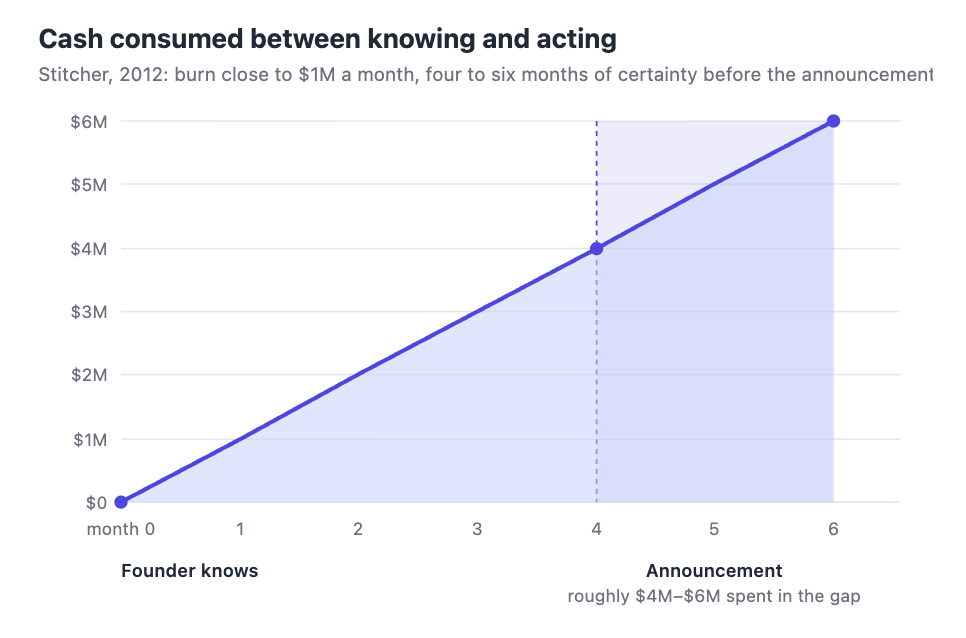
Noah Shanok founded Stitcher in 2006 and ran it for eight years before he began coaching venture-backed CEOs through Startup CEO Coach. In 2012 the company had grown to between 35 and 40 people, burning close to $1 million a month, without product-market fit. He has described knowing for four to six months before he laid off about 20 of those 40 people.
Not suspecting. Knowing.
He has also described why he waited. He had lost confidence, and he hesitated. The delay was painful because he considers it his own fault, in the way he says everything is ultimately the CEO's fault. He had hired those people. Many of them had families. They had believed him.
What the company looked like from the inside during those months is the detail most founders will recognise. Everyone was busy. There were meetings, initiatives, roadmaps, a full calendar of visible work. The product was still leaky, so none of the activity mattered.
That is worth sitting with, because it is probably what a founder reading this sees on their own Monday morning. A company in the gap does not look like a company in trouble. It looks like a company working hard.
The important distinction is that this isn't indecision. The founder has decided. What's missing is the mechanism that converts a private conclusion into a dated action, and nothing inside a startup supplies that mechanism by default. It's the same structure that leaves founders sitting on the decisions they already know they need to make, and the layoff is simply the most expensive instance of it.
What does the gap between deciding and acting actually cost?
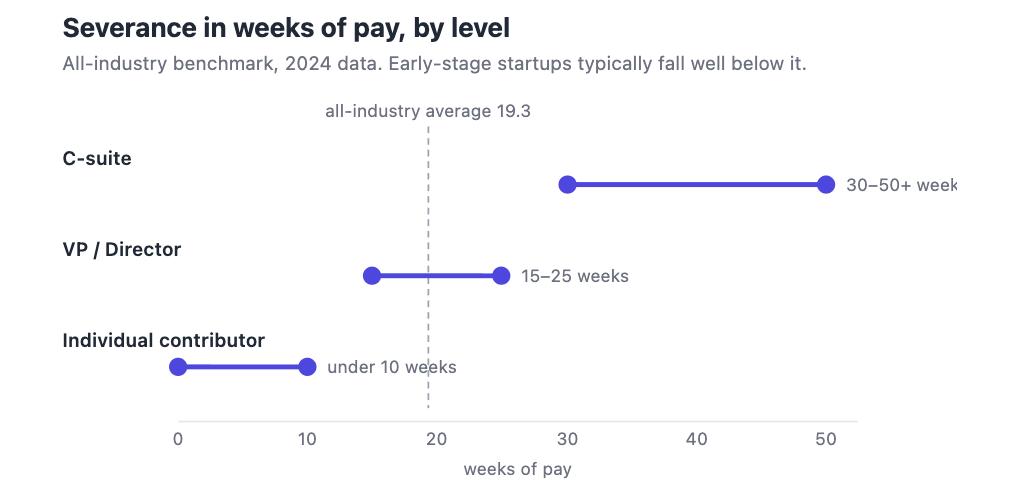
Three things compound at once: cash, optionality, and the credibility of whatever the founder says at the end of it. Founders model the first and are usually blindsided by the other two. The cash number that matters is not payroll, it is severance capacity. In its 2025 Severance and Salary Benchmarking Report, drawing on 2024 data, Challenger, Gray & Christmas put average severance across all industries at 19.3 weeks, up from 15.6 weeks the prior year (Challenger, Gray & Christmas, December 2025). Early-stage startups sit well below that benchmark, and the distance between the two is largely a function of how much cash is left by the time the decision gets made.
That produces an inversion most founders have never considered. Every month of delay spends runway that would otherwise have funded a more generous exit for the people being let go. Waiting feels protective of them. In cash terms it does the opposite, quietly reducing what they walk out with. A founder who waits four months at $1 million a month has not given anyone four extra months of security. They have spent the severance budget on payroll that was already known to be surplus.
The second cost is optionality. A cut made with nine months of runway is a strategy decision, and it can be explained as one. The same cut made with three months is a survival decision. Employees can tell the difference immediately, and the two produce very different companies on the other side.
The third is credibility, and it is the one founders underestimate most. Teams are usually further ahead than leadership assumes. Months of visible hesitation, followed by an announcement framed as a decision made carefully and quickly, reads as something else entirely to people who watched the hesitation happen.
Then there is the part that surprises founders. The cut frequently makes the company faster. Shanok has been direct about the mechanism at work:
"the more people you have, the slower you go. I thought with more people, I could get more done but if you don't have product market fit, everything actually goes slower."
After the 2012 layoff, the smaller team at Stitcher moved faster than the larger one had, and that is the point at which the knowledge in the company began to compound. The speed he gained was available four to six months earlier. He paid several million dollars for the delay, and the compounding started that much later. Hiring ahead of product-market fit is the specific version of this trap, and it sits near the top of the list of things that break as a startup scales: headcount arrives before the clarity that would have told it what to do.
How does a founder tell a necessary cut from a panic cut?
A necessary layoff changes what the company is trying to do. A panic layoff only changes what it costs. The test is whether the founder can state the strategy the smaller company will execute, and whether that strategy would still be right if the money arrived tomorrow.
The research here is often quoted badly, so it is worth stating precisely. Wayne Cascio's study of S&P 500 firms from 1982 to 2000 cast serious doubt on the long-term payoff of employment downsizing. The distinction he drew matters more than that headline. Employment downsizing treats people as costs to be cut; responsible restructuring treats them as assets to be developed (Cascio, "Strategies for responsible restructuring," Academy of Management Executive 16(3), 2002).
Read carelessly, that finding says layoffs do not work. Read properly, it says something narrower and far more useful to a founder holding a spreadsheet: cuts that carry no strategic decision inside them do not produce the returns the people making them expect. The cost comes out. The performance does not go up. If the only thing a founder can say about the plan is that it extends runway, the research predicts a disappointing outcome, and the research is describing companies with considerably more slack than a startup has.
Three questions are worth answering on paper before any number gets set. What is this company for, at this size? Which work stops completely, as opposed to continuing with fewer people on it? Would this shape still be right at twice the runway?
The failure mode is cutting evenly across the organisation to avoid choosing. Even cuts preserve the org chart and destroy the capacity to do anything well, because every team ends up under-resourced against a plan nobody revised. Somebody has to decide what the company stops doing, and that is a strategy decision wearing a spreadsheet.
One more distinction, because founders blur it constantly under pressure. A layoff and an individual performance exit are different decisions with different mechanics. Using a layoff to remove one person a founder has been avoiding is a way of laundering a management decision through a financial event, and teams read it accurately every time. The signals that it's time to fire someone are their own set, and they don't turn into a layoff just because the cash got tight.
How deep should the cut be?
Deep enough that it does not have to happen again. The most expensive layoff is the one followed by a second layoff four months later, because the second round costs a founder something the first did not: the team's belief that leadership can see far enough ahead to be trusted with the question.
Serial rounds reset fear every time. After the second, every remaining employee starts pricing in a third, and the people with the most options act on that pricing first. Those are precisely the people the smaller company was built around. A single deeper cut is harder in the moment and cheaper in every month afterwards.
The second column is not a hypothetical failure mode; it is what happens when a founder sizes the cut against the discomfort of the conversation rather than against the plan.
Research on downsizing and turnover supports the general shape of this. Charlie Trevor and Anthony Nyberg found that downsizing predicts higher voluntary turnover rates, that organisational commitment mediates the relationship, and that the effect is measurably softened by HR practices which convey procedural fairness and embed employees in the organisation (Trevor & Nyberg, Academy of Management Journal 51(2), 2008). The practical translation for a founder is that the departures which follow a layoff are not fixed by the size of the cut alone. How obviously fair the process was changes the number.
Two tests help get the size right.
The first is the runway test. Size the cut so the remaining team has believable runway to reach a milestone that changes the company's position. Venture-side guidance commonly puts the floor around twelve months, and the reasoning is straightforward: anything shorter means the team is being asked to perform while doing arithmetic about their own security.
The second is the rebuild-from-scratch test. If you were staffing this company today, at this stage, against this plan, with no existing employees and no history, what would the team look like? Founders who answer honestly usually arrive at a smaller number than the one they were about to announce. The gap between those two numbers is the part of the org chart that exists because it already exists.
Shanok's 2012 number is a useful reference point for anyone finding the exercise abstract. About half of a 40-person company, in one event. Not staged, not repeated. Arriving at a point where a cut that deep is the correct answer is usually the accumulation of several ordinary leadership mistakes founders make while scaling, each of which looked defensible on the day it was made.
What does the coaching work look like in the weeks before the announcement?
Rarely advice about how to run the meeting. The work is converting a conclusion the founder has already reached into a dated commitment somebody else knows about, then making sure the founder can say out loud, without flinching, the version of events they are about to give a room of people. Four interventions carry most of the weight, and they run in order: fix the date, size the cut, rehearse the words, brief the board. Shanok ran this sequence himself at Stitcher in 2012, arriving at it four to six months later than the situation warranted, which is the argument for having someone outside the company hold the first step.
- Fix a date held externally. The single most useful intervention is a decision date the founder does not control alone. The gap survives on the permanent availability of one more extension, and a committed date held by someone outside the founder's own head removes it. Everything below is downstream of this.
- Size the cut with someone who has no stake in the org chart. Every internal adviser is also a person whose team is affected by the answer. That is not a criticism of them; it is structural. Neutrality is the mechanism here, more than empathy.
- Rehearse the founder's own words. Not a script. The founder saying the true version aloud, in advance, several times, until they can deliver it without softening it into something a room will correctly hear as evasion. Founders who skip this step tend to discover mid-sentence that they cannot say the real reason, and they substitute a smoother one in real time. Teams remember the substitution for years.
- Brief the board before the meeting. Directors should hear the number and the reasoning ahead of the room, in the shape Shanok has described publicly for difficult investor news: the problem, the plan, and the founder's conviction about it. Everything that makes managing a board work in an ordinary quarter — no surprises, a steady reporting rhythm, bad news delivered early instead of optimistically — matters more in this quarter than in any other.
There is a fifth thing that gets no airtime anywhere and probably deserves the most. The founder is executing the hardest week of their operating life while carrying the belief that the situation is their fault. That belief may even be accurate. It is still not useful in the week it has to be executed, and a founder who is running on it tends to over-explain, over-apologise, and take on emotional labour that belongs to nobody. Keeping the two separate, the accountability and the paralysis, is most of what founder emotional resilience means in practice.
What happens to the people who stay?
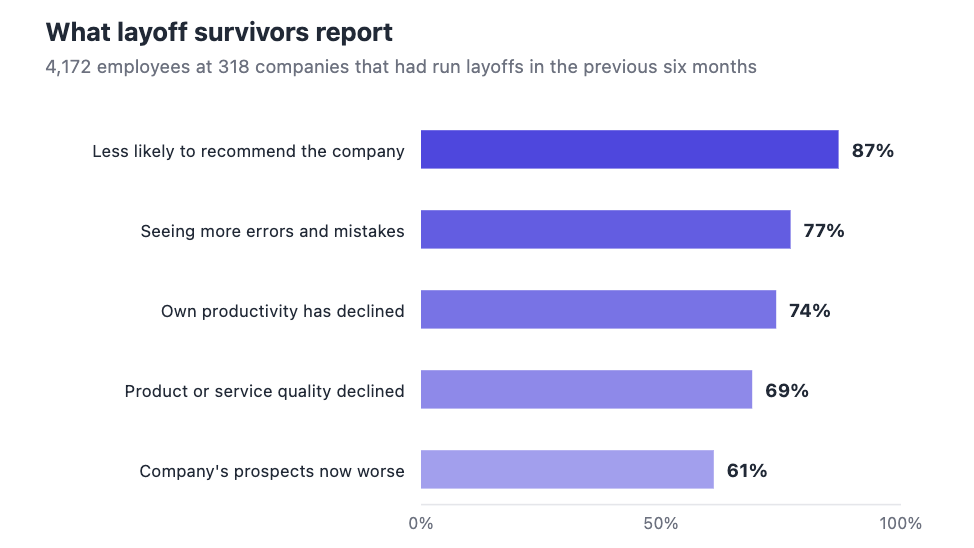
They do not experience relief. The evidence on layoff survivors is consistent and runs against founder intuition: the people who keep their jobs report lower productivity, more errors, and less confidence in the company's future, and the effect persists for months past the point most founders assume it has resolved.
The numbers come from a Leadership IQ survey of 4,172 employees at 318 companies that had run layoffs in the preceding six months. Among survivors, 74% said their own productivity had declined, 77% said they were seeing more errors and mistakes, 69% said the quality of the company's product or service had declined, and 87% said they were less likely to recommend the organisation as a place to work (Leadership IQ, reported January 2009). The three feelings named most often were guilt, anxiety, and anger.
Survivor stress is not ingratitude, and treating it as ingratitude makes it worse. It is a rational response to new information about how the company makes decisions. The broader academic picture supports the same conclusion: the meta-analysis by Magnus Sverke, Johnny Hellgren and Katharina Näswall found that job insecurity has detrimental consequences for employees' job attitudes, organisational attitudes, and health (Sverke, Hellgren & Näswall, Journal of Occupational Health Psychology 7(3), 2002). Uncertainty about whether you still have a job does damage on its own, independent of whether the next cut ever arrives.
Three founder mistakes account for most of the avoidable damage in the fortnight afterwards.
Going quiet. The founder, exhausted and privately grieving, withdraws at exactly the moment the remaining team is reading every available signal. Silence gets filled with the worst interpretation on offer. A founder who was visible daily before the layoff and becomes hard to find after it has told the team something, whether they meant to or not.
Over-apologising. Repeated apology transfers the founder's guilt onto the people who still have to do the work, and quietly asks them to manage it. Say it once, properly, and then be useful. The team needs a functioning CEO more than it needs a remorseful one.
Re-hiring too soon. Opening a role six weeks later tells survivors that the cut was not what they were told it was. It is the fastest available route from survivor stress to resignation letters, and it undoes the credibility the announcement was supposed to buy.
What survivors actually need is narrower than most founders assume: to know what the company is now for, who is responsible for what, and whether this is going to happen again. In that order. Everything else can wait. A founder who could once read the whole company by walking through it has to rebuild that visibility deliberately afterwards, which is the problem of managing a growing team without losing control run in reverse.
How is the company rebuilt after the cut?
By becoming legible again. A smaller company is not the old company with gaps in it. It is a different company, and the founder's first job is to say clearly what it is now for, at this size, with these people, against this plan.
The instinct after a cut is to keep every initiative alive with fewer people on each one. That reproduces the pre-cut problem at lower headcount and burns the credibility the layoff was supposed to buy, because the team can see that nothing was actually decided. Something has to be genuinely abandoned. Founders consistently under-cut the goal list relative to the headcount list, and the mismatch is why so many companies emerge from a layoff slower than they went in.
Re-scoping has to be written down and public: what stopped, who owns what now, what the next milestone is, and when it lands. Delivered once at an all-hands and never referenced again, it does nothing. A team that has just watched half its colleagues leave is not calibrating on the announcement. It is calibrating on whether the next four Thursdays look like leadership said they would.
Which is why cadence matters more than messaging in the recovery period. Predictability is the raw material trust is rebuilt from after a layoff, and it accrues slowly, in small kept commitments, at intervals.
The counterintuitive part, and the honest way to end on it, is what happened at Stitcher. The smaller team moved faster than the larger one had, and the knowledge in the company began compounding at that point. It would be easy to file that under silver lining. It's closer to an indictment. That speed was available four to six months earlier, at a cost of several million dollars and twenty jobs that a faster decision might have partly preserved. The founder wasn't missing information. He was missing a mechanism, and supplying that mechanism is most of what a startup CEO coach actually does in the weeks around a decision like this one. Whether it's worth paying for is a separate question, and our guide to CEO coaching for venture-backed founders works through it honestly, including the stages where the answer is no.
Frequently asked questions
Should a startup do one round of layoffs or several smaller ones?
One, sized so it does not recur. Serial rounds reset fear each time and prompt the people with the most options to leave first. Research on downsizing found the resulting voluntary turnover is softened by processes that are visibly fair (Trevor & Nyberg, Academy of Management Journal, 2008), so both the depth and the fairness of the process matter.
How much notice should a startup give before a layoff?
Federal WARN Act thresholds in the US generally do not reach startup headcount, but several states operate mini-WARN rules with far lower triggers, and non-US jurisdictions frequently require consultation periods measured in weeks. This is genuinely a question for employment counsel in your specific jurisdiction rather than a benchmark to copy.
How much severance do startups typically offer?
Less than the corporate benchmark. Challenger, Gray & Christmas put the all-industry 2024 average at 19.3 weeks, with individual contributors under 10 weeks (December 2025). Early-stage startups usually fall below even that. The useful approach is setting a floor of dignity before the list is drawn up, then being as generous above it as runway allows.
Should a founder warn the team that layoffs are coming?
Two different things get confused here. Signalling financial reality honestly and continuously is almost always right. Pre-announcing a specific cut without dates or names is almost always wrong, because it puts the entire company into an indefinite waiting period, and job insecurity does measurable damage on its own (Sverke et al., 2002).
Do you tell the board before or after you have decided the number?
Before, with the reasoning attached. A board that first hears a decided number in a meeting has been handed a fait accompli, which is a governance problem as much as a relationship one. Directors who were consulted early defend the decision externally; directors who were informed late tend to reopen it.
How long does it take a team to recover after a layoff?
Longer than most founders plan for, and the useful marker is not elapsed time. Recovery tracks demonstrated predictability: whether commitments made in the weeks afterwards are kept at the intervals promised. Survivor effects on productivity and confidence have been measured months out (Leadership IQ, 2009), so a two-week reset is not realistic.
What does a CEO coach actually do differently around a layoff?
Mostly they supply a decision date the founder does not control alone, and a sizing conversation with someone who has no stake in the org chart. Noah Shanok, who ran this decision himself at Stitcher in 2012 and waited four to six months, now coaches venture-backed CEOs on the same call. The distinctive thing is neutrality, not sympathy.
The gap is the part you control
The decision itself is often not the hard part, because by the time a founder is reading an article like this one, it has usually already been made somewhere private. What remains open is the interval, and the interval is the only variable still fully under the founder's control.
It is expensive in a way that compounds. It spends the cash that would have funded a better exit for the people leaving. It converts a strategy decision into a survival decision. It costs the credibility of whatever gets said at the end.
Four to six months, about 20 of 40 people, and a smaller company that moved faster than the larger one ever had. The arithmetic of that gap is the most useful thing a founder sitting on the same decision can look at today.
Sources
- Wayne F. Cascio, "Strategies for responsible restructuring," Academy of Management Executive 16(3), 80–91, 1 August 2002. The article reports that a study of S&P 500 firms from 1982 to 2000 "casts serious doubt on the long-term payoff" of employment downsizing, and draws the distinction used in this article: "In contrast to employment downsizing, a strategy that regards people as costs to be cut, a responsible restructuring strategy focuses on people as assets to be developed." Retrieved 2026-08-25, https://doi.org/10.5465/ame.2002.8540331
- Charlie O. Trevor & Anthony J. Nyberg, "Keeping your headcount when all about you are losing theirs: Downsizing, voluntary turnover rates, and the moderating role of HR practices," Academy of Management Journal 51(2), 259–276, 2008. Cited here for the directional findings stated in the abstract: downsizing predicts voluntary turnover rates, organisational commitment mediates the relationship, and the relationship is mitigated by HR practices that embed employees or convey procedural fairness. A figure widely attributed to this paper — that a layoff of 1% of the workforce produces a 31% increase in voluntary turnover — could not be verified against the paper itself on 2026-08-25 and is deliberately not used. Retrieved 2026-08-25, https://doi.org/10.5465/amj.2008.31767250
- Magnus Sverke, Johnny Hellgren & Katharina Näswall, "No security: A meta-analysis and review of job insecurity and its consequences," Journal of Occupational Health Psychology 7(3), 242–264, July 2002. Cited for the finding stated in the abstract, that job insecurity has detrimental consequences for employees' job attitudes, organisational attitudes, health, and to some extent their behavioural relationship with the organisation. Percentage figures frequently attributed to this paper (a 41% decline in job satisfaction, 36% in organisational commitment, 20% in job performance) do not appear in the abstract and appear to be a secondary conversion of effect sizes; they are not used here. Retrieved 2026-08-25, https://doi.org/10.1037/1076-8998.7.3.242
- Leadership IQ, "Don't expect layoff survivors to be grateful," survey of 4,172 employees at 318 companies that had undertaken layoffs in the previous six months. Figures quoted: 74% say their own productivity has declined, 69% say product or service quality has declined, 77% see more errors and mistakes, 87% are less likely to recommend the organisation, 61% believe the company's future prospects are worse, 64% say colleagues' productivity has declined, 81% say customer service has declined. The study page carries no publication date; contemporaneous trade coverage dates the release to January 2009. Retrieved 2026-08-25, https://www.leadershipiq.com/blogs/leadershipiq/29062401-dont-expect-layoff-survivors-to-be-grateful
- Challenger, Gray & Christmas, "Benchmarking severance in 2025: what 'competitive' really looks like," published 30 December 2025, drawing on the firm's 2025 Severance & Salary Benchmarking Report (2024 data). Figures quoted: average severance across all industries 19.3 weeks, up from 15.6 weeks the prior year; C-suite 30–50+ weeks; VP and Director 15–25 weeks; individual contributors fewer than 10 weeks. Retrieved 2026-08-25, https://www.challengergray.com/blog/benchmarking-severance-in-2025-what-competitive-really-looks-like/
- Noah Shanok's account of the 2012 Stitcher layoff — team of 35 to 40, burn close to $1 million a month, about 20 people let go, four to six months of knowing before acting, the reasons for the delay, and the verbatim quotation on headcount and speed — is taken from his direct answers supplied for this publication, 2026. His founding of Stitcher in 2006 and eight-year tenure are stated on his own published posts, retrieved 2026-08-25, https://www.startupceo.coach/blog/how-do-startup-ceos-avoid-burnout
- A widely circulated claim that a Harvard Business Review meta-analysis found a 25% decrease in performance and a 31% decline in morale after layoffs was checked on 2026-08-25 and could not be traced to any such study. It appears to be a garbled conflation of the Sverke and Trevor papers above, and is noted here only because it dominates secondary search results on this topic.