.png)

There is a version of the failure story that costs nobody anything. The market wasn't ready. The category never materialised. Timing was against us. It is respectable, it is usually partly true, and it is almost impossible to argue with, which is exactly what makes it so popular. The trouble is that it answers a question nobody needed answered. Whether the market was hard is rarely the interesting part. Why the company kept spending against a belief it had not tested, and who was in a position to say so and didn't, is where the actual causes live. Those are decisions, and decisions have owners.
Why do startup post-mortems blame the market?
Because post-mortems are written by the people being judged, and the market is the only cause that implicates nobody in the room. It leaves the founder's judgement intact, the investor's thesis defensible, and the story clean enough to tell at the next fundraise.
That is not cynicism about founders. It's a structural feature of who writes these documents and when. A post-mortem is produced at the worst moment of a founder's professional life, usually within weeks of laying people off, and it is read by the people they will need to raise from again. Under those conditions the market explanation isn't a lie. It's the path of least resistance through a genuinely painful piece of writing.
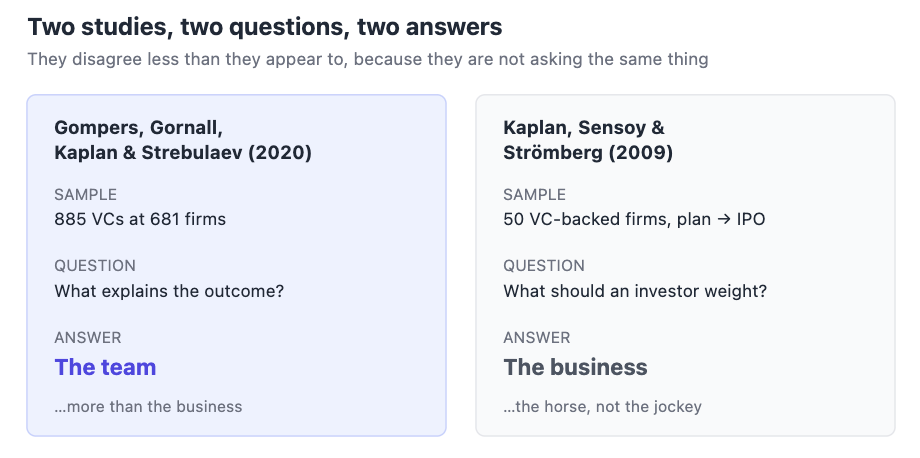
The people funding these companies do not appear to believe it. In 2020, Paul Gompers, Will Gornall, Steven Kaplan and Ilya Strebulaev published a survey of 885 institutional venture capitalists at 681 firms in the Journal of Financial Economics. On investment selection, VCs rated the management team above business characteristics such as product or technology. On outcomes, the finding was blunter still: they "attribute more of the likelihood of ultimate investment success or failure to the team than to the business" (Gompers, Gornall, Kaplan & Strebulaev, "How do venture capitalists make decisions?", Journal of Financial Economics 135(1), 2020).
So there's a gap between the explanations that get published and the explanations the funders hold privately. That gap is worth a founder's attention, because the private version is the one being applied to them: at the next fundraise, in the reference calls, in whether a second company gets backed.
The asymmetry runs deeper than convenience. A market explanation is close to unfalsifiable after the fact. Nobody can prove the market was winnable once the company that would have won it no longer exists, and the counterfactual has no owner. A leadership explanation, by contrast, names decisions, and decisions have dates, minutes and people attached. One of those is comfortable to write down. The other is a document you'd rather not circulate.
Which is also why the failure literature skews the way it does. The post-mortems that get published are a self-selected sample, written by survivors, for an audience they need something from.
None of this means the published reasons are false. Companies genuinely do run out of money. Products genuinely do fail to find product-market fit. Both are accurate descriptions of the final state. Both are also downstream of something, and the something is usually a sequence of decisions made eighteen months earlier by people who had better information available than they used.
What does the research actually say about the team versus the business?
It says both things, from two papers sharing an author, and the apparent contradiction turns out to be the most useful thing on this topic. Investors attribute failure to the team. The best longitudinal evidence says investors should bet on the business instead.
The Gompers survey above is one half. The other half is older and less quoted. In 2009, Steven Kaplan, Berk Sensoy and Per Strömberg published a study in the Journal of Finance tracking how 50 venture-capital-financed companies evolved from their earliest business plan through IPO and into public company life. Their conclusion runs directly against the popular answer:
"We find that firm business lines remain remarkably stable while management turnover is substantial… The results suggest that, at the margin, investors in start-ups should place more weight on investing in a strong business ('the horse') than on a strong management team ('the jockey')."
That is the strongest published counter-argument to this article's title, and it deserves stating at full strength. The authors also checked it against an out-of-sample set of all 2004 IPOs and got similar results, which rules out the easy objection that the finding is an artefact of one cohort or of venture-backed firms specifically.
One caveat matters, and it's a caveat about the question, not the answer. Kaplan's companies reached IPO. It's a success-selected sample, built to tell an investor what to weight at the moment of writing a cheque. It was never designed to explain why a particular company died, and it doesn't claim to.
Notice also what the two papers are measuring. Gompers asked practitioners what they believe explains outcomes. It's a survey of judgement, with all the hindsight bias that implies. Kaplan tracked what actually changed inside real companies over years, which is evidence of a different and harder kind. A careful reader should weight them differently, and should be suspicious of any article that quotes one and pretends the other doesn't exist.
Why do investors bet on the horse while founders work on the jockey?
Because they're answering different questions from different chairs, and both answers are correct. Kaplan's central finding isn't really "the business matters more." It's that the business line is the stable variable and the team is the volatile one. What each party should do with that fact depends entirely on their position.
An investor holds thirty bets and is trying to identify which signal predicts return across a portfolio. If business lines stay remarkably stable and management churns, the business is the thing you can actually underwrite at the point of decision. Weighting it is rational.
A founder holds one bet. They cannot swap the horse. That choice was made years ago and is now the constraint everything else runs inside. And they are, in Kaplan's framing, the volatile variable themselves: the part of the company that turns over, changes, gets replaced. Which means the founder's only real lever is precisely the thing Gompers' venture capitalists say decides the outcome.
Read that way, the 2009 paper stops contradicting the 2020 one and starts explaining it. Management turnover is substantial because the team is where the variance lives. Variance is what produces different outcomes from similar starting conditions. It's not a coincidence that the volatile variable is also the one investors blame.
For a founder the practical translation is short. The market is a constraint you selected once, at the beginning, and are now stuck inside. Leadership is a variable you are re-selecting every week, mostly without noticing you're doing it. One of those is worth spending Monday morning on.
That is also why the useful diagnostic questions are never about the category. They're about what the company believes, what it's spending against that belief, and how quickly it finds out it was wrong, which is closer to the territory covered in what breaks when a startup scales.
What a leadership failure looks like from the inside
It looks like a company doing visibly reasonable things, in a category that turns out to be completely real, dying anyway.
Noah Shanok founded Stitcher in 2006 and ran it for eight years. The company raised through Series B and beyond from a recognisable set of investors: a $2.7 million Series A in 2008, then a $6 million Series B led by Benchmark Capital in April 2010 (TechCrunch, 2010), then a $10 million Series C led by New Enterprise Associates in September 2011, which brought total funding to around $20 million (VentureBeat, 2011).
The horse was right. Podcasting was a real category. It did not fail to materialise, it did not stay niche, and it comfortably outlived the company. Stitcher sold in 2014.
Here is how Shanok describes the ending:
"We basically just ran out of money and it was a firesale. We sold the company for peanuts."
And here is his own account of the cause, which is the reason this article exists:
"I was great at raising money. I just couldn't get Stitcher to make money or grow users quickly,which was the problem."
That is a founder, unprompted, declining the available market explanation about his own company. He had access to it. Podcasting in 2010 was genuinely early, the tooling was bad, and "we were ahead of the curve" would have been an easy and defensible thing to say. He said something else.
The operating error underneath it is the ordinary one, and he's been direct about it too: the company hired as though it had product-market fit when it did not, and then discovered that more people made it slower rather than faster. Correcting that overhire took a cut he waited four to six months to make, which is its own study in how founders decide on layoffs. And eight years of maximum effort, it turns out, buys far less than founders expect when the effort is not converting into output. The arithmetic of what hustle culture actually costs is unforgiving on this point.
It's worth being precise about what that quote does and doesn't concede. He isn't saying the company was badly run in some way that would be obvious to an outsider, and he isn't performing regret. He's making a narrower and more uncomfortable claim: the inputs he was good at supplying were not the inputs the company was short of. Capital arrived. Growth and revenue didn't. Whatever stood between those two things was inside the company.
The point for a founder reading this is not that Stitcher should have been run better in some way visible from here. It's that the category was right, the investors were good, the money was real, and none of it was the binding constraint. Eight years is long enough to rule out bad luck as the whole story, and the ending was not ambiguous.
How does "we ran out of money" hide a decision?
Running out of money is an arithmetic outcome, not a cause. Every company that dies this way spent at a rate somebody chose, against a plan somebody approved, for longer than somebody should have allowed. The post-mortem records the arithmetic and skips all three of the somebodies.
Burn is mostly headcount, and headcount is mostly a belief about traction. A company that hires forty people has made a claim about what it has proven. If the claim is wrong, the error doesn't show up as a strategy problem. It shows up as a cash problem, roughly eighteen months later, which is precisely when the post-mortem gets written and blames the cash.
The lag is what makes this so hard to catch from inside. A hiring decision made in the first quarter produces its consequences in the sixth, by which point the founder is dealing with a runway emergency and has no attention left for archaeology. The decision and its result are far enough apart that they don't feel connected, and the thing that presents itself as urgent is always the cash.
Two further features make the error durable. Headcount is the least reversible spending a company does, because reversing it means firing people who moved cities and turned down other offers. And it's self-justifying while it lasts: forty people generate meetings, roadmaps and visible activity, all of which read as momentum to everyone including the founder.
That last row is the one founders underestimate, and Shanok's account of the Stitcher board is unusually honest about it because nobody in the description is a villain:
"Mostly about me wanting them to leave me alone so I could try to execute. And them wanting to help but not knowing how. And then eventually them getting frustrated because nothing that I tried seemed to be working and we'd been at it for a long time. We were all tired."
Read structurally, that's a governance loop that stopped working. The person closest to the problem wanted autonomy. The people with the capital wanted to help and had no mechanism for doing it. Then exhaustion removed everyone's appetite for reopening the question. No single decision in there is obviously wrong, which is exactly why it survives so long, and why it appears in no post-mortem, ever. What prevents the loop is unglamorous and mostly procedural: a cadence that survives bad quarters, and a habit of pre-wiring the board before the meeting instead of during it. It also depends on a founder who reports the problem before it has a solution attached, which is harder than balancing transparency against optimism usually sounds.
When is it genuinely the market's fault?
Sometimes it is, and an argument that can't concede that isn't an argument. Three categories where the market really is the cause, and a test for telling them apart from the leadership version.
- Regulatory or structural foreclosure. The business becomes illegal, or the platform it depended on closes the channel. No quality of leadership recovers a market that has been shut. This is rare and it is usually obvious.
- A category that genuinely does not exist. Distinct from "early," which is what founders usually mean when they say this. The honest test is whether anyone built a durable business in that category over the following decade. If several did, the category existed and the difference was elsewhere.
- An exogenous shock inside a runway too short to absorb it. A company with three months of cash when something unforeseeable happens has no move available. A company with twenty months does, and how it uses them is a leadership question again.
The test that separates these from leadership failures is comparative, not absolute. Did companies funded at the same time, in the same category, with similar capital, survive? If several did, the market was survivable. That doesn't make the founder incompetent. It relocates the cause to the part of the system that varied.
Podcasting fails that test cleanly, which is why Stitcher belongs in the leadership column and not this one. The category not only existed, it went mainstream. Companies founded in the same space in the same era are large today.
One pattern deserves naming because it is so often misfiled here. Growth itself can outrun a leadership team's capacity, and from the outside the result is indistinguishable from a market that turned: revenue stalls, churn climbs, the category looks saturated. Rapid growth creating leadership problems is a failure of the organisation to keep up with its own success, and it wears the market's clothes almost perfectly.
What can a founder actually change?
Three things. All of them are recurring decisions, none of them is a one-off error, and all are observable well before the outcome arrives.
- What the company believes it has proven. Nearly every fatal spending decision follows a misread of the evidence, not an absence of it. The company has data. It has decided what the data means. The question worth asking monthly is what would have to be true for the current interpretation to be wrong, and whether anyone is tasked with checking.
- How fast belief converts into fixed cost. Headcount is the mechanism that turns a wrong belief into an unrecoverable one, because it is the slowest spending to reverse and the last to show up in the numbers. The gap between what has been proven and what is being spent against it is the single most useful number a founder can track, and almost nobody tracks it.
- Who is allowed to contradict you, and whether they do it early enough to matter. Every company has people who can see the problem. The question is whether the structure rewards saying so at month three or at month fifteen. This is the governance version of the same issue, and it's where the board conversation above becomes concrete.
None of these are mistakes to avoid. They're decisions that recur, which is why they belong to leadership and not to a checklist. Each one does generate a familiar catalogue of specific errors. The recognisable leadership mistakes founders make while scaling are downstream symptoms of these three, not independent problems. So is the most expensive habit in the set, deferring a call you have already made, which is what the third item becomes when nobody is positioned to force it.
The second and third items are close to impossible to audit from inside your own head, which is why founders usually need someone outside the company to get at them at all. Supplying that outside position is much of what a startup CEO coach is for. Whether it's worth paying for is a fair question with a real answer, and our guide to CEO coaching for venture-backed founders works through it including the stages where the answer is no.
Frequently asked questions
Do most startups fail because of the market or the team?
The people who fund them say the team. Surveying 885 institutional venture capitalists at 681 firms, Gompers, Gornall, Kaplan and Strebulaev found VCs attribute the likelihood of ultimate success or failure more to the team than the business (Journal of Financial Economics, 2020). Published post-mortems say the market far more often.
Is "we were too early" ever a real reason?
Occasionally, but it's testable. Ask whether anyone built a durable business in that category over the following decade. If several did, the category existed while the company was alive, and being early was a condition every competitor shared rather than the thing that killed this one.
Can a strong team save a bad market?
No, and claiming otherwise would be silly. A foreclosed or non-existent market defeats any leadership. The argument here is narrower: a weak leadership system loses markets that were winnable, and those failures get filed under the market anyway because nobody benefits from filing them elsewhere.
Why do investors say they back the team but research says back the business?
Because they answer different questions. Kaplan, Sensoy and Strömberg found business lines stay remarkably stable while management turns over substantially (Journal of Finance, 2009). A diversified investor underwrites the stable variable. A founder cannot change the business and is themselves the volatile one.
What is the earliest observable sign a company is failing for leadership reasons?
The widening gap between what has been proven and what is being spent against it. Headcount is the usual expression. A company hiring against a belief it hasn't tested has already made the decision that will show up as a cash problem twelve to eighteen months later.
Can coaching change a company's odds?
It can change the quality and speed of specific decisions, which is the mechanism this article describes. It cannot fix a foreclosed market or manufacture demand. The honest version is narrow: an outside party who has no stake in the org chart makes it likelier that a wrong belief gets caught while the runway can still absorb it.
The horse outlived the company
Post-mortems name the market because it's the explanation that costs nobody anything, and because they're written at the worst possible moment by the people with the most to lose from any other version.
The funders don't appear to believe it. The best longitudinal evidence says the business is the stable part and the people are the part that moves. Both point at the same practical conclusion from opposite directions: the variance lives in the leadership, which is inconvenient, because it's also the only part a founder can still do anything about.
Podcasting was a real category. It went mainstream. One of the earliest companies to bet on it had raised twenty million dollars by 2011, ran for eight years in total, and sold for peanuts. The horse was fine.
Sources
- Paul A. Gompers, Will Gornall, Steven N. Kaplan & Ilya A. Strebulaev, "How do venture capitalists make decisions?", Journal of Financial Economics 135(1), 169–190, January 2020. Abstract verified verbatim from the NBER working-paper version (w22587): "We survey 885 institutional venture capitalists (VCs) at 681 firms… In selecting investments, VCs see the management team as more important than business related characteristics such as product or technology. They also attribute more of the likelihood of ultimate investment success or failure to the team than to the business." Retrieved 2026-08-26, https://doi.org/10.1016/j.jfineco.2019.06.011 and open version at https://www.nber.org/papers/w22587
- Steven N. Kaplan, Berk A. Sensoy & Per Strömberg, "Should Investors Bet on the Jockey or the Horse? Evidence from the Evolution of Firms from Early Business Plans to Public Companies," The Journal of Finance 64(1), 75–115, February 2009. Abstract verified verbatim on 2026-08-26 from the open working-paper PDF (draft dated August 2007) hosted by the Angel Capital Association; its abstract matches the published version, and the volume, issue and page range above were confirmed against Crossref: "We study how firm characteristics evolve from early business plan to IPO to public company for 50 venture capital (VC) financed companies. We find that firm business lines remain remarkably stable while management turnover is substantial… The results suggest that, at the margin, investors in start-ups should place more weight on investing in a strong business ('the horse') than on a strong management team ('the jockey')." Note the sample reached IPO, so it is success-selected and answers what an investor should weight rather than why a given company failed. Retrieved 2026-08-26, https://doi.org/10.1111/j.1540-6261.2008.01429.x
- Stitcher's $6 million Series B led by Benchmark Capital, following a $2.7 million Series A in 2008, reported by TechCrunch, 6 April 2010, retrieved 2026-08-26, https://techcrunch.com/2010/04/06/stitcher-benchmark-6-million
- Stitcher's $10 million round led by New Enterprise Associates with participation from Benchmark Capital, New Atlantic Ventures and Ron Conway: "The new round brings the company's total funding to $20 million," VentureBeat, 21 September 2011, retrieved 2026-08-26, https://venturebeat.com/media/stitcher-web-talk-radio/. Note this is the total as of September 2011; Stitcher operated until 2014 and any later financing is not captured by these announcements.
- Noah Shanok's account of the Stitcher ending, his causal read on the company's failure, and the board dynamic are quoted verbatim from his direct answers supplied for this publication, 2026. His founding of Stitcher in 2006 and eight-year tenure are stated on his own published posts, retrieved 2026-08-26, https://www.startupceo.coach/blog/how-do-startup-ceos-avoid-burnout
- A widely circulated claim that "82% of startups fail because of bad management" was checked on 2026-08-26 and could not be substantiated. It appears to be a corruption of a figure attributed to Jessie Hagen of U.S. Bank concerning cash-flow mismanagement in small businesses, and the underlying study itself could not be located in primary form. It is noted here only because it dominates secondary search results on this topic.
- A frequently repeated figure of "roughly $30 million" raised by Stitcher could not be reconciled with the dated funding announcements above and is not used in this article.