

A hard quarter changes what a startup team pays attention to. The round is slower than planned, a large customer is wavering, or the runway figure has quietly become the most important number in the company. Nobody has announced anything. Everyone is watching the CEO anyway, reading every meeting, every delay and every silence for what it says about the next six months.
Most advice on building trust says two things: be transparent, and keep your word. Both are right. Under uncertainty they also collide. A CEO who is honest about what isn't known can't promise outcomes, and a CEO who keeps promising outcomes will eventually break one. Holding both at once is possible, and the rest of this guide shows how: what a team's trust in its CEO rests on, why uncertainty strains it, and what still works before the answer is in.
What does trust in a startup CEO actually rest on?
A team trusts a CEO when it believes three things: the CEO can handle the problem, will do what they say, and has the team's interests in view. Those are ability, integrity and benevolence in the model Roger Mayer, James Davis and David Schoorman set out in 1995. It's still the standard account of why one person trusts another at work.
The model has held up. In 2007, Jason Colquitt, Brent Scott and Jeffery LePine ran a meta-analysis of 132 independent samples. Perceptions of ability, benevolence and integrity predicted how people behaved at work, even after their overall level of trust was taken into account. In other words, trust is a running judgment about three specific things.
This guide is about one direction of that judgment: the team's trust in its CEO. The opposite direction, whether a founder trusts the team enough to hand work over, is a separate problem and one of the reasons startup leadership becomes reactive.
A common way to frame the CEO's side of this names three things to work on: consistency, competence and psychological safety. Two of them map straight onto the model. Consistency is how a team reads integrity, and competence is how it reads ability. Psychological safety is a different kind of thing. It belongs to the team, and it's where you can see whether the team has concluded that its leader is safe to be honest with. One of the three signals stops working when the future is unclear, and that's where the trouble starts.
Why does uncertainty make trust harder to keep?
Uncertainty removes the signal CEOs normally lean on. In calm periods a CEO proves ability by forecasting and then delivering. When the round, the market or the runway is unclear, every forecast is a guess, and a guess that misses costs integrity as well as ability. The team doesn't separate "was wrong" from "said something untrue" as neatly as the CEO does.
The backdrop isn't encouraging. In August 2026, Gallup found that just 20% of US employees strongly agreed they trust the leadership of their organization, down from 24% in 2019. Confidence was weaker still where uncertainty bites: 27% strongly agreed they were confident in their company's financial future, against 37% in 2018. Employees who do trust their leadership are 3.7 times as likely to be engaged at work.

Review data points the same way. Glassdoor's 2026 midyear analysis found that average senior-leadership ratings fell below 3.5 in April 2026, the worst month since 2017. In reviews discussing senior leadership, mentions of distrust were up 18% in 2026 so far, compared with 2025. It's review data rather than a survey, but the direction matches.
The mechanism has been studied closely. In a 2004 study of a hospital going through restructuring, Prashant Bordia and colleagues found that uncertainty was linked to strain both directly and through something specific: a lost sense of control.
A second study led by Bordia looked at what people do when information is missing. During change, negative rumors outnumbered positive ones and went with higher stress. Neither study is of a startup. A small company with no internal communications function has fewer buffers against the same effect.
So silence is never neutral. In an information vacuum the team writes its own version of events, and it writes the pessimistic one.
Trust during uncertainty draws on what was built before
Research on organizations in disruption treats keeping trust during a crisis as its own problem, one that draws on reserves built earlier. In 2020, Gustafsson, Gillespie, Searle, Hope Hailey and Dietz studied four organizations through the 2009 financial crisis and treated trust preservation as distinct from building or repairing it. What mattered was whether people could draw on foundations of trust the organization already had.
A companion review by Gillespie, Searle, Gustafsson and Hailey concluded that employee trust can survive a crisis and can even grow during one. That's the hopeful half. The demanding half is that preservation works from what's already there.
Four established organizations aren't startups, and the finding is directional. Still, it says something founders rarely hear: you can't install trust in the quarter you need it.
A startup's reserve is small because its history is short. Everything the team knows about how its CEO behaves under pressure comes from a year or two of hard moments. That's why the early, unglamorous behaviors carry so much weight. The same logic runs through team building for startup CEOs: structures installed while things are calm cost far less than structures installed in a crisis.
Gallup's global research on what followers need points somewhere useful. People describing what leaders contribute to their lives mostly talk about hope and trust, according to Gallup's global leadership report. Hope accounts for 56% of mentions and trust for 33%, against 7% for compassion and 4% for stability.
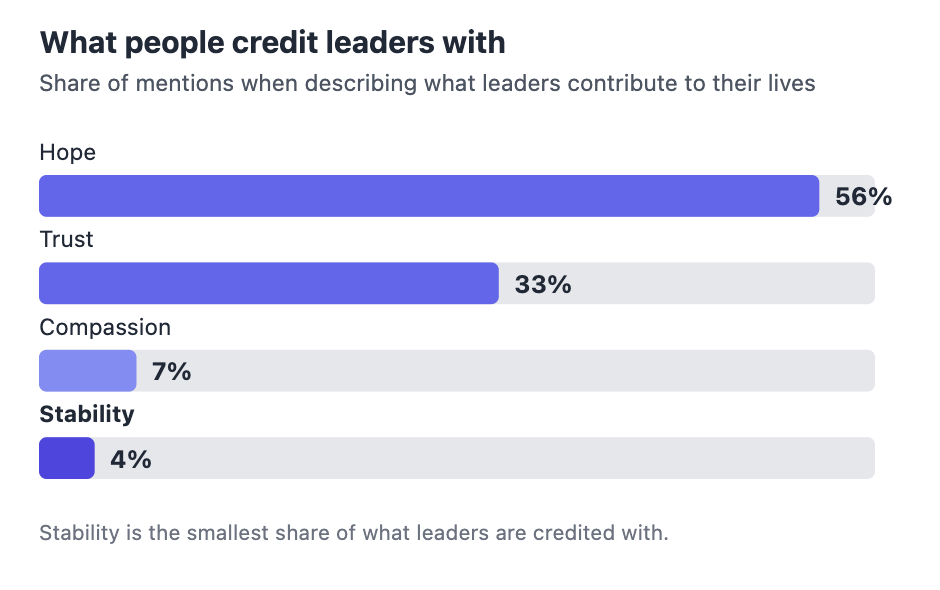
Stability is the one thing a CEO in a hard quarter genuinely can't offer. It's also the smallest share of what people credit leaders with. Hope and trust are still on the table, and both survive an honest "we don't know yet" far better than a confident forecast that later misses.
How do you show competence when you can't promise outcomes?
Replace predictions with conditional commitments. A conditional commitment is a promise about your response instead of the result: what you'll do if each likely thing happens, and when the team will hear about it. It can be kept whatever happens, so it carries the ability signal without putting the integrity signal at risk.
This is the editorial team's framework. Before writing it, we read the pages that currently rank for this question. Each one recommends both transparency and keeping your word, and we found none that deals with what happens when the two collide. "Be transparent" and "keep your word" stop pulling against each other once the word you give is about your own response. It also hands back some of the control that, in Bordia's research, uncertainty takes away.
Show the criteria before the decision. A team that has seen the thresholds reads the eventual call as the plan working. A team that hasn't reads the same call as a surprise, and surprises are where trust gets spent fastest.
One of the few field experiments on this kind of candor is old and still striking. In 1991, David Schweiger and Angelo DeNisi ran a field experiment in two plants of a company that had just announced a merger. One plant received a realistic preview of what the merger would mean; the other received limited information. The preview reduced the merger's dysfunctional effects on employees, and the effects lasted for the length of the study. The preview didn't improve the news; it limited the damage.
For the bad news itself, the structure Noah Shanok recommends in his post on transparency with investors, problem, plan, conviction, carries straight over to a team.
Sometimes the conditional commitment ends in cuts. The commitment was still worth making, and the mechanics of that moment are covered in coaching founders through layoffs.
Why small kept promises matter most when the news is bad
The team tracks the match between what the CEO says and what the CEO does, and that match survives uncertainty as long as the promises are about things the CEO controls. Behavioral integrity is the researchers' name for it. A 2015 meta-analysis by Simons, Leroy, Collewaert and Masschelein found it had stronger effects on trust, performance and citizenship behavior than perceived moral integrity.
The commercial version of the finding is older and blunter. In a survey of more than 6,500 employees at 76 Holiday Inn hotels, Tony Simons and Judi McLean Parks found that a one-eighth-point rise in a hotel's word-deed score, on a five-point scale, could be expected to lift profitability by 2.5% of revenues. For an average-sized hotel, that was more than $250,000 a year. No other manager behavior they measured had as large an effect on profits. It's correlational and comes from one hotel chain, so read it as direction rather than precision.

Under uncertainty, make fewer and smaller promises, and keep every one. The promise that matters most is usually about timing. "You'll hear by Friday" is a commitment the team will check, and missing it costs more than whatever the news turns out to be.
The hardest test of consistency is the first all-hands after something goes wrong, when the team already has part of the story. The words that meeting has to match were spoken weeks before it, and the most closely watched gap between words and deeds is usually a problem everyone can already see.
What is the team watching when nothing has been announced?
The team is watching how the CEO handles the problems it already knows about. A team can't judge a CEO's predictions, because it can't see the future either. It can judge whether a performance problem, a dead project or a missed target that everyone has noticed is being dealt with, and how long that takes.
Shanok, who founded Stitcher in 2006 and ran it for eight years before coaching venture-backed CEOs at Startup CEO Coach, has written about the plainest case, a hire who isn't working, in his post on knowing when to let someone go: "The people around this person already know something is wrong. They're watching to see what you do about it. How you handle this moment tells your team more about your leadership than almost anything else you do."
He goes further in the same post: "The team is not blind. They see the performance gap. They see the extra management overhead. And they watch the CEO rationalize it month after month. That erodes trust in leadership more than the firing ever would."
A watched decision, in the editorial team's term, is one where everyone has the information, nobody has the announcement, and the delay itself is read as a statement about what the CEO will tolerate. It's how a CEO can be scrupulously honest in every all-hands and still lose trust. What the team grades is the distance between what everyone knows and what's being done about it.
When the watched decision concerns one person, the conversation that settles it needs its own preparation, covered in the guide to difficult conversations. The trust question arrives earlier, at the point where the CEO knows and hasn't acted.
How does psychological safety show whether the team trusts you?
Psychological safety is a team's shared belief that it's safe to take interpersonal risks. Amy Edmondson defined it that way in a 1999 study of 51 work teams at one manufacturer. In a startup the riskiest version is bringing the CEO bad news, and the climate around that risk is the most visible evidence that a team trusts its leader. When it's missing, the CEO is usually the last to know.
Google's study of 180 of its own teams ranked psychological safety first of the five dynamics that set its effective teams apart. It's internal research rather than peer-reviewed work, but it matches the academic picture.
That picture is broad. A 2017 meta-analysis covered 136 independent samples, more than 22,000 people and nearly 5,000 groups. It found psychological safety predicts task performance and the kind of helping behavior nobody writes into a job description.
The clearest test in a startup is what happens to the person who brings the CEO bad news first. Do they get thanked, interrogated or quietly marked down? The team notices, and it adjusts how early the next piece of bad news arrives. That suggests a practical measure: how many weeks pass between a problem appearing and the CEO hearing about it. If that number is growing, trust is leaking. The watched decision and the messenger test are both benevolence signals, the third part of the model: they show whose interests the CEO protects when protecting them costs something.
Goodwill isn't enough to keep disagreement productive under pressure. The rules for it, agreed before anyone is angry, are set out in the conflict-norms section of the team-building guide.
What changes as the company grows past the CEO's direct reach?
Trust stops running mainly through the CEO. Kurt Dirks and Donald Ferrin's 2002 meta-analysis of research on trust in leadership found that direct leaders, people's immediate supervisors, are a particularly important referent of trust. At seed stage the CEO is everyone's direct leader. By Series B, most people's direct leader is a manager the CEO hired.
So the CEO's trust work changes shape, as part of the wider shift from seeing everything yourself to keeping visibility as the team grows. It moves from being consistent in person to making sure managers can make conditional commitments too. That means giving them the thresholds, the timing and the authority to say what happens next. A manager whose only answer is "I don't know, ask the CEO" can't preserve anyone's trust.
Frequently asked questions
Should a startup CEO share runway numbers with the whole team?
Usually yes, as a range with triggers attached rather than a bare date. A runway figure on its own invites people to do their own arithmetic and reach the worst conclusion. Paired with what happens at each threshold, it becomes a commitment the team can watch you keep.
What should a CEO say when they don't know the answer yet?
Say so, then give the date you'll know more and what would change the plan. "I don't know yet, I'll know by the 15th, and if this happens we'll do that" is a complete answer. The date is the promise, so pick one you can keep.
Is it better to over-communicate or to wait until you have answers?
Shorter and more often beats waiting. When information is missing, people fill the gap, and Bordia's research found the rumors that fill it skew negative. A brief update saying nothing has changed still closes the gap the rumors would otherwise occupy.
Can transparency damage trust?
Yes, when it hands the team anxiety with no response attached. Sharing every worry in real time asks people to carry the CEO's uncertainty with nothing they can do about it. Disclosure builds trust when it arrives with a plan, even a conditional one.
How can a CEO tell whether the team trusts them?
Three signals are cheap to watch: whether people disagree with you in meetings, whether questions at all-hands are real ones, and how early problems reach you. According to Gallup, only one US employee in five strongly trusts their organization's leadership. With trust that scarce, a quiet room is worth checking before you read it as agreement.
When is a trust problem a coaching problem?
When the same trust signal keeps failing after the CEO has seen it. A timing promise missed twice, bad news that keeps arriving late, or a watched decision that has been visible for a quarter are patterns, and patterns under pressure are hard to see from inside. That's the point where an outside view earns its place.
The team is already watching
A startup team doesn't wait for the all-hands to decide whether it trusts the CEO. It decides from evidence it already has: which promises were kept, how the last piece of bad news was received, and what happened to the problem everyone could see.
Most of that evidence was gathered before the hard quarter began, which is why the research treats trust in a crisis as something preserved from foundations already laid. What a CEO controls now is how much of the reserve gets spent, and conditional commitments spend the least.
This week, write down the three things your team is most uncertain about, and make one conditional commitment on each, with a date. If holding to them keeps slipping under pressure, a conversation about coaching is one place to start.
Sources
- An Integrative Model of Organizational Trust, Academy of Management Review
- Trust, Trustworthiness, and Trust Propensity: A Meta-Analytic Test of Their Unique Relationships With Risk Taking and Job Performance, Journal of Applied Psychology
- Leadership and Management Indicator, Gallup
- Worklife Trends 2026: Midyear Check-in, Glassdoor
- Uncertainty During Organizational Change: Is It All About Control?, European Journal of Work and Organizational Psychology
- Management Are Aliens! Rumors and Stress During Organizational Change, Group & Organization Management
- Preserving Organizational Trust During Disruption, Organization Studies
- Preserving Employee Trust During Crisis, Behavioral Science & Policy
- Global Leadership Report: What Followers Want, Gallup
- Communication With Employees Following a Merger: A Longitudinal Field Experiment, Academy of Management Journal
- How Leader Alignment of Words and Deeds Affects Followers: A Meta-analysis of Behavioral Integrity Research, Journal of Business Ethics
- Study Shows Company Earnings Rise When Employees Believe Managers Mean What They Say, Cornell Chronicle
- Psychological Safety and Learning Behavior in Work Teams, Administrative Science Quarterly
- Understand Team Effectiveness, Google
- Psychological Safety: A Meta-Analytic Review and Extension, Personnel Psychology
- Trust in Leadership: Meta-Analytic Findings and Implications for Research and Practice, Journal of Applied Psychology
- How do I balance transparency vs optimism with investors?, Startup CEO Coach
- How do I know when it's time to fire someone?, Startup CEO Coach

