.png)
The job that took a UK founder from £0 to £5M in revenue is not the job that takes them to £50M. It's three different jobs, arriving in sequence, and most founders only notice the handoff after they've already fallen behind it.
That sequence is what this piece maps. Noah Shanok is an advisor and investor in more than 30 startups and coaches venture-backed founders through Startup CEO Coach, with client companies representing over $3.5B in aggregate enterprise value across the US and UK; the definitive guide to CEO coaching for venture-backed founders covers what that coaching involves more broadly. The pattern below draws on public UK market data rather than a single client story, because the underlying shift shows up across the whole £5M-to-£50M band, not in one company's numbers.
Why does the £5M-to-£50M stretch break founder-CEOs who were fine at £5M?
Because the operating model that got a company to £5M runs on the founder's personal bandwidth, and bandwidth is the one resource that doesn't scale with revenue. At £5M, a founder can plausibly still touch every hire, every deal, and every product call. At £50M, the same habit is the constraint, not the strength.
Three breaks carry most of that distance. The first is a delegation break, roughly £5M to £10M. The founder needs someone absorbing operational load before the workload absorbs the founder. The second is a leadership-team break, roughly £10M to £25M, where decisions that used to live in the founder's head need explicit owners. Without one, the new leadership team becomes its own bottleneck. The third is a system break, roughly £25M to £50M, where the founder's job shifts from operator to capital allocator and external face of the company.
This framework runs on revenue bands rather than headcount, because in the UK specifically, financing pace and hiring-market timing move faster than team size does. In 2025, UK VC funding hit $23.6bn, up 35% year over year from $17.5bn and the third-highest total on record (HSBC Innovation Banking UK & Dealroom, via UKTN, 2026). That momentum didn't stall: H1 2026 brought $17bn, up 102% year over year and the strongest first half since 2022 (HSBC Innovation Banking UK & Dealroom, via UKTN, 2026). A well-capitalized UK founder can hit £10M in revenue with a team still shaped for £3M, which is exactly when the delegation break bites hardest.
This piece stays on the revenue-banded shift specifically, not the wider environment around it. UK boards, employment law, and equity culture shape the same period differently, and are covered in CEO coaching for UK founders, while scaling from 20 to 100 employees maps the same ground by headcount instead of revenue. A funding-stage view of the same journey lives in Series A to Series C: the coaching needs that change at each stage. For what breaks more broadly as a startup scales, our breakage guide covers team, systems, and founder role together.
£5M-£10M: the delegation break
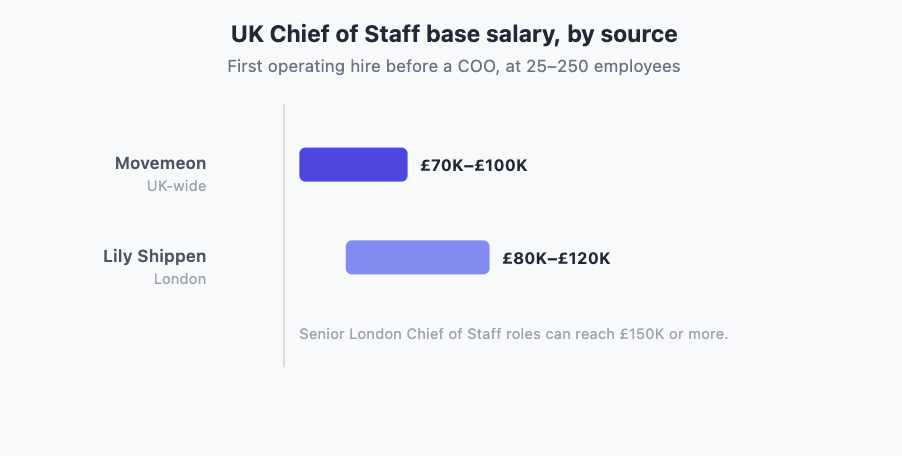
The delegation break is the point, roughly £5M to £10M in UK revenue, at which a founder can no longer personally absorb every coordination task without it costing the business. At £5M to £10M in UK revenue, the founder is still the bottleneck on nearly every material decision, and the fix usually isn't a COO. It's a Chief of Staff. UK founder-CEOs typically bring in a Chief of Staff once the company reaches roughly 25 to 250 employees, at a base salary of £70,000 to £100,000 (Movemeon, 2026), with London roles commonly landing at £80,000 to £120,000 (Lily Shippen, 2025) and senior positions reaching £150,000-plus (Lily Shippen, 2026).
The reason Chief of Staff comes first isn't cost, though it's cheaper than a COO. It's scope. A Chief of Staff absorbs the founder's own overflow: chasing follow-through on decisions already made, running the operating rhythm, prepping board materials, killing the small fires that would otherwise land on the founder's desk. A COO owns a function outright. Most £5M-£10M companies don't yet have a function big enough or stable enough to hand over that way; what they have is a founder drowning in coordination work a Chief of Staff is built to take.

What a Chief of Staff hire does and doesn't fix
A Chief of Staff fixes coordination debt, not judgment debt. They can run the board-prep process, chase the follow-through on decisions the founder already made, and protect the founder's calendar from low-value fires. What they can't do is make the calls that only the founder has the context or authority to make: strategic direction, key hires at the leadership level, and anything that changes the company's risk profile. Founders who try to delegate judgment along with coordination usually end up re-litigating the same decisions a few weeks later, which is worse than not delegating at all.
£10M-£25M: the leadership-team break
At £10M to £25M, the symptom changes. Meetings multiply. Decisions that used to close in a hallway conversation get re-litigated in three separate rooms, and hires who are senior on paper aren't yet operating that way. The underlying cause is that decisions which used to live in the founder's head now need an explicit owner. Without one, the new leadership team becomes a second bottleneck instead of the fix for the first.
Between £10M and £25M in revenue, decisions that used to live in a UK founder's head need an explicit owner. Without documented decision rights, a newly hired leadership team becomes a second bottleneck instead of fixing the first one, and meetings multiply as the same calls get re-litigated repeatedly.
The founders who get through this cleanest write the decision rights down before the ambiguity forces a fight. That doesn't mean a governance manual. It means naming, in plain language, who decides what at the current size of the company, and revisiting it as the company grows past it.

Board sophistication tends to rise alongside this band too: investors who backed a £5M company expect a different level of reporting once it's three or four times that size, and founders who haven't yet built the cadence and pre-wiring habits that a more demanding board rewards often find that out in the room. Our guide on how startup CEOs manage board relationships covers those habits directly.
£25M-£50M: the system break
The system break is the point, roughly £25M to £50M in UK revenue, at which the founder's job stops being about any single decision and becomes about the systems and people who make decisions without them. Past £25M, the CEO's job stops being operator and becomes capital allocator, culture steward, and external face of the company. That's not a finance metaphor. It means the founder's scarcest resource is no longer their own hours, it's their attention across a leadership team that now has to run without them in the room for most decisions. It's a variant of the same identity shift covered in when the founder becomes CEO, arriving a second time at a different scale.
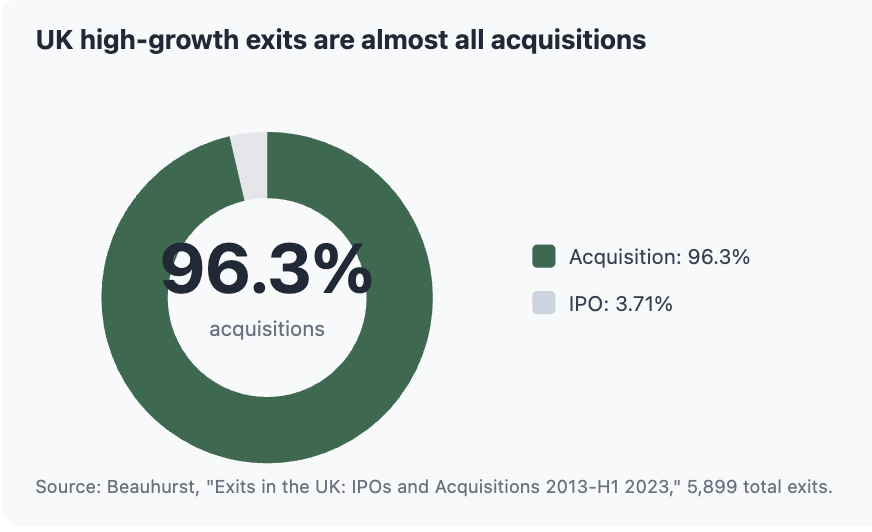
In the UK, two pieces of local texture sharpen that shift. First, Enterprise Management Incentive option schemes become a genuine retention lever at this stage, not a hiring nicety, because the people who joined at £10M are the ones a founder most needs to keep past £50M. Second, companies in this band start looking like acquisition targets whether the founder is planning for it or not. Of nearly 5,900 UK high-growth companies tracked from 2013 through the first half of 2023, 96.3% that exited did so via acquisition and 3.71% via IPO (Beauhurst, "Exits in the UK: IPOs and Acquisitions 2013-H1 2023", 2023). A 2025 follow-up study covering exits since 2015 found the same pattern holding two years later, with acquisitions still dominant across nearly 8,000 tracked exits (Beauhurst x Charles Stanley, "Exits in the UK: Selling Up, Not Out", 2025).
That exit backdrop matters for how a founder should read UK company-size thresholds, too. The turnover and balance-sheet limits that define a "small company" under the Companies Act rose for financial years beginning on or after 6 April 2025, from £10.2M to £15M in turnover and £5.1M to £7.5M in balance-sheet total, with the employee threshold unchanged at 50 (ICAEW; Teamed, 2025). A company sitting at £20M in revenue in 2026 is, statutorily, in a different reporting category than it would have been a year earlier. It's a paperwork change, but it's also a useful marker that the business has genuinely left "small" behind, which is often true well before the founder's own instincts catch up.

What does this look like in practice?
The scenario below is illustrative, built from patterns visible across UK scale-up reporting, not a specific client and not drawn from Noah Shanok's coaching practice.
Take a hypothetical UK B2B software company at £6M in revenue with 40 people, growing fast enough that the founder is now the approver on nearly every hire, every deal above a few thousand pounds, and every product decision. Six months and a Chief of Staff hire later, the founder has their calendar back, but the company has also grown into £11M in revenue and a leadership team that didn't exist a year earlier. Meetings start running long because nobody's sure who actually owns the pricing call anymore.
That's the leadership-team break arriving on schedule. The founder who handles it well writes down who decides what, revisits it every couple of quarters, and treats the friction as a sign the company outgrew its structure, not a sign the hires were wrong. By £30M, the same hypothetical founder is spending more time with the board and prospective acquirers than with any single function, because the company has become the kind of asset UK acquirers actually look for.
By £45M, the same company has an EMI option pool that's been running for three years, and the people who joined during the leadership-team break are now the ones fielding informal calls from corp-dev teams at larger competitors. The founder's job at this point looks almost nothing like it did at £6M: less product, less hiring, far more time on the relationships that determine what happens to the company, and to the people in it, over the next 18 months. None of that is a straight line. Each break arrives a little earlier than the founder expects, and the founder who prepares for it in advance loses far less time than the one who waits for the friction to force the issue.
How do founders get stuck between bands?
The most common failure is skipping the delegation break and trying to leadership-team a workload problem instead. A founder who's drowning in coordination work hires a VP of Operations or brings on two more direct reports rather than a Chief of Staff, and ends up with more people to manage and the same amount of personal bandwidth. The fix for an overloaded founder is almost never more direct reports. It's someone absorbing the coordination itself.
The most common failure is skipping the Chief of Staff hire and adding direct reports instead, which increases headcount without reducing the founder's coordination load. A useful tell: if every meeting on a UK founder-CEO's calendar still requires them personally, no real leadership team has formed yet.
There's a UK-specific pressure that makes this worse. With UK VC funding accelerating again through 2026, founders feel pressure to look scaled ahead of a raise, before the operating model underneath actually supports it. A leadership team assembled to impress a board looks different from one built because the company genuinely needed it, and investors who've sat through enough of these rounds can usually tell the difference.
The opposite failure shows up too, just later. Some founders reach £25M still making every call personally, then try to jump straight into system-break behavior, stepping back from the business before a leadership team exists that can actually run it. Attention that isn't backed by a team with clear decision rights doesn't read as strategic focus. It reads as absence, and the company usually stalls exactly when it looked ready to compound.
The tell is usually the founder's calendar. If every meeting on it still has the founder in the room, no leadership team has actually formed yet, no matter what the org chart says.
How should founders prepare for each break before it happens?
The founders who handle these transitions best start building 70% to 80% of the way to the next revenue band, not after they've already hit it. A short checklist for each:
- Approaching £5M-£10M: start the Chief of Staff search before the founder's calendar is fully underwater, since a good hire takes months to close and even longer to fully ramp.
- Approaching £10M-£25M: write down decision rights before the leadership team is fully assembled, so new hires join a structure that already exists rather than one they have to negotiate.
- Approaching £25M-£50M: put EMI scheme mechanics and retention planning in place before the people who joined at £10M start fielding calls from acquirers, and treat board readiness as ongoing work, not a pre-raise scramble.
None of this removes the friction each break brings. It just moves the friction earlier, when it's cheaper to absorb, instead of later, when a founder is managing it under pressure and in front of a board.
Frequently Asked Questions
What's the difference between a Chief of Staff and a COO at a scaling UK startup?
A Chief of Staff absorbs coordination work across the founder's whole remit: board prep, follow-through, calendar protection. A COO owns a function outright, usually operations. UK founders typically hire a Chief of Staff first, at 25 to 250 employees and £70,000 to £120,000 in base salary, and only bring on a COO once a function is large enough to hand over fully (Movemeon, 2026; Lily Shippen, 2026).
Does a UK startup need a formal leadership team before £10M in revenue?
Not usually. Most UK founders operate as the sole real decision-maker until somewhere between £10M and £25M in revenue, when the volume of decisions outpaces what one person can hold in their head. Forming a leadership team earlier than that, without a genuine need for it, tends to create coordination overhead the company doesn't yet require.
When should a UK founder-CEO start preparing for acquisition interest?
Around the £25M-£50M band, since that's when most UK high-growth companies start attracting real acquirer attention, and acquisitions account for 96.3% of tracked UK high-growth exits since 2013 (Beauhurst, 2023). Preparation means clean decision rights, a leadership team that can operate without the founder in every room, and EMI retention planning already in place, not a scramble once a term sheet arrives.
How is scaling a UK startup different from scaling one in the US at this revenue stage?
The underlying operating shifts are similar; what changes is the environment around them, including board composition, employment law, and equity culture. Our guide on CEO coaching for UK founders covers those differences directly; this piece focuses on the revenue-banded operating shift itself.
What typically goes wrong when a UK startup scales too fast for its leadership structure?
Founders add headcount and titles faster than they clarify who actually decides what, which produces a leadership team that argues instead of executes. Our diagnostic on why rapid growth creates leadership problems covers the fuller pattern; in the UK-specific case here, the trigger is usually a founder trying to skip the delegation break entirely.
Is there a headcount-based version of this same framework?
Yes. This piece bands the transition by revenue because UK financing pace often outruns headcount growth, but the same underlying shift also maps to team size. See what startup CEO coaching looks like scaling from 20 to 100 employees for that version.
The job changes three times before £50M, not once
A founder who's still operating like it's £5M at £30M in revenue isn't failing to scale the same job harder. They're doing the wrong job for where the company actually is. The delegation break, the leadership-team break, and the system break each demand something the previous stage didn't, and UK founders face them against a financing and hiring market that moves fast enough to make the gap between where the company is and where the founder's habits are worse than it looks on paper.
None of the three breaks are optional, and none of them announce themselves clearly in advance. The founders who come through the £5M-to-£50M stretch intact are usually the ones who started building for the next break before the current one had fully stopped hurting.
Sources
- HSBC Innovation Banking UK & Dealroom (via UKTN), "UK VC investment sees first annual growth in four years," retrieved 2026-08-10, https://www.uktech.news/news/investment-news/uk-vc-investment-sees-first-annual-growth-in-four-years-20260115
- HSBC Innovation Banking UK & Dealroom (via UKTN), "Record AI investment drives strongest UK startup funding since 2022," retrieved 2026-08-10, https://www.uktech.news/funding/record-ai-investment-drives-strongest-uk-startup-funding-since-2022-20260706
- Movemeon, "What is, and when and why would you hire, a Chief of Staff," retrieved 2026-08-10, https://www.movemeon.com/insight/what-is-and-when-and-why-would-you-hire-a-chief-of-staff
- Lily Shippen, "Chief of Staff job description template," retrieved 2026-08-10, https://lilyshippen.co.uk/job-description-templates/chief-of-staff/
- Lily Shippen, "Chief of Staff careers: your questions answered," retrieved 2026-08-10, https://lilyshippen.co.uk/chief-of-staff-careers-your-questions-answered/
- ICAEW, "Changes in company size thresholds and directors' report requirements," retrieved 2026-08-10, https://www.icaew.com/technical/corporate-reporting/uk-regulation-for-company-accounts/changes-in-company-size-thresholds-and-directors-report-requirements
- Teamed, "UK Company Size Thresholds 2026: April 2025 Changes," retrieved 2026-08-10, https://www.teamed.global/insights/uk-company-size-thresholds-2026-april-2025-changes
- Beauhurst, "Exits in the UK: IPOs and Acquisitions 2013-H1 2023," retrieved 2026-08-10, https://www.beauhurst.com/research/exits-in-the-uk-ipos-and-acquisitions-2013-h1-2023/
- Beauhurst x Charles Stanley, "Exits in the UK: Selling Up, Not Out," retrieved 2026-08-10, https://www.beauhurst.com/research/exits-in-the-uk-2025/