.png)
There is a standard way of deciding when the founder should stop being the person who closes. You wait until revenue reaches some level, and then you hire. The level varies depending on who you ask, and the disagreements are wide enough that founders reasonably conclude the whole thing is guesswork.
It is guesswork, though for a more specific reason than most of the advice admits. Revenue records what the founder produced. It says nothing about whether any of it can be produced by somebody else, which is the only question the handoff actually turns on.
The moment that answers it is usually visible in a single deal.
Why the revenue threshold is the wrong trigger for ending founder-led sales
Because revenue measures output and the handoff is a question about transferability. The published thresholds are opinions rather than findings, they disagree with each other by a wide margin, and none of them is derived from data on when handoffs actually succeed.
It is worth being precise about where those numbers come from, because they get repeated as though they were research. The most widely quoted version belongs to Jason Lemkin, who tells founders to close their first 10 to 20 customers personally and puts the handoff at "~$1M ARR or so or when you can no longer handle the volume of leads yourself" (SaaStr). That is a practitioner's judgement offered as one, and it should be read that way. No dataset underwrites it, and the competing figures in circulation carry no dataset either.
The one widely cited firm that states a standard rather than a number is Bessemer Venture Partners, and the standard is a condition. At $1M in ARR it is "typical—and expected—for a CEO to be in sales pitch meetings," and a company should "hire one or two salespeople to start and only continue to hire once those initial reps are hitting market quotas autonomously and lead velocity rate exceeds quota capacity" (Bessemer Venture Partners, Scaling from $1 to $10 million ARR, April 2022). That is a test of the system, not a reading off the top line.
The deeper problem with a revenue trigger is what it rewards. A founder who has personally closed $2M has demonstrated that the founder can sell. That is the one fact everybody already knew. It does not establish that the product has pull rather than push, which is a separate question and the one that determines whether a new seller has anything to work with. Founders who confuse traction with product-market fit tend to industrialise the wrong motion at exactly this moment.
One boundary, stated plainly. This piece is about the founder's side of the transition and not about which executive to hire or when; the case for timing a first executive hire sits separately, and the two decisions are easier to make when they are not collapsed into one.
The real trigger is the deal only the founder could close
The deal only the founder could have closed. Founder-led sales ends when the founder has produced something a non-founder can sell with — a reference, not a playbook. A playbook records what the founder did. A reference transfers why the buyer said yes, and only the second one survives contact with a new seller.
What the Ford deal changed at Stitcher
Noah Shanok founded Stitcher in 2006 and ran it for eight years before he began coaching venture-backed CEOs through Startup CEO Coach. In 2012 the company announced its integration with Ford Sync; he ran that partnership himself and gave a Bloomberg Television interview about it that March. Afterwards he recruited James Wu, an industry veteran, from SiriusXM to take over automotive. GM, Subaru and Jaguar followed.
His account of what changed is the part worth sitting with. Once Ford was signed, the other manufacturers came to them, and the deals got much easier.
Nothing about the company's revenue crossed a line that year. What changed was the nature of the conversation. Before Ford, the pitch had to establish that a podcast app belonged in a car at all, and that argument could only be made by the person willing to stake the company on the answer. After Ford, the argument had already been won by somebody else's purchase order. The remaining work was qualification, sequencing and negotiation — real work, demanding work, and work that an industry veteran does better than a founder.
That is the shape of the handoff. The founder does the first impossible deal. The deal creates the proof. The proof makes the role hireable.
Noah's career contains the same transition seen from the other side. He was the first sales hire at StubHub, where he closed the first NBA deal done with a secondary ticket provider before becoming VP of Sales. That deal opened the league up for the company, which is the same mechanism running one level down: a seller does the thing nobody has done before, and the ground afterwards is different for everyone who follows.
One honest caveat belongs here, because the alternative is to fake precision. The reference effect is something operators describe consistently and researchers have barely measured. The academic literature on customer references is either qualitative or sits behind paywalls with effect sizes nobody has verified in public. There is no credible study showing that a marquee logo lifts win rates by some percentage, and any article that gives you one is inventing it. The 2012 example above is offered as one operator's experience, which is what it is.

Transitioning out of founder-led sales: what is actually being handed off?
Not "sales". Three separable things travel under that word: the authority to commit the company, the judgement about which deals to walk away from, and relationships that belong to a person instead of an organisation. Only the first is a matter of policy. The third is the one that causes trouble.
Marketing research has a name for the mechanism. Palmatier, Scheer and Steenkamp distinguish a customer's loyalty to the selling firm from loyalty vested in the individual salesperson. Studying 362 buyer–salesperson dyads with triadic data drawn from the buyer, the salesperson and the sales manager, they found that only salesperson-owned loyalty directly affects the tangible outcomes of sales growth and selling effectiveness — and that the same loyalty raises the seller's risk of losing the business if that salesperson defects to a competitor (Journal of Marketing Research, May 2007).
Read that against a founder and it stops being an abstraction. The relationships that convert best are precisely the ones vested in the person who cannot be replaced, promoted out, or hired again. The founder is the extreme case of a documented risk, and the risk grows with every quarter the arrangement continues.
There is also more work in the job than founders expect, and less of it is selling. In research released in December 2022, Salesforce found that sales representatives spend 28% of their week actually selling, with the remainder going to deal management, data entry and administration (Salesforce, December 2022, n=7,775).
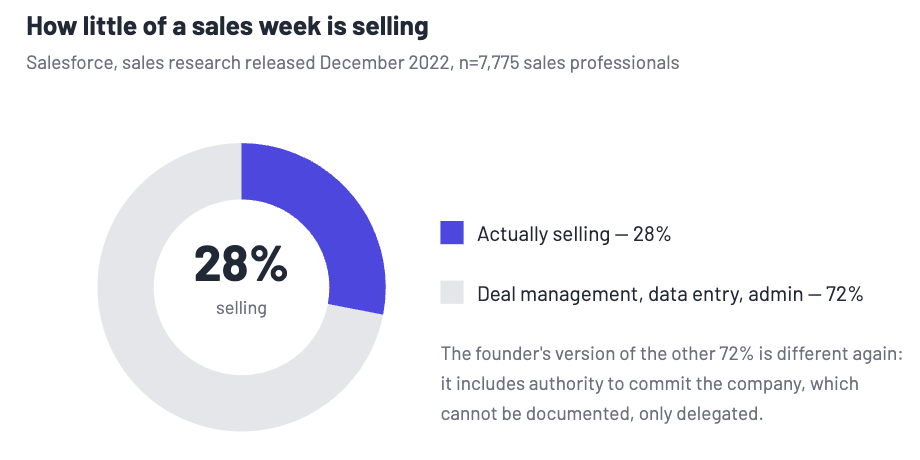
The founder's split is different again, and worse. Alongside the administration sits commit authority that nobody else in the building has. That is the part which cannot be written down and handed over. It has to be granted, and granting it is a decision about how much control a founder is willing to release rather than a process to be documented.
Why does the handoff start about a year before you need it?
Because of arithmetic that most founders run too late. Average account executive ramp reached 6.2 months in 2026, described by the publisher as the highest in the study's research history, and 48% of representatives hit annual quota, down from 51% in 2024 (The Bridge Group, AE Models, Motions & Metrics: 2026 Research Report, June 2026, n=158).
Stack a sales cycle on top of that ramp and the picture sharpens. Surveying go-to-market executives at more than 150 business-to-business software companies in January 2026, ICONIQ reported average cycle length by deal size: six weeks under $10K, twelve weeks from $10K to $50K, seventeen weeks from $50K to $100K, and twenty-four weeks above $100K (ICONIQ, The State of Go-to-Market in 2026, March 2026).
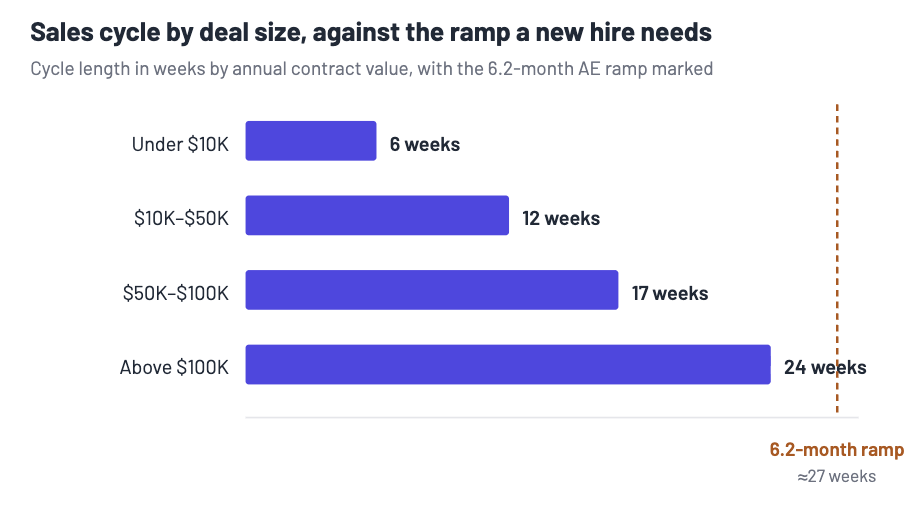
Ramp alone runs longer than the longest cycle in the data. A new hire's first fully owned enterprise deal lands roughly a year after their start date.
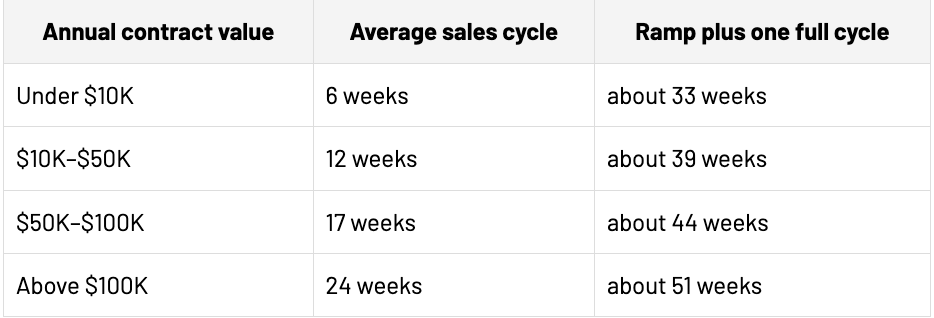
Put the two together and a new hire's first genuinely self-sourced enterprise deal closes around a year after their start date. Their first commission cheque arrives long before that, and their first useful contribution earlier still. This is the first deal that proves the motion works with the founder out of it.
The consequence for the founder is uncomfortable and specific. You cannot begin the handoff at the point where you have run out of capacity, because somebody has to carry the gap, and for most of that year the somebody is still you. Founders who wait until selling has visibly become the ceiling are choosing the worst available starting conditions, and a company run from that position tends to stay there; it is one of the mechanics behind startup leadership becoming reactive.
Roughly a coin flip on quota is the honest base rate. Plan the first attempt as though there will be a second one.
The founder who hands off by pretending to

Almost every piece of advice on this topic ends with the same sentence: the founder never fully leaves sales. It is correct, and it is almost always delivered without its cost.
Here is the cost. The founder hands off in name, then keeps every deal above some threshold, because those are the deals that matter and because the founder is genuinely better at them. Each individual intervention is defensible. The pattern is only visible in aggregate, which is why it can run for a year without anybody naming it.
Three things happen. The new hire never accumulates the wins that build internal credibility, so the rest of the company keeps treating them as the person who handles the small accounts. Buyers learn that the real decision-maker is one escalation away, and they start there, which is one of the scaling mistakes that are hardest to see from the inside. Pipeline quietly re-concentrates in the founder, which is where it began.
Most articles on this subject offer signals. What a founder can actually use is a test, so here is one. Over the last quarter, did any deal of consequence close where the buyer never spoke to you? If the answer is no, the handoff has not happened, whatever the organisation chart says. If the answer is yes, count how many, and whether the number is going up.
There is a measurable cost to holding those deals back. Only 48% of account executives hit annual quota in 2026, on an average ramp of 6.2 months (The Bridge Group, June 2026). A rep denied the deals that build internal credibility is far likelier to land in the other 52%, and the founder then reads that outcome as evidence the hire was wrong.
The workable version of "never fully leave" is narrower than it sounds. The founder is the escalation, not the default. Which deals qualify gets decided in advance, in writing, when no specific deal is on the table — because deciding it in the moment reliably produces the answer that this one is special. That discipline is one instance of a broader pattern in what breaks as a company scales: the founder's judgement stays excellent while the founder's availability becomes the constraint.
What does handing off sales set in motion for the founder?
More than a hire. It is the opening move in a documented professionalisation sequence, and venture backing measurably accelerates that sequence.
Hellmann and Puri studied 170 Silicon Valley start-ups with primary data collected between 1994 and 1997. Using proportional hazard models, they found venture-backed firms roughly 1.79 times more likely at any given point to appoint a VP of Sales and Marketing. The same method applied to the chief executive's own job returned a hazard ratio of 2.32 for bringing in an outside CEO, significant at the one percent level — venture-backed companies were more than twice as likely to make that change (Hellmann & Puri, Venture Capital and the Professionalization of Start-Up Firms, The Journal of Finance, February 2002).
That data is from the mid-1990s and predates software-as-a-service entirely, so treat it as a structural finding about venture-backed dynamics and not as a current benchmark. The structure has held up better than the vintage suggests.
There is a humane counterpoint in the same paper, and it rarely gets quoted. Of the 91 founder-CEO transitions the authors observed, a little over 40% were what they classed as accommodating: the founder stayed with the company in a different role.
The best evidence on what chief executives do with their time points the same direction, with a caveat that has to be stated in the same breath. Bandiera, Hansen, Prat and Sadun tracked 1,114 chief executives of manufacturing firms across six countries, logging 42,233 activities through daily interviews. Their behavioural index separates "leaders", who run multifunction and high-level meetings, from "managers", who run individual meetings with core functions. One standard deviation along that index is associated with an increase of 7% in sales, controlling for labour, capital and other firm-level variables (Journal of Political Economy, 2020).
The authors are careful about what this means, and the care matters more than the headline. They find no best practice in CEO behaviour and attribute the productivity gap to CEOs being mismatched to firms rather than to one style being better everywhere. The sample is established manufacturers, not seed-stage software companies, and the relationship is a correlation. Read it as the closest available analogy and nothing stronger.
This is why the decision gets delayed past the point where the arithmetic says go. The founder is not being irrational about sales. They are being rational about what the handoff is the beginning of, and the discomfort is a fairly accurate reading of the situation. Founders who have already worked through the shift from founder to chief executive tend to find this specific handoff easier, because the harder identity question has already been asked. For those who have not, it arrives disguised as a hiring decision, which is one reason self-worth fused to company outcomes makes the call so much heavier than it looks.
What replaces selling in the founder's week?
Nothing, unless it is chosen. Every treatment of this subject ends at the hire, and the founder's calendar does not refill itself with the right things by default. It refills itself with whatever is loudest.
The freed time is also smaller than it looks. Sales representatives spend just 28% of their week actually selling, the rest going to deal management, data entry and administration (Salesforce, December 2022, n=7,775). A founder who hands off the function still carries the escalations and the commit decisions, so what comes back is judgement time rather than a cleared calendar.
The legitimate claimants are short in number. The next binding constraint, whatever it turns out to be. Capital. Building the rest of the leadership team, which is now the work that determines the ceiling. Most founders find the first quarter after the handoff strangely uncomfortable, because selling supplied a daily scoreboard and none of these do.
The distinction that matters most is easy to state and hard to hold. The founder stops closing. The listening has to continue.
Losing customer signal is a genuine failure mode of the handoff, and it is a different failure from losing revenue — slower, quieter, and usually discovered a product cycle late. Revenue drops announce themselves. A founder's slow drift out of contact with what buyers are actually saying announces itself about nine months afterwards, in a roadmap that no longer fits the market.
Deliberate customer contact after the handoff has a different shape from the version that came before. Fewer conversations. Chosen deliberately, out of whatever is in the pipeline. Detached from a close, which changes what the customer tells you. The same principle applies to the rest of the freed capacity: it is worth designing the systems that decide what reaches the founder before the vacuum fills itself.
And there is the other job, the one the Ford story points at. The founder's remaining sales work is to go and find the next deal that nobody else in the company could close.
Frequently asked questions
What does a founder actually hand over on day one, before the new hire has closed anything?
Introductions and authority, in that order. Warm relationships transfer only when the founder makes the handover explicit to the customer rather than letting it happen by attrition. Authority has to be stated to the team as well, including the deal size the new hire can commit to without asking, because ambiguity there defaults back to the founder within a fortnight.
Does founder-led sales end at a different point for enterprise than for self-serve?
The lead time changes, not the principle. ICONIQ put average cycle length at six weeks below $10K in annual contract value and twenty-four weeks above $100K (March 2026). An enterprise founder therefore has to begin the handoff roughly four months earlier than a founder selling small contracts, simply to reach the same point.
What if the founder genuinely is the best salesperson in the company?
They usually are, and it is not the relevant question. The relevant question is whether the company can sell without them. A founder who is the best closer and also the only closer has not built a sales capability; they have built a dependency that happens to be performing well.
How do you tell whether a new sales hire is failing or the process never existed?
Establish the base rate before judging the person. Only 48% of account executives hit annual quota in 2026, and average ramp ran 6.2 months (The Bridge Group, June 2026). Underperformance inside the first two quarters is close to the norm. Diagnose whether anything existed to hand over before concluding the hire was wrong.
What does an accommodating founder transition look like in practice?
Hellmann and Puri classed a little over 40% of the founder-CEO transitions they observed as accommodating, meaning the founder stayed with the company in a different role (2002). In practice that usually means product, technology or the customer-facing edge of strategy: work where the founder's judgement still compounds and the operating cadence belongs to somebody else.
What does coaching actually address during this handoff?
Mostly the judgement question underneath the hiring question: what the founder is willing to stop being good at in public. The mechanics of a sales transition are well documented and rarely the blocker. The reluctance to release commit authority, and the loss of a daily scoreboard, are what tend to stall it.
The handoff starts with proof, not a number
The question is not when the founder's selling stops working. Founder-led selling usually keeps working for a long time after it should have ended, which is exactly what makes it difficult to leave.
The question is what the founder has produced that somebody else can carry. A revenue figure cannot answer that. A signed reference customer can, because it moves the argument out of the founder's head and into a place where a new seller can pick it up.
Ford was announced in 2012. What made the automotive role hireable was not the revenue that followed it, and not a playbook written afterwards. It was that the hardest question in the category had already been answered by someone else's decision to buy. The founder's job after a handoff like that is to go and find the next question of the same size.
Sources
- The Bridge Group, "AE Models, Motions & Metrics: 2026 Research Report," published 23 June 2026, based on 158 company-level responses from business-to-business sales, operations and revenue leaders at companies running account-executive-led motions. Figures used: average ramp time 6.2 months, described by the publisher as the highest in the study's research history; and 48% of representatives achieved annual quota in 2026, against 51% in 2024. Retrieved 2026-08-26, https://blog.bridgegroupinc.com/2026-ae-compensation-quota-ai-metrics
- ICONIQ, "The State of Go-to-Market in 2026," published March 2026, survey of more than 150 business-to-business software go-to-market executives, fielded January 2026 and supplemented with quarterly operating data from selected portfolio companies. Figures used: average sales cycle by annual contract value of 6 weeks under $10K, 12 weeks for $10K–$50K, 17 weeks for $50K–$100K and 24 weeks above $100K. Quota-attainment figures from this report are deliberately not used alongside its 2025 edition, because the two vintages restate the same years differently. Retrieved 2026-08-26, https://www.iconiq.com/growth/reports/state-of-go-to-market-2026
- Robert W. Palmatier, Lisa K. Scheer & Jan-Benedict E. M. Steenkamp, "Customer Loyalty to Whom? Managing the Benefits and Risks of Salesperson-Owned Loyalty," Journal of Marketing Research 44(2), 185–199, May 2007. Cited for the distinction between firm-owned and salesperson-owned loyalty, the finding that only salesperson-owned loyalty directly affects sales growth and selling effectiveness, and the finding that it simultaneously increases the risk of losing the business if the salesperson departs. The publisher blocks automated crawlers, so the abstract was verified through Crossref on 2026-08-27, which returns it in full: "In a study of 362 buyer-salesperson dyads using triadic data (from buyer, salesperson, and sales manager)...only salesperson-owned loyalty, a newly identified construct, directly affects the more tangible seller financial outcomes of sales growth and selling effectiveness...because salesperson-owned loyalty simultaneously increases the seller's risk of losing business if the salesperson defects to a competitor, managers need to manage effectively the benefit-risk trade-off." Retrieved 2026-08-27, https://doi.org/10.1509/jmkr.44.2.185
- Thomas Hellmann & Manju Puri, "Venture Capital and the Professionalization of Start-Up Firms: Empirical Evidence," The Journal of Finance 57(1), 169–197, February 2002. Primary data on 170 Silicon Valley start-ups collected by the authors between 1994 and 1997, analysed with Cox proportional hazard models. Figures used, each verified against the full text on 2026-08-27: Table V reports a hazard ratio of 1.793 for time-to-sales-VP among venture-backed firms, significant at the five percent level; Table VI Panel B reports a hazard ratio of 2.32 for time-to-turnover, defined as the arrival of the first outside CEO, significant at one percent; and "out of a total of 91 turnovers observed over the entire sample, we find that in 38 cases (i.e., in a little over 40 percent), the founders remained involved in their companies." A widely repeated pair of figures putting founder-CEO turnover at 61.5% for venture-backed firms against 35.8% for non-venture-backed firms was checked against the full text and appears nowhere in the paper; it is not used here. The age of the sample is stated in the body of this article. Retrieved 2026-08-26, https://doi.org/10.1111/1540-6261.00419
- Oriana Bandiera, Stephen Hansen, Andrea Prat & Raffaella Sadun, "CEO Behavior and Firm Performance," Journal of Political Economy 128(4), 2020; earlier circulated as NBER working paper 23248. Data on 1,114 chief executives across Brazil, France, Germany, India, the United Kingdom and the United States, capturing 42,233 activities through daily phone interviews across a full week per executive. Cited for the behavioural separation of "manager" and "leader" types, the association between the manager type's outside client and supplier contact and lower productivity, and the association between a one-standard-deviation move towards the leader index and roughly 7% higher sales. The sample is established firms rather than startups and the relationships are associational; both limits are stated in the body. Retrieved 2026-08-26, https://sekhansen.github.io/pdf_files/jpe_2020.pdf
- Salesforce, sales productivity research release, published 8 December 2022, based on a survey of 7,775 sales professionals fielded between 24 August and 30 September 2022 across North America, Latin America, Asia-Pacific and Europe. Figure used: representatives spend 28% of their working week actually selling. A "40% of time selling" figure attributed to a 2026 Salesforce report circulates widely and could not be verified against Salesforce's own material on 2026-08-26; it is not used here. Retrieved 2026-08-26, https://www.salesforce.com/news/stories/sales-research-2023/
- Bessemer Venture Partners, "Scaling from $1 to $10 million ARR," published 14 April 2022. Quoted for its stated standard that at $1M in ARR it is "typical—and expected—for a CEO to be in sales pitch meetings," and that a company should continue hiring "only once those initial reps are hitting market quotas autonomously." This is a named firm's guidance rather than research, and is presented as such. Retrieved 2026-08-26, https://www.bvp.com/atlas/scaling-from-1-to-10-million-arr
- Noah Shanok's account of the Ford Sync partnership — that he ran it personally, that it was announced in 2012, that he recruited James Wu from SiriusXM to take over automotive afterwards, and that once Ford was signed the other manufacturers already knew the company and the deals became easier — is taken from his direct answers supplied for this publication, 2026. The March 2012 Bloomberg Television interview and the subsequent GM, Subaru and Jaguar integrations are from the same record. His role at StubHub as first sales hire and later VP of Sales, and the first NBA deal done with a secondary ticket provider, are from the same source. The quotation on founder development is verbatim from his written answers. His founding of Stitcher in 2006 and eight-year tenure are stated on his own published posts, retrieved 2026-08-26, https://www.startupceo.coach/blog/how-do-startup-ceos-avoid-burnout
- Jason Lemkin, "What are the best ways to transition from the founder-led sales stage?", SaaStr. Cited for two statements verified on the page on 2026-08-27: "You need to close your first 10-20 customers yourself", and "the transition typically happens when you hit ~$1M ARR or so or when you can no longer handle the volume of leads yourself." The page also opens on the claim that a founder never gets to leave sales. This is a named practitioner's judgement rather than a research finding, and is presented as such in the body. Retrieved 2026-08-27, https://www.saastr.com/what-are-the-best-ways-to-transition-from-the-founder-led-sales-stage
- Widely circulated figures deliberately not used in this article, each checked on 2026-08-26 and found untraceable to a primary source: that the average tenure of a VP of Sales is 19 months, which traces to a 2018 social-media post carrying no study behind it; that 70% of first VP of Sales hires fail within 12 to 18 months, which has no named study and is sometimes falsely attributed to The Bridge Group, who publish account-executive data rather than VP tenure; that ICONIQ found founder-led sales runs out at around $15M in ARR, which appears in neither its 2025 nor its 2026 go-to-market report; and any percentage figure attached to the effect of a marquee reference customer on win rates or cycle length, for which no primary quantitative source could be found.